Market Summary
Executive Summary and Global Market Analysis
Insulation building materials refer to engineered construction materials that are used to prevent heat transmission from within an interior environment to the exterior environment. The materials are commonly installed on various surfaces such as roof panels, walls, floors, and basements for increased energy retention. An increasing number of construction professionals have adopted the use of the materials to meet growing concerns for conserving energy. The growth of construction activity and changes in construction regulations have contributed to the increased application of materials by professionals working in the industry.
Material classification arises from the need for different types of materials depending on the application. Insulation building materials such as fiberglass and mineral wool have been extensively utilized because of their effectiveness in preventing heat transmission and the low costs involved. Polystyrene and PUR/PIR materials have been found useful in applications where high insulation efficiency is expected. Aerogel materials have emerged for consideration in unique installations due to limited spaces and heat insulation properties.
In terms of insulation technology development, significant achievements have been made in increasing fire resistance and moisture control, along with optimizing thermal conductivity. In addition, progress in materials development has allowed producing lighter versions of insulation materials, providing better durability and flexibility during installation. Competitive pressures arise from intensive activity towards innovation in products, high efficiency in using resources, and regulatory alignment. There is a trend toward developing a wider range of products, taking into account different climatic regions and buildings.
Segment Analysis
Building Insulation Materials Market Segmentation
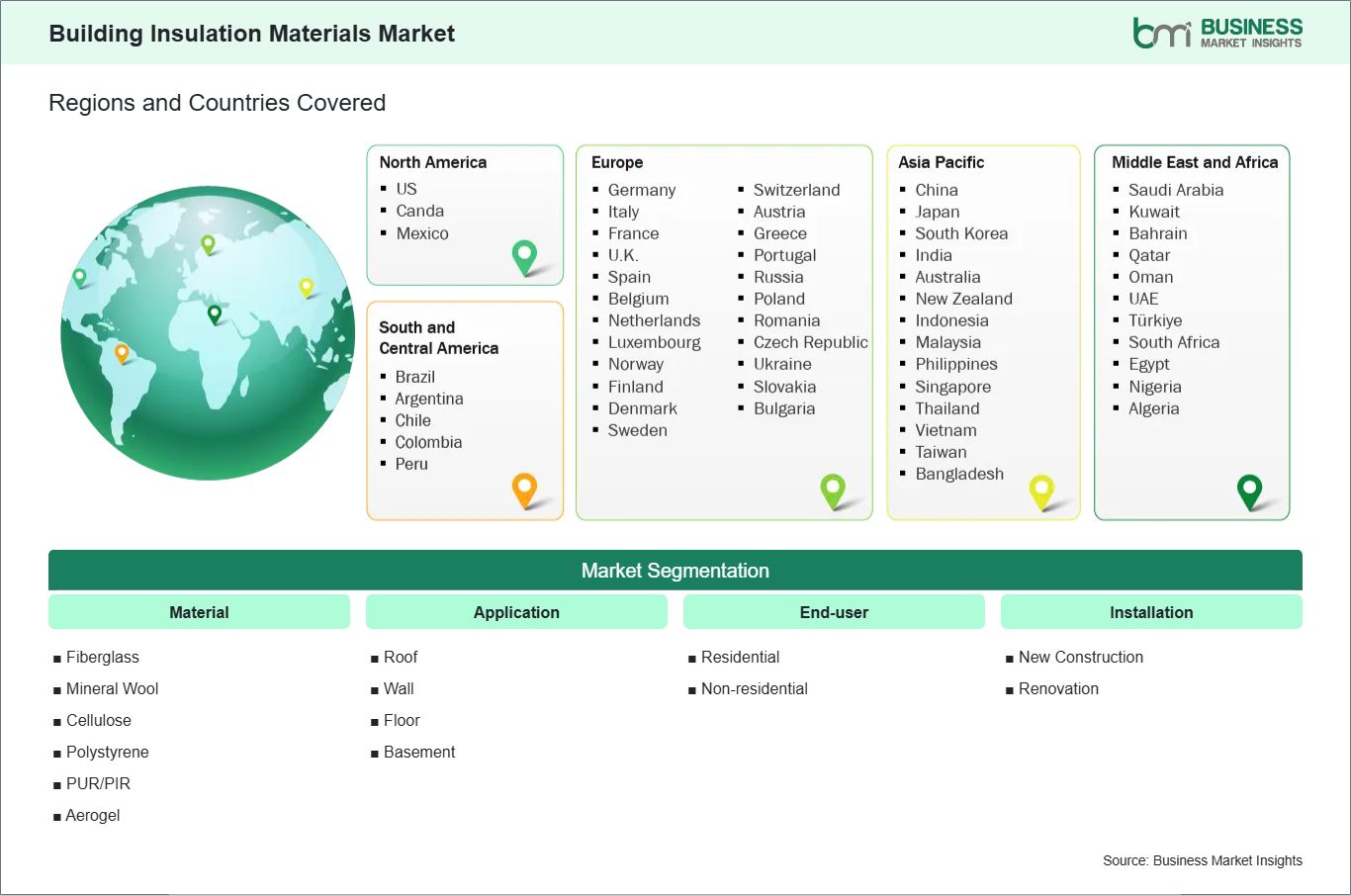
The building insulation materials market is segmented based on material, application, end-user, reflecting the increasing demand for energy-efficient construction solutions that enhance thermal performance, reduce energy consumption, and improve building sustainability.
By Material
- Fiberglass - Widely used due to cost-effective thermal insulation performance
- Mineral Wool - Preferred for fire resistance and acoustic insulation efficiency
- Cellulose - Utilized in eco-conscious construction and retrofit applications
- Polystyrene - Supports rigid insulation in structural building components
- PUR/PIR - Delivers high thermal resistance in compact construction systems
- Aerogel - Applied in advanced insulation requiring minimal thickness
By Application
- Roof - Enhances thermal stability in upper building envelopes
- Wall - Reduces heat transfer across internal and external structures
- Floor - Improves energy efficiency in multi-level construction systems
- Basement - Supports moisture resistance and thermal control in underground areas
By End-user
- Residential - Focuses on energy-efficient housing development
- Non-residential - Includes commercial and industrial infrastructure applications
- By Installation
- New Construction - Integrated during primary building development phases
- Renovation - Applied in retrofit energy efficiency upgrades
By Installation
- New Construction - Integrated during primary building development phases
- Renovation - Applied in retrofit energy efficiency upgrades
Market Forces
Building Insulation Materials Market Drivers and Opportunities
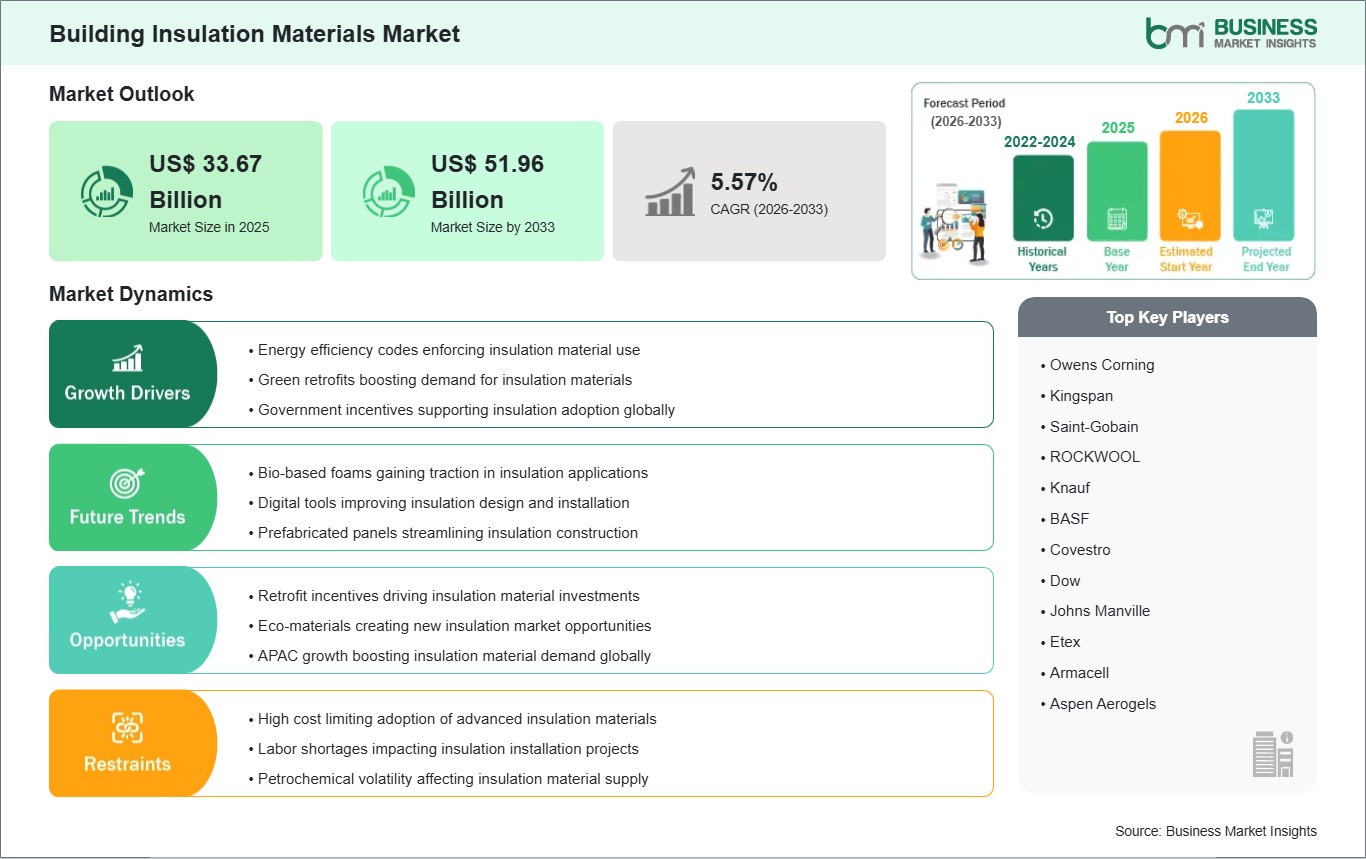
Energy efficiency codes enforcing insulation material use
Stricter regulations regarding the energy efficiency of buildings have raised the demand for advanced insulation materials used in various constructions. Insulation materials are being employed in response to energy efficiency requirements and standards and as a way to minimize energy wastage from building envelopes. The trend towards sustainable development has led to greater inclusion of such materials in buildings.
The regulatory framework remains an important driver in selecting materials for residential and commercial constructions. Companies in the construction industry are working within the confines of energy performance standards. As such, insulation materials have become increasingly common in the construction of new facilities and renovations.
Retrofit incentives driving insulation material investments
Programs for urban regeneration are promoting construction improvements through strategic measures for achieving energy efficiency. Insulation products are gaining greater use in retrofits without changing the existing structure in any significant way. Progress in the area of installing insulation products is leading to a higher rate of incorporation into older building systems.
Construction cycles in the future will be geared towards optimizing energy usage in existing infrastructure systems. The growth in retrofit-related demand is contributing to increased usage of such products in both residential and commercial buildings. This development is driving growth in the market going forward.
Size and Share Analysis
Building Insulation Materials Market Size and Share Analysis
The Building Insulation Materials Market is projected to grow from US$ 33.67 Billion in 2025 to US$ 51.96 Billion by 2033 , registering a CAGR of 5.57% from 2026 to 2033.
By material, fiberglass and mineral wool maintain a strong position due to cost efficiency, durability, and reliable thermal insulation performance across diverse climatic conditions. Cellulose is gaining traction in environmentally focused construction due to its recycled composition and thermal efficiency. Polystyrene continues to be widely used in rigid insulation applications, while PUR/PIR materials are expanding in high-performance building systems requiring superior insulation efficiency. Aerogel is gradually adopted in advanced construction projects where space constraints and high thermal resistance are critical requirements.
By application, roof and wall insulation dominate demand due to their direct impact on reducing heat transfer across building envelopes. Floor insulation is increasingly applied in multi-storey buildings to enhance energy retention and occupant comfort. Basement insulation is also expanding in moisture-prone structures requiring improved thermal stability and protection against environmental variations.
By end-user, residential construction accounts for a major share, driven by energy-efficient housing developments and rising awareness of thermal comfort. Non-residential buildings, including commercial and institutional infrastructure, are steadily increasing adoption to meet energy compliance standards and improve long-term operational efficiency.
By installation type, new construction holds a significant share due to early-stage integration of insulation materials in modern building designs. Renovation is also expanding steadily, supported by retrofit programs and building upgrade initiatives focused on improving energy performance in existing structures.
Report Coverage
Building Insulation Materials Market Report Coverage and Deliverables
The "Building Insulation Materials Market Size and Forecast (2022 - 2033)" report provides a detailed analysis of the market covering below areas:
- The market size and forecast at global, regional, and country levels for all the key market segments covered under the scope
- The market trends, as well as drivers, restraints, and opportunities
- The market analysis covering key trends, global and regional framework, major players, regulations, and recent developments
- Industry landscape and competition analysis covering market concentration, heat map analysis, prominent players, and recent developments for the market
- Detailed company profiles, including SWOT analysis
Geographic Insights
Building Insulation Materials Market Geographic Insights
The building insulation materials market shows diverse regional adoption patterns influenced by advancements in automotive electronics, increasing demand for vehicle safety and comfort systems, and rising adoption of electric, connected, and automated vehicles.
Adoption of building insulation materials in the global marketplace varies from region to region depending on the factors such as construction efficiency standards, climatic adjustment measures, and sustainable building practices. Urbanization and renovation trends are driving the usage patterns for insulation materials in different regions globally.
In North America, material usage is consistent due to strict standards related to building energy use and improvement of residential buildings. Commercial buildings now also use insulation materials as part of their construction for efficient heat management. The trend of renovating the existing buildings in the region adds to the consistent adoption of the materials.
Asia Pacific reflects strong expansion momentum driven by rapid urbanization and large-scale residential development. Construction activity across metropolitan regions continues to increase insulation material demand in both new and retrofit projects. Industrial and commercial infrastructure expansion also supports broader integration of energy-efficient building materials.
Europe maintains a strong focus on sustainable construction practices aligned with environmental efficiency standards. Insulation material deployment is reinforced through renovation-driven energy upgrade programs. Emerging markets across the Middle East, Africa, and South America are gradually increasing adoption, supported by infrastructure development and rising awareness of thermal efficiency in building systems.
Industry Activity
Recent Developments
The building insulation materials market is evaluated by gathering qualitative and quantitative data post primary and secondary research, which includes important corporate publications, association data, and databases. A few of the key developments in the building insulation materials market are:
- In May 2024, Saint-Gobain (through CertainTeed) announced a partnership with TimberHP to distribute wood-fiber insulation products across North America, expanding its portfolio of sustainable, bio-based insulation solutions in response to rising demand for low-carbon building materials.
- In June 2022, Owens Corning announced that it had signed an agreement to acquire Natural Polymers, a U.S.-based manufacturer of spray polyurethane foam insulation, in order to expand its insulation product portfolio and strengthen its position in high-growth building insulation segments.
Trust & Transparency
Research Methodology
The market analysis combines proprietary research with secondary data from government agencies, company disclosures, regulatory filings, industry databases and expert interviews. Market estimates are validated through data triangulation, cross-market benchmarking and analyst
review.
View Full Research Methodology
Key Sources Referred:
International Energy Agency (IEA)
International Organization for Standardization (ISO)
S. Department of Energy
United Nations Environment Programme
S. Energy Information Administration
Company Websites
Company Annual Reports
Company Investor Presentations