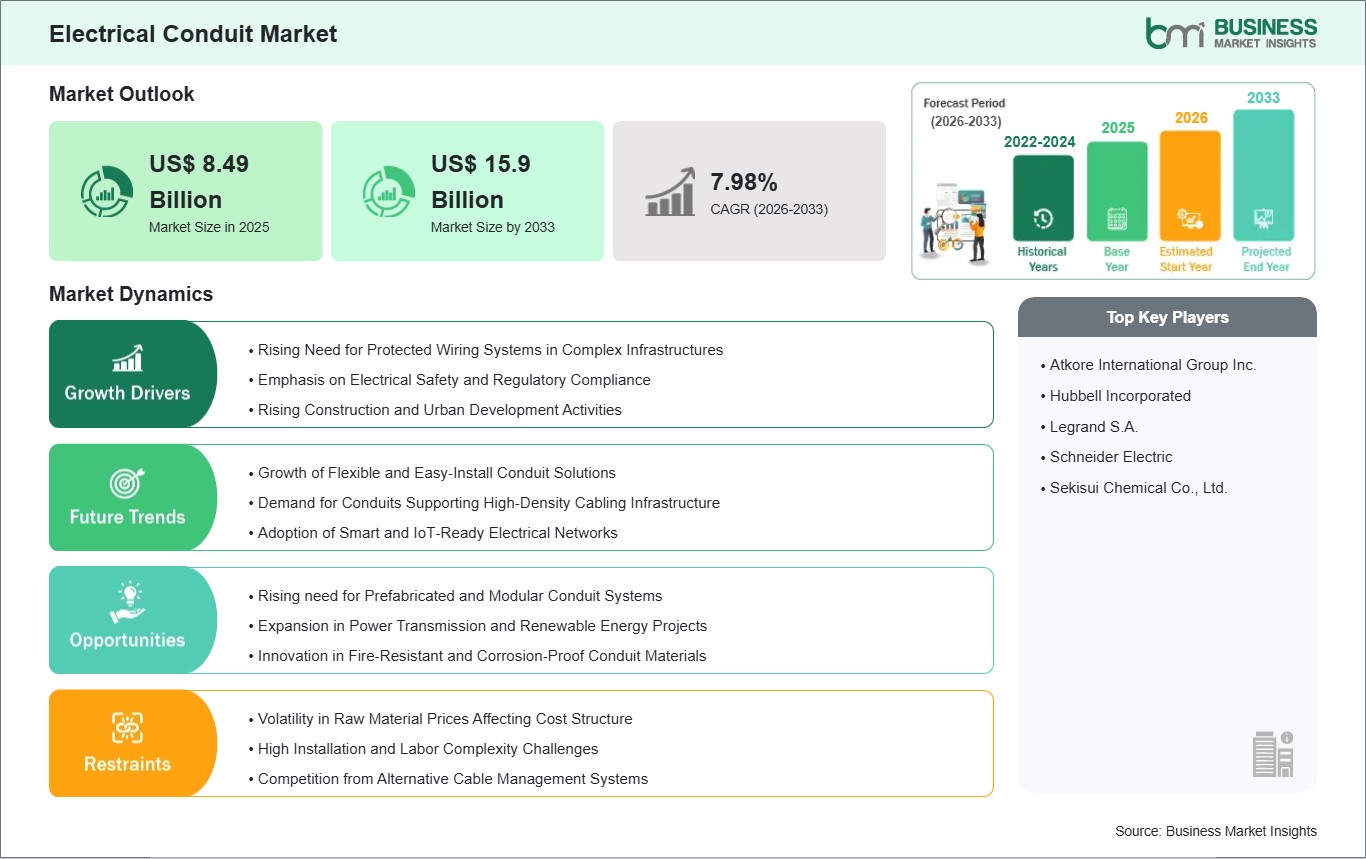
The Electrical Conduit Market size is expected to reach US$ 15.9 Billion by 2033 from US$ 8.49 Billion in 2025 .The market is estimated to record a CAGR of 7.98% from 2026 to 2033.
The electrical conduit market, as a whole, constitutes one of the fundamental segments of the electrical industry, acting as an essential part for the protection and guidance of electrical wiring in buildings, business entities, and industries. Electrical conduits play a vital role in ensuring protection, safety, and abidance with regulations associated with electrical wiring, thus acting as an integral part of contemporary building and infrastructure projects. The electrical conduit market is witnessing growth owing to factors such as high levels of urbanization, expansions in industries, and the adoption of smart building technology. Another significant factor contributing to the support of this market is the adoption of durable and corrosion-resistant materials, including PVC, steel, and aluminum, which minimize the cost of maintenance and extend the longevity of the system. In addition, the need to ensure compliance with regulations associated with safety, fire, and building codes also contributes to the support of this market. However, the market faces challenges with high installation costs, especially for metal conduits, and the emergence of new alternatives for flexible conduits, which provide lower labor requirements. Inconsistencies in electrical codes around the world also present technical challenges for international manufacturers. The focus on long-life infrastructure, high-rise buildings, and industrial process control continues to support the need for reliable electrical conduit products.

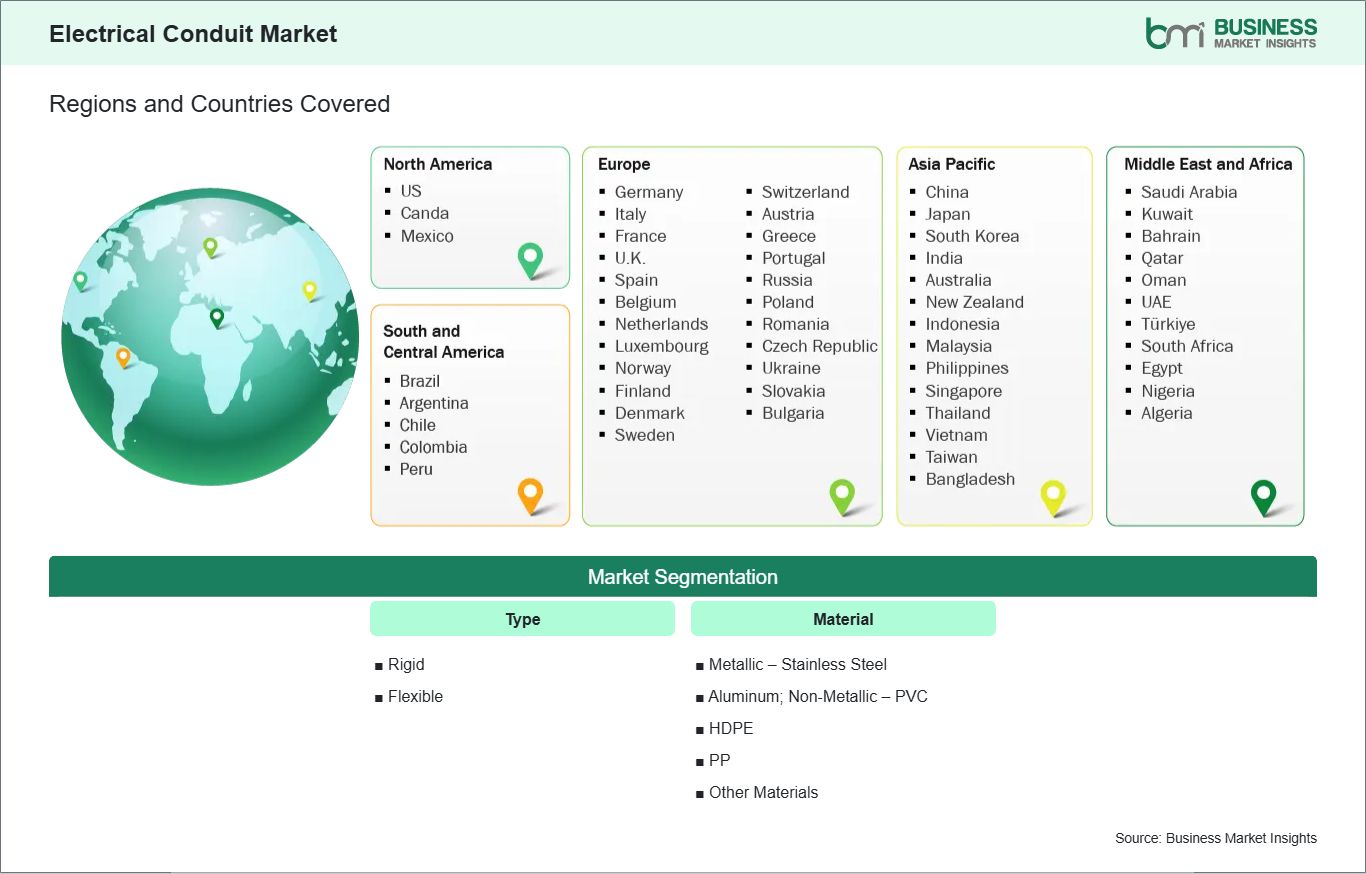
Key segments that contributed to the derivation of the electrical conduit market analysis are type, material, and end user industry.
The increasing complexity of modern infrastructure is driving demand for electrical conduits that safeguard wiring systems. Buildings, industrial facilities, and transportation hubs rely on dense networks of electrical cables, and conduits ensure these systems are protected from mechanical damage, moisture, and fire. Their use has become essential in maintaining operational safety and minimizing downtime caused by electrical faults.
The safety and regulatory compliance aspects are significant drivers for this growth. The electrical conduits create a standard channel for the wiring, thus preventing any accidental short circuits or exposure. There is an increasing focus from engineers and builders to use materials that can withstand building codes, as well as environmental exposure, whether it is in heavy industrial applications or in high-rise building projects.
The conduits are also playing an important role in ensuring long-term reliability, as they can improve maintenance efficiency, thus reducing costs and minimizing downtime for repairs and upgrades. This has been driving the demand for electrical conduit systems worldwide.
Prefabricated and modular conduit systems are opening new growth opportunities in the electrical infrastructure market. These systems allow for faster installation, easier scalability, and greater design flexibility, making them particularly valuable in large commercial projects, industrial plants, and rapidly expanding urban developments. Pre-assembled conduit networks reduce on-site labor and installation errors, improving project timelines and quality.
The adoption of modular systems is also being supported by the rise of smart buildings and automated infrastructure. Prefabricated conduits can integrate with sensors, energy management systems, and advanced wiring configurations, enabling buildings to be more efficient, adaptable, and future-ready. This synergy between electrical conduit design and modern building technology is creating a clear path for market growth.
Innovation in materials and connectors further enhances opportunities. Lightweight, corrosion-resistant, and flexible conduit options expand applications to areas previously considered challenging, such as outdoor installations or complex industrial layouts. As construction projects become more modular, scalable, and technologically advanced, prefabricated and modular conduit systems are emerging as a practical solution to meet evolving electrical infrastructure needs worldwide.

The electrical conduit market is experiencing steady growth, with market size and share analysis reflecting evolving treatment preferences and competitive dynamics among key players. The report evaluates important subsegments categorized within type, material, and end user industry, highlighting their respective contributions to overall market performance.
By type, the Rigid subsegment dominated the Electrical Conduit market in 2025. Rigid conduits offer superior strength, durability, and protection against mechanical damage, making them highly suitable for critical electrical installations, which drives their widespread adoption.
Based on material, the Non‑Metallic subsegment dominated the Electrical Conduit market in 2025. Non-metallic conduits provide corrosion resistance, lightweight handling, and cost-effectiveness, making them ideal for diverse construction and industrial applications, supporting strong market demand.
In terms of end user industry, the Building & Construction subsegment dominated the Electrical Conduit market in 2025. Building and construction projects require reliable conduits for safe and efficient electrical wiring, reinforcing the dominance of this segment.
| Report Attribute | Details |
|---|---|
| Market size in 2025 | US$ 8.49 Billion |
| Market Size by 2033 | US$ 15.9 Billion |
| Global CAGR (2026 - 2033) | 7.98% |
| Historical Data | 2022-2024 |
| Forecast period | 2026-2033 |
| Segments Covered | By Type
|
|
Regions and Countries Covered
| |
| North America | US, Canada, Mexico |
| Europe | Belgium, Austria, Finland, Denmark, Greece, Poland, Romania, Russia, Ukraine, Czech Republic, Slovakia, Bulgaria, Italy, Luxembourg, Germany, Switzerland, France, Netherlands, Norway, Portugal, Spain, Sweden, United Kingdom |
| Asia-Pacific | Australia, China, India, Japan, South Korea, Indonesia, Malaysia, Philippines, Singapore, Thailand, Vietnam, Bangladesh, New Zealand, Taiwan |
| South and Central America | Brazil, Argentina, Peru, Chile, Colombia |
| Middle East and Africa | Bahrain, Kuwait, Oman, Qatar, Saudi Arabia, United Arab Emirates, Turkiye, South Africa, Egypt, Algeria, Nigeria |
| Market leaders and key company profiles |
|
The "Electrical Conduit Market Size and Forecast (2022 - 2033)" report provides a detailed analysis of the market covering below areas:
The geographical scope of the Electrical Conduit market report is divided into five regions: North America, Asia Pacific, Europe, Middle East & Africa, and South & Central America. The Electrical Conduit market in North America is expected to grow during the forecast period.
North America holds a major share in the global electrical conduit market, driven by a large construction environment, stringent safety requirements, and a strong industrial base. In this region, electrical conduits are commonly employed in commercial buildings, data centers, housing schemes, and other critical projects where long-lasting performance, fire resistance, and cable organization are critical factors. The use of electrical conduits is further supported by government regulations that emphasize adherence to electrical and building codes to provide a safe and reliable cable management solution. The North American market, in particular, is dominated by the need for high-end products such as coated steels and high-grade PVC, which offer corrosion resistance, high strength, and easy installation. The focus on smart buildings, renewable energy, and upgrading old structures with new electrical systems is also driving the need for efficient conduit systems. Although high installation costs and the need for skilled labor may be a hindrance, the focus on infrastructure, safety, and technology makes North America a leader in the utilization of electrical conduit systems worldwide. The market players in this region benefit from an established distribution chain, standardized product offerings, and the need for constant innovation, setting the pace for the world.

The electrical conduit market is evaluated by gathering qualitative and quantitative data post primary and secondary research, which includes important corporate publications, association data, and databases. A few of the key developments in the electrical conduit market are:
The Electrical Conduit Market is valued at US$ 8.49 Billion in 2025, it is projected to reach US$ 15.9 Billion by 2033.
As per our report Electrical Conduit Market, the market size is valued at US$ 8.49 Billion in 2025, projecting it to reach US$ 15.9 Billion by 2033. This translates to a CAGR of approximately 7.98% during the forecast period.
The Electrical Conduit Market report typically cover these key segments-
The historic period, base year, and forecast period can vary slightly depending on the specific market research report. However, for the Electrical Conduit Market report:
The Electrical Conduit Market is populated by several key players, each contributing to its growth and innovation. Some of the major players include:
The Electrical Conduit Market report is valuable for diverse stakeholders, including:
Essentially, anyone involved in or considering involvement in the Electrical Conduit Market value chain can benefit from the information contained in a comprehensive market report.
Please tell us your area of interest
(Market Segments/ Regions and Countries/ Companies)