
Gourmet Salts Market Outlook: Size, Share, Trends, Growth Analysis, Competitive Landscape & Forecast, 2026-2033

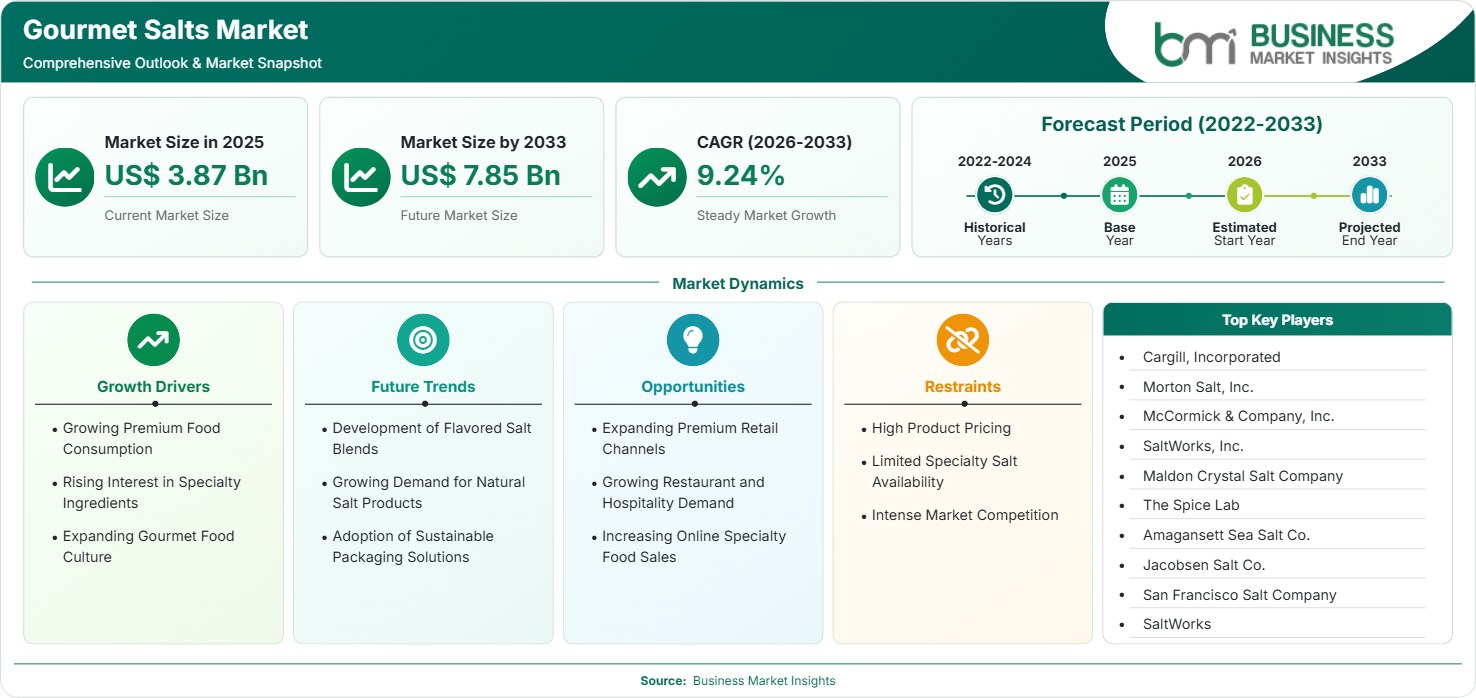
The Gourmet Salts Market size was valued at US$ 3.87 Billion in 2025 and is projected to reach US$ 7.85 Billion by 2033, growing at a CAGR of 9.24% during 2026–2033. Premium culinary experiences, artisanal sourcing, distinctive textures, restaurant innovation, specialty retail, digital discovery, private-label development, and gifting create opportunities across household, foodservice, meat, seafood, and savory applications worldwide, including hospitality.

Report Coverage
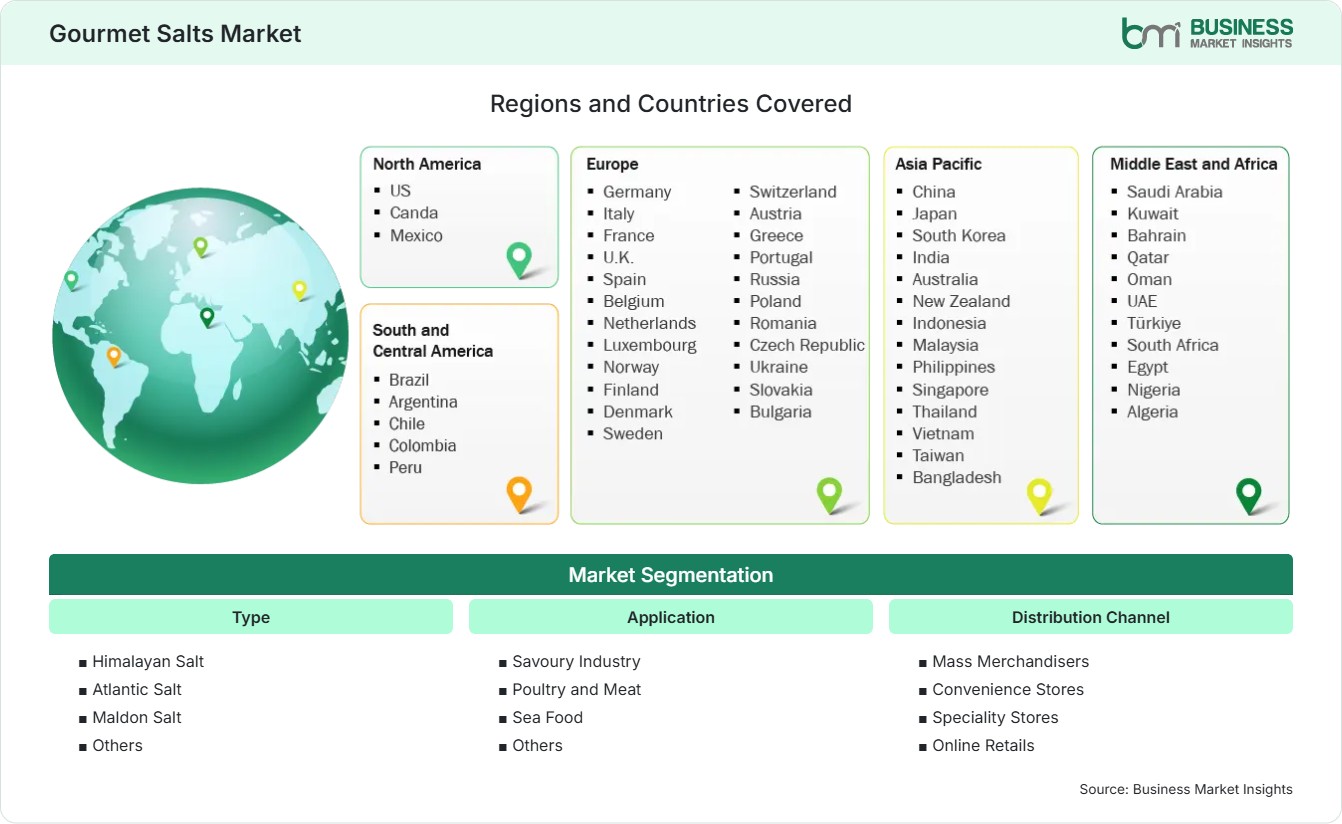
  • Type: Himalayan Salt, Atlantic Salt, Maldon Salt, Others
  • Application: Savoury Industry, Poultry and Meat, Sea Food, Others
  • Distribution Channel: Mass Merchandisers, Convenience Stores, Speciality Stores, Online Retails
US$ 3.87 Bn Market size in 2025
US$ 7.85 Bn Market Size by 2033
9.24% CAGR, 2026 - 2033
2026-2033 Forecast Period

AI Overview

Gourmet Salts Market Summary

  • North America Region: North America holds a 27%–29% share in 2025, growing at a CAGR of 8.1%–8.8% through 2033, supported by premium grocery penetration, chef-led product development, specialty seasoning demand, foodservice innovation, online discovery, private-label expansion, and differentiated packaging formats. The U.S. represents the dominant regional market, with a 7.8%–8.5% CAGR, supported by premium seasonings and established specialty-food distribution.
  • Fastest Growing Region: Asia Pacific holds a 24%–26% share in 2025 and is advancing at a CAGR of 10.4%–11.2%, supported by urbanization, restaurant modernization, culinary experimentation, premium grocery formats, e-commerce penetration, tourism, and rising consumer interest in distinctive ingredients.
  • Leading Segment: Himalayan Salt accounts for a 35%–39% share in 2025 and is advancing at a CAGR of 9.8%–10.5%, supported by recognizable pink coloration, premium positioning, broad retail availability, gifting potential, culinary presentation, and consumer interest in differentiated natural ingredients. Industry research also identifies Himalayan salt as a leading product category.
  • High Growth Segment: Online Retails is projected to advance at a CAGR of 11.5%–12.5%, benefiting from specialty product discovery, broader geographic assortment, direct-to-consumer brands, subscription opportunities, reviews, recipe-led merchandising, and convenient access to niche salt varieties.
  • Key Market Opportunity: Premiumization creates room for flavored, smoked, infused, textured, traceable, gift-ready, and application-specific salts, allowing producers to capture higher value through differentiation rather than competing solely on commodity pricing.
  • Major Market Players: Cargill, Incorporated; Morton Salt, Inc.; McCormick & Company, Incorporated; SaltWorks, Inc.; Maldon Crystal Salt Company Limited; The Spice Lab; Amagansett Sea Salt Co.; Jacobsen Salt Co.; San Francisco Salt Company; Bitterman & Sons, Inc.
Strategic Insights

Gourmet Salts Market: Strategic Insights

Gourmet Salts Market Strategic Framework
FREE PDF
Request your free sample
Request free sample
Stakeholder View

Key Takeaways

  • The value chain extends from salt sourcing and harvesting through cleaning, grading, processing, blending, packaging, distribution, and retail presentation. Supplier differentiation increasingly depends on consistency, provenance, packaging quality, and channel access.
  • Savoury Industry applications provide the broadest commercial base, while online retail offers greater upside through specialty-product discovery, direct purchasing, broader assortment visibility, and targeted consumer engagement.
  • Product innovation is shifting toward distinctive textures, crystal sizes, colors, finishing formats, packaging configurations, and application-specific positioning rather than basic commodity differentiation.
  • Asia Pacific provides an attractive expansion opportunity because changing culinary preferences, premium food consumption, foodservice development, and modern retail penetration can widen the addressable customer base.
  • Market participants can strengthen competitive positioning through portfolio expansion, premium packaging, specialty sourcing relationships, processing capabilities, and distribution partnerships rather than relying solely on volume-based competition.
  • Combining specialty stores with online retail can improve product discovery and geographic accessibility while allowing suppliers to communicate origin, usage recommendations, culinary positioning, and product differentiation directly to buyers.
Geographic Outlook

Gourmet Salts Market Regional Highlights

North America Gourmet Salts Market

North America represents a 27%–29% share in 2025 and is projected to record a CAGR of 8.1%–8.8% through 2033. The region benefits from mature specialty-food retail, strong foodservice penetration, premium seasoning adoption, and established suppliers. The Gourmet Salts Market share reflects strong consumer familiarity with sea salt, kosher formats, flavored seasonings, and finishing products.

  • Premium grocery chains provide shelf space for differentiated salts, allowing brands to communicate provenance, flavor, texture, and culinary usage rather than competing primarily through price.
  • Foodservice operators increasingly use finishing salts as visible menu ingredients, creating opportunities for larger-grain, smoked, infused, and specialty-origin products.
  • Private-label programs enable retailers to develop exclusive assortments while outsourcing sourcing, grading, packaging, and quality-management requirements to specialized suppliers.
  • U.S. demand remains the principal regional contributor, supported by sophisticated distribution infrastructure and established culinary seasoning consumption.

US Gourmet Salts Market

The U.S. represents approximately 68%–72% of North America's 2025 Gourmet Salts Market, with a CAGR of 7.8%–8.5% through 2033. Its scale is supported by national grocery distribution, specialty retailers, restaurant chains, food manufacturers, and digital marketplaces. Product discovery is increasingly influenced by recipes, social content, seasonal cooking, and premium pantry positioning. Cargill's broad food-grade salt portfolio and SaltWorks' specialty positioning demonstrate the coexistence of industrial-scale supply and highly differentiated culinary formats.

  • Premium seasoning launches increasingly emphasize finishing applications, with texture and flavor layering positioned as simple upgrades to everyday meals.
  • Online channels reduce geographic limitations for niche brands, allowing consumers to access imported, artisanal, smoked, and flavored varieties.
  • Restaurant and specialty-food demand supports product experimentation, particularly where chefs use finishing ingredients as visible components of presentation and menu differentiation.

Europe Gourmet Salts Market

Europe holds a 24%–26% share in 2025 and is projected to expand at a CAGR of 8.7%–9.4% through 2033. The region combines established culinary traditions with strong specialty-food cultures, supporting premium sea salts and finishing formats. The United Kingdom, France, Italy, Spain, and Germany form important demand centers, while the United Kingdom and France provide particularly strong environments for artisanal and origin-focused products. The region's Gourmet Salts Market growth is supported by foodservice sophistication, specialty retail, culinary tourism, and premium packaging.

  • The United Kingdom benefits from strong recognition of flake salt and established chef-led culinary culture, supporting premium finishing formats.
  • France provides a favorable environment for provenance-led sea salts, artisanal positioning, and premium culinary products associated with regional gastronomy.
  • Germany's large food retail system offers opportunities for specialty products to scale through premium private-label and natural-food channels.
  • Italy and Spain support demand through Mediterranean cuisine, seafood preparation, restaurant consumption, and premium food gifting.

Asia Pacific Gourmet Salts Market

Asia Pacific holds a 24%–26% share in 2025 and records the fastest regional trajectory at a CAGR of 10.4%–11.2% through 2033. China, Japan, Australia, South Korea, and India represent major commercial opportunities, while Southeast Asia provides strong incremental potential. Rising premium food consumption, restaurant modernization, tourism, digital retail, and international cuisine adoption are strengthening demand.

  • China offers scale through modern grocery, restaurant expansion, e-commerce, and premium imported-food channels serving increasingly diverse culinary preferences.
  • Japan's sophisticated food culture supports high-quality salts where crystal structure, origin, purity, and controlled flavor contribution are important purchase attributes.
  • India provides high-growth potential through premium retail, culinary experimentation, restaurant expansion, and online specialty-food distribution.
  • Australia combines local sea-salt production with premium food culture, export capabilities, and strong interest in provenance-led ingredients.

Rest of World Gourmet Salts Market

Rest of World accounts for a 20%–22% of the Gourmet Salts Market share in 2025 and is projected to grow at a CAGR of 9.2%–10.0% through 2033. South and Central America benefit from restaurant development, tourism, premium grocery expansion, and growing interest in international cuisines. Brazil and Mexico provide the strongest commercial bases, while Chile and Colombia offer niche growth opportunities through premium foodservice and modern retail. The Middle East and Africa are supported by hospitality investment, tourism, imported specialty foods, and premium dining.

  • Brazil provides the largest regional consumption opportunity, supported by a broad food industry, urban retail networks, and growing premium seasoning availability.
  • Mexico benefits from strong culinary identity, tourism, restaurant demand, and increased exposure to international ingredients and premium packaged foods.
  • The United Arab Emirates offers premium hospitality opportunities where specialty ingredients support high-end restaurants, hotels, catering, and experiential dining.
  • Saudi Arabia is developing demand through hospitality investment, tourism expansion, and modernization of premium foodservice infrastructure.
Global Market Geography
FREE PDF
Request your free sample
Request free sample
Segment Analysis

Gourmet Salts Market Segmentation

Type

The Type segment remains central to product differentiation, with Himalayan Salt holding a 35%–39% share in 2025 and advancing at a CAGR of 9.8%–10.5%. Distinctive color, texture, provenance, and premium positioning influence adoption, while specialty varieties broaden culinary experimentation. Product segmentation increasingly reflects sensory performance and presentation rather than basic sodium functionality.

  • Himalayan Salt: Pink coloration, coarse textures, recognizable provenance, and premium positioning support household, restaurant, gifting, and specialty retail adoption across multiple culinary occasions.
  • Atlantic Salt: Sea-derived identity and clean sensory positioning support premium cooking, finishing, seafood preparation, and specialty grocery applications where provenance strengthens product differentiation.
  • Maldon Salt: Characteristic pyramid-shaped flakes provide visual and textural appeal for finishing dishes, restaurant plating, baking, cocktails, and premium home cooking occasions.

Application

Application demand is diversified across Savoury Industry, Poultry and Meat, and Sea Food, with premium salts increasingly selected for sensory differentiation. Savoury applications provide broad formulation opportunities, while protein and seafood uses benefit from texture, adherence, finishing performance, and flavor enhancement across foodservice and manufacturing channels.

  • Savoury Industry: Specialty crystals, infused profiles, and controlled particle sizes support snacks, sauces, prepared foods, seasonings, and premium savory formulations requiring differentiated sensory characteristics.
  • Poultry and Meat: Coarse and flaked salts support seasoning adhesion, surface finishing, marinades, dry rubs, and presentation, creating opportunities across processors, restaurants, and premium packaged foods.
  • Sea Food: Sea-derived and finishing salts complement seafood's delicate flavors, supporting chefs, processors, restaurants, and premium retail products where provenance and texture influence consumer perception.

Distribution Channel

Distribution is becoming increasingly omnichannel, with Mass Merchandisers retaining scale while Speciality Stores and Online Retails provide stronger discovery environments. Online Retails represents the high-growth segment at a CAGR of 11.5%–12.5%, supported by assortment breadth, direct brand access, reviews, recipe content, and convenience.

  • Mass Merchandisers: Broad physical reach and high shopper traffic support mainstream premiumization, seasonal displays, multipacks, and accessible gourmet salt formats.
  • Convenience Stores: Smaller pack sizes and impulse-oriented merchandising create opportunities for finishing salts, flavored products, portable seasoning formats, and premium snack applications.
  • Speciality Stores: Curated assortments allow brands to communicate origin, harvesting method, flavor profile, texture, and culinary application while supporting higher-value products.
  • Online Retails: Digital channels provide virtually unlimited assortment, direct-to-consumer engagement, recipe-led discovery, subscription models, gifting options, and access to niche imported or artisanal varieties.
Market Forces

Gourmet Salts Market Dynamics

Key Market Drivers

Growing Premium Food Consumption

Premium food consumption is strengthening demand for ingredients that deliver differentiation beyond basic functionality. Gourmet salts can serve to improve appearance, texture, taste sensation, and finishing properties, which means that such salts can be applicable for premium household cooking, food services, hospitality industry, and packaged gourmet foods. The Gourmet Salts Market growth can be associated with the need of consumers to improve their culinary experience and supplier seek to offer premium products. In addition, gourmet salts allow manufacturers to offer premium products based on unique crystals of salt in terms of shape, color, origin, packaging, and usage instructions. Such attributes help to achieve further product differentiation and encourage retailers to allocate shelf space for unique seasonings.

Rising Interest in Specialty Ingredients

Specialty ingredients increasingly influence purchasing decisions because buyers seek distinctive characteristics that can improve culinary differentiation. Gourmet salts provide a variety of options based on the crystal structure, texture, color, place of origin, and unique positioning based on their application. The Gourmet Salts Market trends continue to evolve in such a way that increasingly favors gourmet salt products being positioned as unique ingredients rather than just standard spices or seasonings. Gourmet salts may be used by restaurants for finishing and presentation, as well as by producers of packaged food products for premium mixes. Assortment can also be segmented on the basis of its use, form and perceived quality of the product.

Expanding Gourmet Food Culture

The expansion of gourmet food culture supports broader experimentation with specialized ingredients across household and professional cooking. The exposure to premium culinary concepts via restaurants, specialty stores, media, culinary communities and e-commerce is rising among consumers, which might foster the uptake of finishing salts and special types of seasonings for home consumption. Crystal size, texture and application have an impact on the final dish, and it is useful that consumers understand. In addition, foodservice providers can be a factor in the discovery of the product by using unique salts in premium culinary concepts and presentations. Suppliers can further support the trend by providing guidelines for proper usage, recipe-based merchandising, smaller sample sizes, and gift packaging.

Key Market Opportunities

Expanding Premium Retail Channels

Premium retail expansion creates an opportunity to place differentiated salt varieties alongside other specialty culinary ingredients, enabling suppliers to capture consumers seeking higher-value products. Products can be segmented based on the place of origin, texture, color, application, and packing type of the products, helping shoppers in comparing the products. The Gourmet Salts Market could get benefited by offering curated combinations that include both traditional products and more exclusive products, giving the consumers a chance to upgrade from regular salt to gourmet salts. For manufacturers, retail expansion would enable them to offer small premium packs, gifting options, chef inspired collections, and differentiated product lines that address multiple price points without weakening overall premium positioning.

Growing Restaurant and Hospitality Demand

Restaurant and hospitality operators provide an important opportunity because specialty salts can contribute to finishing, presentation, flavor development, and menu differentiation. Distinctive products can be part of the premium dining concept's culinary experience, while hotels and hospitality establishments can benefit from incorporating specialty ingredients into their restaurant, banquet, and premium food offerings. The suppliers can design foodservice-oriented formats with reliable crystal quality and packaging as well as reliable supply chain management. The Gourmet Salts Market can benefit from forming business relationships with chefs, distributors, hospitality providers, and culinary institutes that would help to shape product preferences. Custom formats can assist in meeting additional needs of the institutional business.

Increasing Online Specialty Food Sales

Online specialty food retailing gives sellers better control over their offering of assortment, education of product, targeting customers, and geographic reach. Digital media is able to communicate origins, textures, appropriate uses, packing information, and cooking suggestions better than limited shelf space allows. The Gourmet Salts Market Forecasts can benefit from further channel diversification as buyers desire easy access to unique products that are not available in local stores. The direct-to-consumer sales channel gives small brands an opportunity to try out new products, receive purchasing feedback, offer limited formats, and create order repeatability.

Market Restraints and Challenges

High Product Pricing

Factor: Gourmet salts can require specialized sourcing, harvesting, grading, processing, packaging, branding, and distribution, creating higher costs than conventional salt products. Impact: Higher retail pricing can narrow the addressable customer base and make premium products more vulnerable to substitution by conventional salts. Price sensitivity can be another barrier for adoption of the product in value-oriented retail settings and large scale food applications, where the price of ingredients is taken into account very carefully. The producer needs to make a compromise between its luxury status and the package size, format, channels used and the culinary value of the product.

Limited Specialty Salt Availability

Factor: Specialty varieties can depend on specific geographic sources, harvesting conditions, processing requirements, and supply relationships, creating availability constraints for certain products. Impact: Supply limitations may result in inconsistent product availability, longer replenishment cycles, higher logistics costs, and difficulties maintaining stable retail assortments. The above situation can negatively impact small suppliers with limited sources of supplies as well as buying power. Producers can reduce risk by engaging in diverse supplier arrangements, having proper inventory policies, and improving coordination between suppliers. However, diversification of the portfolio into several types can complicate procurement processes. Effective planning is critical for sustaining consistency as well as retaining uniqueness.

Company Analysis

Competitive Landscape

The competitive structure combines large-scale salt suppliers, flavor companies, specialty producers, artisanal brands, and private-label specialists. The Gourmet Salts Market analysis indicates that competitive advantage increasingly depends on sourcing credibility, processing capabilities, product variety, foodservice support, packaging, and distribution reach.

Company Name

Overview

Products and Services relevant to this market

Cargill, Incorporated

Large global food and ingredient supplier with extensive salt-processing capabilities and established food-industry distribution.

Sea salts, flaked salts, specialty food-processing salts, crystal-size options, sodium-reduction solutions, and foodservice formats.

Morton Salt, Inc.

Major North American salt producer with broad consumer, industrial, and foodservice capabilities.

Culinary salts, sea salts, kosher formats, specialty seasonings, foodservice products, and packaged salt solutions.

McCormick & Company, Incorporated

Global flavor company using extensive seasoning expertise to develop consumer-facing premium flavor formats.

Gourmet salts, finishing salts, flavored seasonings, spice blends, culinary products, and recipe-oriented solutions.

SaltWorks, Inc.

Specialty salt supplier focused on all-natural salts, premium sourcing, processing, customization, and private-label services.

Himalayan, sea, smoked, flavored, infused, finishing, private-label, and specialty food-industry salt formats.

Maldon Crystal Salt Company Limited

Specialist producer recognized for hand-harvested sea-salt flakes and strong culinary positioning.

Maldon sea-salt flakes, smoked flakes, culinary products, foodservice applications, and premium consumer formats.

The Spice Lab

Specialty seasoning company focused on distinctive blends, salts, spices, and gift-oriented culinary products.

Flavored salts, gourmet seasoning blends, specialty spice products, culinary gift collections, and packaged salt assortments.

Amagansett Sea Salt Co.

Artisanal sea-salt producer emphasizing traditional harvesting and premium culinary positioning.

Hand-harvested sea salt, finishing formats, culinary salts, and premium packaged products for consumers and chefs.

Jacobsen Salt Co.

Premium American salt producer known for carefully harvested sea salt and chef-oriented specialty products.

Flake salts, infused salts, kosher salt, finishing products, gift assortments, and culinary specialty formats.

San Francisco Salt Company

Specialty salt distributor and supplier serving retail, foodservice, and culinary customers.

Sea salts, Himalayan salts, kosher salts, specialty salts, flavored products, and bulk culinary formats.

Bitterman & Sons, Inc.

Specialty salt and seasoning company focused on distinctive culinary ingredients and premium flavor experiences.

Finishing salts, flavored salts, specialty seasonings, culinary blends, and differentiated gourmet ingredient formats.

Trust & Transparency

Research Methodology

The market analysis combines proprietary research with secondary data from government agencies, company disclosures, regulatory filings, industry databases and expert interviews. Market estimates are validated through data triangulation, cross-market benchmarking and analyst review.

View Full Research Methodology

Questions Answered

Frequently Asked Questions

What does the Gourmet Salts Market Report cover?

The report covers market dynamics, regional opportunities, type, application and distribution-channel segmentation, competitive positioning, growth drivers, opportunities, restraints, and strategic considerations relevant to suppliers, manufacturers, retailers, investors, and other industry participants.

What packaging strategies can support premium salt sales?

Premium jars, resealable containers, compact finishing formats, gift-oriented packs, and visually distinctive packaging can strengthen product presentation. Packaging that communicates product characteristics and recommended culinary uses can also help consumers understand the value of specialty varieties.

Which distribution channel offers strong future potential?

Online retail offers strong potential because it expands geographic access, supports broad specialty assortments, enables detailed product information, and allows smaller producers to reach targeted consumers without extensive physical retail networks.

How can manufacturers differentiate gourmet salt products?

Manufacturers can differentiate products through crystal size, texture, color, sourcing characteristics, processing methods, packaging formats, culinary applications, and product positioning.

What factors are influencing consumer interest in gourmet salts?

Consumer interest is influenced by premium food experiences, culinary experimentation, distinctive textures, colors, product origins, packaging, and perceived ingredient quality.

Access the Full Gourmet Salts Market Report

Get segment-level forecasts, regional estimates, competitive benchmarking, company profiles and downloadable Excel datasets.

Access the full Gourmet Salts Market Report
350 pages PDF & Excel | 2026-08-19