
Golf Simulator Market Outlook: Size, Share, Trends, Growth Analysis, Competitive Landscape & Forecast, 2026–2033

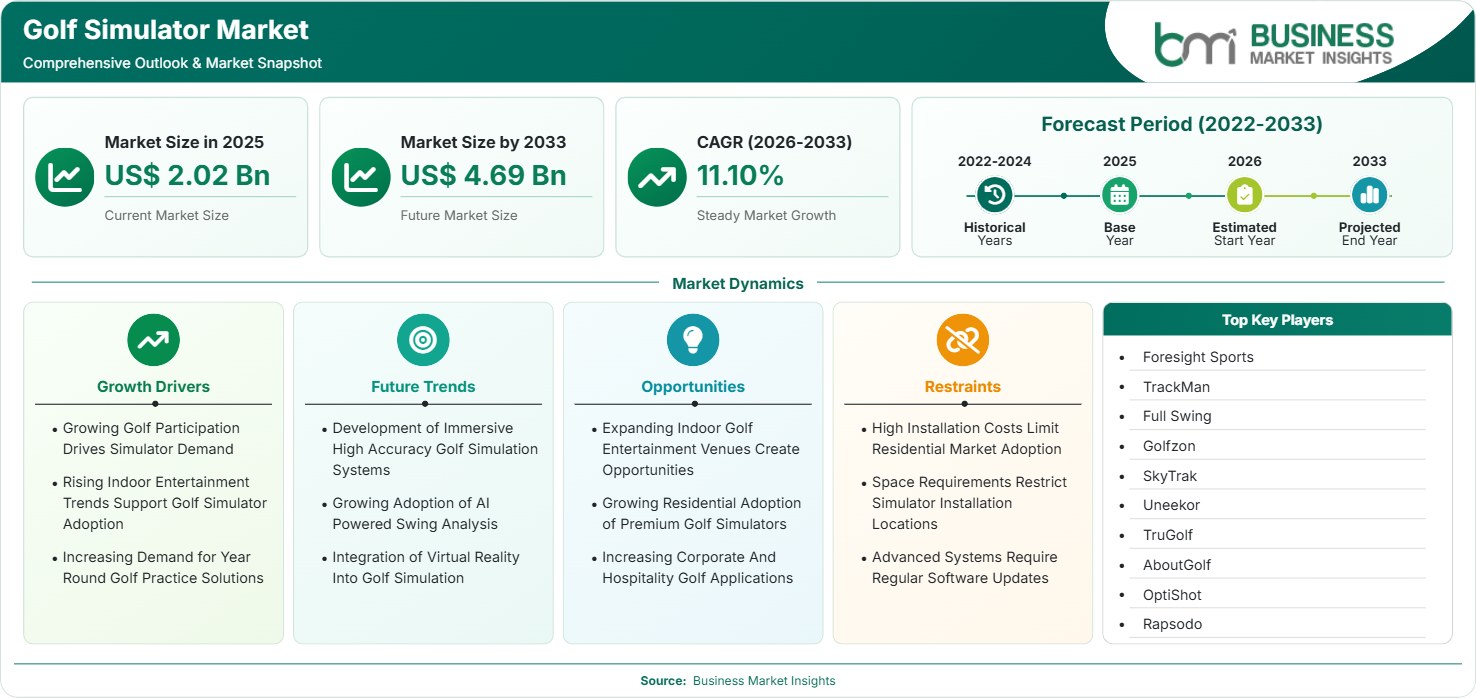
The Golf Simulator Market size was valued at US$ 2.02 billion in 2025 and is projected to reach US$ 4.69 billion by 2033, growing at a CAGR of 11.10% during 2026–2033. Rising golf participation, indoor entertainment demand, year-round practice requirements, and expanding residential and commercial applications are creating opportunities.

Report Coverage
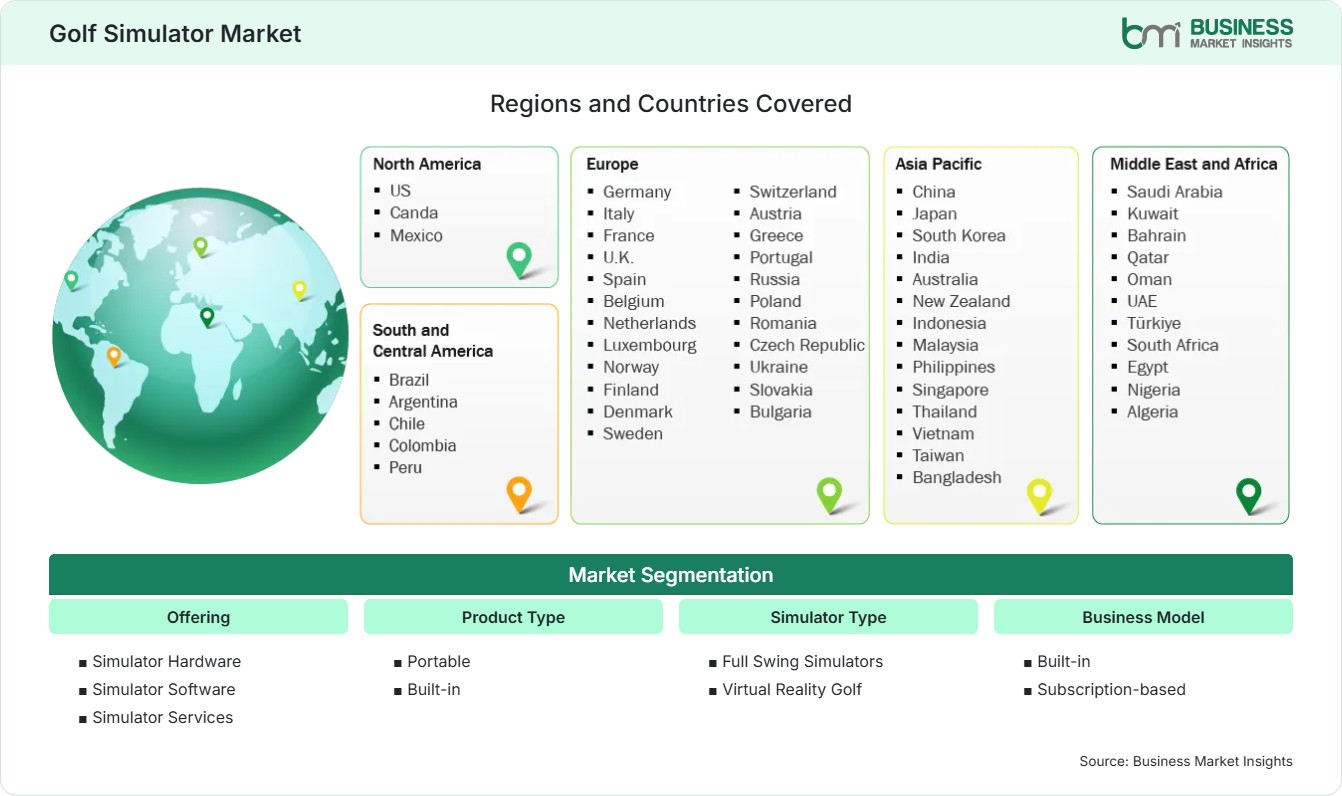
  • Offering: Simulator Hardware, Simulator Software, Simulator Services
  • Product Type: Portable, Built-in
  • Simulator Type: Full Swing Simulators, Virtual Reality Golf
  • Business Model: Built-in, Subscription-based
  • End-user: Commercial, Residential/Amateur, Educational Institutes
US$ 2.02 Bn Market size in 2025
US$ 4.69 Bn Market Size by 2033
11.10% CAGR, 2026 - 2033
2026-2033 Forecast Period

01 AI Overview

Golf Simulator Market Summary

  • North America Region: North America holds a 40%–44% share in 2025 and is projected to grow at a 10.2%–11.3% CAGR through 2033, supported by established golf participation, indoor entertainment venues, premium residential installations, launch-monitor adoption, and technology-led training demand. The U.S. represents the regional center of demand, supported by strong recreational participation and expanding commercial simulator facilities.
  • Fastest Growing Region: Asia Pacific holds a 16%–20% share in 2025 and is projected to grow at a 12.5%–14.0% CAGR through 2033, supported by screen-golf adoption, urban leisure spending, expanding indoor entertainment, technology penetration, and growing interest in accessible golf formats across China, Japan, South Korea, India, and Australia.
  • Leading Segment: Simulator Hardware holds a 50%–54% Golf Simulator Market share in 2025 and is projected to grow at a 10.8%–11.7% CAGR through 2033, supported by demand for launch monitors, high-speed cameras, radar systems, impact screens, projectors, and integrated performance-tracking equipment.
  • High Growth Segment: Portable products hold a 61%–65% share in 2025 and are projected to grow at a 12.0%–13.0% CAGR through 2033, supported by easier installation, flexible room usage, lower space requirements, home practice, and growing consumer preference for movable golf technology.
  • Key Market Opportunity: Expansion of indoor golf venues, premium residential installations, subscription software, corporate recreation, hospitality amenities, and educational training creates opportunities for suppliers offering integrated, flexible, connected, and scalable simulator ecosystems.
  • Major Market Players: Foresight Sports; TrackMan; Full Swing; Golfzon; SkyTrak; Uneekor; TruGolf; AboutGolf; OptiShot; Rapsodo.
02 Strategic Insights

Golf Simulator Market: Strategic Insights

Golf Simulator Market Strategic Framework
FREE PDF
Request your free sample
Request free sample
03 Stakeholder View

Key Takeaways

  • The value chain increasingly connects sensor manufacturers, display and projection suppliers, simulation software developers, installers, venue operators, golf instructors, distributors, and recurring-service providers.
  • Commercial entertainment, residential practice, professional coaching, corporate recreation, and hospitality applications offer distinct monetization models, allowing suppliers to diversify beyond equipment sales.
  • Product development is moving toward smaller launch monitors, improved camera and radar fusion, more realistic graphics, wireless connectivity, automated analytics, and software ecosystems that support continuous engagement.
  • Asia Pacific provides an attractive expansion pathway because indoor golf formats can overcome weather, urban space, and course-access limitations while aligning with technology-oriented entertainment preferences.
  • Subscription software, virtual course libraries, remote coaching, memberships, and digital competitions are strengthening recurring-revenue opportunities alongside traditional hardware sales.
  • The ecosystem is becoming more accessible to new golfers because simulator environments provide immediate feedback, gamified experiences, and less intimidating alternatives to conventional course-based participation.
04 Geographic Outlook

Golf Simulator Market Regional Highlights

North America Golf Simulator Market

North America represents a 40%–44% share in 2025 and is projected to grow at a 10.2%–11.3% CAGR through 2033. The region benefits from established golf participation, mature indoor entertainment infrastructure, premium consumer spending, and strong adoption of performance technologies. The United States remains the principal contributor, while Canada supports additional demand through seasonal indoor practice requirements.

  • Commercial simulator venues are expanding the addressable audience by combining golf practice with social entertainment, food, leagues, coaching, and competitive experiences.
  • Residential buyers increasingly seek premium launch monitors and complete simulator rooms that support practice, entertainment, club fitting, and year-round recreation.
  • Seasonal weather conditions strengthen indoor practice demand, particularly in northern markets where outdoor golf becomes less convenient during colder months.
  • Corporate and hospitality facilities are incorporating simulator bays as differentiated recreational amenities that support events, employee engagement, customer entertainment, and premium leisure experiences.
  • Continued technology development is improving realism, measurement quality, software usability, and installation flexibility across residential and commercial environments.

US Golf Simulator Market

The United States accounts for approximately 72%–78% of North American demand in 2025 and is projected to grow at a 10.4%–11.6% CAGR through 2033. Strong golf participation, established simulator businesses, consumer familiarity with launch-monitor technology, and commercial indoor entertainment investment support continued expansion across major metropolitan and suburban markets.

  • Indoor golf businesses are broadening their offerings through memberships, leagues, coaching, corporate events, food services, and social gaming experiences.
  • Residential adoption is supported by affluent golfers seeking convenient practice environments that combine performance analysis with entertainment and family recreation.
  • Technology competition is encouraging improvements in portability, launch measurement, course libraries, graphics, connectivity, and software functionality.
  • Golf retailers and specialty distributors are increasing consumer exposure to simulator equipment through demonstrations, fitting services, and integrated installation packages.

Europe Golf Simulator Market

Europe holds a 26%–30% share in 2025 and is projected to grow at a 10.8%–12.0% CAGR through 2033. The United Kingdom, Germany, France, Sweden, and the Netherlands represent important markets, while the United Kingdom and Germany provide strong commercial and residential opportunities. Seasonal weather and urban density reinforce indoor golf applications.

  • The United Kingdom benefits from weather-related practice limitations and growing consumer interest in premium home simulator installations.
  • Germany is developing demand across golf clubs, training facilities, commercial entertainment venues, and technologically advanced residential applications.
  • Nordic countries provide favorable conditions for indoor golf because long winters encourage consumers to seek consistent year-round practice environments.
  • Commercial operators are combining simulator golf with hospitality, social activities, coaching, and competitive formats to increase facility utilization.
  • Premium residential demand is supported by affluent consumers seeking technology-enabled leisure spaces and personalized golf training environments.

Asia Pacific Golf Simulator Market

Asia Pacific accounts for a 16%–20% share in 2025 and is projected to expand at a 12.5%–14.0% CAGR through 2033. Japan, South Korea, China, Australia, and India are key markets, with South Korea and Japan demonstrating strong indoor golf cultures. China and India provide longer-term opportunities through expanding urban leisure markets.

  • South Korea's established screen-golf culture provides a strong foundation for technology-intensive indoor golf entertainment and performance applications.
  • Japan supports demand through golf participation, compact urban entertainment formats, indoor practice requirements, and advanced consumer technology adoption.
  • China presents opportunities through expanding urban leisure spending, premium entertainment concepts, golf participation initiatives, and growing technology adoption.
  • India is developing a broader addressable market as golf participation, indoor recreation, premium hospitality, and sports technology awareness increase.
  • Australia benefits from strong golf participation and growing indoor formats that provide convenient, social, and weather-independent playing environments.

Rest of World Golf Simulator Market

Rest of World represents a 10%–14% share in 2025 and is projected to grow at a 9.5%–10.7% CAGR through 2033. South America, the Middle East, and Africa are developing markets where premium leisure facilities, hospitality investments, climate considerations, and expanding sports infrastructure can support simulator deployment.

South American adoption is concentrated around affluent consumers, golf clubs, training centers, and entertainment facilities, while Middle Eastern markets offer opportunities through luxury hotels, residential developments, sports academies, and destination leisure projects.

  • Gulf countries are creating premium sports and hospitality environments where simulator technology can complement indoor recreation and golf-focused amenities.
  • South American markets can benefit from lower-access indoor practice formats that complement established outdoor golf participation.
  • Hospitality developers are incorporating golf simulation into premium properties to differentiate recreational offerings and extend golf-related experiences beyond traditional courses.
  • Training academies and educational facilities can use simulation for instruction, assessment, club fitting, and structured skill development.
Global Market Geography
FREE PDF
Request your free sample
Request free sample
05 Segment Analysis

Golf Simulator Market Segmentation

Offering

Simulator Hardware holds a 50%–54% share in 2025 and is projected to grow at a 10.8%–11.7% CAGR through 2033. Hardware remains foundational because accurate sensing, projection, enclosure systems, and computing infrastructure determine simulator performance, realism, and user experience.

  • Simulator Hardware: Hardware includes launch monitors, sensors, projectors, screens, enclosures, mats, and computing components, with demand supported by accuracy improvements and increasingly flexible installation configurations.
  • Simulator Software: Software provides virtual courses, practice modes, analytics, games, competitions, and user management, supporting recurring engagement and differentiation beyond physical equipment.
  • Simulator Services: Services encompass installation, calibration, maintenance, training, fitting, and technical support, with demand increasing as sophisticated systems require professional deployment and ongoing optimization.

Product Type

Portable products hold a 61%–65% share in 2025 and are projected to grow at a 12.0%–13.0% CAGR through 2033. Their flexible deployment, comparatively simpler installation, and suitability for multipurpose spaces support adoption among residential users and smaller commercial operators.

  • Portable: Portable systems allow users to move equipment between rooms or locations, supporting flexible home practice, recreational use, demonstrations, and space-conscious installations.
  • Built-in: Built-in systems provide dedicated simulator environments with optimized positioning, projection, enclosure, and wiring, supporting premium residential installations and commercial facilities requiring consistent performance.

Simulator Type

Full Swing Simulators hold a 68%–72% share in 2025 and are projected to grow at a 10.7%–11.8% CAGR through 2033. Their immersive gameplay, realistic course environments, and suitability for commercial and training applications support broad adoption, while VR provides an emerging complementary experience.

  • Full Swing Simulators: Full swing systems reproduce golf environments through projection, launch monitoring, and simulation software, supporting practice, entertainment, coaching, leagues, and competitive play.
  • Virtual Reality (VR) Golf: VR golf combines head-mounted visualization with interactive environments, supporting immersive gameplay and differentiated entertainment experiences as hardware and motion-tracking technologies improve.

Business Model

Built-in installations hold a 70%–74% share in 2025 and are projected to grow at a 10.2%–11.2% CAGR through 2033. Dedicated systems remain attractive for venues and premium users requiring reliable operation, while subscription models create recurring software revenue.

  • Built-in: Built-in systems support permanent installations where optimized room configuration, high-quality projection, equipment integration, and continuous availability justify higher initial investment.
  • Subscription-based: Subscription models generate recurring revenue through software access, course libraries, analytics, competitions, updates, and connected services, strengthening customer retention.

End-user

Commercial users hold a 50%–54% share in 2025 and are projected to grow at a 10.7%–11.8% CAGR through 2033. Commercial venues can monetize simulator capacity through bookings, memberships, instruction, events, leagues, and hospitality services, supporting higher utilization than occasional residential use.

  • Commercial: Commercial installations serve golf lounges, clubs, entertainment venues, academies, retailers, and hospitality properties seeking multiple revenue streams from simulator capacity.
  • Residential/Amateur: Residential systems support personal practice, entertainment, family recreation, and off-season play, with demand shaped by affordability, space availability, and installation simplicity.
  • Educational Institutes: Educational applications provide structured training, physical education, coaching, and sports analytics, supporting controlled learning environments where outdoor course access is limited.
06 Market Forces

Golf Simulator Market Dynamics

Key Market Drivers

Growing Golf Participation Drives Simulator Demand

With the increasing number of golf lovers, there is a rising demand for simulator technology in several locations, including commercial venues, residential areas, training centers, and amusement parks. The increasing adoption of simulators by golf players for perfecting their swing, analysis of the flight path of the ball, performance consistency, and getting an authentic golf experience without considering the availability of outdoor courses is on the rise. Rising preference for golf experience, practice sessions, and technology-based training is contributing to the Golf Simulator Market growth across various consumer segments. Increasing accuracy of sensors and authentic courses are bringing more value to simulation-driven practice and entertainment.

Rising Indoor Entertainment Trends Support Adoption

Modern indoor entertainment increasingly combines sport participation with social elements, which increases the need for golf variants that are capable of running outside the traditional golf course environment. Simulator centers allow hosting of leagues, private events, training sessions, business events, as well as multiplayer games in a confined indoor environment. Better graphics, virtual courses, game elements, and scoring systems increase the attractiveness of simulators to golfers and even to those people who do not play golf. Consequently, the Golf Simulator Market analysis goes far beyond sports equipment and addresses the digital entertainment, hospitality, and leisure industries.

Increasing Demand for Year-Round Golf Practice Solutions

Year-round practice demands continue to drive adoption for golfers challenged by weather, season, geography, and scheduling constraints. Simulators offer the ability to train swings, assess shots, play simulated courses, and maintain routines without having to go outdoors. The Golf Simulator Market forecast are based on the ongoing need for innovations that minimize reliance on ideal playing conditions. Home-based simulators enable golfers to transform their garages, basements, free rooms, and recreational spaces into multi-functional practice areas, while golf courses may be able to keep up with business even in adverse outdoor conditions. The benefits are most pronounced when bad weather, urbanization, tee shortages, or far distances impede outdoor practice routines.

Key Market Opportunities

Expanding Indoor Golf Entertainment Venues Create Opportunities

Increased development of indoor golf entertainment centers presents an opportunity for providers of equipment, software solutions, installation, and maintenance. There are multiple ways in which commercial simulators may be used to combine golf with food & beverage, leagues, coaching, corporate events, and games between friends, which results in more visits per bay. Consequently, the Golf Simulator Market trend is shifting towards experience-based business models rather than mere equipment sales. Providers of solutions need to develop systems that can withstand intensive operation, easy booking, remote management, multi-user capabilities, and high performance levels.

Growing Residential Adoption of Premium Golf Simulators

Residential installation represents an exciting potential area for the supplier, offering the chance to cater to rich golfers, enthusiasts, and even families requiring the best in leisure technology. Such high-end systems have the capability of incorporating launch measurement, projector screen, realistic images, club evaluation, virtual golf courses, and even entertainment features. The buyer’s decision to purchase is now being made on the basis of accuracy, ease of setup, the software used, realism, and upgradeability. The premium residential simulator system can be used for coaching, club fitting, leisure, and even competition from afar, thus ensuring usage goes beyond practice alone.

Increasing Corporate and Hospitality Golf Applications

There are possibilities within the corporate and hospitality sectors for the positioning of simulators as experiential amenities rather than specialist sports equipment. Simulators in hotels, resorts, office campuses, private clubs, residential communities, and event facilities could be used for purposes of entertainment, customer engagement, employee leisure, and premium guest services, respectively. There is the possibility of making bookings and generating revenues through the use of simulators as an amenity in these facilities. There is potential for the development of business solutions by suppliers with features such as longevity, central management, automatic scheduling, analytics, and maintenance simplicity. Simulators could even be integrated with golf tourism in hospitality operations.

Market Restraints and Challenges

High Installation Costs Limit Residential Market Adoption

Factor: Installation of a complete simulator requires a launch monitor, projection system, screen, enclosure, impact substance, computer, floor space, lighting, electricity, and calibration. Impact: High cost at the onset of purchase may prevent families from purchasing the product, and instead choose simpler versions of systems that can be easily portable. This problem is faced not only by consumers but also by operators, as it is necessary to provide enough space for each bay installed. To fight this problem, manufacturers have adopted a variety of strategies, including modular kits, miniaturization of devices, portable launch monitors, and a lesser need for installation.

Space Requirements Restrict Simulator Installation Locations

Factor: Simulator installation depends on the adequate size of the room, swing area, ceiling height, screen distance, projector location, and mobility of the player. Impact: The lack of space in the residential room and the high cost of real estate will cause the inability to install a simulator or a decrease in the number of places where the simulator can be installed. The size of the room becomes particularly important for full swing simulators because players require sufficient space to do swings. However, portable launch monitors solve the problem owing to their portability, while immersive solutions require appropriate screens and hitting areas. The calculation of bay size in accordance with the earnings should be conducted by commercial companies, while residential users like to share the system’s space.

07 Company Analysis

Competitive Landscape

The competitive environment combines launch-monitor accuracy, immersive simulation software, hardware integration, installation capability, and recurring digital services. The Golf Simulator Market report reflects a landscape where suppliers compete across residential, commercial, coaching, entertainment, and institutional applications.

Company Name

Overview

Products and Services relevant to this market

Foresight Sports

Golf technology provider focused on launch monitoring, simulation, club fitting, and performance analysis across professional and consumer applications.

Launch monitors, simulator packages, FSX software platforms, virtual golf, performance analytics, fitting technologies, and commercial simulator solutions.

TrackMan

Golf technology company specializing in radar and camera-based measurement, simulation, performance analytics, and professional training applications.

TrackMan launch monitors, simulator systems, virtual courses, performance software, coaching tools, and commercial golf technology.

Full Swing

Golf technology provider offering immersive simulation and performance systems for professional, commercial, and residential users.

Full Swing simulator systems, launch monitoring, virtual golf, training analytics, immersive entertainment, and integrated simulator environments.

Golfzon

Golf technology company known for screen-golf systems, interactive gameplay, simulation platforms, and indoor golf entertainment.

Screen-golf systems, simulator hardware, software platforms, virtual courses, interactive gameplay, commercial venue technologies, and training solutions.

SkyTrak

Golf technology brand focused on accessible launch monitoring and simulation for home golfers, coaches, and recreational users.

Launch monitors, simulator packages, shot analysis, virtual golf software, practice tools, and connected performance applications.

Uneekor

Golf technology company developing camera-based launch monitors and simulator solutions emphasizing detailed club and ball analysis.

Launch monitors, simulator systems, performance software, virtual golf, swing analysis, and home or commercial installation solutions.

TruGolf

Golf simulation provider offering software, hardware, virtual courses, and integrated simulator systems for diverse applications.

Golf simulators, E6 software, virtual courses, launch-monitor integration, commercial systems, and training applications.

AboutGolf

Golf simulation technology provider serving commercial, residential, training, and entertainment applications.

Simulator systems, virtual golf software, launch-monitor integration, custom installations, and commercial golf simulation solutions.

OptiShot

Golf simulator technology brand focused on accessible indoor golf and consumer-oriented simulation experiences.

Infrared simulator systems, software, virtual courses, practice modes, entertainment features, and home golf solutions.

Rapsodo

Sports technology company providing data-driven golf performance tools with emphasis on portable measurement and analytics.

Mobile launch monitors, golf performance applications, shot tracking, analytics, practice tools, and connected golf technology.

10 Trust & Transparency

Research Methodology

The market analysis combines proprietary research with secondary data from government agencies, company disclosures, regulatory filings, industry databases and expert interviews. Market estimates are validated through data triangulation, cross-market benchmarking and analyst review.

View Full Research Methodology

11 Questions Answered

Frequently Asked Questions

What does the Golf Simulator Market report indicate about future competition?

Future competition will focus on measurement accuracy, portability, immersive graphics, software ecosystems, virtual course content, installation efficiency, recurring services, and commercial support. Companies capable of combining reliable hardware with engaging software, flexible business models, and strong customer support will be better positioned to address residential and commercial demand.

Why are indoor entertainment venues creating new opportunities for golf simulators?

Indoor venues can combine golf with social gaming, leagues, coaching, corporate events, hospitality, and food and beverage services. This broadens the customer base beyond dedicated golfers and allows operators to generate revenue from multiple activities while maintaining utilization during weather disruptions and traditional off-season periods.

How are advanced simulation technologies influencing adoption?

Advanced radar and camera tracking, realistic graphics, virtual course libraries, automated analytics, connected applications, and improved software interfaces are increasing the value of simulator systems. These technologies provide immediate performance feedback while making indoor golf more immersive, accessible, measurable, and engaging for experienced golfers and newcomers.

Which applications present the strongest opportunity in the market?

Commercial entertainment venues, premium residential installations, golf academies, corporate facilities, hospitality properties, and educational institutes present attractive opportunities. These applications use simulation for multiple purposes, including practice, entertainment, instruction, events, competitions, customer engagement, and employee recreation, increasing equipment utilization and potential revenue diversification.

What factors are improving Golf Simulator Market return on investment?

Increasing golf participation, commercial indoor entertainment, year-round practice demand, premium residential installations, and recurring software services are improving return on investment. Simulator systems can generate value through equipment sales, venue bookings, memberships, coaching, events, club fitting, and hospitality applications while extending golf engagement beyond traditional courses.

Access the Full Golf Simulator Market Report

Get segment-level forecasts, regional estimates, competitive benchmarking, company profiles and downloadable Excel datasets.

Access the full Golf Simulator Market Report
350 pages PDF & Excel | 2026-08-19