
Gluten-Free Baking Mixes Market Outlook: Size, Share, Trends, Growth Analysis, Competitive Landscape & Forecast, 2026-2033

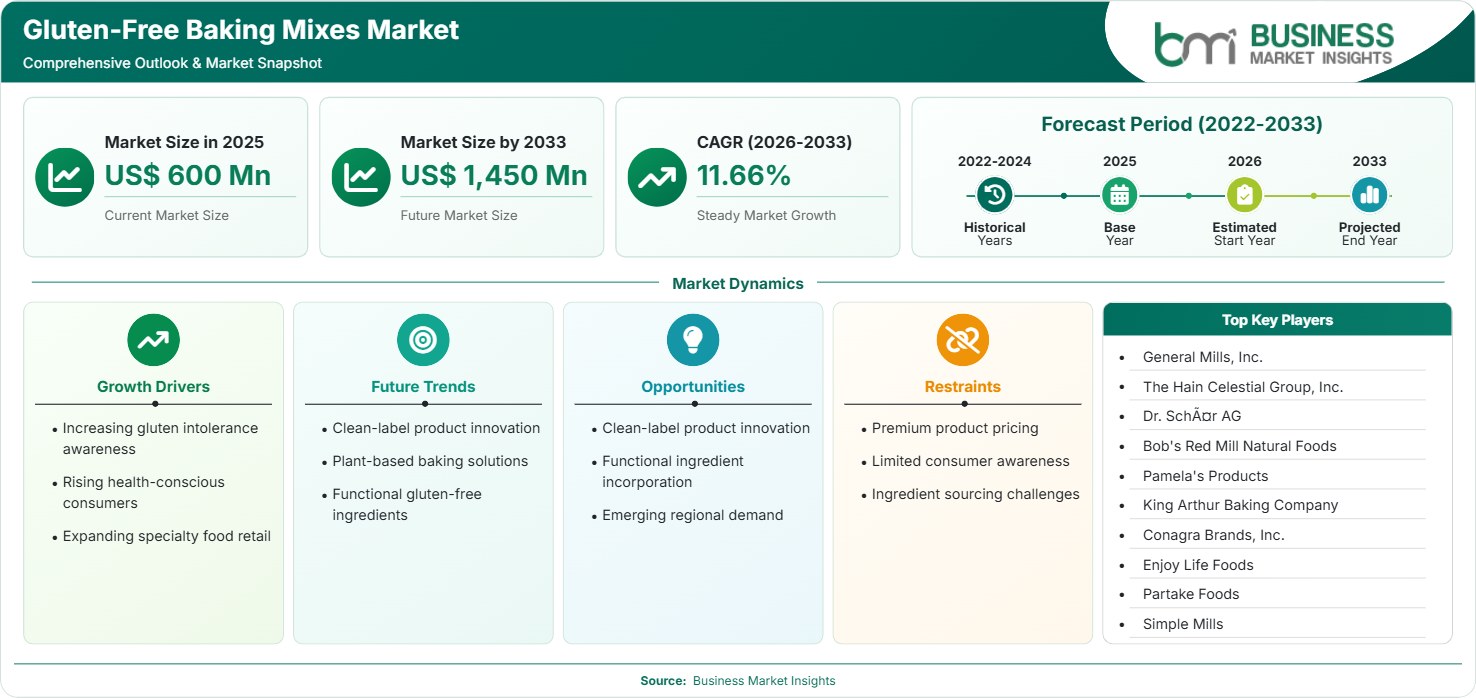
The Gluten-Free Baking Mixes Market size was valued at US$ 0.60 billion in 2025 and is projected to reach US$ 1.45 billion by 2033, growing at a CAGR of 11.66% during 2026–2033. Growth is driven by increasing gluten intolerance awareness, rising health-conscious consumers, and expanding specialty food retail, while opportunities are emerging through clean-label product innovation, functional ingredient incorporation, and emerging regional demand.

Report Coverage
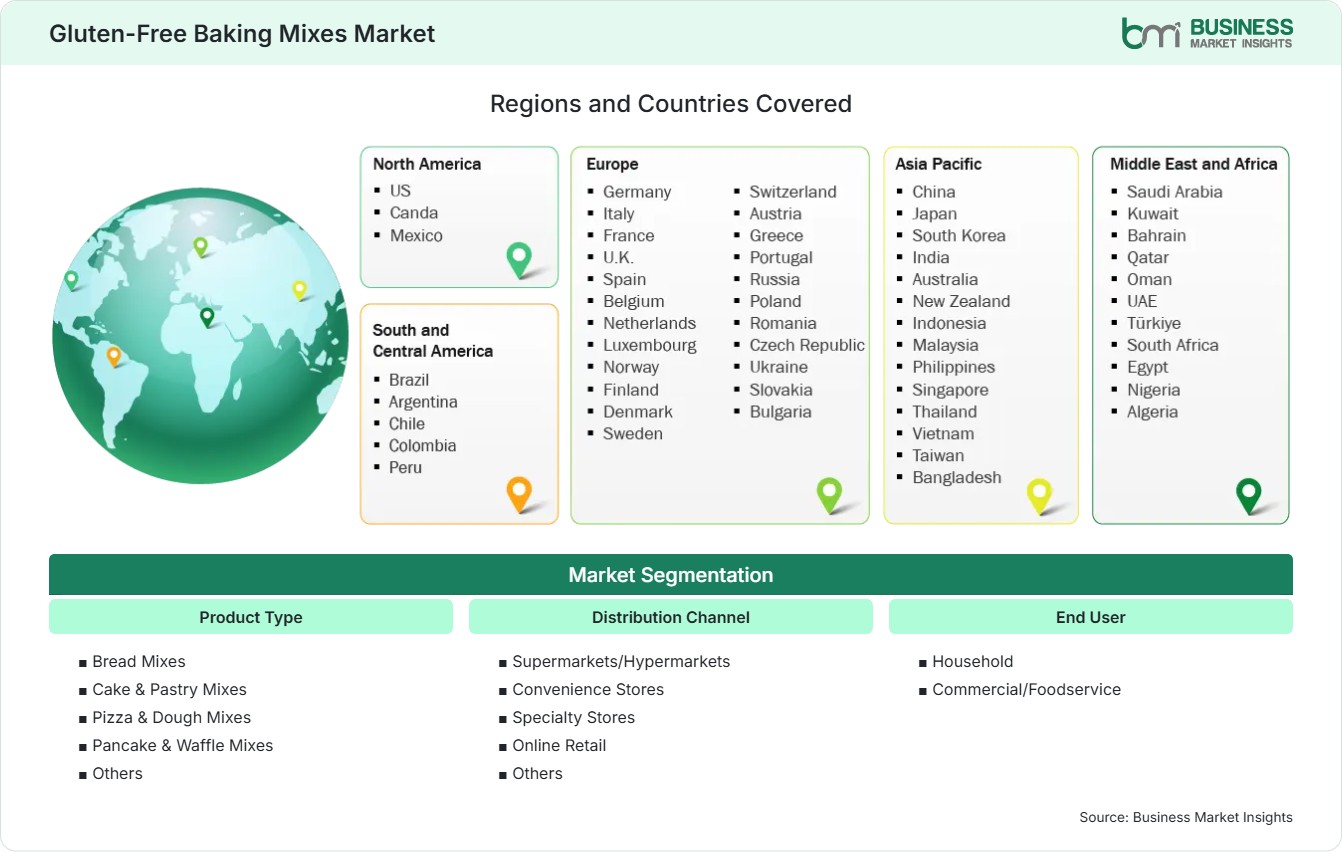
  • Product Type: Bread Mixes, Cake & Pastry Mixes, Pizza & Dough Mixes, Pancake & Waffle Mixes, Others
  • Distribution Channel: Supermarkets/Hypermarkets, Convenience Stores, Specialty Stores, Online Retail, Others
  • End User: Household, Commercial/Foodservice
US$ 600 Mn Market size in 2025
US$ 1,450 Mn Market Size by 2033
11.66% CAGR, 2026 - 2033
2026-2033 Forecast Period

01 AI Overview

Gluten-Free Baking Mixes Market Summary

  • North America Region: North America accounts for approximately 40%–44% market share in 2025 and is projected to grow at a 10.8%–11.8% CAGR during 2026–2033. The region benefits from strong awareness of gluten-related disorders, developed specialty food retail networks, and high demand for convenient healthy baking solutions. The U.S. market is supported by strong retail penetration and is estimated to grow at approximately 11.0%–12.0% CAGR.
  • Fastest Growing Region: Asia Pacific represents around 18%–22% of the global market in 2025 and is expected to expand at 12.5%–13.5% CAGR through 2033. Rising disposable incomes, changing dietary preferences, expanding e-commerce platforms, and growing awareness of gluten-free lifestyles are accelerating regional demand.
  • Leading Segment: Bread Mixes hold approximately 32%–36% market share in 2025 and are expected to grow at a 10.8%–11.8% CAGR. Increasing demand for convenient homemade bakery products, dietary alternatives, and improved gluten-free formulations is supporting segment expansion.
  • High Growth Segment: Online Retail represents approximately 22%–26% market share in 2025 and is projected to grow at 13.0%–14.0% CAGR. Digital shopping adoption, wider product availability, and direct-to-consumer specialty food brands are accelerating online channel growth.
  • Key Market Opportunity: Clean-label formulations, functional ingredients, protein enrichment, ancient grains, and expansion into emerging consumer markets are creating opportunities for manufacturers to diversify gluten-free baking mix portfolios.
  • Major Market Players: General Mills, Inc., The Hain Celestial Group, Inc., Dr. Schär AG, Bob's Red Mill Natural Foods, Pamela's Products, King Arthur Baking Company, Conagra Brands, Inc., Enjoy Life Foods, Partake Foods, and Simple Mills.
02 Strategic Insights

Gluten-Free Baking Mixes Market: Strategic Insights

gluten-free-baking-mixes-market-market-strategic-framework
FREE PDF
Request your free sample
Request free sample
03 Stakeholder View

Key Takeaways

  • The market ecosystem is shifting toward specialty ingredient suppliers, food manufacturers, retailers, and direct-to-consumer platforms focused on dietary-specific products.
  • Bread mixes and convenient baking solutions offer strong growth potential due to increasing household adoption of homemade gluten-free foods.
  • Product innovation is centered on clean-label ingredients, improved taste profiles, functional nutrition, and allergen-free formulations.
  • Asia Pacific provides attractive expansion opportunities due to rising awareness, digital retail growth, and evolving consumer food preferences.
  • Companies are strengthening competitive positions through product launches, brand expansion, partnerships, and premium specialty food offerings.
  • Growing demand for personalized nutrition and functional foods is influencing future gluten-free product development strategies.
04 Geographic Outlook

Gluten-Free Baking Mixes Market Regional Highlights

North America Gluten-Free Baking Mixes Market

North America accounted for approximately 40%–44% of the global market in 2025 and is projected to grow at a 10.8%–11.8% CAGR during 2026–2033. The region maintains leadership due to high consumer awareness of gluten intolerance, strong specialty food retail penetration, and widespread availability of gluten-free products. The Gluten-Free Baking Mixes Market share is supported by established health food brands, premium product adoption, and increasing demand for convenient home baking solutions.

  • The United States remains the largest contributor due to strong demand for allergen-free foods and developed specialty grocery channels.
  • Canada is witnessing increased adoption through expanding health-focused retailers and growing consumer interest in dietary alternatives.
  • Manufacturers are introducing clean-label formulations using alternative grains and functional ingredients to improve nutritional value.
  • Online grocery platforms are expanding product accessibility for consumers seeking specialized baking products.

US Gluten-Free Baking Mixes Market

The United States accounted for approximately 36%–40% of global market revenue in 2025 and is expected to grow at a 11.0%–12.0% CAGR through 2033. The country benefits from high awareness of celiac disease and gluten sensitivity, strong specialty food distribution, and consumer preference for healthier bakery alternatives. Growing demand for convenient baking products and premium ingredient formulations is encouraging manufacturers to expand gluten-free offerings across retail and foodservice channels.

  • Rising awareness of gluten-related health conditions is increasing demand for dedicated gluten-free food products.
  • Specialty supermarkets and online retailers are improving access to diverse baking mix varieties.
  • Food manufacturers are investing in innovative formulations to improve taste, texture, and nutritional performance.

Europe Gluten-Free Baking Mixes Market

Europe accounted for approximately 28%–32% of the global gluten-free baking mixes market in 2025 and is expected to grow at a 10.5%–11.5% CAGR between 2026 and 2033. Germany, the United Kingdom, France, and Italy represent important markets due to increasing demand for health-oriented foods and established specialty product categories. Germany is estimated to grow at 10.8%–11.8% CAGR, while the United Kingdom is projected to expand at 10.6%–11.6% CAGR, supported by rising gluten-free adoption and retail availability.

  • Germany leads regional demand through strong consumer awareness and extensive availability of gluten-free bakery products.
  • The United Kingdom is experiencing growth through health-conscious consumers and expanding online food retail.
  • France is witnessing increased interest in premium and clean-label gluten-free baking solutions.
  • European manufacturers are focusing on natural ingredients and improved product formulations.

Asia Pacific Gluten-Free Baking Mixes Market

Asia Pacific accounted for approximately 18%–22% of global revenue in 2025 and represents the fastest-growing region with a projected 12.5%–13.5% CAGR during 2026–2033. China, Japan, India, and Australia are contributing to regional expansion through rising health awareness, urbanization, and increasing availability of international food products. China is projected to grow at 12.8%–13.8% CAGR, while India is expected to expand at 13.0%–14.0% CAGR due to changing dietary preferences and retail modernization.

  • China is expanding gluten-free product adoption through increasing health awareness and premium food consumption.
  • India is witnessing rising interest in alternative bakery products due to evolving dietary preferences.
  • Japan is supporting market development through demand for functional and specialty foods.
  • Australia benefits from established health food culture and strong gluten-free product availability.
  • E-commerce expansion is improving access to gluten-free baking mixes across emerging markets.

Rest of World Gluten-Free Baking Mixes Market

Latin America, the Middle East, and Africa collectively represented approximately 5%–8% of global revenue in 2025 and are forecast to grow at a 11.5%–12.5% CAGR between 2026 and 2033. Brazil, Mexico, UAE, and South Africa are emerging markets due to increasing awareness of dietary wellness, expanding specialty retail, and rising demand for imported health foods. The Gluten-Free Baking Mixes Market growth in these regions is supported by changing consumer lifestyles and improved distribution networks.

  • Latin American markets are developing through increasing health awareness and growth of specialty food categories.
  • Brazil and Mexico are expanding demand through modern retail channels and urban consumer adoption.
  • Middle Eastern markets are benefiting from premium food consumption and hospitality sector demand.
  • UAE is supporting product growth through international food retail expansion and health-focused consumers.
  • African markets are gradually developing through improved retail infrastructure and awareness of dietary alternatives.
global-market-geography
FREE PDF
Request your free sample
Request free sample
05 Segment Analysis

Gluten-Free Baking Mixes Market Segmentation

Product Type

Product Type segmentation accounted for approximately 90%–94% of global revenue in 2025 and is projected to grow at a 11.0%–11.8% CAGR between 2026 and 2034. Demand is increasing due to expanding home baking trends, rising preference for allergen-free products, and improved formulation quality. Bread mixes represent a leading category due to household consumption patterns, while cake, pastry, pizza, and breakfast-oriented mixes are gaining traction through product diversification and premium bakery alternatives.

  • Bread Mixes: Bread mixes represent a leading product category due to household baking demand, convenience benefits, and increasing consumer preference for gluten-free staple alternatives.
  • Cake & Pastry Mixes: Cake and pastry mixes are gaining popularity through premium dessert applications, celebrations, and demand for gluten-free indulgence products.
  • Pizza & Dough Mixes: Pizza and dough mixes are expanding as consumers seek convenient gluten-free alternatives for popular bakery and meal preparation applications.
  • Pancake & Waffle Mixes: Pancake and waffle mixes benefit from breakfast category expansion and demand for easy-to-prepare gluten-free meal options.

Distribution Channel

Distribution Channel segmentation accounted for approximately 92%–96% of market demand in 2025 and is forecast to grow at a 11.2%–12.0% CAGR through 2034. Retail expansion, digital commerce growth, and increasing availability of specialty food products are improving consumer access. Supermarkets and hypermarkets remain important due to product visibility and convenience, while online retail is expanding rapidly through wider product selection, subscription models, and direct-to-consumer brand strategies.

  • Supermarkets/Hypermarkets: Supermarkets and hypermarkets remain important channels due to broad consumer reach, product visibility, and availability of multiple gluten-free baking brands.
  • Convenience Stores: Convenience stores support impulse purchases and accessibility for consumers seeking quick food preparation solutions.
  • Specialty Stores: Specialty stores attract health-conscious consumers through curated gluten-free products and expert product recommendations.
  • Online Retail: Online retail is expanding through digital convenience, wider product variety, direct brand access, and increasing specialty food purchases.

End User

End User segmentation accounted for approximately 88%–92% of total gluten-free baking mixes market demand in 2025 and is expected to grow at a 11.3%–12.1% CAGR during 2026–2034. Household consumers are the dominant segment due to rising interest in home baking, dietary preferences, and demand for convenient preparation solutions. Commercial and foodservice users are increasing adoption as restaurants, bakeries, and cafes expand gluten-free menu offerings to serve diverse customer requirements.

  • Household: Household adoption is increasing due to rising gluten intolerance awareness, convenient preparation, and growing interest in healthier homemade bakery products.
  • Commercial/Foodservice: Commercial users are adopting gluten-free mixes to expand menu options, address dietary needs, and serve health-conscious customers.
06 Market Forces

Gluten-Free Baking Mixes Market Dynamics

Key Market Drivers

Increasing Gluten Intolerance Awareness

The increasing number of people who are gluten intolerant, suffer from celiac disease, and are sensitive to gluten is increasing the need for specialty bakery products globally. People are demanding bakery products that cater to their dietary needs without compromising taste or convenience. The growth in the Gluten-Free Baking Mixes market forecast is being driven by better detection of diseases related to gluten, increased availability of information related to health, and an increase in the range of gluten-free foods available. Food companies are improving the formulations of the baking mixes using new forms of flour such as rice, almond, coconut, and chickpeas.

Rising Health-Conscious Consumer Preferences

Consumer awareness of wellness, health, and nutrition is driving purchases among consumers in the food industry. There is increased demand for healthier, more nutritious foods that do not contain allergens. Baking mixes free from gluten have been gaining popularity due to their suitability to be used by individuals who are concerned about their health, irrespective of whether they are forced to eat such products due to medical reasons. Manufacturers have taken advantage of this behavior by including proteins, fiber, natural sugars, and nutrient-dense grains in their baking mixes. It has become apparent from the Gluten-Free Baking Mixes Market trends that there is a shift towards high-quality foods.

Expansion of Specialty Food Retail Channels

Growth in specialty food retailers, health stores, and digital grocery services is enhancing the availability of gluten-free baking mixes. More consumers can purchase a variety of products via health food sections, e-commerce websites, and direct-to-consumer portals. Growth in retail is assisting in reaching the intended customers for smaller specialty food producers and expanding markets for already established companies. More shelf space is being provided for gluten-free items in supermarkets and hypermarkets due to the increase in demand for products that cater to specific diets. More effective distribution is boosting the category by lowering the availability barriers.

Key Market Opportunities

Clean-Label Product Innovation

Innovation in clean labeling presents a great opportunity, as consumers tend to favor foods with known ingredients and minimal processing. Manufacturers are working on the development of gluten-free baking mixes based on clean-labeling formulas. It allows companies to offer their products to compete in the marketplace and take into account consumer concerns about transparency and the quality of food. Firms that use clean-label technology will be able to draw health-conscious customers and offer them premium bakery products. Possible innovation opportunities include improving taste and texture, as well as developing natural preservatives to address challenges faced by gluten-free products.

Functional Ingredient Incorporation

Integration of functional ingredients provides new prospects for producers to improve the nutritional value of their gluten-free baking mixes by adding various ingredients like plant proteins, dietary fibers, ancient grains, seeds, and fortified nutrients. These developments will help meet consumer demands for products that offer nutritional value besides ease of use. The functional products have greater chances of targeting customers who are not gluten-sensitive but need food products that contribute to their general well-being. By creating distinctly nutritious products, brands can foster loyal consumers willing to pay higher prices.

Emerging Regional Market Expansion

Growth in emerging markets is possible as the knowledge of gluten-free diets grows alongside the development of food retail channels. The growing purchasing power, urban lifestyle, and exposure to global food trends have led to the consumption of specialty bakery products in developing countries. Companies can take advantage of this growth by developing products according to the tastes of the consumers, establishing proper logistics systems, and forming partnerships with regional retailers. Growth possibilities exist in the Asia-Pacific, Latin American, and Middle Eastern markets as people become more health-conscious and e-commerce grows.

Market Restraints and Challenges

Premium Product Pricing Challenges

Factor: Gluten-free baking mixes often require specialized ingredients, dedicated production processes, and quality certifications, resulting in higher manufacturing expenses compared with conventional baking products. Impact: The premium pricing strategy can be limiting for price-sensitive consumers and can constrain market penetration in emerging markets. Other factors that have contributed to higher costs include the use of alternative flour types, special formulation of the product, and strict manufacturing practices. Manufacturers are striving to streamline supply chain operations and the production process to alleviate pressure on production costs. But ensuring product quality and competitive pricing is still difficult.

Limited Consumer Awareness in Emerging Markets

Factor: Awareness of gluten intolerance, celiac disease, and gluten-free dietary options remains comparatively limited in several developing markets. Impact: Consumer ignorance may limit the growth of demand, lower trial rates, and hinder the expansion of the category in areas other than the mature ones. Consumers lack knowledge of the benefits of gluten-free foods, how to prepare these products, and their varieties. Educating consumers is essential for the successful promotion of this category in these new regions. It is possible to achieve this through investments in education and communications. Lack of awareness is an issue for firms that want global expansion.

07 Company Analysis

Competitive Landscape

The Gluten-Free Baking Mixes Market analysis highlights a competitive landscape driven by established food manufacturers, specialty gluten-free brands, and health-focused ingredient innovators. Companies are broadening their product portfolio using clean label formulations, alternative flour mixes, functional ingredients, and digital marketing. Players in the market are concerned about enhancing flavor, functionality, nutrition, and convenience for home consumers, commercial bakers, and food service providers that require easy access to gluten-free products.

Company Name

Overview

Products and Services relevant to this market

General Mills, Inc.

Global food company offering consumer food brands across multiple categories.

Gluten-free baking mixes, specialty food products, flour alternatives, and packaged baking solutions.

The Hain Celestial Group, Inc.

Natural and organic food company focused on health-oriented consumer products.

Gluten-free mixes, organic baking products, natural food ingredients, and specialty bakery solutions.

Dr. Schär AG

Leading gluten-free food company specializing in dietary products.

Gluten-free baking mixes, bread products, bakery ingredients, and celiac-friendly food solutions.

Bob's Red Mill Natural Foods

Natural foods manufacturer specializing in grain-based products.

Gluten-free baking mixes, alternative flours, baking ingredients, and specialty food products.

Pamela's Products

Gluten-free food brand focused on allergen-friendly bakery products.

Gluten-free baking mixes, pancake mixes, cookies, and specialty bakery formulations.

King Arthur Baking Company

Baking company offering premium baking ingredients and solutions.

Gluten-free flour blends, baking mixes, baking ingredients, and consumer baking products.

Conagra Brands, Inc.

Food company offering branded packaged food products across categories.

Gluten-free baking products, frozen foods, specialty food brands, and consumer solutions.

Enjoy Life Foods

Allergy-friendly food company focused on inclusive food products.

Gluten-free baking products, allergen-free ingredients, snacks, and specialty foods.

Partake Foods

Plant-based and allergen-friendly food company.

Gluten-free baking mixes, cookies, allergen-free bakery products, and clean-label formulations.

Simple Mills

Health-focused food company producing clean-label packaged foods.

Gluten-free baking mixes, almond flour products, crackers, and better-for-you bakery solutions.

08 Industry Activity

Recent Developments

May 2026

Nowhere Bakery launched a new clean-label Chocolate Cake Baking Mix formulated without refined sugar, seed oils, gums, or fillers. The vegan and gluten-free product expands the company's baking mix portfolio to meet growing consumer demand for healthier and allergen-friendly baking solutions.

May 2026

De Smaakspecialist acquired Dutch organic brands Joannusmolen and IDorganics, expanding its portfolio of organic and gluten-free flours, porridges, and baking products while strengthening its position in the clean-label and specialty baking ingredients market.

April 2026

King Arthur Baking Company launched two new gluten-free baking mixes, Gluten-Free Roll & Bun Mix and Gluten-Free Double Chocolate Chip Cookie Mix, expanding its gluten-free product portfolio with convenient baking solutions for retail and e-commerce consumers.

February 2026

Eshbal Functional Food Inc. acquired Gluten Free Nation, a U.S.-based commercial baker specializing in gluten-free bread and baked foods, expanding its North American presence and strengthening its gluten-free product portfolio through established manufacturing, sales, and distribution capabilities.

10 Trust & Transparency

Research Methodology

The market analysis combines proprietary research with secondary data from government agencies, company disclosures, regulatory filings, industry databases and expert interviews. Market estimates are validated through data triangulation, cross-market benchmarking and analyst review.

View Full Research Methodology

11 Questions Answered

Frequently Asked Questions

What challenges affect gluten-free baking mix adoption?

Premium pricing, limited awareness in some regions, higher ingredient costs, and consumer concerns regarding taste and product performance remain key challenges.

Why is online retail becoming important for gluten-free baking mixes?

In the gluten-free baking mixes market report, online retail provides wider product availability, direct access to specialty brands, convenient purchasing, and improved reach among consumers seeking dietary-specific products.

How are manufacturers improving gluten-free baking products?

Companies are improving products through alternative flour blends, clean-label ingredients, functional nutrition additions, and technologies that enhance taste and texture.

Which product category leads the gluten-free baking mixes market?

Bread mixes represent a leading category due to their essential household application, convenience benefits, and increasing demand for gluten-free alternatives to traditional bakery products.

What is driving demand for gluten-free baking mixes?

Increasing awareness of gluten intolerance, health-conscious consumption, specialty food retail expansion, and demand for convenient home baking solutions are driving market growth.

Access the Full Gluten-Free Baking Mixes Market Report

Get segment-level forecasts, regional estimates, competitive benchmarking, company profiles and downloadable Excel datasets.

Access the full Gluten-Free Baking Mixes Market Report
350 pages PDF & Excel | 2026-07-31