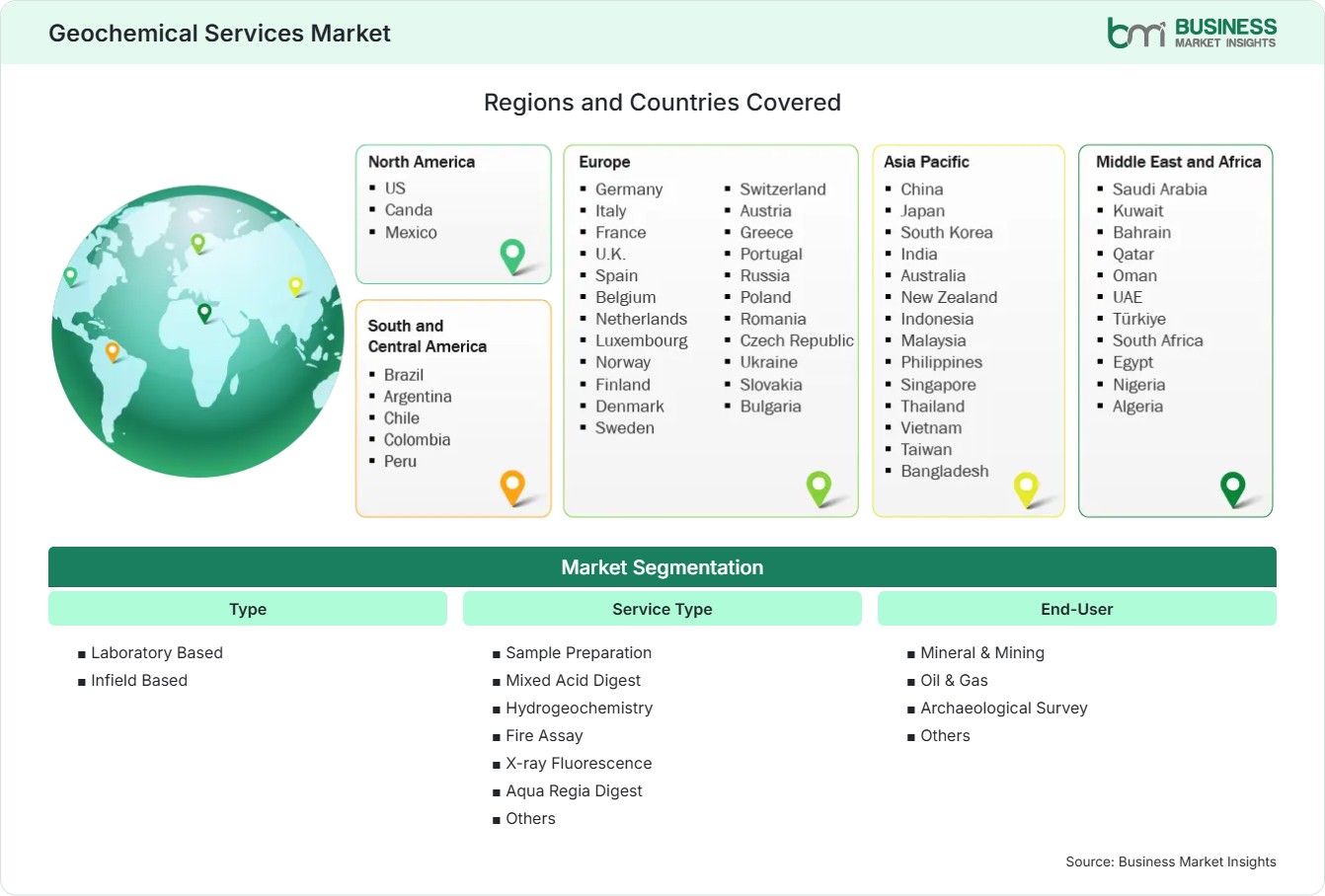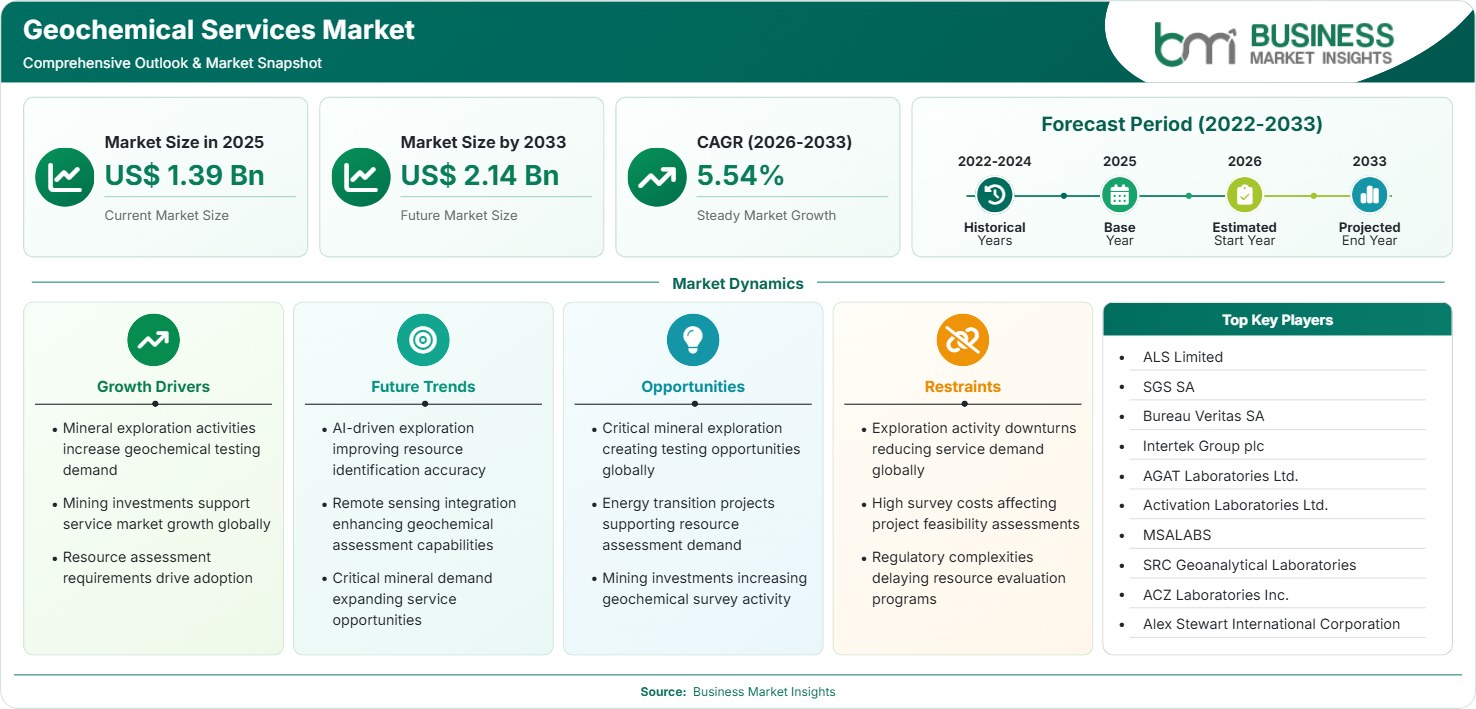
Geochemical Services Market Regional Highlights
North America Geochemical Services Market
North America represents the largest regional revenue contributor, accounting for 34%–37% of global demand in 2025 while advancing at a 5.0%–5.4% CAGR through 2033. Strong mineral exploration budgets, established laboratory networks, and government-backed critical mineral initiatives support continued expansion. Canada and the United States remain primary demand centers due to extensive gold, copper, lithium, and rare earth exploration programs. The region maintains leadership in analytical innovation, quality assurance standards, and accredited testing infrastructure. The Geochemical Services Market share remains highest in North America.
- Critical mineral funding programs support expanded testing requirements for lithium, nickel, copper, and rare earth exploration across North American jurisdictions.
- Major analytical laboratories continue investing in automation technologies that improve throughput, detection limits, operational efficiency, and service scalability.
- Environmental assessment regulations increase demand for hydrogeochemical monitoring and contamination characterization across mining and resource-development projects.
- Collaboration between geological surveys and exploration companies supports long-term demand for specialized analytical and interpretation services.
US Geochemical Services Market
The United States accounts for approximately 58%–62% of North American revenues and expands at a 5.1%–5.5% CAGR through 2033. Federal initiatives targeting domestic critical mineral supply chains encourage additional exploration activities. Lithium development programs, copper projects, and rare earth investments drive testing demand. Increased environmental monitoring requirements and technological leadership further strengthen market prospects. Advanced laboratory infrastructure and geoscience expertise continue supporting sustained service adoption throughout exploration, energy, and environmental applications.
- Domestic resource security strategies accelerate analytical requirements associated with exploration and reserve delineation projects.
- Advanced instrumentation adoption improves trace element detection and supports complex mineral characterization requirements.
- Environmental remediation projects create recurring testing demand beyond conventional exploration applications.
- Strong private-sector investment strengthens innovation and promotes development of specialized testing methodologies.
Europe Geochemical Services Market
Europe accounts for 24%–27% of global revenue in 2025 and is projected to expand at a 4.8%–5.2% CAGR through 2033. Regional demand benefits from strategic mineral sourcing initiatives, environmental monitoring regulations, and increased exploration of battery metal resources. Finland and Sweden lead regional activity, while Portugal demonstrates faster expansion through lithium-related projects. Strong regulatory oversight encourages high-quality laboratory standards and scientific validation requirements, supporting stable demand for analytical services across exploration and environmental sectors.
- European critical raw materials strategies encourage increased geological assessment and laboratory testing activities.
- Battery value chain investments stimulate demand for copper, lithium, and rare earth exploration support services.
- Finland remains a leading exploration destination, while Portugal exhibits higher growth potential linked to lithium development.
- Strict environmental compliance frameworks increase groundwater and ecological monitoring requirements.
Asia Pacific Geochemical Services Market
Asia Pacific captures 27%–30% of global Geochemical Services Market revenue and records the highest regional CAGR of 6.4%–6.8% through 2033. Australia, China, and India remain major contributors, while Indonesia demonstrates accelerated growth supported by nickel and strategic mineral exploration. Rising investment in mining infrastructure, exploration technologies, and laboratory capacity expansion fuels regional demand. Growing resource security concerns and energy transition initiatives continue strengthening long-term development prospects. The region is expected to generate the strongest contribution to future industry expansion.
- Australian exploration expenditure remains among the highest globally, sustaining significant demand for advanced laboratory services.
- Indonesia benefits from rising nickel resource development requiring comprehensive analytical and geological assessment.
- Government-supported geological surveys improve understanding of mineral potential across emerging exploration regions.
- Regional laboratory investments expand testing capacity and reduce turnaround times for exploration operators.
- Growing industrialization supports long-term expansion of mining and energy resource assessment activities.
Rest of World Geochemical Services Market
The Rest of World region, including South & Central America and the Middle East & Africa, represents 12%–15% of global revenue in 2025 and advances at a 5.7%–6.1% CAGR through 2033. Chile, Peru, South Africa, and Saudi Arabia continue attracting resource-investment activity. Expanding exploration programs, geological mapping initiatives, and mining diversification strategies support long-term service demand. Increased foreign investment and infrastructure improvements are enhancing access to analytical capabilities throughout developing mining jurisdictions. Strong copper and gold projects underpin regional opportunities.
- Chile and Peru maintain leadership through extensive copper exploration and development activities.
- Saudi Arabia's mining diversification strategy supports rising demand for exploration and geochemical assessment services.
- African gold and critical mineral projects create substantial opportunities for specialized laboratory providers.
- Infrastructure modernization improves access to testing networks and analytical expertise.
- International mining investment continues supporting exploration project pipelines across emerging economies.