
Factory Acceptance Testing Fat Services Market Outlook: Size, Share, Trends, Growth Analysis, Competitive Landscape & Forecast, 2026-2033

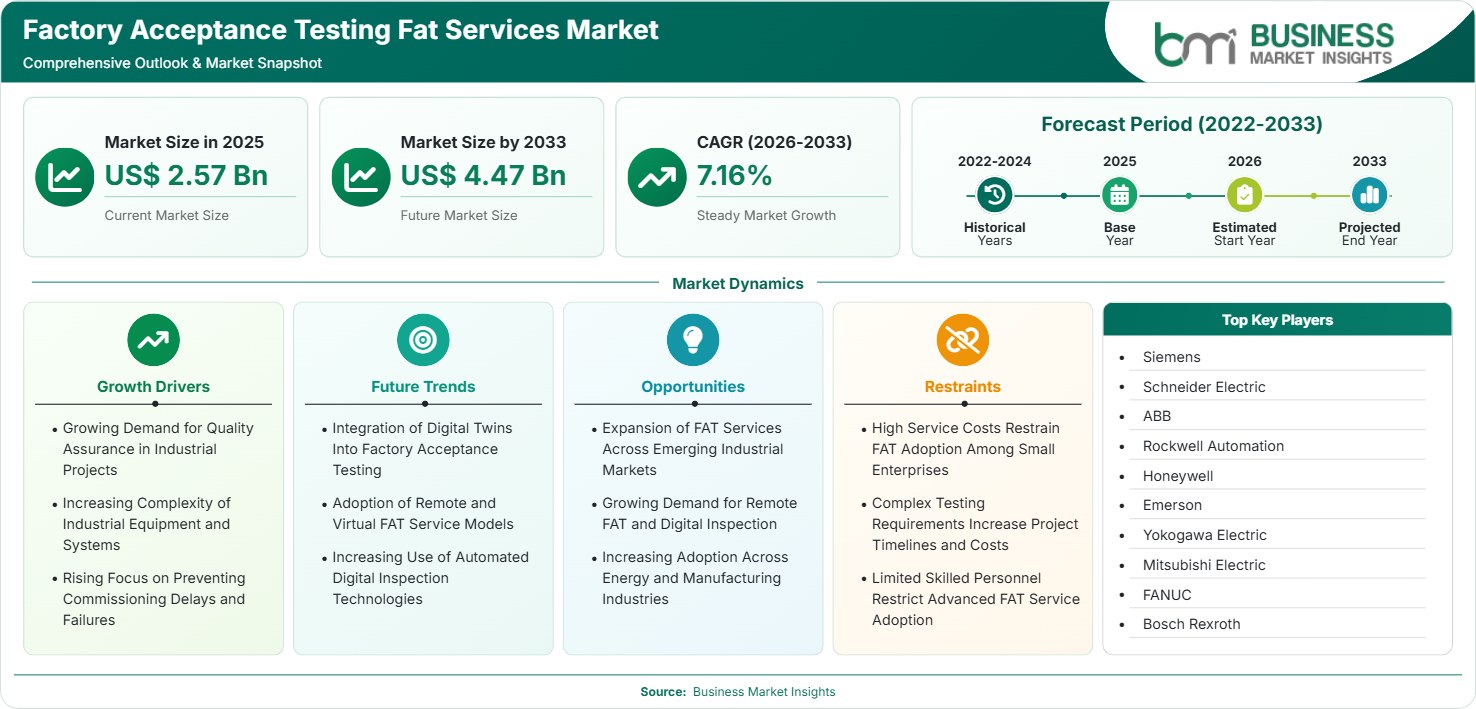
The Factory Acceptance Testing Fat Services Market size was valued at US$ 2.57 billion in 2025 and is projected to reach US$ 4.47 billion by 2033, growing at a CAGR of 7.16% during 2026–2033, supported by industrial automation, quality assurance, digital inspection, remote testing, and increasing project complexity.

Report Coverage
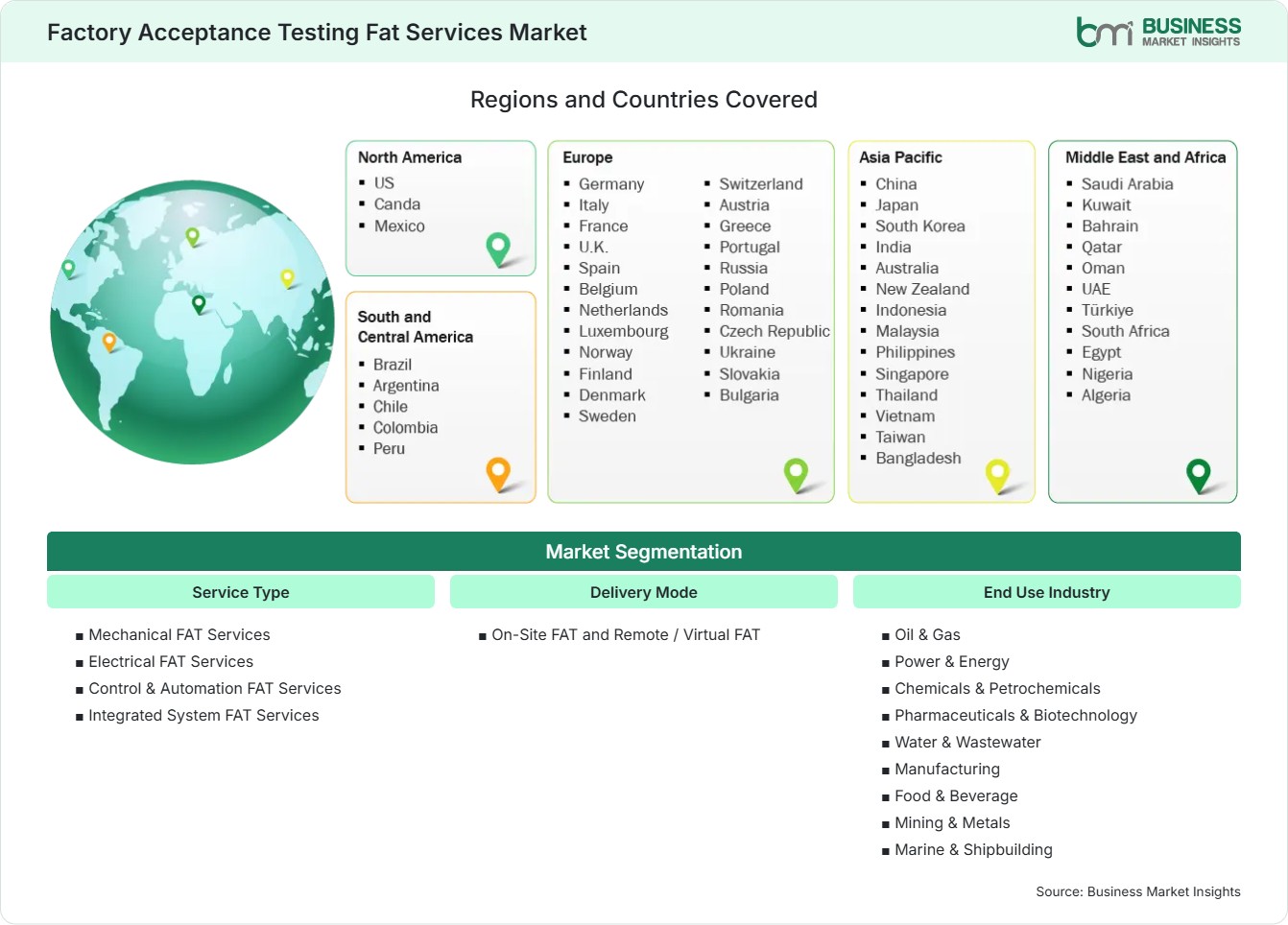
  • Service Type: Mechanical FAT Services, Electrical FAT Services, Control & Automation FAT Services, Integrated System FAT Services
  • Delivery Mode: On-Site FAT and Remote / Virtual FAT
  • End Use Industry: Oil & Gas, Power & Energy, Chemicals & Petrochemicals, Pharmaceuticals & Biotechnology, Water & Wastewater, Manufacturing, Food & Beverage, Mining & Metals, Marine & Shipbuilding
US$ 2.57 Bn Market size in 2025
US$ 4.47 Bn Market Size by 2033
7.16% CAGR, 2026 - 2033
2026-2033 Forecast Period

01 AI Overview

Factory Acceptance Testing Fat Services Market Summary

  • North America: North America holds a 34%–37% share in 2025, growing at a CAGR of 6.8%–7.4% during 2026–2033, supported by advanced automation, strict quality requirements, complex industrial projects, and strong demand for remote testing capabilities. The US Factory Acceptance Testing Fat Services Market is projected to expand at a 6.9%–7.5% CAGR, driven by modernization across energy, manufacturing, pharmaceuticals, and process industries.
  • Fastest Growing Region: Asia Pacific accounts for a 25%–29% share in 2025 and is advancing at a CAGR of 8.2%–9.0% through 2033, supported by industrialization, manufacturing capacity expansion, infrastructure investments, automation adoption, and growing outsourcing of specialized testing services.
  • Leading Segment: Control & Automation FAT Services holds a 30%–34% share in 2025 and records a CAGR of 7.5%–8.2%, supported by increasingly sophisticated control architectures, PLC integration, automation validation, cybersecurity requirements, and demand for reliable commissioning.
  • High Growth Segment: Remote / Virtual FAT is estimated at a 18%–22% share in 2025 and is growing at a CAGR of 9.0%–10.0%, benefiting from digital collaboration platforms, reduced travel requirements, faster inspection cycles, and distributed engineering teams.
  • Key Market Opportunity: Digital FAT platforms create opportunities to connect suppliers, integrators, and customers through virtual inspections, synchronized documentation, real-time issue tracking, remote witnessing, and standardized acceptance workflows.
  • Major Market Players: Siemens, Schneider Electric, ABB, Rockwell Automation, Honeywell, Emerson, Yokogawa Electric, Mitsubishi Electric, FANUC, and Bosch Rexroth.
02 Strategic Insights

Factory Acceptance Testing Fat Services Market: Strategic Insights

Factory Acceptance Testing Fat Services Market Strategic Framework
FREE PDF
Request your free sample
Request free sample
03 Stakeholder View

Key Takeaways

  • Industrial buyers increasingly view factory acceptance testing as a risk-management mechanism rather than a final inspection activity. Early validation helps identify design discrepancies, integration issues, documentation gaps, and control-system failures before equipment reaches the operating site.
  • Control and automation testing offers strong commercial potential as industrial systems incorporate PLCs, distributed control systems, robotics, industrial networks, safety systems, and increasingly sophisticated software. Suppliers capable of validating integrated architectures can capture higher-value service engagements.
  • Remote and virtual FAT is changing service delivery by allowing customers to witness testing through secure video, digital dashboards, shared documentation, and real-time collaboration. This model can reduce travel requirements while improving participation from international engineering and procurement teams.
  • Asia Pacific presents an attractive investment opportunity because manufacturing expansion, infrastructure development, and industrial automation are increasing the volume of equipment requiring structured acceptance procedures. Local service capabilities can improve responsiveness and reduce cross-border project friction.
  • Strategic partnerships between automation vendors, system integrators, engineering firms, and specialized inspection providers are likely to strengthen competitive positioning. Collaboration can combine technical expertise with digital platforms, enabling broader project coverage and more integrated testing workflows.
04 Geographic Outlook

Factory Acceptance Testing Fat Services Market Regional Highlights

North America Factory Acceptance Testing Fat Services Market

North America represents a 34%–37% share in 2025 and is projected to grow at a CAGR of 6.8%–7.4% through 2033. Strong automation adoption, advanced manufacturing, energy infrastructure, and demanding quality standards sustain service requirements. The region's Factory Acceptance Testing Fat Services Market share reflects high-value industrial projects requiring detailed validation, documentation, cybersecurity checks, and integrated control testing before commissioning.

  • US demand is supported by modernization of manufacturing, power, pharmaceutical, and chemical facilities, where automated testing helps reduce commissioning risks and validate complex equipment before installation.
  • Canada offers opportunities through energy, mining, and infrastructure projects requiring documented equipment verification, while remote FAT capabilities improve participation across geographically dispersed project teams.
  • Advanced automation environments are increasing demand for control-system validation, software checks, network testing, and integrated system verification before equipment shipment to operating facilities.
  • Digital collaboration is improving remote witnessing and documentation, enabling engineering teams, customers, and suppliers to review test evidence without extensive travel or prolonged onsite coordination.

US Factory Acceptance Testing Fat Services Market

The US accounts for a 28%–31% share in 2025 and is expected to register a 6.9%–7.5% CAGR during 2026–2033. Demand is supported by industrial modernization, automation investments, pharmaceutical manufacturing, energy infrastructure, and advanced production facilities. The Factory Acceptance Testing Fat Services Market benefits from sophisticated engineering ecosystems where customers increasingly require structured acceptance evidence before equipment installation and commissioning.

  • Pharmaceutical and biotechnology projects require extensive documentation and validation, creating opportunities for structured FAT services covering equipment performance, controls, data integrity, and process-related requirements.
  • Industrial automation investments increase the need for testing PLCs, robotics, safety systems, communication networks, and software before complex equipment is delivered to operating sites.
  • Energy and infrastructure modernization supports demand for systematic testing, particularly where project delays can create substantial financial consequences and operational disruptions.

Europe Factory Acceptance Testing Fat Services Market

Europe holds a 27%–30% share in 2025 and is projected to grow at a CAGR of 6.5%–7.2%. Germany remains a leading Factory Acceptance Testing Fat Services Market with a 6.8%–7.5% CAGR, while the UK and France offer steady opportunities. Industrial automation, machinery manufacturing, energy transition projects, and stringent quality expectations support demand for comprehensive testing and documented acceptance procedures.

  • Germany's advanced machinery and automation ecosystem generates demand for integrated testing of robotics, controls, industrial networks, and production equipment before shipment.
  • The UK benefits from investments in energy, pharmaceuticals, and advanced manufacturing, where structured acceptance testing helps manage complex procurement and commissioning requirements.
  • France presents opportunities across aerospace, energy, transportation, and industrial automation, with customers seeking stronger verification before deploying specialized equipment.
  • European sustainability and efficiency initiatives are encouraging modernization projects, creating additional requirements for testing new automated systems and integrated equipment before operational deployment.

Asia Pacific Factory Acceptance Testing Fat Services Market

Asia Pacific represents a 25%–29% share in 2025 and is projected to expand at an 8.2%–9.0% CAGR. China leads regional demand, while India records a faster 9.0%–10.0% CAGR as manufacturing, energy, infrastructure, and process industries expand. Growing industrial automation and equipment localization are increasing the need for standardized acceptance testing and remote inspection.

  • China benefits from extensive manufacturing capacity and automation investments, creating sustained requirements for testing industrial equipment, control systems, and integrated production technologies.
  • India's expanding manufacturing and infrastructure base supports opportunities for FAT providers as new facilities require reliable equipment validation before commissioning.
  • Japan and South Korea maintain demand through advanced electronics, automotive, robotics, and industrial automation sectors requiring detailed equipment and control-system verification.
  • Southeast Asian manufacturing hubs are attracting investment in industrial facilities, chemicals, electronics, and food processing, creating additional demand for structured pre-shipment testing.

Rest of World Factory Acceptance Testing Fat Services Market

South and Central America account for a 7%–10% share in 2025 and are projected to grow at a 6.5%–7.5% CAGR, supported by industrial modernization and energy investments. Brazil leads regional demand, while Mexico benefits from manufacturing expansion. The Middle East and Africa represent a 8%–11% share and are growing at a 7.5%–8.5% CAGR, supported by energy and infrastructure projects.

  • Brazil's industrial, energy, mining, and manufacturing projects create opportunities for equipment validation, particularly where imported systems require comprehensive acceptance procedures before deployment.
  • Mexico benefits from manufacturing investment and supply-chain localization, increasing requirements for testing production equipment, automation systems, and integrated industrial technologies.
  • Gulf countries are investing in energy diversification and infrastructure, generating demand for rigorous equipment verification across large-scale industrial and process projects.
  • Africa's energy, mining, water, and industrial development projects provide opportunities for FAT services that reduce commissioning risks and improve equipment reliability.
Global Market Geography
FREE PDF
Request your free sample
Request free sample
05 Segment Analysis

Factory Acceptance Testing Fat Services Market Segmentation

Service Type

Service Type represents a core segmentation dimension, with Mechanical FAT Services, Electrical FAT Services, Control & Automation FAT Services, and Integrated System FAT Services addressing distinct validation requirements. Control & Automation FAT Services lead with a 30%–34% share in 2025 and a 7.5%–8.2% CAGR through 2034, supported by increasingly integrated industrial architectures, software validation, and automation complexity.

  • Mechanical FAT Services: Validate equipment assemblies, dimensions, mechanical performance, and component functionality before shipment, helping identify manufacturing deviations and installation risks at an early project stage.
  • Electrical FAT Services: Cover electrical panels, wiring, power distribution, protection systems, and functional checks, supporting reliable installation and reducing electrical faults during commissioning.
  • Control & Automation FAT Services: Address PLCs, control logic, interfaces, automation sequences, alarms, and communication networks, with demand rising as industrial systems become more digitally integrated.
  • Integrated System FAT Services: Validate interconnected equipment and subsystems under coordinated operating conditions, helping customers identify integration problems before complex systems reach the installation site.

Delivery Mode

Delivery Mode includes On-Site FAT and Remote / Virtual FAT. On-Site FAT remains the dominant approach, while Remote / Virtual FAT is expanding faster because digital collaboration reduces travel requirements and enables geographically distributed stakeholders to participate. The Factory Acceptance Testing Fat Services Market scope is broadening as hybrid testing combines physical inspections with remote witnessing and digital documentation.

  • On-Site FAT: Provides direct physical inspection and hands-on verification, remaining important for complex machinery, mechanical systems, and projects requiring direct customer observation.
  • Remote / Virtual FAT: Uses secure video, digital records, live dashboards, and remote collaboration to accelerate acceptance activities while reducing travel and coordination costs.

End Use Industry

End-use industries include Oil & Gas, Power & Energy, Chemicals & Petrochemicals, Pharmaceuticals & Biotechnology, Water & Wastewater, Manufacturing, Food & Beverage, Mining & Metals, and Marine & Shipbuilding. Manufacturing and energy-related projects represent important demand centers, while pharmaceuticals and biotechnology require highly documented testing. The Factory Acceptance Testing Fat Services Market trends increasingly reflect industry-specific validation requirements and digital quality management.

  • Oil & Gas: Requires rigorous testing of equipment and control systems because operational failures can create substantial safety, environmental, and financial consequences.
  • Power & Energy: Uses FAT procedures to validate electrical equipment, automation, protection systems, and integrated plant technologies before installation and commissioning.
  • Chemicals & Petrochemicals: Demand detailed testing for process equipment, control systems, safety functions, and integrated technologies operating under demanding conditions.
  • Pharmaceuticals & Biotechnology: Require extensive documentation and validation to support quality, compliance, process consistency, and reliable equipment performance.
  • Water & Wastewater: Increasing infrastructure modernization creates opportunities for testing pumps, control systems, automation, and integrated treatment equipment before deployment.
  • Manufacturing: Automation-intensive production environments require systematic testing of machinery, robotics, controls, and communication systems before production begins.
  • Food & Beverage: FAT procedures help verify processing, packaging, automation, and control equipment, supporting consistent operations and reducing commissioning disruptions.
  • Mining & Metals: Large-scale equipment and remote operating environments increase the importance of pre-installation validation and documented equipment performance.
  • Marine & Shipbuilding: Complex equipment integration creates demand for acceptance testing covering mechanical, electrical, automation, and communication systems.
06 Market Forces

Factory Acceptance Testing Fat Services Market Dynamics

Key Market Drivers

Growing Demand for Quality Assurance in Industrial Projects

Owners of industrial projects nowadays are focusing on ensuring the quality assurance of the equipment before it leaves the manufacturing plant because any defects found at the time of the installation will lead to additional costs and efforts. The FAT process provides structured evidence that the machinery, electrical system, controls, and integrated equipment meet all set requirements. The Factory Acceptance Testing Fat Services Market growth is due to the increased demand from project owners for better assurance of the suppliers’ performance.

Increasing Complexity of Industrial Equipment and Systems

In modern manufacturing equipment, a combination of mechanical parts, electronics, sensors, software, automation systems, cybersecurity features, and communication channels is more common than not. It necessitates an alternative to traditional equipment testing, as each part may function correctly, but the whole system may be unable to perform. FAT Services solve the problem through checking the interface, sequence of actions, alarms, control, and communication. As such, there is a strong connection between the Factory Acceptance Testing Fat Services Market growth opportunity and digitalization and automation of the industry.

Rising Focus on Preventing Commissioning Delays and Failures

Delays during the process of commissioning could cause considerable costs due to wasted labor, delayed production, fines, and disrupted schedules. Increasingly, clients are using FAT to eliminate risks related to idle labor, delayed production, and similar issues by ensuring that equipment is ready to use prior to delivery. Through testing, possible problems can be found in regard to the documents, controls, mechanics, and the process of integration itself, when the supplier still has access to the engineering support. Thus, Factory Acceptance Testing Fat Services Market trends towards better acceptance procedures, especially for big industrial projects.

Key Market Opportunities

Expansion of FAT Services Across Emerging Industrial Markets

Rapid industrial growth in Asia, the Middle East, Latin America, and Africa is creating a need for quality assurance services across these regions. The creation of new production plants, energy facilities, chemical production plants, and infrastructural developments involves complicated equipment obtained from various sources. This gives room for independent testing firms and automation companies to create their regional presence. In the case of Factory Acceptance Testing Fat Services Market forecast, this market becomes especially interesting due to the use of international standards and detailed acceptance procedures in the development of industrial projects in those countries.

Growing Demand for Remote FAT and Digital Inspection

Remote FAT offers an ideal opportunity to improve traditional acceptance processes through secure video communication, electronic documentation, live test dashboards, and joint issue tracking. Customers will be able to see tests being conducted in different countries, while suppliers can minimize the need for travel and speed up the approval process. The idea seems particularly appealing for multinational projects involving engineers, procurement specialists, and operations teams across multiple countries. Additional chances can arise from combining the remote witnessing concept with on-site inspections. As companies become increasingly familiar with electronic quality management, providers have a chance to offer unique solutions.

Increasing Adoption Across Energy and Manufacturing Industries

The energy and manufacturing sectors are viable prospects, as equipment reliability affects process continuity and asset utilization. The deployment of power solutions, renewable energy sources, automation, and manufacturing projects leads to the necessity of validation services prior to implementation. FAT vendors have the possibility to diversify their portfolio by offering system validation, which involves electrical equipment, automation, software, and safety functionality. Testing is not limited to equipment; rather, focusing on system readiness is becoming increasingly important for customers. FAT vendors that specialize in specific sectors have an opportunity to establish relationships with engineering companies and equipment manufacturers.

Market Restraints and Challenges

High Service Costs Restrain FAT Adoption Among Small Enterprises

Factor: Comprehensive FAT services can require specialized engineers, advanced testing equipment, travel, documentation, and extended testing schedules. These expenses can be difficult for smaller industrial companies to absorb, particularly when projects have limited budgets or less complex equipment. Impact: Cost sensitivity may encourage some customers to perform basic internal checks instead of commissioning comprehensive third-party FAT services. This can limit adoption among smaller enterprises and create pricing pressure for service providers. Providers can address this challenge by offering modular testing packages, remote participation options, standardized documentation, and risk-based testing approaches that align service depth with project complexity and customer budgets.

Complex Testing Requirements Increase Project Timelines and Costs

Factor: Integrated industrial systems often require extensive testing across mechanical equipment, electrical systems, automation controls, software, communication networks, and safety functions. Coordinating these activities can require multiple engineering teams and repeated testing cycles when nonconformities are identified. Impact: Complex FAT programs may extend project schedules and increase costs, particularly when customer requirements change during testing. These challenges can discourage streamlined acceptance processes and create pressure to shorten testing activities. Digital test management, standardized protocols, simulation, and early engineering collaboration can reduce inefficiencies. However, complex projects will continue to require detailed planning to balance thorough validation against delivery schedules.

07 Company Analysis

Competitive Landscape

The Factory Acceptance Testing Fat Services Market analysis indicates that competition is shaped by automation expertise, engineering capabilities, geographic reach, digital testing tools, and the ability to support complex industrial projects. Major participants combine equipment technologies with testing, commissioning, integration, and lifecycle services.

Company Name

Overview

Products and Services relevant to this market

Siemens

Global industrial technology provider with extensive automation and digitalization capabilities.

Industrial automation, control systems, digital engineering, testing, commissioning, and integrated system validation.

Schneider Electric

Energy management and automation company serving industrial and infrastructure customers worldwide.

Automation platforms, electrical systems, control solutions, digital monitoring, and equipment validation services.

ABB

Global technology company specializing in electrification, automation, motion, and industrial digitalization.

Industrial automation, control systems, electrical equipment, robotics, and integrated testing capabilities.

Rockwell Automation

Industrial automation specialist serving manufacturing and process industries.

PLCs, control systems, industrial networks, software, automation integration, and testing support.

Honeywell

Technology provider with broad industrial automation and process control expertise.

Process control, automation systems, safety technologies, software, and integrated equipment validation.

Emerson

Industrial technology company focused on automation, process control, and operational performance.

Automation systems, control platforms, instrumentation, software, and testing and commissioning support.

Yokogawa Electric

Industrial automation and measurement technology provider serving process industries globally.

Distributed control systems, instrumentation, safety systems, automation integration, and testing services.

Mitsubishi Electric

Automation and electrical technology provider with strong industrial manufacturing capabilities.

PLCs, industrial automation, drives, control systems, robotics, and factory testing support.

FANUC

Robotics and factory automation specialist serving manufacturing industries worldwide.

Industrial robots, CNC systems, automation equipment, controls, and integrated system validation.

Bosch Rexroth

Industrial technology company specializing in drive, control, and automation solutions.

Motion control, hydraulic systems, automation platforms, drives, and equipment testing support.

10 Trust & Transparency

Research Methodology

The market analysis combines proprietary research with secondary data from government agencies, company disclosures, regulatory filings, industry databases and expert interviews. Market estimates are validated through data triangulation, cross-market benchmarking and analyst review.

View Full Research Methodology

11 Questions Answered

Frequently Asked Questions

Where can readers find broader industry insights?

A comprehensive Factory Acceptance Testing Fat Services Market report can help stakeholders evaluate service models, competitive positioning, regional opportunities, technology adoption, and evolving customer requirements across industrial applications.

What technologies are improving FAT workflows?

Digital documentation, remote witnessing, industrial simulation, cloud collaboration, automated test records, and integrated issue tracking are improving FAT workflows. These technologies can increase transparency while shortening review and approval cycles.

Which industries have strong demand for FAT services?

Demand is strong across manufacturing, energy, oil and gas, chemicals, pharmaceuticals, water treatment, mining, and marine applications. Projects involving complex automation and integrated equipment typically require more comprehensive testing.

How is remote FAT changing industrial equipment acceptance?

Remote testing allows customers to witness procedures through secure video, digital records, and collaboration platforms. It can reduce travel requirements and enable faster participation from geographically dispersed engineering and procurement teams.

Why is factory acceptance testing important for industrial projects?

FAT helps customers identify equipment defects, integration problems, control-system issues, and documentation gaps before shipment. Early corrective action can reduce field rework, commissioning delays, and unexpected project costs.

Access the Full Factory Acceptance Testing Fat Services Market Report

Get segment-level forecasts, regional estimates, competitive benchmarking, company profiles and downloadable Excel datasets.

Access the full Factory Acceptance Testing Fat Services Market Report
350 pages PDF & Excel | 2026-08-04