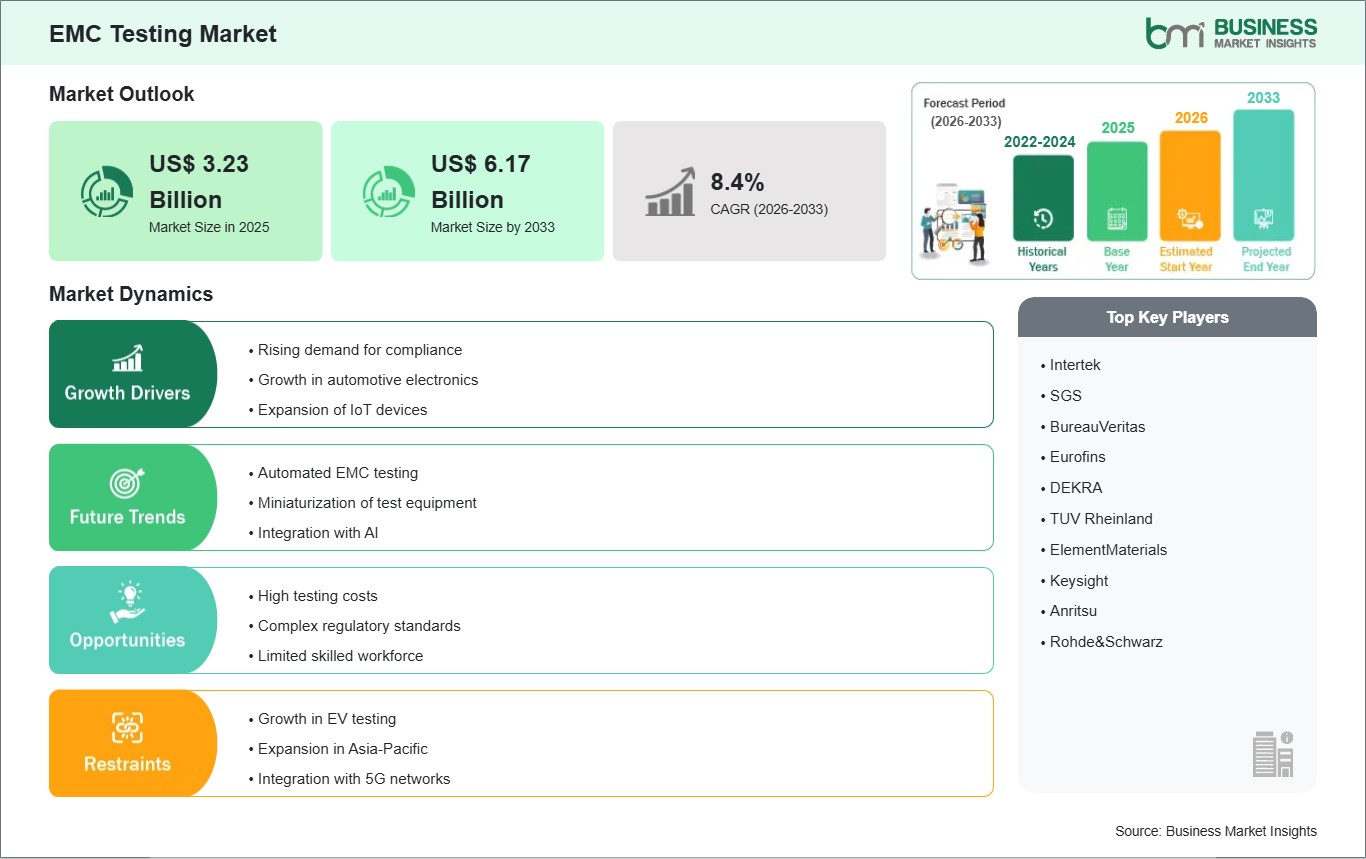
The EMC testing market size is expected to reach US$ 6.17 billion by 2033 from US$ 3.23 billion in 2025. The market is estimated to record a CAGR of 8.4% during 2026 to 2033.
EMC testing is a way to determine how well electronic devices perform to prevent or minimize the negative effects of electromagnetic interference (EMI). These testing procedures confirm compliance with regulatory guidelines as well as provide an assurance that products function reliably in the presence of other electronic devices. Also, as electronically connected products are more advanced and interdependent, EMC testing has become an integral part of the overall product development and market approval process.
Manufacturers work in an increasingly complicated electromagnetic environment due to the prevalence of wireless technologies, the increase in connected infrastructures and the growth of complex electronic components. Regulatory agencies are continuing to impose strict compliance requirements and, therefore, encouraging companies to perform EMC evaluations during the early stages of product design. This allows manufacturers to minimize the risk of product failure or defects during development, which can lead to increased reliability and a streamlined certification process for products seeking use in both domestic and foreign markets.
The testing, certification, and inspection services providing the necessary means for achieving quality assurance and regulatory compliance are collectively referred to as "the market." of the numerous service segments, testing is a particularly prominent portion, on account of its role in verifying product readiness for commercial release. Demand for testing services is primarily generated by Electronic System Integration into automotive and consumer electronics, regulatory requirements (e.g., aerospace, telecommunications, medical, etc.), and the need for the assurance of operational capability and compliance of these new and integrating technologies.
Current technological developments related to EMC test laboratories are having a major impact on the capability of EMC test facilities. Automated measurement systems, digital modeling tools, and advanced diagnostic technologies will improve test accuracy and laboratory productivity, while fulfilling the needs of new technology applications as they emerge. The competitiveness in this marketplace will be heavily based on laboratory expansion, new accreditation programs, and developing specialized expertise that can satisfy evolving compliance and performance standards in global markets.

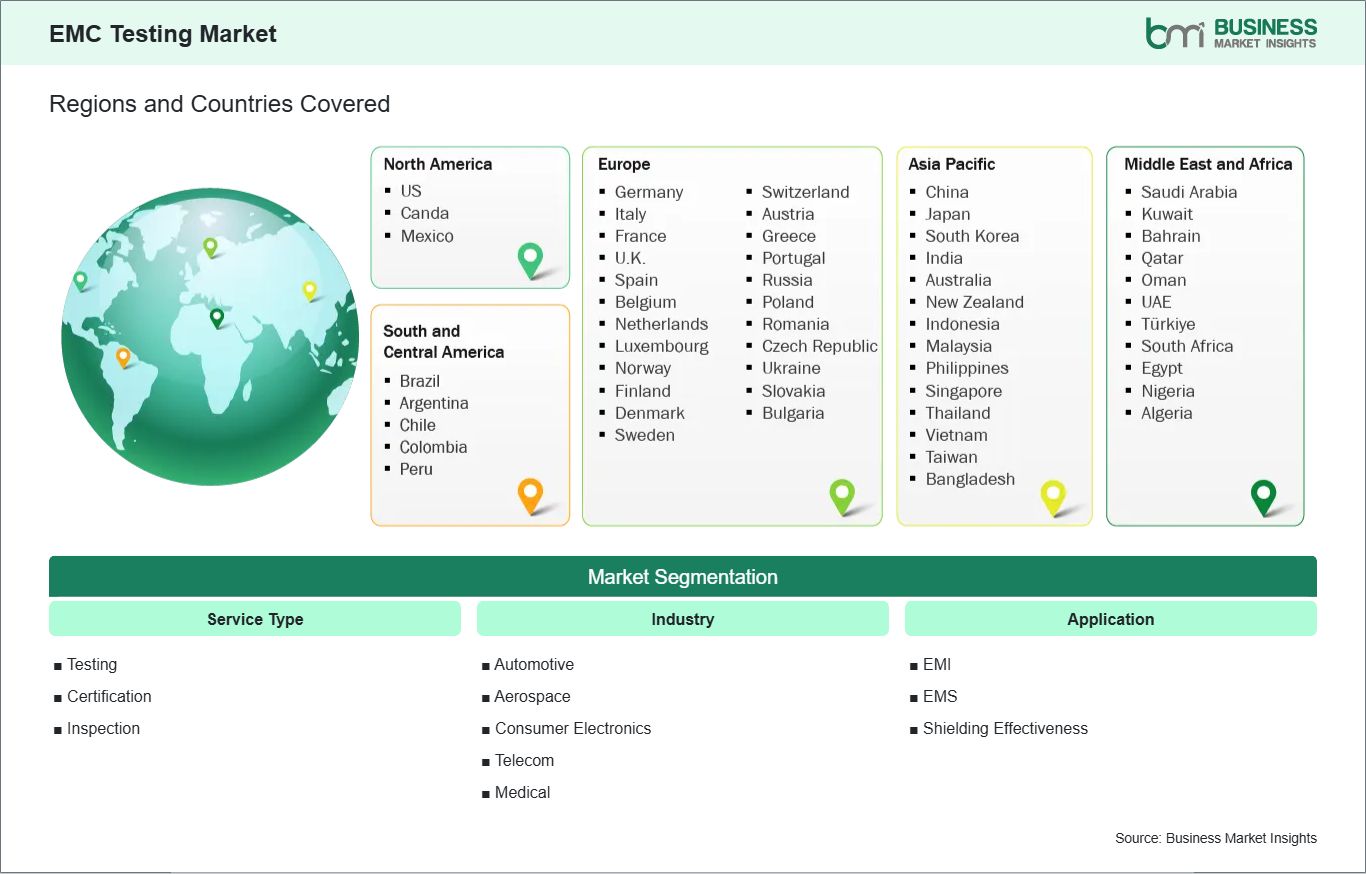
The EMC testing market is segmented by service type, industry, and application, reflecting diverse compliance requirements across electronic ecosystems.
Electronic products today are increasingly governed by stringent regulatory and compliance requirements before they can be introduced into commercial markets. As devices become more connected, operate at higher frequencies, and incorporate greater system complexity, the risk of electromagnetic interference also rises. This creates significant challenges for manufacturers during the product development cycle, particularly in ensuring electromagnetic compatibility (EMC). EMC testing has therefore become a critical step in verifying that electronic systems can operate as intended without causing or suffering from unwanted electromagnetic disturbances. It helps manufacturers meet regulatory standards, reduce certification delays, and ensure smooth product approvals across different international markets.
Compliance is critical to assuring product reliability and preserving customer trust beyond regulatory approvals; failure of products to meet EMC (electromagnetic compatibility) requirements can lead to performance impairments, including disruption in expected signal transmission, malfunctioning of systems, or loss of the system's operational capability, all of which have the potential to result in costly product recalls and damage to the company's reputation. Failure to meet EMC requirements can result in serious safety and operational issues in market sectors such as health care, automotive, and aerospace, as well as telecommunications. An increasing number of companies are incorporating EMC considerations earlier in the design process rather than reserving them until the end of testing on the product. This shift creates greater quality and reliability of the product in its entirety, and will support long-term product value through the use of robust electronic performance free of any interference, while supporting the larger quality assurance initiatives of the organization.
The rapid transition toward electric mobility has significantly increased the importance of electromagnetic compatibility (EMC) testing within the automotive industry. Electric vehicles (EVs) rely heavily on complex electronic systems, including battery management units, power electronics, onboard communication modules, and advanced control systems. These components must operate seamlessly together without causing electromagnetic interference that could affect vehicle safety or performance. As a result, EMC testing has become a vital part of design validation, system integration, and final certification processes for electric vehicles.
Beyond normal vehicle safety requirements of those vehicles, charging infrastructure, including charging stations, wireless communications systems, and smart grid infrastructure, will need extensive compatibility testing for electrical emissions and radiofrequency emissions to ensure safe and reliable use. Additionally, fast charging systems, which operate wirelessly, introduce multiple additional electromagnetic challenges that need careful management for stable and reliable charging, including sensor communication required for advanced driver-assistance systems (ADAS) and on-board processing of large amounts of data to complete the ADAS vehicle operation. Overall, the increase in the number of EVs being produced and the increased expansion of EV charging infrastructure will contribute to maintaining a steady and continuous need for EMC testing services. Electric vehicle systems are increasingly relying on software-defined vehicles and wireless electronic communications, concerning safety, efficiency, and full reliability of each component/system across the entire transportation value chain will grow as more safety testing is required of all transportation systems.

The EMC testing market is projected to grow from US$ 3.23 billion in 2025 to US$ 6.17 billion by 2033, registering a CAGR of 8.4% from 2026 to 2033.
By service type, the market is segmented into testing, certification, and inspection. Testing holds a dominant position due to its essential role in evaluating electromagnetic compatibility, identifying interference risks, and ensuring products meet regulatory requirements before commercialization. Manufacturers rely on testing services throughout product development to verify performance under different electromagnetic conditions. Certification services support formal regulatory approvals and market access, while inspection services assist in maintaining compliance consistency across manufacturing and operational processes.
By industry, the market is categorized into automotive, aerospace, consumer electronics, telecom, and medical. Consumer electronics accounts for a significant share owing to the high volume of connected devices requiring electromagnetic compatibility validation prior to market introduction. Automotive applications continue to expand with the integration of advanced electronic systems, electric vehicle technologies, and driver-assistance features. Aerospace, telecom, and medical sectors require rigorous EMC assessments to ensure reliable operation of critical equipment in environments where performance disruptions can have substantial operational consequences.
By application, the market is segmented into EMI, EMS, and shielding effectiveness. EMI represents the leading application segment due to the widespread need to control electromagnetic emissions and prevent interference between electronic systems. EMC testing for EMI applications supports regulatory compliance and operational reliability across diverse industries. EMS evaluations assess the ability of products to withstand external electromagnetic disturbances without performance degradation, while shielding effectiveness testing verifies the capability of materials and enclosures to limit electromagnetic transmission and enhance system protection.
| Report Attribute | Details |
|---|---|
| Market size in 2025 | US$ 3.23 Billion |
| Market Size by 2033 | US$ 6.17 Billion |
| Global CAGR (2026 - 2033) | 8.4% |
| Historical Data | 2022-2024 |
| Forecast period | 2026-2033 |
| Segments Covered | By Service Type
|
|
Regions and Countries Covered
| |
| North America | US, Canada, Mexico |
| Europe | Germany, Italy, France, U.K., Spain, Belgium, Netherlands, Luxembourg, Norway, Finland, Denmark, Sweden, Switzerland, Austria, Greece, Portugal, Russia, Poland, Romania, Czech Republic, Ukraine, Slovakia, Bulgaria |
| Asia-Pacific | China, Japan, South Korea, India, Australia, New Zealand, Indonesia, Malaysia, Philippines, Singapore, Thailand, Vietnam, Taiwan, Bangladesh |
| South and Central America | Brazil, Argentina, Chile, Colombia, Peru |
| Middle East and Africa | Saudi Arabia, United Arab Emirates, Kuwait, Bahrain, Qatar, Oman, Turkiye, South Africa, Egypt, Nigeria, Algeria |
| Market leaders and key company profiles |
|
The "EMC Testing Market Size and Forecast (2022-2033)" report provides a detailed analysis of the market covering below areas:
The EMC testing market shows diverse regional adoption patterns influenced by regulatory frameworks, electronics manufacturing intensity, technology innovation cycles, and product certification requirements. Across the global landscape, organizations increasingly prioritize electromagnetic compatibility assessments to ensure market access, operational reliability, and compliance with evolving technical standards. The widespread integration of connected technologies continues to reinforce the relevance of specialized testing services across multiple industries.
North America maintains a strong market presence supported by advanced technology development, established compliance infrastructure, and extensive research activities. Product manufacturers frequently engage testing services throughout development programs to satisfy industry-specific performance requirements. The region's concentration of automotive, aerospace, medical, and telecommunications activities contributes to sustained utilization of EMC testing capabilities across complex electronic applications.
Asia Pacific benefits from its position as a major electronics manufacturing hub, where large-scale production volumes create continuous demand for testing and certification services. Regional industries are introducing increasingly sophisticated consumer devices, automotive systems, and communication technologies that require comprehensive electromagnetic compatibility evaluations. Investments in industrial modernization and advanced manufacturing further strengthen the need for accredited testing environments throughout the region.
Europe emphasizes stringent regulatory compliance and product quality assurance, supporting consistent demand for EMC verification services. Automotive innovation, industrial automation, and healthcare technology development contribute to ongoing testing requirements. Emerging markets in the Middle East, Africa, and South and Central America are gradually strengthening technical compliance frameworks as industrial activities expand. These regions present opportunities associated with infrastructure modernization, technology adoption, and increasing participation in international trade networks.

The EMC testing market is evaluated by gathering qualitative and quantitative data post primary and secondary research, which includes important corporate publications, association data, and databases. Recent developments and news in the market include:
The EMC Testing Market is valued at US$ 3.23 Billion in 2025, it is projected to reach US$ 6.17 Billion by 2033.
As per our report EMC Testing Market, the market size is valued at US$ 3.23 Billion in 2025, projecting it to reach US$ 6.17 Billion by 2033. This translates to a CAGR of approximately 8.4% during the forecast period.
The EMC Testing Market report typically cover these key segments-
The historic period, base year, and forecast period can vary slightly depending on the specific market research report. However, for the EMC Testing Market report:
The EMC Testing Market is populated by several key players, each contributing to its growth and innovation. Some of the major players include:
The EMC Testing Market report is valuable for diverse stakeholders, including:
Essentially, anyone involved in or considering involvement in the EMC Testing Market value chain can benefit from the information contained in a comprehensive market report.
Please tell us your area of interest
(Market Segments/ Regions and Countries/ Companies)