
Robotics System Integration Services Market Outlook: Size, Share, Trends, Growth Analysis, Competitive Landscape & Forecast, 2026-2033

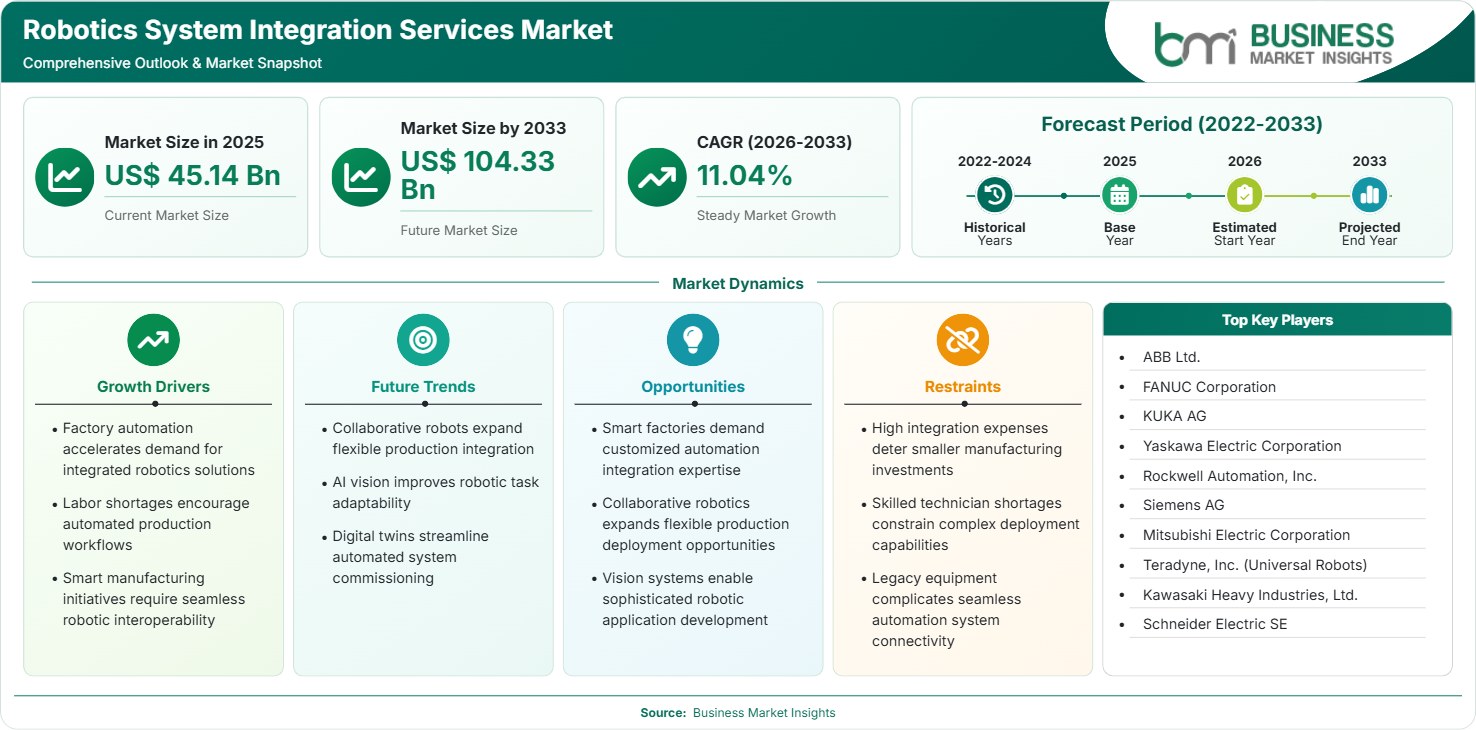
The Robotics System Integration Services Market size was valued at US$ 45.14 Billion in 2025 and is projected to reach US$ 104.33 Billion by 2033, growing at a CAGR of 11.04% during 2026–2033. Rising smart factory investments, increasing labor shortages, AI-enabled robotics deployment, warehouse automation expansion, and demand for flexible manufacturing systems are creating substantial growth opportunities across industrial and logistics environments.

Report Coverage
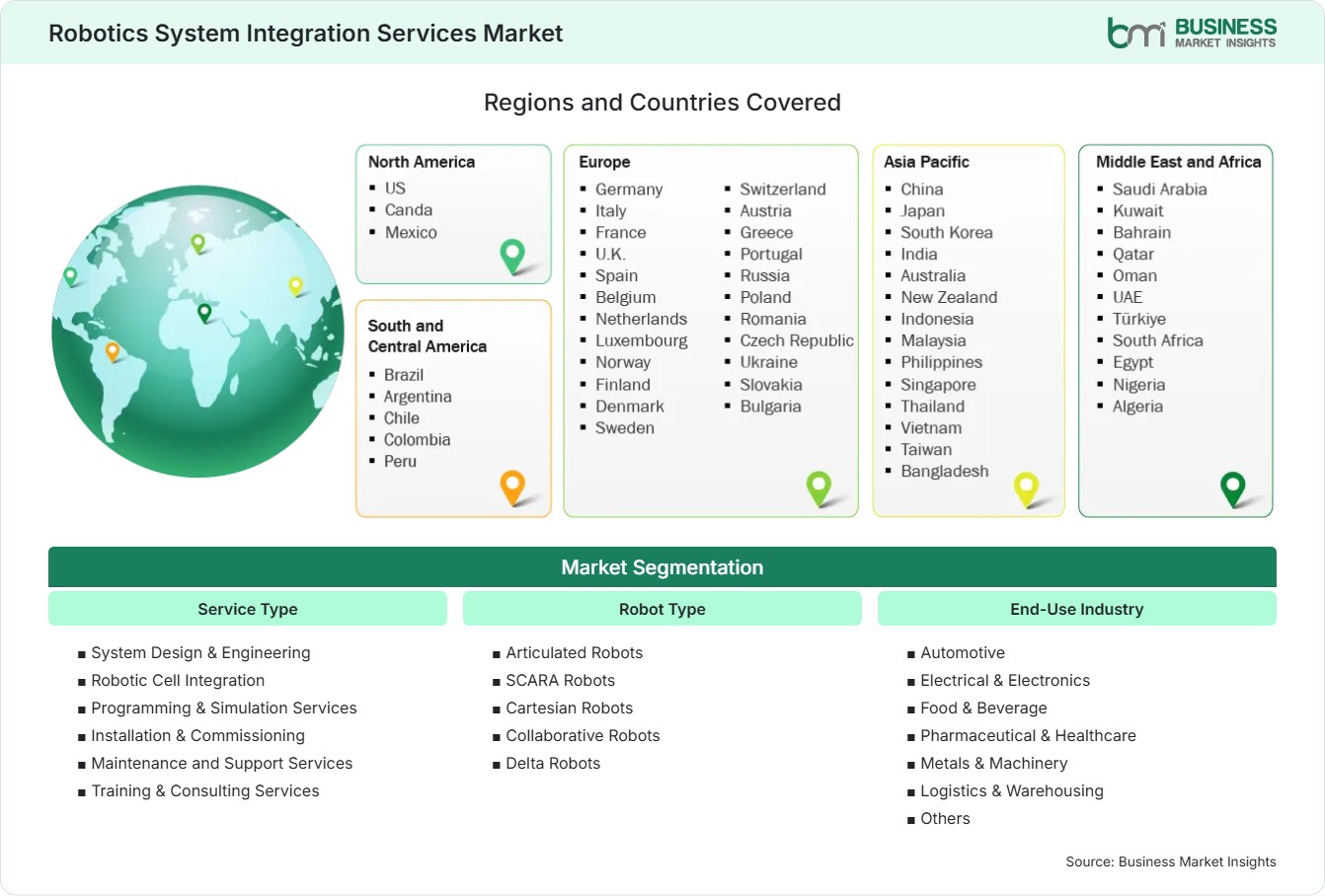
  • Service Type: System Design & Engineering, Robotic Cell Integration, Programming & Simulation Services, Installation & Commissioning, Maintenance and Support Services, Training & Consulting Services
  • Robot Type: Articulated Robots, SCARA Robots, Cartesian Robots, Collaborative Robots, Delta Robots
  • End-Use Industry: Automotive, Electrical & Electronics, Food & Beverage, Pharmaceutical & Healthcare, Metals & Machinery, Logistics & Warehousing, Others
US$ 45.14 Bn Market size in 2025
US$ 104.33 Bn Market Size by 2033
11.04% CAGR, 2026 - 2033
2026-2033 Forecast Period

AI Overview

Robotics System Integration Services Market Summary

  • North America Region: North America holds a market share of 34%–37% in 2025, growing at a CAGR of 9.8%–10.6% during 2026–2033, driven by automotive automation upgrades, reshoring initiatives, digital manufacturing investments, autonomous warehouse deployment, AI-enabled process optimization, demand for productivity enhancement, advanced robotics engineering capabilities, skilled integration ecosystems, customer-specific automation requirements, and industrial safety modernization programs. The U.S. market benefits from strong manufacturing modernization spending and is projected to expand at a CAGR of 10.0%–10.8%.
  • Fastest Growing Region: Asia Pacific holds a market share of 29%–32% in 2025, growing at a CAGR of 12.8%–13.8% during 2026–2033, supported by industrial expansion, electronics manufacturing growth, logistics automation adoption, government-backed smart manufacturing programs, increasing robot density, localization strategies, labor optimization initiatives, export-oriented production, technology partnerships, and capacity expansion investments.
  • Leading Segment: Automotive accounts for 27%–30% market share in 2025 and is projected to grow at a CAGR of 10.4%–11.2%, supported by welding automation, battery manufacturing expansion, quality consistency requirements, flexible assembly systems, vehicle electrification initiatives, advanced robotics deployment, production efficiency goals, predictive maintenance integration, throughput optimization, and manufacturing modernization investments.
  • High Growth Segment: Collaborative Robots account for 16%–19% share in 2025 and are anticipated to expand at a CAGR of 14.5%–15.5%, driven by human-machine collaboration, rapid deployment requirements, operational flexibility, SME automation adoption, lower installation complexity, growing safety compliance, workforce augmentation strategies, adaptive production environments, scalable automation, and reduced programming barriers.
  • Key Market Opportunity: Integration of AI-powered robotics, digital twins, machine vision, and autonomous mobile robots creates opportunities for highly customized automation architectures, accelerating productivity, operational intelligence, flexibility, quality assurance, and lifecycle optimization.
  • Major Market Players: ABB Ltd.; FANUC Corporation; KUKA AG; Yaskawa Electric Corporation; Rockwell Automation, Inc.; Siemens AG; Mitsubishi Electric Corporation; Teradyne, Inc. (Universal Robots); Kawasaki Heavy Industries, Ltd.; Schneider Electric SE.
Strategic Insights

Robotics System Integration Services Market: Strategic Insights

Robotics System Integration Services Market Strategic Framework
FREE PDF
Request your free sample
Request free sample
Stakeholder View

Key Takeaways

  • The ecosystem in the market is increasingly reliant on cooperation among robot makers, software suppliers, vision technology providers, automation consultants, and commissioning specialists, so integration capabilities have become a key factor in distinguishing one company from another.
  • Because retailers and third-party logistics companies are accelerating their investments in automation to enhance fulfillment speed, inventory accuracy, and labor productivity, the potential for logistics and warehousing applications is considerable.
  • The use of digital twin technology is changing how deployments are carried out, as it enables virtual testing, predictive optimization, and quicker commissioning, whilst reducing the risks of integration and implementation costs.
  • India, Vietnam, Indonesia, and Mexico offer very attractive investment opportunities because of their industrial expansion, their strategies for diversifying manufacturing, and their increasing rates of automation adoption.
  • The competitive landscape is being altered, and the range of integrated services is being expanded as automation providers, industrial software firms, and robotics specialists carry out strategic acquisitions.
  • Lifecycle service contracts, including predictive maintenance, remote monitoring, and workforce training, are becoming important recurring revenue streams for integrators.
Geographic Outlook

Robotics System Integration Services Market Regional Highlights

North America Robotics System Integration Services Market

North America accounted for approximately 34%–37% of global revenue in 2025 and is expected to record a CAGR of 9.8%–10.6% through 2033. The region benefits from industrial automation modernization, reshoring initiatives, and strong investment activity across automotive, aerospace, electronics, and warehouse automation sectors. The Robotics System Integration Services Market share remains significant because manufacturers increasingly implement integrated robotics environments that combine AI, machine vision, and digital monitoring capabilities. Demand is strongest among facilities pursuing productivity improvements, workforce optimization, and operational resilience through advanced automation architectures.

  • The original automation systems being used by automobile OEMs are still being replaced with intelligent robotics systems that support the production of electric vehicles and advanced assembly operations.
  • More warehouse operators are adopting autonomous robotics that are integrated with fulfillment software to increase the speed of processing and improve inventory accuracy.
  • Food and beverage manufacturers are investing money in robotic systems for packaging, inspection, and the handling of materials to cope with labor shortages and meet compliance requirements.
  • The increasing use of AI-powered predictive maintenance helps to improve equipment utilization and reduce operational interruptions.
  • Investments in semiconductors and in electronics increase the demand for highly customized precision automation environments.

US Robotics System Integration Services Market

The United States represents approximately 77%–81% of North American revenue and is projected to grow at 10.0%–10.8% through 2033. High rates of capital expenditure, advanced manufacturing strategies, and technological innovation drive further integration of robotic systems. Flexible production strategies have become increasingly important in manufacturing due to varying product specifications. Diverse industries such as the automotive industry, logistics, aerospace, semiconductors, and consumer goods have increased the market potential for various services.

  • Various federal programmes which support domestic manufacturing are promoting investments in advanced automation technologies in a number of different industrial sectors.
  • The challenges relating to the availability of labor are still causing the deployment of robotics solutions in warehouses, distribution centers, and manufacturing facilities to be accelerated.
  • The use of digital twins and machine vision technologies improves deployment efficiency and operational performance.
  • The growing number of battery manufacturing plants creates a continuous need for advanced robotic engineering services.

Europe Robotics System Integration Services Market

Europe accounted for approximately 26%–29% market share in 2025 and is anticipated to expand at a CAGR of 10.2%–11.0% through 2033. The German market continues to be the leader in this regard, and manufacturing centers in the Eastern Europe region exhibit high rates of adoption. Sustainable development campaigns, industrial competitiveness projects, and modern engineering capabilities make organizations invest in robotics systems. The automotive, pharmaceutical, and machinery manufacturing industries continue to be the largest adopters.

  • Germany has the leading regional demand, backed by a widespread automotive and industrial manufacturing infrastructure, with a compound annual growth rate between 10.3% and 11.1%.
  • Poland has strong growth potential as a result of the expansion of its manufacturing sector and its industrial modernization programmes, with a compound annual growth rate ranging from 11.8% to 12.8%.
  • The uptake of collaborative robotics is speeding up among small and medium-sized enterprises that are looking for flexible and cost-effective automation solutions.
  • The automation used in the manufacturing of pharmaceuticals provides opportunities for advanced validation and integration services.
  • Industrial digitalization programs help set up connected and data-driven robotics environments.

Asia Pacific Robotics System Integration Services Market

Asia Pacific represented approximately 29%–32% of global revenue in 2025 and is projected to register the fastest CAGR of 12.8%–13.8% through 2033. Fast-paced industrialization, increased electronics manufacturing, and smart manufacturing supported by the government drive robust expansion. China remains the largest market, while India and Southeast Asia are identified as fast-growing markets. Investments in automotive, semiconductor, and logistics infrastructure increase demand. Increasing robot density within the manufacturing plants is improving the prospects for providers.

  • China is able to retain its position of regional leadership due to its extensive production activities in the fields of electronics, automobiles, and industry, which are backed by automation policies.
  • India is showing strong growth momentum with a compound annual growth rate between 13.8% and 14.8% since manufacturers are making greater investments in automation.
  • The expansion of semiconductor manufacturing is leading to greater demand for the integration and testing of precision robotics.
  • The increase in e-commerce leads to warehouse automation initiatives that include the use of autonomous mobile robots and intelligent fulfillment systems.
  • Initiatives promoted by the government to encourage the adoption of integrated manufacturing platforms.

Rest of World Robotics System Integration Services Market

The rest of the world accounted for approximately 8%–11% of the robotics system integration services market revenue in 2025 and is expected to grow at a CAGR of 10.8%–11.8% through 2033. South and Central America continue benefiting from industrial modernization projects, especially in the automotive and food processing sectors. Meanwhile, Middle East and African economies are increasingly investing in logistics, energy, and industrial infrastructure automation. Rising diversification initiatives and productivity enhancement goals support growing adoption of integrated robotics solutions across commercial and industrial environments.

  • Brazil is leading South and Central America in terms of expanding investments in manufacturing automation and industrial productivity solutions.
  • Mexico benefits from nearshoring trends and growing demand for automotive production automation projects.
  • Saudi Arabia is supporting the deployment of automation by means of its industrial diversification and its smart manufacturing initiatives.
  • The United Arab Emirates is expanding its investments in logistics automation to modernize its warehousing and distribution systems.
  • There are increasingly more opportunities being generated in the field of automation for food processing and packaging in emerging markets.
Global Market Geography
FREE PDF
Request your free sample
Request free sample
Segment Analysis

Robotics System Integration Services Market Segmentation

Service Type

Service Type accounted for the largest portion of value creation within the Robotics System Integration Services Market, with engineering and implementation activities collectively representing over 30%–33% of spending in 2025. Demand continues to expand as manufacturers require complete design, deployment, validation, and lifecycle support. The Robotics System Integration Services Market scope increasingly extends beyond installation toward end-to-end operational optimization and digital integration strategies.

  • System Design & Engineering: Provides architecture development, process assessment, equipment selection, and workflow optimization, enabling organizations to establish customized automation frameworks aligned with productivity and quality objectives.
  • Robotic Cell Integration: Supports seamless coordination among robots, sensors, conveyors, vision systems, and software platforms to create efficient automation environments across manufacturing operations.
  • Programming & Simulation Services: Facilitates offline programming, virtual validation, and operational optimization, reducing commissioning risks while improving deployment efficiency and production readiness.
  • Installation & Commissioning: Ensures proper deployment, performance validation, safety verification, and operational startup, supporting reliable implementation across industrial facilities.
  • Maintenance and Support Services: Focuses on preventative maintenance, troubleshooting, upgrades, and remote monitoring, helping operators maximize system reliability and lifecycle performance.
  • Training & Consulting Services: Enables workforce readiness, operational excellence, technology adoption, and automation planning through structured training and advisory support.

Robot Type

Robot Type segmentation reflects varying automation requirements across industries. Articulated robots currently account for approximately 38%–41% share in 2025 and remain dominant due to their versatility. However, the Robotics System Integration Services Market trends increasingly favor collaborative robots as manufacturers pursue flexible automation environments requiring human-machine cooperation, faster deployment schedules, and simplified operational scalability.

  • Articulated Robots: Widely used in welding, assembly, handling, and painting applications where flexibility, payload capacity, and multi-axis movement are essential.
  • SCARA Robots: Preferred for high-speed assembly and pick-and-place activities requiring accuracy, repeatability, and compact operating footprints.
  • Cartesian Robots: Offer reliable linear motion capabilities suitable for packaging, material handling, loading, and machine tending applications.
  • Collaborative Robots: Enable safe interaction with human workers while supporting flexible production requirements and automation expansion across smaller facilities.
  • Delta Robots: Deliver exceptional speed and precision for packaging, sorting, inspection, and food processing applications requiring rapid repetitive movements.

End-Use Industry

The Automotive segment represented 27%–30% Robotics System Integration Services Market share in 2025 and remains the leading end-use category due to extensive robotics adoption across welding, assembly, painting, and battery manufacturing environments. Automotive production increasingly depends on integrated automation ecosystems delivering consistency, productivity, and operational flexibility. Logistics and warehousing demonstrate the strongest expansion trajectory, supported by e-commerce growth and fulfillment automation initiatives.

  • Automotive: Continues investing in advanced robotics integration to support electrification strategies, quality improvements, flexible manufacturing, and throughput optimization.
  • Electrical & Electronics: Requires precision automation solutions supporting semiconductor production, component assembly, quality control, and miniaturized manufacturing processes.
  • Food & Beverage: Adopts robotics for packaging, palletizing, sorting, and inspection activities while addressing hygiene and regulatory compliance needs.
  • Pharmaceutical & Healthcare: Utilizes automation to enhance accuracy, traceability, contamination control, and production scalability across critical operations.
  • Metals & Machinery: Deploys robotics for welding, fabrication, machining support, inspection, and heavy material handling applications.
  • Logistics & Warehousing: Expands automation investment for fulfillment, inventory management, packaging, and autonomous material movement across distribution networks.
Market Forces

Robotics System Integration Services Market Dynamics

Key Market Drivers

Industry 4.0 Deployment Accelerating Automation Integration

Manufacturers worldwide are increasing their investments in connected factories that incorporate robotics, industrial IoT, machine vision, and analytics platforms. According to the International Federation of Robotics, global industrial robot installations remain at historically high levels, reinforcing the need for specialized system integration expertise. As production facilities transition toward data-driven operations, demand is growing for customized engineering, simulation, and commissioning services that integrate multiple technologies into unified automation environments. Robotics System Integration Services Market growth is increasingly influenced by requirements for interoperability, operational visibility, predictive maintenance, and real-time production optimization. Integrators capable of delivering scalable digital manufacturing architectures are securing larger project pipelines across automotive, electronics, and industrial machinery sectors.

Persistent Labor Constraints Across Manufacturing Sectors

Workforce shortages continue to affect manufacturing, logistics, and warehousing operations across developed and emerging economies. Companies increasingly deploy robotics solutions to maintain production continuity, improve safety, and reduce dependence on difficult-to-fill positions. Integrators play a critical role in translating automation objectives into operational systems tailored to customer requirements. Demand extends beyond robot installation toward comprehensive workflow redesign and workforce transition planning. Robotics System Integration Services Market growth remains closely tied to labor economics, as organizations require sophisticated automation architectures that enhance productivity without compromising quality, compliance, or operational flexibility across diverse industrial environments.

Expansion of E-Commerce and Automated Warehousing

The logistics infrastructure is still undergoing continuous changes due to the fast growth of online retail. Distribution centers are now using autonomous mobile robots, robotic picking systems, automated storage systems, and smart sorting platforms. To set up these environments, complex integration is required among warehouse management software, vision systems, conveyors, and robotic equipment. Since end-to-end implementation capabilities are being offered, service providers have benefited from the ongoing level of project activity. The increasing demand for same-day order fulfillment and greater accuracy is driving the need for automation. As a result, integrators are becoming strategic partners by providing scalable deployment architectures that promote operational efficiency and long-term growth. The ongoing transformation of the logistics sector remains a major factor in the global uptake of robotics.

Key Market Opportunities

AI-Driven Robotics Orchestration Platforms

Artificial intelligence is creating opportunities to develop advanced orchestration environments that can coordinate multiple robotic assets within a single workflow. Integrators can leverage AI technologies to improve route planning, predictive maintenance, dynamic scheduling, and process optimization. As customers seek measurable productivity outcomes rather than standalone hardware deployments, service providers capable of integrating intelligent software capabilities gain competitive advantages. Robotics System Integration Services Market Forecasts increasingly support investment in AI-enabled engineering solutions due to their ability to reduce implementation complexity, improve utilization rates, and enhance decision-making capabilities across manufacturing and logistics settings.

Automation Adoption Among Small and Mid-Sized Enterprises

In the past, the introduction of robotics has mainly been the concern of large manufacturers who had substantial capital. Nowadays, however, the rise of collaborative robots, easy-to-use software, and subscription-based service models is making automation more accessible to small and medium-sized enterprises. By providing scalable deployment packages that require less capital outlay, integrators can meet unmet demand. There are attractive opportunities available in sectors such as food processing, contract manufacturing, packaging, and healthcare services. As more organizations become aware of the productivity advantages and the problems related to their workforce, they are increasingly adopting automation. Companies that make it easier to implement and train are well-positioned to capitalize on significant market growth.

Digital Twin and Virtual Commissioning Services

Digital twin technology enables simulation, testing, and optimization before any physical deployment, thereby reducing project risks and shortening implementation time. Nowadays, more integrators are adding virtual commissioning capabilities to their services to improve engineering accuracy and give customers greater confidence. The use of this technology is growing in areas such as the automotive industry, electronics, warehouse automation, and the pharmaceutical sector, all of which suffer from high downtime costs. Companies appreciate the opportunity to assess different operating scenarios and to verify performance before installation takes place. Service providers with strong modeling skills can increase their margins while delivering tangible benefits to their projects, creating a promising avenue for long-term growth.

Market Restraints and Challenges

High Integration Complexity and Extended Deployment Cycles

Large automation projects usually include work with several vendors, outdated equipment platforms, various software architectures, and different operational needs. Because of the high level of integration, technical difficulties arise in the areas of interoperability, validation, cybersecurity, and performance optimization. As a result, the schedules for deployment can go beyond the original ones, leading to higher implementation costs and a delay in achieving a return on investment. It is common for organizations to need customized engineering and thorough testing before the systems are fully ready for operation. The degree of complexity is especially noticeable in facilities that are undergoing a complete digital transformation across multiple production lines. Such challenges may cause smaller organizations to avoid launching large automation initiatives and place a strain on integrators to deliver consistent project results.

Skilled Workforce Shortage and Capacity Constraints

Robotics deployment requires specialists in control engineering, industrial software, machine vision, safety systems, and operational technology networks. Factor: the limited availability of experienced professionals restricts service capacity and increases labor costs for integration providers. Impact: project backlogs, recruitment challenges, and higher implementation expenses can reduce deployment efficiency. As automation adoption accelerates, competition for skilled technical personnel intensifies. Organizations must invest significantly in employee development, certification programs, and knowledge transfer initiatives to maintain service quality. Workforce limitations remain a persistent challenge for providers seeking to scale operations across multiple regions and industries.

Company Analysis

Competitive Landscape

The competitive environment is characterized by global automation leaders combining robotics expertise, industrial software capabilities, and engineering services. Robotics System Integration Services Market analysis shows increasing emphasis on lifecycle support, AI integration, and digital manufacturing solutions.

Company Name

Overview

Products and Services relevant to this market

ABB Ltd.

Global automation and robotics leader serving manufacturing, logistics, and process industries through integrated digital solutions.

Robotics engineering, robotic cells, commissioning, maintenance, industrial software, vision systems, and automation consulting.

FANUC Corporation

Major industrial robotics supplier with extensive installation base across automotive and electronics manufacturing sectors.

Industrial robots, programming services, robotic automation integration, lifecycle support, simulation, and optimization services.

KUKA AG

German automation specialist known for advanced robotics and digital manufacturing technologies.

Robot integration, engineering services, automated production systems, simulation tools, and maintenance solutions.

Yaskawa Electric Corporation

Leading provider of industrial robots and motion control technologies serving diverse manufacturing industries.

Motoman robots, system integration, controls engineering, commissioning, and training services.

Rockwell Automation, Inc.

Industrial automation company focused on connected enterprise and smart manufacturing environments.

Control systems integration, industrial software, robotics connectivity, analytics, and support services.

Siemens AG

Global industrial technology company offering comprehensive automation and digitalization solutions.

Digital twins, industrial software, robotics integration, virtual commissioning, and lifecycle management.

Mitsubishi Electric Corporation

Automation and factory technology provider serving electronics and manufacturing sectors globally.

Factory automation systems, robotics engineering, programming, installation, and operational support.

Teradyne, Inc. (Universal Robots)

Collaborative robotics pioneer enabling flexible automation for organizations of multiple sizes.

Collaborative robots, deployment consulting, application engineering, workforce training, and support services.

Kawasaki Heavy Industries, Ltd.

Industrial robotics manufacturer with strong expertise across manufacturing and material handling applications.

Robotic automation systems, welding solutions, integration engineering, and maintenance services.

Schneider Electric SE

Automation and energy management specialist supporting industrial digital transformation initiatives.

Industrial automation, software integration, control platforms, engineering services, and digital operations support.

Trust & Transparency

Research Methodology

The market analysis combines proprietary research with secondary data from government agencies, company disclosures, regulatory filings, industry databases and expert interviews. Market estimates are validated through data triangulation, cross-market benchmarking and analyst review.

View Full Research Methodology

Questions Answered

Frequently Asked Questions

What does a Robotics System Integration Services Market Report typically evaluate?

A Robotics System Integration Services Market Report generally assesses demand drivers, regional opportunities, competitive developments, technology adoption patterns, segment performance, and future market outlook.

Which region is expected to expand fastest through 2033?

Asia Pacific demonstrates the strongest growth profile owing to manufacturing expansion, automation investments, electronics production growth, and supportive industrial policies.

What distinguishes system integration services from robot hardware sales?

Integration services focus on designing, deploying, programming, testing, validating, and maintaining complete automation environments rather than merely supplying equipment.

Which industry generates the largest demand for integrated robotic solutions?

Automotive remains the leading industry because vehicle manufacturing depends extensively on robotic welding, assembly, painting, material handling, and battery production systems.

What factors are driving adoption of robotics integration services across industries?

Organizations are pursuing automation to improve productivity, address labor shortages, enhance quality consistency, and support digital transformation initiatives across manufacturing and logistics environments.

Access the Full Robotics System Integration Services Market Report

Get segment-level forecasts, regional estimates, competitive benchmarking, company profiles and downloadable Excel datasets.

Access the full Robotics System Integration Services Market Report
350 pages PDF & Excel | 2026-09-16
Similar Research

Related Market Reports