
Machining Centers Market Outlook: Size, Share, Trends, Growth Analysis, Competitive Landscape & Forecast, 2026-2033

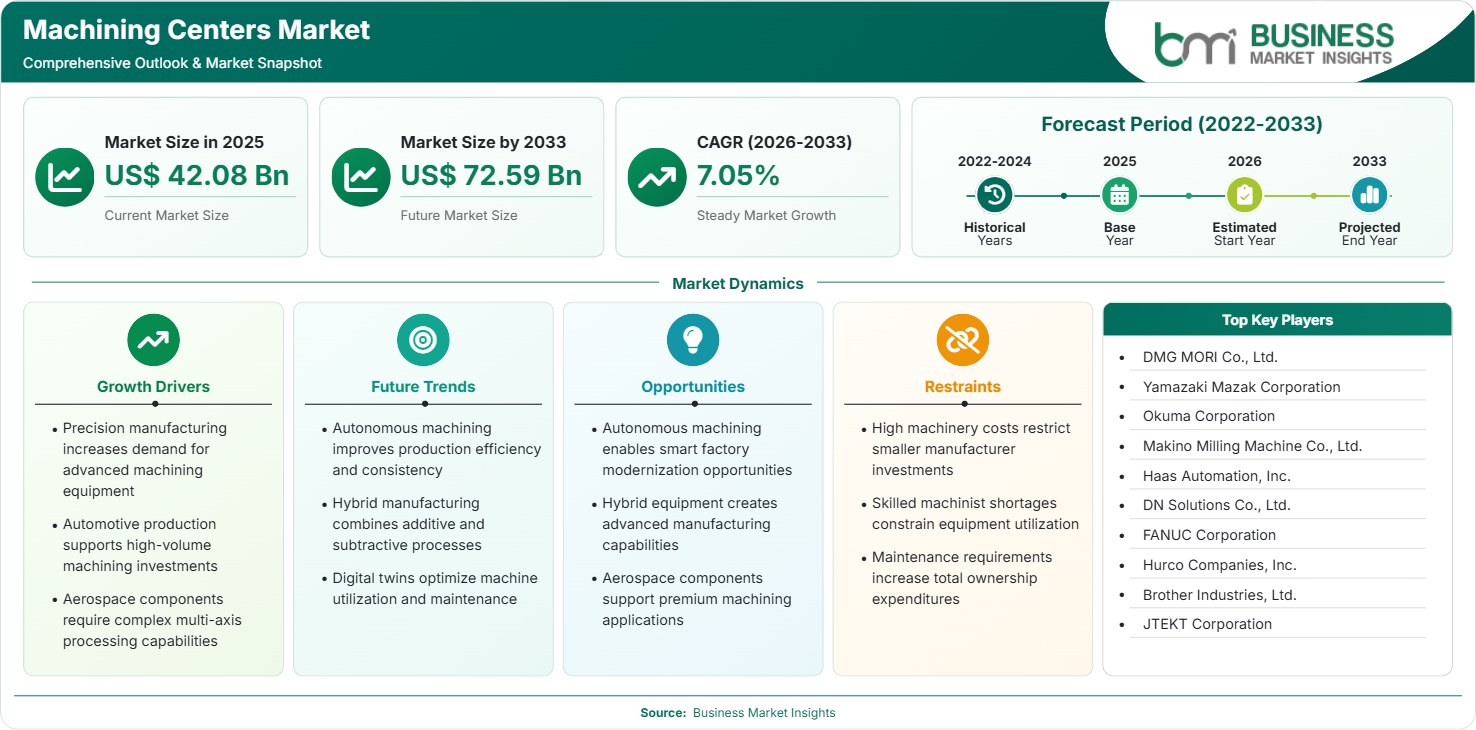
The Machining Centers Market size was valued at US$ 42.08 Billion in 2025 and is projected to reach US$ 72.59 Billion by 2033, growing at a CAGR of 7.05% during 2026–2033. Rising industrial automation, increasing adoption of multi-axis CNC systems, expansion of electric vehicle manufacturing, aerospace production growth, and smart factory investments continue creating new revenue opportunities across global manufacturing ecosystems.

Report Coverage
  • Product: Vertical Machining Center, Horizontal Machining Center, Others
  • Application: Automotive, General Machinery, Precision Machinery, Transport Machinery, Others
US$ 42.08 Bn Market size in 2025
US$ 72.59 Bn Market Size by 2033
7.05% CAGR, 2026 - 2033
2026-2033 Forecast Period

AI Overview

Machining Centers Market Summary

  • North America Region: Holds a market share of 24%–27% in 2025, growing at a CAGR of 6.4%–6.8% during 2026–2033, supported by aerospace modernization, reshoring initiatives, advanced manufacturing spending, defense procurement growth, and increasing deployment of automated CNC production cells across industrial facilities.
  • US Market: Accounts for 72%–76% of North American demand, expanding at a CAGR of 6.5%–6.9%, propelled by aerospace investment, automotive localization, robotics integration, and high-precision machining requirements.
  • Fastest Growing Region: Asia Pacific holds a market share of 39%–42% in 2025, advancing at a CAGR of 8.0%–8.5% during 2026–2033, driven by industrialization, semiconductor investments, electric vehicle manufacturing expansion, localized machine tool production, government incentives, export-oriented manufacturing growth, and increasing automation adoption.
  • Leading Segment: Vertical Machining Center accounts for 44%–47% share in 2025, witnessing a CAGR of 6.8%–7.2%, supported by versatility, compact footprint, lower installation costs, widespread automotive usage, flexibility in medium-volume production, and growing demand for precision metalworking operations.
  • High Growth Segment: Automotive Application represents 29%–32% share in 2025, registering a CAGR of 8.1%–8.6%, fueled by EV component manufacturing, lightweight metal processing requirements, battery housing production, drivetrain redesign, and increasing utilization of advanced machining technologies.
  • Key Market Opportunity: Expansion of connected manufacturing platforms, AI-enabled process optimization, predictive maintenance systems, and digital machining ecosystems is creating substantial productivity gains while reducing downtime and operational costs globally.
  • Major Market Players: DMG MORI Co., Ltd.; Yamazaki Mazak Corporation; Okuma Corporation; Makino Milling Machine Co., Ltd.; Haas Automation, Inc.; DN Solutions Co., Ltd.; FANUC Corporation; Hurco Companies, Inc.; Brother Industries, Ltd.; JTEKT Corporation.
Strategic Insights

Machining Centers Market: Strategic Insights

Machining Centers Market Strategic Framework
FREE PDF
Request your free sample
Request free sample
Stakeholder View

Key Takeaways

  • To deliver production ecosystems focused on productivity, the industry value chain is bringing together software providers, automation vendors, machine tool manufacturers, cutting tool manufacturers, and industrial service companies.
  • The most promising areas for growth are automotive electrification and the manufacture of lightweight components, since there is an increasing demand for machining battery cases, motor parts, and structural assemblies.
  • Innovation in products is now focusing on five-axis machining, adaptive control technologies, digital twins, predictive maintenance, and AI-assisted programming methods, which improve operational performance.
  • Asia Pacific remains the best investment opportunity due to the expansion of its industrial capacity, the government's manufacturing programs, rising export production, and the growing adoption of advanced CNC technologies.
  • As companies aim to expand their geographic presence and offer a wider range of manufacturing solutions, strategic acquisitions, technology partnerships, and investment programs focused on automation are becoming more common.
  • There is a growing demand for driving intelligent machine tools as a result of the sustainability that minimizes, which aim at reducing material waste, power consumption, and the operating costs over the lifecycle.
Geographic Outlook

Machining Centers Market Regional Highlights

North America Machining Centers Market

North America accounted for 24%–27% of the global Machining Centers Market demand in 2025 and is projected to expand at a CAGR of 6.4%–6.8% through 2033. Equipment demand continues to benefit from the strength of aerospace manufacturing, defense modernization, and industrial reshoring programs. Digitally enabled manufacturing processes have been adopted more by medium to large-sized industrial plants. The region enjoys high levels of automation, labor expertise, and continued investments in precision engineering technology. There is also a very high demand for multi-axis equipment used in aerospace, medical devices, energy, and transportation industries.

  • Aerospace manufacturers are continuing to increase their investments in precision machining systems to meet the demands of growing aircraft production, the fabrication of engine components, and the need for processing advanced materials, while at the same time improving both the volume and accuracy of production.
  • Efforts to reshore operations in various industrial sectors are leading firms to increase their spending on sophisticated machining equipment, which in turn allows them to improve their ability to produce goods domestically and decrease their reliance on foreign supply chains.
  • Increasingly, suppliers in the automotive sector are using automated machining methods for the production of components for electric vehicles, battery assemblies, lightweight structures, and drivetrain systems, which demand a high degree of dimensional accuracy and consistent processing.
  • Smart factory adoption remains a major growth catalyst as manufacturers integrate robotics, industrial IoT platforms, predictive maintenance solutions, and digitally connected production cells.
  • The defense procurement programs create a demand for advanced machine tools that are capable of producing components that are essential for a mission, together with very strict tolerance specifications and quality requirements.

US Machining Centers Market

The US market contributes 72%-76% of the regional revenue and is expected to achieve a CAGR of 6.5%-6.9% for the period of 2026-2033. High demand in aerospace and defense, industrial equipment, medical devices, and transportation manufacturing sectors will drive capital investment. Governmental policies on manufacturing within the country, semiconductors, and logistics will enhance future growth prospects. The Machining Centers Market share remains concentrated among technologically advanced manufacturing clusters where automation deployment, skilled labor availability, and engineering expertise facilitate the adoption of sophisticated production equipment.

  • Aerospace suppliers continue expanding production capacity to address growing commercial aviation backlogs and defense platform requirements, creating demand for high-performance machining solutions.
  • The investments made in semiconductor manufacturing help to meet the precision-machining needs of the production equipment, tooling systems, and other critical infrastructure components used in fabrication facilities.
  • Attempts to automate the industry lead to the replacement of old equipment with machining centers that are digitally integrated to enhance efficiency, accuracy, and the rate at which the equipment is used.
  • Advanced manufacturing policies continue attracting investment into domestic production facilities requiring reliable, high-productivity machining technologies.

Europe Machining Centers Market

Europe held approximately 21%–24% of the global Machining Centers Market revenue in 2025 and is anticipated to grow at a CAGR of 6.2%–6.7% through 2033. Germany continues to be the dominant regional market because of its highly developed machine tools, automobile, and industrial machinery industries. The Eastern European nations continue to become favorable destinations for production investments due to competitive manufacturing costs and growing industrial capabilities. The sustainability efforts have motivated companies to upgrade the existing systems using energy-efficient machinery.

  • Germany remains the largest contributor, supported by strong automotive production, industrial machinery exports, advanced engineering capabilities, and widespread deployment of automated manufacturing systems.
  • Poland is among the fastest-growing markets, with estimated growth exceeding regional averages as manufacturers expand industrial capacity and attract foreign investment.
  • Manufacturers increasingly adopt energy-efficient equipment and resource-optimization technologies to align with sustainability objectives and evolving regulatory standards.
  • Aerospace suppliers across France, Germany, and the United Kingdom continue investing in precision manufacturing systems to improve component quality and production efficiency.
  • Industry 4.0 implementation strategies are accelerating the adoption of connected machining environments featuring advanced monitoring, analytics, and automation capabilities.

Asia Pacific Machining Centers Market

Asia Pacific generated 39%–42% of global revenue in 2025 and is projected to record the highest CAGR of 8.0%–8.5% during the forecast period. China maintains regional leadership through large-scale manufacturing activity and machine tool consumption. India and Southeast Asian economies are emerging as major investment destinations. Rapid industrialization, adoption of automation, expanding electronics production, and electric vehicle manufacturing are driving growth in the Machining Centers Market across multiple end-use industries. Regional manufacturers increasingly prioritize advanced CNC technologies to improve competitiveness and production efficiency.

  • China remains the dominant market due to extensive manufacturing infrastructure, strong machine tool demand, and substantial investments in industrial modernization initiatives.
  • India is among the fastest-growing countries, supported by production-linked incentive schemes, automotive expansion, and increasing investment in industrial automation.
  • Semiconductor production growth is creating demand for precision machining equipment used in manufacturing tools, fixtures, and production systems.
  • Southeast Asian economies continue attracting electronics and industrial manufacturing investments as companies diversify supply chain strategies.
  • Rising electric vehicle production supports growing requirements for high-precision machining systems utilized across battery, motor, and structural component manufacturing.

Rest of World Machining Centers Market

The Rest of World region accounted for 10%–13% of global Machining Centers Market revenue in 2025 and is forecast to expand at a CAGR of 6.8%–7.3% through 2033. South and Central American markets benefit from automotive manufacturing development and industrial modernization investments. Meanwhile, Middle East and African countries are increasingly investing in manufacturing diversification strategies. Government infrastructure programs, industrial localization policies, and rising demand for engineered components are supporting machinery investments. Opportunities continue expanding as manufacturers pursue productivity improvements and operational efficiency enhancements.

  • Industrial development initiatives across Gulf countries support the adoption of advanced manufacturing technologies. Growing localization efforts, particularly in industrial production and transportation equipment manufacturing, are encouraging investment in modern machining systems.
  • Brazil remains the largest South American contributor due to its automotive sector, diversified industrial base, and increasing investments in advanced manufacturing capabilities.
  • Mexico benefits from nearshoring activity and strong integration with North American supply chains, supporting long-term demand for precision production equipment.
  • Saudi Arabia continues expanding non-oil industrial activities through manufacturing diversification initiatives that require technologically advanced production infrastructure.
  • South Africa maintains demand from mining equipment, industrial machinery, and transportation manufacturing sectors requiring dependable machining capability.
  • Infrastructure modernization and industrial policy programs across emerging economies support the replacement of outdated equipment with higher-productivity manufacturing technologies.
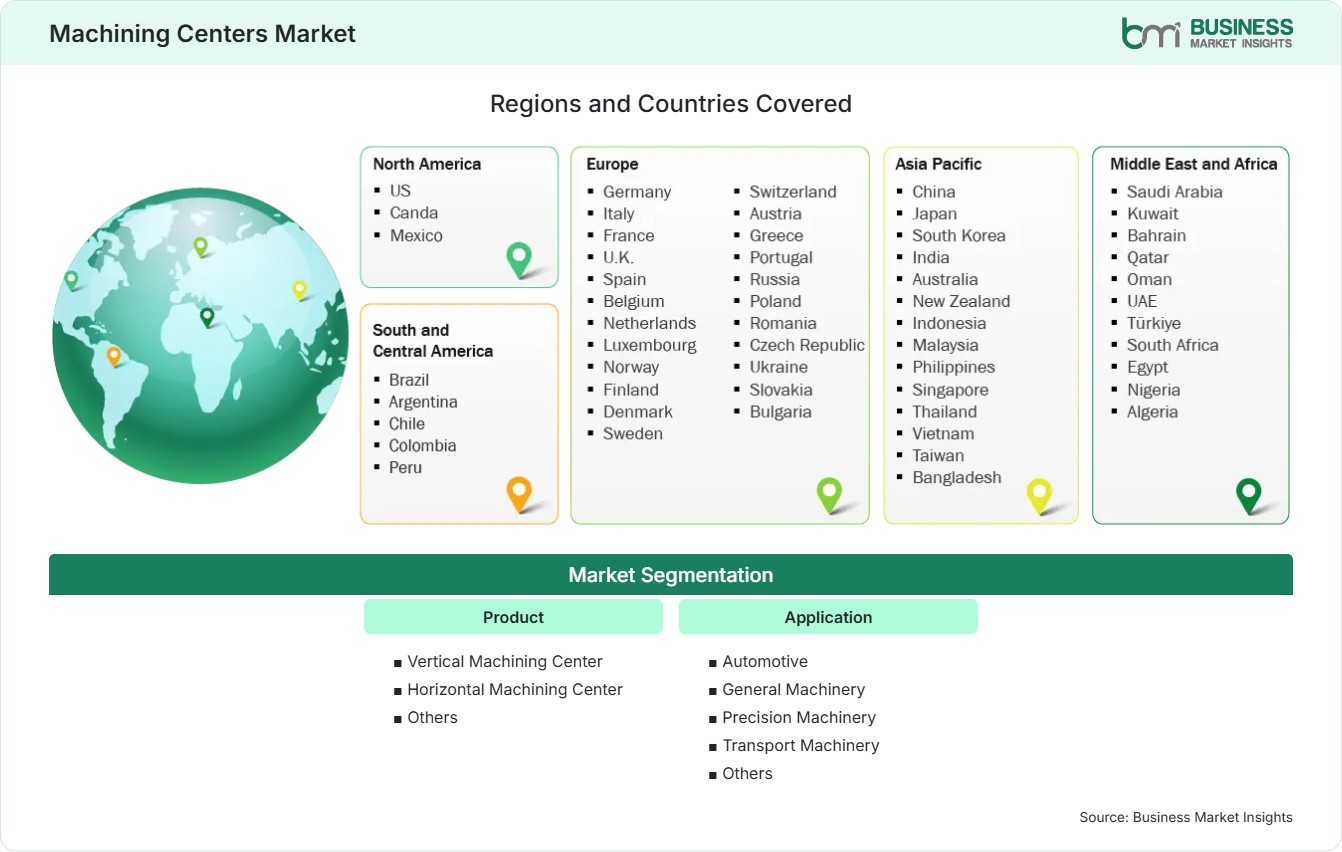
Global Market Geography
FREE PDF
Request your free sample
Request free sample
Segment Analysis

Machining Centers Market Segmentation

Product

The product category remains the largest revenue contributor, with Vertical Machining Centers accounting for 44%–47% share in 2025 and registering a CAGR of 6.8%–7.2% through 2033. Demand is influenced by productivity requirements, automation adoption, manufacturing flexibility, and increasing precision requirements. The overall Machining Centers Market scope continues expanding as manufacturers seek equipment capable of supporting diverse materials, high-speed processing, and digitally integrated production environments.

  • Vertical Machining Center: Widely deployed across automotive, aerospace, general engineering, and component manufacturing environments due to operational flexibility, efficient floor-space utilization, and suitability for medium-volume production requirements.
  • Horizontal Machining Center: Preferred for large-scale production applications requiring high material removal rates, enhanced chip evacuation, reduced downtime, and efficient processing of complex industrial components.

Application

Application demand remains diversified, with the Automotive segment accounting for 29%–32% market share in 2025 and achieving 8.1%–8.6% CAGR during the forecast period. Electric vehicle manufacturing, lightweight component production, and precision engineering requirements continue to support expansion. Emerging Machining Centers Market trends indicate strong adoption across transportation equipment, industrial machinery, and advanced manufacturing industries seeking productivity improvements.

  • Automotive: Electrification initiatives and demand for lightweight vehicle platforms support extensive deployment of precision machining technologies across drivetrain, battery, and structural component production.
  • General Machinery: Industrial equipment producers increasingly adopt advanced machining systems to enhance productivity, improve component consistency, and reduce manufacturing cycle times across diverse production environments.
  • Precision Machinery: Manufacturers require high-accuracy machining capabilities for the production of specialized components utilized in electronics, medical devices, instrumentation, and advanced industrial applications.
  • Transport Machinery: Expanding production of rail systems, aerospace components, marine equipment, and commercial transportation platforms supports long-term demand for advanced machining technologies.
Market Forces

Machining Centers Market Dynamics

Key Market Drivers

Accelerating Industrial Automation Across Manufacturing

Manufacturers are now, more than ever, incorporating automated production systems to boost productivity, ensure consistent quality, and cope with the shortage of skilled workers. Machining centers fitted with robotics, tool monitoring, and predictive analytics capabilities enable continuous operations and reduce production costs. In the automotive, aerospace, electronics, and industrial machinery sectors, investment in digitally connected manufacturing technologies is still going on. The broader adoption of Industry 4.0 strategies is driving demand for advanced CNC systems capable of collecting operational data and improving machine performance. The current level of automation in both developed and developing economies remains a key driver of long-term growth and the adoption of new technologies across the entire manufacturing value chain.

Growth in Aerospace and Defense Manufacturing

The aerospace sector needs highly accurate machining solutions for engine parts, structural assemblies, landing gear systems, and advanced materials. The increasing targets for aircraft production, ongoing fleet modernization programs, and rising defense procurement investments are leading to greater demand for technologically sophisticated equipment. Manufacturers are now using five-axis and multi-axis machining systems to produce components with complex shapes and tighter tolerances. The continued expansion in the production of commercial aircraft, military vehicles, satellites, and aerospace components is resulting in substantial demand.

Electric Vehicle Production Expansion

The rapid electrification of the transportation sector is having a global impact on the requirements for manufacturing components. The production of electric vehicles involves a large number of machining operations for battery cases, motor assemblies, transmission systems, power electronics enclosures, and structural parts. As the capacity of electric vehicle manufacturing plants increases, spending on advanced CNC machinery is also going up. Manufacturers are looking for production systems that can handle lightweight materials, achieve precise tolerances, and meet high-volume output demands. Both vehicle original equipment manufacturers and component suppliers are making greater investments in their supply chains by increasing capital expenditure on modern machining infrastructure, thus boosting long-term demand in the automotive and transportation manufacturing sectors.

Key Market Opportunities

AI-Enabled Smart Manufacturing Ecosystems

Artificial intelligence is currently being used to change the way machining processes are carried out by means of predictive maintenance, adaptive machining, automated programming, and improved workflow management. Nowadays, more manufacturers are looking for solutions that will allow them to cut down on equipment downtime and increase machine utilization rates. By combining AI with industrial IoT platforms, it is possible to achieve real-time process monitoring and optimize performance. Companies that provide intelligent machining solutions can secure a distinct competitive advantage while expanding their recurring service revenue. Continued across various sectors, investment in digital manufacturing transformation is accelerating, with smart machining ecosystems emerging as one of the most promising opportunities for equipment manufacturers, software suppliers, and automation partners over the period under review.

Expansion of Manufacturing Capacity in Emerging Nations

Countries across Asia, Latin America, and the Middle East are implementing industrial development programs to strengthen domestic manufacturing capabilities. Growing foreign direct investment, favorable production economics, and government-supported industrial zones continue attracting global manufacturers. New production facilities require advanced machining equipment for metalworking and precision manufacturing operations. These investment trends create opportunities for machine tool vendors to expand geographic presence and establish local service networks. Long-term industrialization initiatives across emerging economies are expected to generate sustained equipment demand and support favorable Machining Centers Market Forecasts throughout the assessment period.

Demand from Semiconductor and Electronics Industries

The expansion of semiconductor manufacturing is opening up new opportunities in the field of precision machining. Since fabrication plants need highly accurate tooling systems, production equipment components, and special fixtures, there is a growing demand for manufacturing infrastructure as a result of increased investments in semiconductor self-sufficiency programs in many major economies. Electronics producers also need precision-machined parts for use in high-performance devices and industrial equipment. The fact that semiconductor investments, the production of advanced electronics, and the need for precision engineering are coming together offers a promising area for growth to companies that provide technically advanced machining systems able to meet ever more demanding production standards.

Market Restraints and Challenges

High Capital Investment Requirements

Factor: Advanced machining centers require significant upfront investment for equipment, tooling, software, automation integration, and workforce training. Impact: Small and medium-sized manufacturers may delay modernization projects despite potential productivity benefits. Financing challenges become more pronounced during periods of economic uncertainty or elevated borrowing costs. Installation, calibration, and commissioning expenses further increase ownership costs. Although lifecycle benefits remain attractive, substantial capital requirements can slow purchasing decisions and extend replacement cycles. This challenge is particularly evident in price-sensitive markets where manufacturers prioritize cost control and gradual technology upgrades instead of large-scale investments.

Skilled Workforce Shortage and Technical Complexity

Factor: Modern machining systems increasingly depend on advanced programming, process engineering expertise, and digital manufacturing competencies. Impact: Insufficient availability of skilled operators and programmers can limit equipment utilization and reduce operational efficiency. Many industrial regions face workforce aging and talent shortages, creating barriers to the effective implementation of sophisticated machining technologies. Training requirements add operational costs while extending deployment timelines. As machinery becomes more technologically advanced, manufacturers must invest in workforce development programs to ensure productivity gains and avoid underutilization of high-performance production assets.

Company Analysis

Competitive Landscape

The competitive environment remains characterized by technology innovation, global distribution capabilities, automation expertise, and service network expansion. In this Machining Centers Market analysis, leading participants focus on advanced CNC systems, digital manufacturing solutions, multi-axis machining capabilities, and integrated automation platforms.

Company Name

Overview

Products and Services relevant to this market

DMG MORI Co., Ltd.

Global machine tool manufacturer with strong presence across aerospace, automotive, medical, and industrial manufacturing sectors.

Vertical machining centers, horizontal machining centers, automation systems, digital manufacturing solutions, software platforms, and lifecycle support services.

Yamazaki Mazak Corporation

Major producer of advanced machine tools with worldwide manufacturing and technology center network.

Multi-axis machining centers, CNC systems, automation solutions, smart manufacturing software, and precision engineering services.

Okuma Corporation

Japanese manufacturer recognized for integrated CNC technologies and high-precision production equipment.

Vertical machining centers, horizontal machining centers, intelligent controls, automation platforms, and machining software.

Makino Milling Machine Co., Ltd.

Specialized supplier of high-performance machining and precision manufacturing technologies.

CNC machining centers, aerospace manufacturing solutions, die and mold systems, and advanced automation technologies.

Haas Automation, Inc.

Leading American machine tool company serving diversified industrial manufacturing applications globally.

Vertical machining centers, horizontal platforms, rotary systems, CNC controls, tooling solutions, and operator training services.

DN Solutions Co., Ltd.

Global machine tool manufacturer focused on productivity enhancement and industrial automation.

Machining centers, turning systems, smart factory technologies, automation modules, and production optimization solutions.

FANUC Corporation

Industrial automation leader delivering CNC, robotics, and manufacturing technology solutions.

CNC controls, industrial robots, smart automation systems, machining integration technologies, and predictive monitoring tools.

Hurco Companies, Inc.

Provider of CNC machine tools and manufacturing productivity technologies.

Vertical machining platforms, software controls, automation features, engineering support, and production optimization solutions.

Brother Industries, Ltd.

Diversified technology company with strong presence in compact machining systems.

Speed-oriented machining centers, industrial automation solutions, production efficiency technologies, and maintenance services.

JTEKT Corporation

Industrial technology company operating extensive machine tool and manufacturing equipment businesses.

Machining centers, precision manufacturing systems, motion technologies, industrial components, and automation solutions.

Trust & Transparency

Research Methodology

The market analysis combines proprietary research with secondary data from government agencies, company disclosures, regulatory filings, industry databases and expert interviews. Market estimates are validated through data triangulation, cross-market benchmarking and analyst review.

View Full Research Methodology

Questions Answered

Frequently Asked Questions

What insights does a Machining Centers Market Report provide to stakeholders?

The Machining Centers Market Report offers a strategic assessment of competitive positioning, technology developments, investment opportunities, regional demand patterns, application trends, growth prospects, and evolving customer requirements across the industry.

How does digitalization influence purchasing decisions?

Manufacturers increasingly prioritize systems with predictive maintenance, industrial IoT connectivity, remote monitoring, automation integration, and advanced analytics because these technologies improve productivity and reduce operating costs.

Which product category dominates industry revenue?

Vertical machining centers lead global demand because of their operational versatility, cost effectiveness, relatively compact footprint, and suitability for diverse manufacturing applications across multiple industries.

Why is Asia Pacific the fastest-growing regional market?

Rapid industrialization, expanding electronics manufacturing, electric vehicle production growth, government industrial policies, automation investments, and increasing manufacturing exports continue supporting strong regional expansion.

What industries generate the highest demand for machining centers?

Automotive, aerospace, industrial machinery, precision engineering, electronics, transportation equipment, and medical device manufacturing collectively represent the largest end-use industries due to their requirements for precision component production and operational efficiency.

Access the Full Machining Centers Market Report

Get segment-level forecasts, regional estimates, competitive benchmarking, company profiles and downloadable Excel datasets.

Access the full Machining Centers Market Report
350 pages PDF & Excel | 2026-09-16
Similar Research

Related Market Reports