
Smart Mining Market Outlook: Size, Share, Trends, Growth Analysis, Competitive Landscape & Forecast, 2026-2033

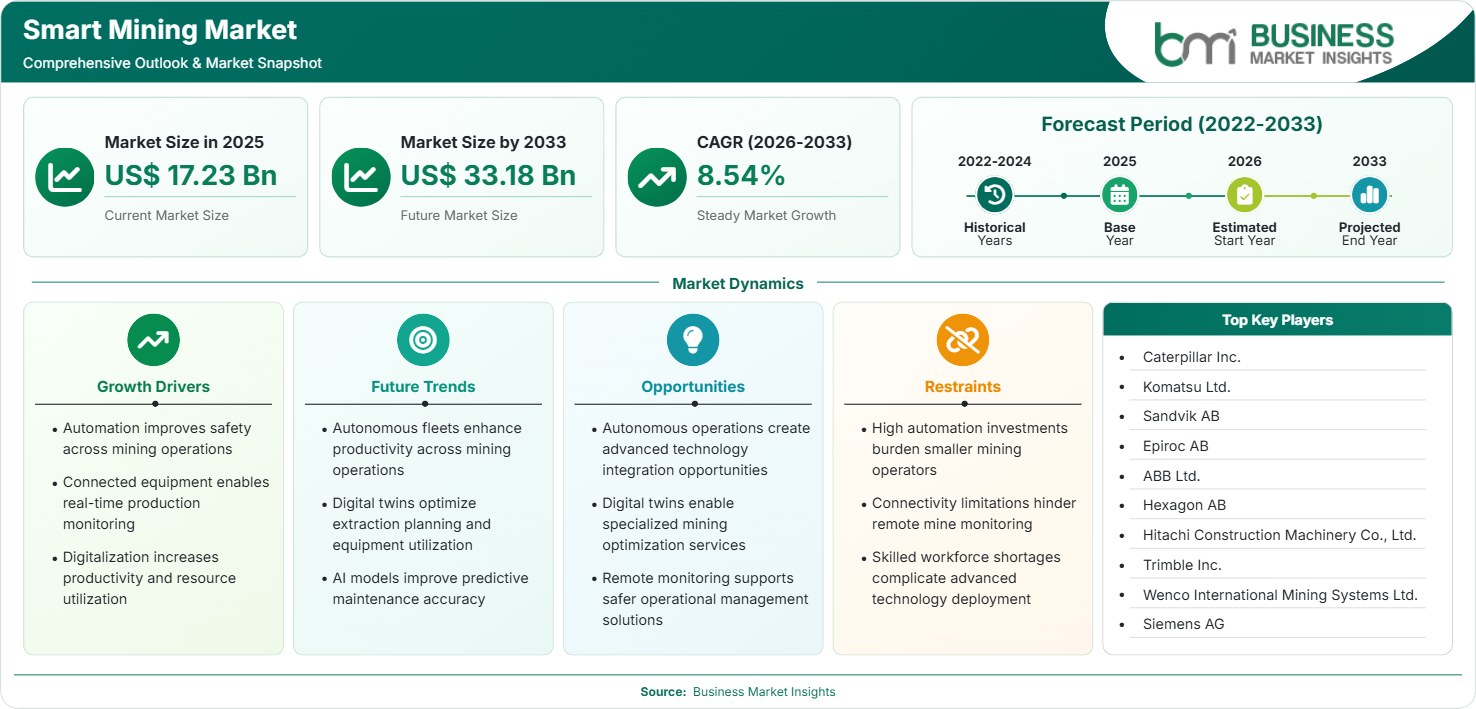
The Smart Mining Market size was valued at US$ 17.23 Billion in 2025 and is projected to reach US$ 33.18 Billion by 2033, growing at a CAGR of 8.54% during 2026–2033. The increasing deployment of mine automation, rising demand for real-time asset monitoring, growing focus on worker safety, and wider use of AI-enabled operational systems are opening significant opportunities across mining ecosystems worldwide.

Report Coverage
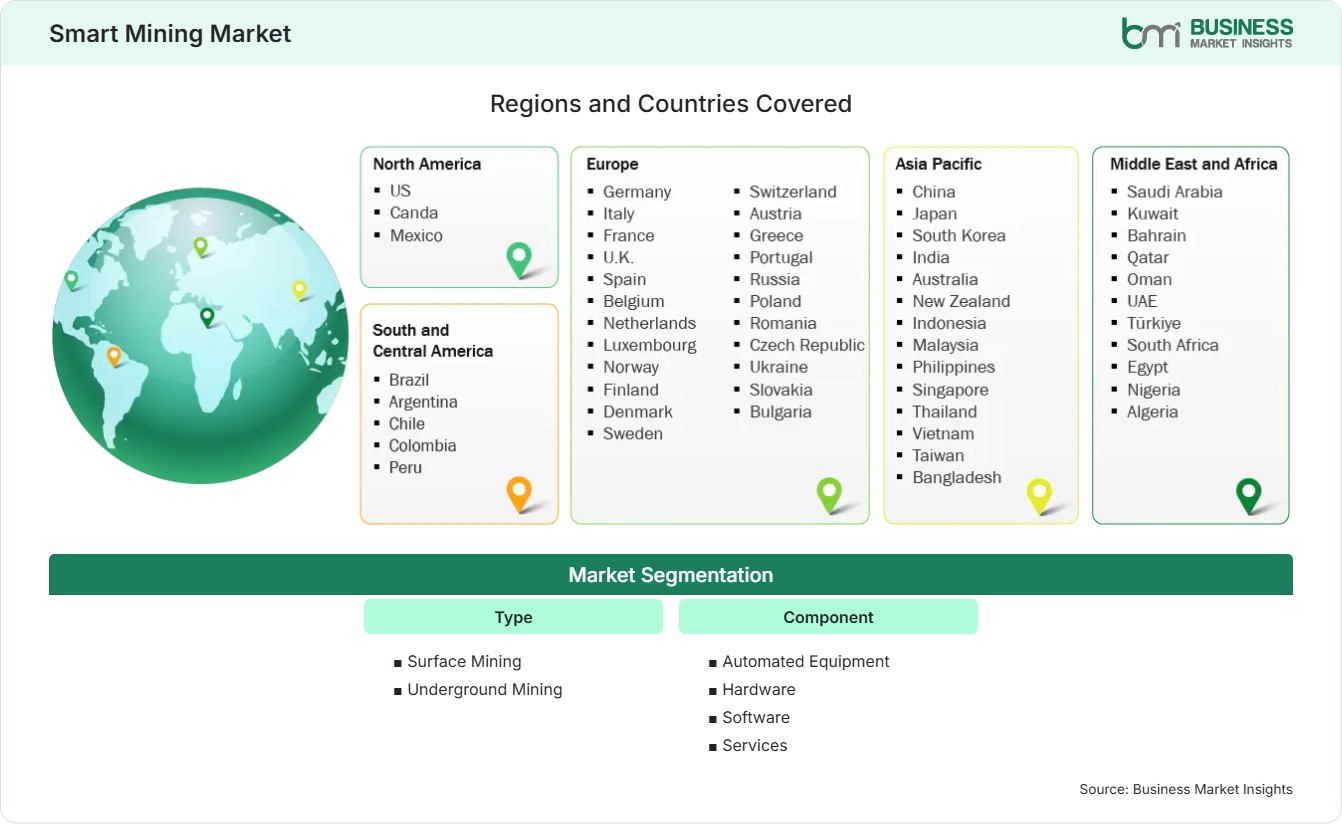
  • Type: Surface Mining, Underground Mining
  • Component: Automated Equipment, Hardware, Software, Services
US$ 17.23 Bn Market size in 2025
US$ 33.18 Bn Market Size by 2033
8.54% CAGR, 2026 - 2033
2026-2033 Forecast Period

AI Overview

Smart Mining Market Summary

  • North America Region: North America holds a market share of 34%–37% in 2025, growing with a CAGR of 7.8%–8.4% during 2026–2033. Growth is supported by the increasing adoption of autonomous haulage, digital mine planning, advanced communication infrastructure, safety compliance initiatives, predictive maintenance technologies, workforce optimization programs, sustainability mandates, operational efficiency goals, data-driven extraction strategies, and industrial automation investments. The US market is benefiting from large-scale digital mine modernization programs and is expected to record a CAGR of 8.0%–8.5% through 2033.
  • Fastest Growing Region: Asia Pacific accounts for 27%–30% share in 2025 and is anticipated to expand at 10.0%–10.8% CAGR during 2026–2033. This expansion is being driven by rising mineral demand, investments in smart infrastructure, large-scale mine digitization, greater deployment of autonomous equipment, supportive industrial policies, connectivity upgrades, resource optimization initiatives, sustainability goals, productivity improvement programs, and expanding critical minerals production activities.
  • Leading Segment: Hardware represents 31%–34% share in 2025 and is expected to grow at 8.3%–8.9% CAGR during 2026–2033. Demand continues to be supported by sensor integration, RFID deployment, intelligent monitoring systems, machine health tracking, safety improvements, operational visibility requirements, communication infrastructure modernization, process automation initiatives, digital transformation spending, and the growing adoption of connected mining environments.
  • High Growth Segment: Software accounts for 24%–27% share in 2025 and is projected to expand at 10.2%–10.9% CAGR during 2026–2033. Growth is being encouraged by greater deployment of analytics, operational intelligence platforms, logistics optimization tools, cloud integration capabilities, predictive decision systems, remote monitoring applications, digital twin development, AI-enabled workflows, production planning solutions, and enterprise-wide data integration.
  • Key Market Opportunity: Expanding deployment of AI-driven analytics platforms across critical mineral operations is creating opportunities to improve productivity, support predictive maintenance, lower operating costs, reduce environmental impact, improve resource recovery, and establish scalable remote-management frameworks.
  • Major Market Players: Caterpillar Inc.; Komatsu Ltd.; Sandvik AB; Epiroc AB; ABB Ltd.; Hexagon AB; Hitachi Construction Machinery Co., Ltd.; Trimble Inc.; Wenco International Mining Systems Ltd.; Siemens AG.
Strategic Insights

Smart Mining Market: Strategic Insights

Smart Mining Market Strategic Framework
FREE PDF
Request your free sample
Request free sample
Stakeholder View

Key Takeaways

  • The value chain is shifting from equipment-centric operations toward integrated digital ecosystems that combine sensors, automation software, cloud platforms, autonomous equipment, and analytics-driven decision support systems.
  • Software-led optimization platforms and intelligent connectivity solutions offer the strongest upside as mining companies increasingly require remote operations, resource planning, predictive maintenance, and improved operational efficiency.
  • Artificial intelligence, digital twins, edge computing, and autonomous vehicle technologies are reshaping mine productivity models while supporting better safety, asset utilization, and sustainability performance.
  • Asia Pacific presents a compelling investment case because of expanding metal production, critical mineral development projects, government-backed digitization initiatives, and rapid infrastructure modernization.
  • Strategic acquisitions and partnerships are increasingly centered on industrial software, automation systems, sensor technologies, and connected equipment capabilities that strengthen digital mining portfolios.
  • Environmental monitoring and carbon-reduction initiatives are encouraging the deployment of intelligent systems that help optimize energy use, water consumption, and extraction efficiency across mining sites.
Geographic Outlook

Smart Mining Market Regional Highlights

North America Smart Mining Market

North America accounted for approximately 34%–37% of global revenue in 2025 and is projected to expand at a 7.8%–8.4% CAGR during 2026–2033. The area is advantaged by the use of very mechanized mining techniques, autonomous hauling systems, industrial connectivity, and mining ecosystems. The Smart Mining Market share leadership of North America remains supported by strong capital expenditure and continued technology integration across metal, coal, and mineral extraction projects.

  • Autonomous haulage fleets are being deployed more widely across large surface mines, helping improve equipment utilization, reduce operational risk exposure, and strengthen mine productivity through continuous, data-driven optimization.
  • Mining companies are increasingly integrating AI-enabled asset monitoring solutions to limit equipment downtime, improve maintenance scheduling, and strengthen operational reliability across complex extraction environments.
  • Canada remains a leading innovation hub for connected mining technologies, supported by advanced mineral development projects and close collaboration among technology providers, mining operators, and research institutions.
  • Expansion of critical mineral supply chains supporting battery and renewable energy industries is encouraging investment in digital exploration, intelligent resource management, and automated extraction technologies.
  • Industrial cybersecurity investments are increasing across mining sites as operators work to protect connected assets, remote operations centers, and cloud-based production management systems.

US Smart Mining Market

The United States represented approximately 68%–72% of North American Smart Mining Market revenue in 2025 and is expected to register a 8.0%–8.5% CAGR through 2033. Large-scale mining companies are investing in mining automation, operational intelligence, and predictive maintenance tools to increase extraction efficiency. The federal push toward securing the supply chain of critical minerals and domestic resource development is boosting technological investments.

  • Increasing domestic demand for copper, lithium, and rare earth minerals is accelerating the adoption of connected mining technologies that can improve operational visibility and resource utilization efficiency.
  • Large mining sites are expanding remote-control and autonomous operating capabilities to address workforce challenges, improve safety outcomes, and support continuous production activities.
  • Cloud-enabled analytics platforms are increasingly being used for mine planning, ore tracking, equipment diagnostics, and operational performance management, helping drive productivity improvements across extraction projects.
  • Technology partnerships between mining operators and industrial automation suppliers continue to support the deployment of integrated digital solutions throughout mining value chains.

Europe Smart Mining Market

Europe held an estimated 22%–25% Smart Mining Market share of the global market in 2025 and is projected to achieve a 7.5%–8.1% CAGR during 2026–2033. Adoptability in the region is significantly affected by sustainability laws, safety standards for employees, and energy efficiency programs. It is observed that mining companies are increasingly resorting to smart monitoring techniques and automation technology to achieve their goals.

  • Strict environmental regulations are encouraging the deployment of intelligent monitoring systems that can optimize fuel consumption, emissions performance, and resource extraction efficiency across mining operations.
  • Germany maintains regional leadership through advanced industrial automation capabilities and strong demand for integrated operational intelligence technologies that support productivity improvement programs.
  • Finland records one of the fastest regional growth rates, supported by technological innovation ecosystems, mining digitization investments, and critical mineral development initiatives.
  • Autonomous drilling, advanced analytics, and remote operational management platforms are seeing wider deployment across Nordic mining projects focused on operational excellence.
  • Greater attention to battery-metal supply chains is encouraging the adoption of connected technologies that improve traceability, resource optimization, and sustainability performance metrics.

Asia Pacific Smart Mining Market

Asia Pacific accounted for around 27%–30% of worldwide Smart Mining Market revenue in 2025 and is anticipated to expand at a 10.0%–10.8% CAGR through 2033, making it the fastest-growing regional market. Rapid industrialization, rising mineral demand, and government-supported mining modernization programs are contributing to strong adoption momentum.

  • Australia remains the region's largest adopter of autonomous haulage, intelligent drilling, and operational analytics systems that improve resource recovery and strengthen productivity metrics.
  • India demonstrates one of the strongest growth profiles, supported by mining reforms, infrastructure investments, and increasing interest in digital technologies for operational modernization.
  • Rising demand for metals required by renewable energy and electric vehicle industries is driving the adoption of intelligent extraction and resource optimization technologies.
  • Expansion of high-speed industrial connectivity networks is enabling broader deployment of remote operations, cloud-based analytics, and predictive maintenance systems.
  • Regional operators are investing heavily in integrated software platforms to improve mine planning accuracy, production forecasting, and real-time decision-making capabilities.

Rest of World Smart Mining Market

The Rest of World region represented approximately 13%–16% of global Smart Mining Market revenue in 2025 and is forecast to record a 8.8%–9.5% CAGR during 2026–2033.

South and Central America benefit from major copper and lithium mining investments, particularly in Chile and Brazil, while the Middle East and Africa are seeing increased deployment of automation platforms across expanding mineral extraction projects. Saudi Arabia and South Africa remain important regional markets, supported by mining diversification strategies, digital transformation programs, and investments in productivity-enhancing technologies.

  • Chile maintains regional leadership due to extensive copper production activities and growing deployment of advanced operational intelligence systems that enhance extraction efficiency.
  • Brazil demonstrates strong technology adoption, driven by modernization initiatives, operational safety requirements, and increasing use of connected mining equipment.
  • Saudi Arabia is investing significantly in mineral development diversification strategies that encourage the adoption of digital and automated mining technologies.
  • South Africa continues integrating automation and monitoring systems to improve workforce safety, resource utilization, and operational performance outcomes.
  • International investment in critical mineral exploration projects is expanding opportunities for intelligent operational management and connected infrastructure solutions across emerging markets.
Global Market Geography
FREE PDF
Request your free sample
Request free sample
Segment Analysis

Smart Mining Market Segmentation

Type

The Type segment remains fundamental to industry expansion, with Surface Mining accounting for approximately 58%–62% market share in 2025 while the segment grows at around 8.1%–8.7% CAGR through 2033. The Smart Mining Market scope continues to expand as operators deploy automation, intelligence platforms, and connected assets across different extraction environments. Underground operations are also increasingly adopting digital technologies to improve safety and operational visibility.

  • Surface Mining: Dominates adoption due to extensive utilization of autonomous haulage systems, fleet management platforms, intelligent drilling technologies, and predictive maintenance solutions that support large-scale resource extraction operations.
  • Underground Mining: Growth is supported by increasing emphasis on worker safety, real-time environmental monitoring, remote operations, and communication systems capable of improving operational efficiency underground.

Component

Component adoption is being driven by increasing digital transformation investments throughout mining ecosystems. Hardware accounted for approximately 31%–34% Smart Mining Market share in 2025 and is expected to advance at 8.3%–8.9% CAGR, while software demonstrates the strongest expansion potential. Rising requirements for data-driven decision-making, operational optimization, and predictive analytics continue to support demand across all component categories.

  • Automated Equipment: Expanding use of autonomous machinery is helping improve productivity, optimize labor, maintain operational consistency, and strengthen safety performance across challenging mining environments.
  • Excavator: Smart excavation equipment combines connectivity, automation, and diagnostic capabilities to improve digging accuracy, productivity levels, and fleet utilization across mining projects.
  • Load Haul Dump: Advanced load haul dump systems support efficient material movement, remote operation capabilities, enhanced safety performance, and real-time operational visibility.
  • Hardware: Hardware deployment remains central to intelligent mine infrastructure, supporting data acquisition, equipment monitoring, operational connectivity, and automated process management activities.
  • Sensors: Sensors provide real-time monitoring of equipment condition, environmental parameters, asset performance, and productivity indicators across mining operations.
  • RFID Tags: RFID solutions improve asset tracking, inventory management, personnel visibility, and operational coordination throughout mining environments.
  • Intelligent Systems: Intelligent monitoring platforms combine multiple data streams to support predictive decision-making, equipment optimization, and improved operational efficiency.
  • Software: The software category has the strongest expansion profile, supported by increasing adoption of analytics, cloud technologies, and integrated operational management platforms.
  • Logistics Software: Logistics platforms improve transportation planning, material flow visibility, scheduling efficiency, and resource allocation within mining operations.
  • Data and Operation Management Software: These solutions centralize operational intelligence, production monitoring, performance evaluation, and decision support capabilities.
  • Connectivity Solutions: Connectivity technologies enable seamless communication among equipment, control centers, operational platforms, and workforce management systems.
  • Analytics Solutions: Advanced analytics applications support predictive maintenance, production optimization, operational forecasting, and improvements in data-driven planning.
  • Remote Management Solutions: Remote management technologies enable centralized oversight, operational continuity, workforce efficiency, and stronger decision-making capabilities.
  • Services: Service offerings remain essential for the successful deployment, integration, maintenance, and lifecycle optimization of intelligent mining technologies.
  • Support and Maintenance: Ongoing technical support helps maintain operational reliability, optimize system performance, and realize long-term value from deployed technologies.
  • System Integration and Implementation Services: Integration specialists support the deployment of complex digital ecosystems while ensuring interoperability across equipment, software, and operational platforms.
Market Forces

Smart Mining Market Dynamics

Key Market Drivers

Growing Deployment of Autonomous Mining Operations

There is an increased effort by mining firms to invest in autonomous haulage, drilling and remotely controlled machinery to enhance efficiency and safety. Autonomous machinery reduces the dangers that humans face and makes for an efficient cycle of operations. Big mining companies from Australia, North America, and Latin America have continued to automate due to shortages in labor and high costs of operation. Intelligent control systems make it easier to achieve effective fuel management, route planning, and utilization of assets. In addition, as mining processes become increasingly deep and complex, intelligent automation is becoming an indispensable investment in mining infrastructure.

Expansion of Industrial IoT and Connected Mine Infrastructure

The growing use of industrial IoT technologies is creating strong demand for connected mining ecosystems. Sensors, RFID tags, fleet communication systems, and edge computing platforms generate large volumes of operational data that improve visibility across extraction activities. Real-time monitoring provides the opportunity for the operator to monitor the health of the machinery, the condition of the environment, the productivity level, and the safety performance of the labor force. The increased use of 5G and private wireless networks has also contributed to more reliable data transmissions in remote mining areas. As digital transformation strategies continue to mature, connected infrastructure remains a major catalyst supporting Smart Mining Market growth across mining operations worldwide.

Demand for Safety and Regulatory Compliance Technologies

Regulatory agencies and mining operators continue to place greater emphasis on worker protection, environmental stewardship, and operational transparency. Intelligent monitoring technology helps in achieving compliance through constant monitoring of emissions, ventilation systems, equipment status, and hazard-prone areas. Advanced surveillance technology, proximity detection systems, and predictive maintenance software may contribute to decreasing risk of accidents and increasing accountability in operations. Environmental monitoring technology will enable companies to achieve their sustainability goals and comply with regulations. With the tightening of governmental control over the safety of mines and environmental performance, more and more attention is being paid to investment in intelligent monitoring technology.

Key Market Opportunities

Critical Mineral Extraction Technology Investments

Accelerating demand for lithium, nickel, copper, cobalt, and rare earth minerals is creating new opportunities for digital mining technologies. The production of minerals is necessary for renewable energy technologies, electric car production, and batteries. The industry is making efforts to use analytics, automated machines, and intelligent infrastructure in order to extract more minerals with minimal effects on nature. Digital mining tools are helpful for making more exact models of mineral deposits and better forecasts regarding production. For many newly developed mineral projects, smart solutions are implemented right from the design phase. Such investments will result in future demand for hardware, software, and services in digital mining environments.

Growth of AI-Powered Operational Intelligence Platforms

AI-powered solutions offer huge potential for production optimization, predictive maintenance, and resource management. The machine learning algorithms work with massive amounts of data from operations and find areas of inefficiency, predict failures, and develop better methods of resource extraction. AI-based decision support systems allow operators to enhance their efficiency while cutting down the costs of operations. The combination with digital twins helps mining companies test various scenarios and get more accurate plans. Investors appreciate operational intelligence based on software due to its tangible results. Consequently, Smart Mining Market Forecasts increasingly identify analytics and AI platforms as some of the highest-growth technology categories during the forecast period.

Remote Operations Centers and Workforce Transformation

Mining organizations continue to expand remote operations capabilities to improve productivity and address workforce availability challenges. The use of centralized operational control facilities will help monitor various facilities without increasing the need for manpower in risky settings. Connectivity and the adoption of cloud-based facilities will make it possible to monitor things in real-time and diagnose problems before taking any decisions. A remote control may help ensure continued operations even in remote mining areas. Increasing acceptance of hybrid operations is opening up possibilities for technology companies providing communications tools, analytical tools, cybersecurity tools, and management tools.

Market Restraints and Challenges

High Initial Capital Requirements and Integration Complexity

Factor: Large-scale deployment of autonomous equipment, industrial IoT infrastructure, analytics platforms, and connectivity networks requires significant upfront capital expenditures. Impact: Smaller and mid-size mining enterprises frequently have budget constraints that could hinder their modernization efforts and lower technology adoption levels. Combining old hardware with the latest technologies might also drive up the cost of implementation and the complexity involved. There is also the need to enhance communication systems, skills of the personnel, and cybersecurity systems all at once. These factors might add even more time and risk to the implementation process. Even though the advantages are clear in the long run, huge investment costs still stand out as a hurdle in this regard.

Cybersecurity Risks Across Connected Mining Ecosystems

Factor: Expanding connectivity among equipment, operational technology networks, cloud platforms, and remote management systems increases exposure to cybersecurity threats. Impact: Any operational disruption, security breach, loss in production, and reputation could greatly impact the efficiency of the mining activities. Critical infrastructure is facing growing cyber threats aimed at industrial control systems and other connected infrastructure. It is important to monitor and update software, as well as have cybersecurity skills. There are additional issues related to compliance and data governance. Cybersecurity continues to be a major challenge impacting decisions about the implementation of new technology in mining.

Company Analysis

Competitive Landscape

The competitive environment is characterized by strategic technology partnerships, automation investments, and continued expansion of digital platforms. Current Smart Mining Market analysis indicates increasing competition among equipment manufacturers, industrial automation providers, software developers, and specialized mining technology companies.

Company Name

Overview

Products and Services relevant to this market

Caterpillar Inc.

Global leader in mining equipment, automation technologies, and digital fleet management solutions serving major mining operators worldwide.

Autonomous haulage systems, fleet management software, connected machinery, predictive maintenance tools, and operational analytics platforms.

Komatsu Ltd.

Major supplier of intelligent mining systems with strong capabilities in automation and equipment digitization.

Autonomous trucks, smart mining solutions, equipment monitoring systems, analytics tools, and productivity optimization technologies.

Sandvik AB

Leading producer of mining equipment focused on automation, digitalization, and sustainable mining operations.

Automated drilling systems, underground equipment, fleet monitoring, connectivity solutions, and digital mining platforms.

Epiroc AB

Specialized mining technology company emphasizing intelligent automation and connected operations.

Autonomous drilling equipment, digital fleet solutions, remote-control technologies, and mine optimization software.

ABB Ltd.

Industrial automation provider delivering electrification and digital transformation technologies for mining customers.

Process automation systems, industrial software, predictive analytics, asset management, and electrical infrastructure solutions.

Hexagon AB

Technology company specializing in digital reality solutions and operational intelligence platforms.

Mine planning software, analytics systems, positioning technologies, safety platforms, and operational monitoring products.

Hitachi Construction Machinery Co., Ltd.

Global supplier of mining machinery integrating automation and digital capabilities.

Connected excavators, fleet optimization software, equipment monitoring systems, and operational intelligence solutions.

Trimble Inc.

Provider of positioning and digital workflow technologies supporting mining productivity improvements.

Machine guidance systems, geospatial solutions, asset tracking technologies, and connected operational platforms.

Wenco International Mining Systems Ltd.

Mining technology specialist focused on operational efficiency and fleet optimization.

Fleet management software, dispatch systems, machine monitoring applications, and productivity enhancement tools.

Siemens AG

Industrial technology leader delivering automation, connectivity, and digital infrastructure capabilities.

Industrial IoT platforms, automation systems, digital twin technologies, analytics software, and communication infrastructure.

Trust & Transparency

Research Methodology

The market analysis combines proprietary research with secondary data from government agencies, company disclosures, regulatory filings, industry databases and expert interviews. Market estimates are validated through data triangulation, cross-market benchmarking and analyst review.

View Full Research Methodology

Questions Answered

Frequently Asked Questions

Why are cybersecurity investments becoming important in mining?

As mining operations become increasingly connected, organizations need to protect operational technology networks, cloud platforms, and critical production systems from cyber threats that could disrupt operations.

What does a Smart Mining Market Report typically evaluate?

A Smart Mining Market Report generally examines market size, technology adoption trends, competitive dynamics, regional outlooks, investment opportunities, segmentation patterns, and future growth prospects across the industry.

How are software platforms changing mining operations?

Modern software platforms provide real-time operational visibility, predictive maintenance capabilities, production planning tools, analytics-driven decision support, and centralized management of geographically dispersed assets.

Which region offers the strongest long-term investment potential?

Asia Pacific presents the strongest growth outlook because of expanding mining activity, increasing critical mineral production, supportive government policies, and rising investment in digital transformation initiatives.

What factors are accelerating adoption of intelligent mining technologies?

Increasing automation requirements, worker safety initiatives, productivity improvement targets, environmental compliance needs, and demand for critical minerals are encouraging operators to deploy connected digital mining solutions.

Access the Full Smart Mining Market Report

Get segment-level forecasts, regional estimates, competitive benchmarking, company profiles and downloadable Excel datasets.

Access the full Smart Mining Market Report
350 pages PDF & Excel | 2026-09-16
Similar Research

Related Market Reports