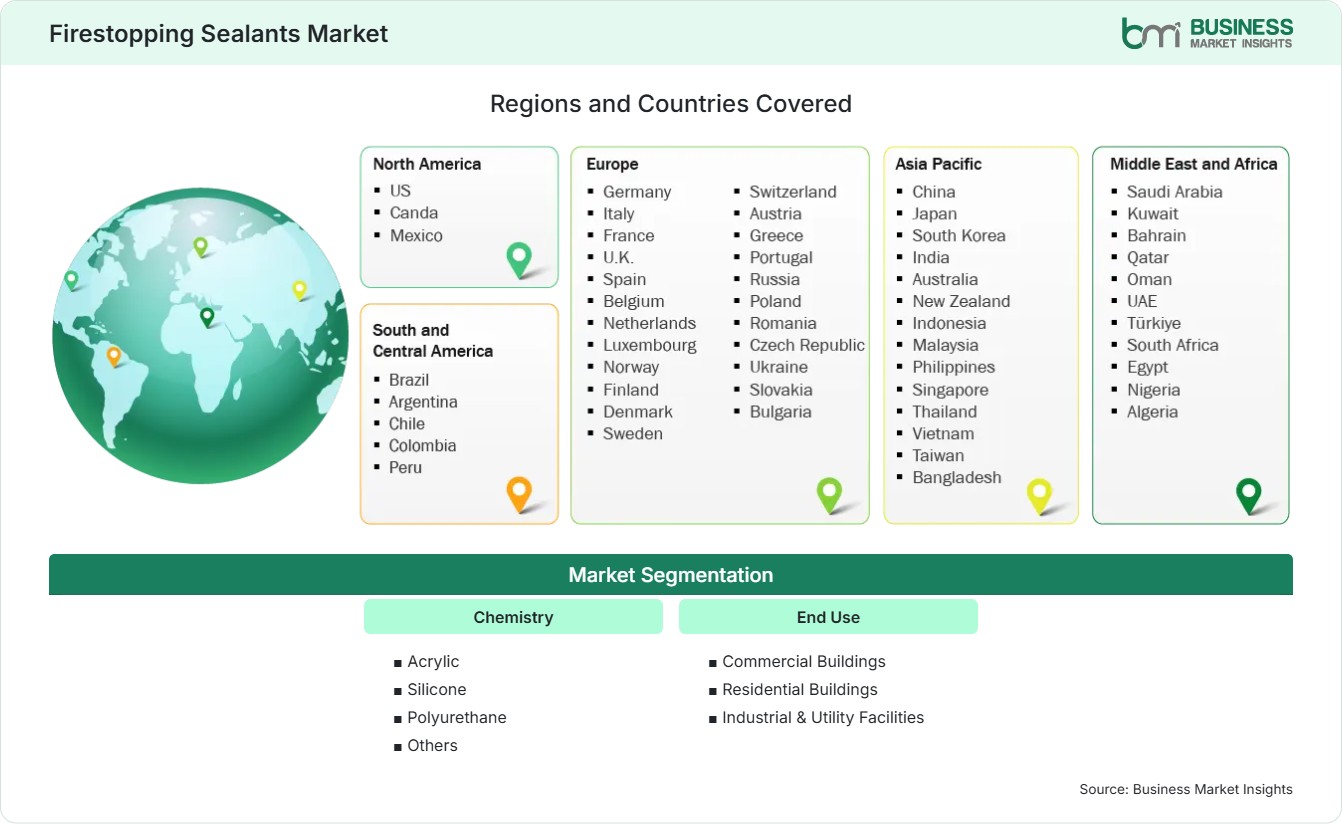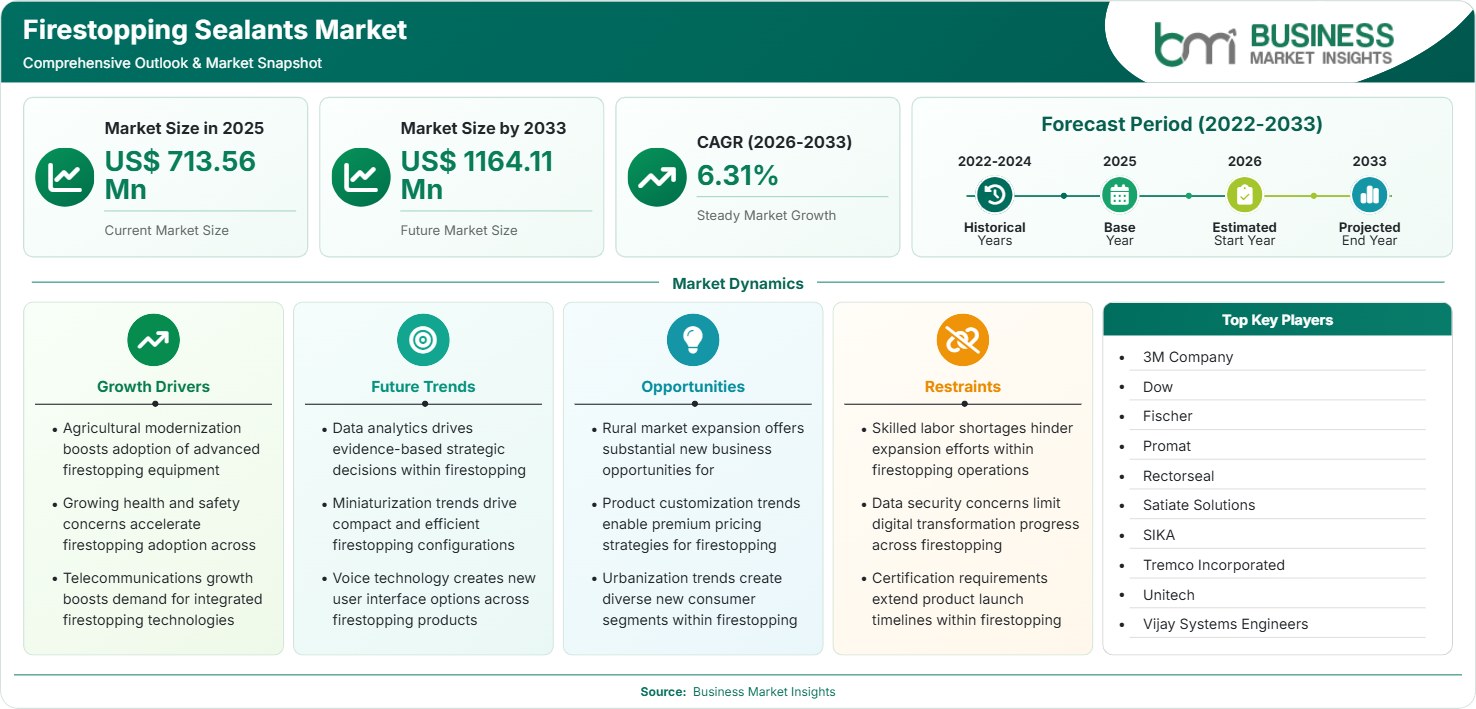
Firestopping Sealants Market Regional Highlights
North America Firestopping Sealants Market
North America accounted for 35%–38% of the Firestopping Sealants Market share in 2025 and is projected to expand at a CAGR of 5.8%–6.2% during 2026–2033. The region benefits from mature construction standards, stringent passive fire protection regulations, and widespread adoption of certified sealing systems across commercial and industrial projects. Building owners increasingly prioritize lifecycle safety, retrofit compliance, and low-emission construction materials. Continuous investment in healthcare facilities, educational institutions, transportation infrastructure, and hyperscale data centers further supports stable regional demand for advanced firestopping sealants.
- Strong enforcement of International Building Code (IBC), National Fire Protection Association (NFPA), and UL certification requirements continues encouraging contractors to install tested passive fire protection systems across commercial developments and critical infrastructure.
- Growing modernization of hospitals, airports, educational campuses, and mixed-use developments creates sustained demand for certified firestop sealing materials capable of protecting penetrations, expansion joints, and service openings against smoke and fire spread.
- Increasing investments in cloud computing infrastructure and hyperscale data centers require reliable passive fire compartmentation systems to minimize operational risks and satisfy insurance as well as regulatory compliance requirements.
- Sustainability initiatives encourage adoption of environmentally responsible acrylic and silicone formulations with lower VOC emissions while supporting green building certifications and improving indoor environmental quality across new construction projects.
- Expansion of industrial automation, pharmaceutical manufacturing, and logistics facilities continues strengthening specification of durable firestop solutions designed for complex cable penetrations and utility service installations.
US Firestopping Sealants Market
The United States represented 82%–85% of North American revenue during 2025 while advancing at a CAGR of 5.9%–6.3% through 2026–2033. Demand remains supported by high-value commercial developments, data centers, healthcare facilities, manufacturing plants, and infrastructure renovation programs. Federal and state building safety regulations encourage adoption of tested passive fire protection assemblies. Growing investments in resilient buildings and energy-efficient construction continue supporting demand for high-performance firestopping sealants across both new construction and renovation activities.
- Commercial office redevelopment and mixed-use construction increasingly specify certified sealing systems to ensure fire compartment integrity and simplify regulatory inspections throughout the building lifecycle.
- Rapid expansion of artificial intelligence data centers increases demand for advanced passive fire protection around electrical penetrations, communication cables, and mechanical service openings.
- Healthcare infrastructure modernization requires reliable firestop systems that maintain smoke resistance, infection control compatibility, and long-term durability within hospitals and medical research facilities.
- Industrial reshoring initiatives support additional investments in advanced manufacturing plants, semiconductor facilities, and logistics centers requiring certified passive fire protection systems throughout production environments.
Europe Firestopping Sealants Market
Europe captured 28%–31% Firestopping Sealants Market share in 2025 and is expected to register a CAGR of 5.7%–6.1% during the forecast period. Strict implementation of harmonized construction standards, sustainable building initiatives, and energy-efficient renovation programs continues driving product adoption. Germany remains the leading national market because of its advanced construction sector, while Poland demonstrates the fastest regional expansion with a CAGR of 6.8%–7.2% supported by industrial development and commercial infrastructure investments.
- Renovation of aging public infrastructure across Western Europe increases specification of certified firestop materials that comply with updated passive fire protection regulations and energy-efficient building upgrades.
- Growth in logistics warehouses, pharmaceutical production, and transportation terminals supports broader adoption of high-performance sealing systems across industrial and commercial applications.
- Rising emphasis on circular construction practices encourages manufacturers to introduce environmentally responsible sealants with improved durability, reduced emissions, and longer maintenance intervals.
- Investments under regional infrastructure modernization programs continue strengthening demand across hospitals, railway stations, airports, and educational facilities requiring certified compartmentation solutions.
- Engineering consultants increasingly specify tested integrated firestop systems instead of standalone products, improving installation quality and regulatory compliance across complex building projects.
Asia Pacific Firestopping Sealants Market
Asia Pacific represented 27%–30% of global revenue in 2025 and is anticipated to achieve the fastest regional expansion with a CAGR of 7.1%–7.6% during 2026–2033. Rapid urbanization, industrialization, and government-supported infrastructure programs continue driving construction activity across the region. China remains the largest Firestopping Sealants Market owing to large-scale commercial and industrial developments, whereas India records the fastest regional growth at a CAGR of 7.8%–8.3% supported by smart cities, manufacturing expansion, and stricter building safety requirements.
- Rising metro rail, airport, and smart city developments create sustained demand for passive fire protection products capable of meeting increasingly rigorous construction regulations.
- Manufacturing investments across electronics, automotive, renewable energy, and semiconductor industries increase specification of durable firestop sealing systems within complex industrial facilities.
- Growing awareness among developers regarding lifecycle building safety encourages early integration of certified firestop systems during project planning and design phases.
- Expansion of healthcare infrastructure, educational institutions, and high-rise residential projects supports long-term demand for acrylic, silicone, and polyurethane-based firestopping solutions.
- International manufacturers continue expanding regional production facilities and distribution partnerships to strengthen local supply chains and reduce delivery timelines.
Rest of World Firestopping Sealants Market
Rest of World accounted for 8%–10% of total Firestopping Sealants Market revenue in 2025 and is forecast to grow at a CAGR of 6.3%–6.8% through 2026–2033. South & Central America benefits from increasing commercial construction and industrial modernization, particularly in Brazil, while the Middle East & Africa experiences growing adoption through mega infrastructure developments, energy projects, and hospitality investments. Saudi Arabia leads regional demand, whereas the United Arab Emirates demonstrates one of the strongest growth trajectories supported by diversified infrastructure expansion.
Growing emphasis on international building standards and insurance compliance is encouraging wider use of certified passive fire protection systems. Increasing foreign investment across logistics, energy, transportation, and tourism infrastructure continues creating new opportunities for manufacturers supplying advanced firestopping technologies.
- Brazil continues strengthening demand through industrial facility expansion, healthcare construction, and modernization of commercial real estate requiring certified fire compartmentation systems.
- Saudi Arabia's large-scale urban development programs and industrial diversification initiatives support wider deployment of advanced passive fire protection technologies across strategic infrastructure.
- The United Arab Emirates records rapid adoption across mixed-use developments, airports, hospitality projects, and data centers emphasizing internationally certified building safety standards.
- Oil and gas infrastructure investments across the Middle East continue supporting demand for durable firestop materials capable of performing under demanding environmental conditions.
- International engineering firms increasingly specify globally certified sealing systems for landmark infrastructure projects, improving quality assurance and long-term operational safety.