Market Summary
Executive Summary and Global Market Analysis
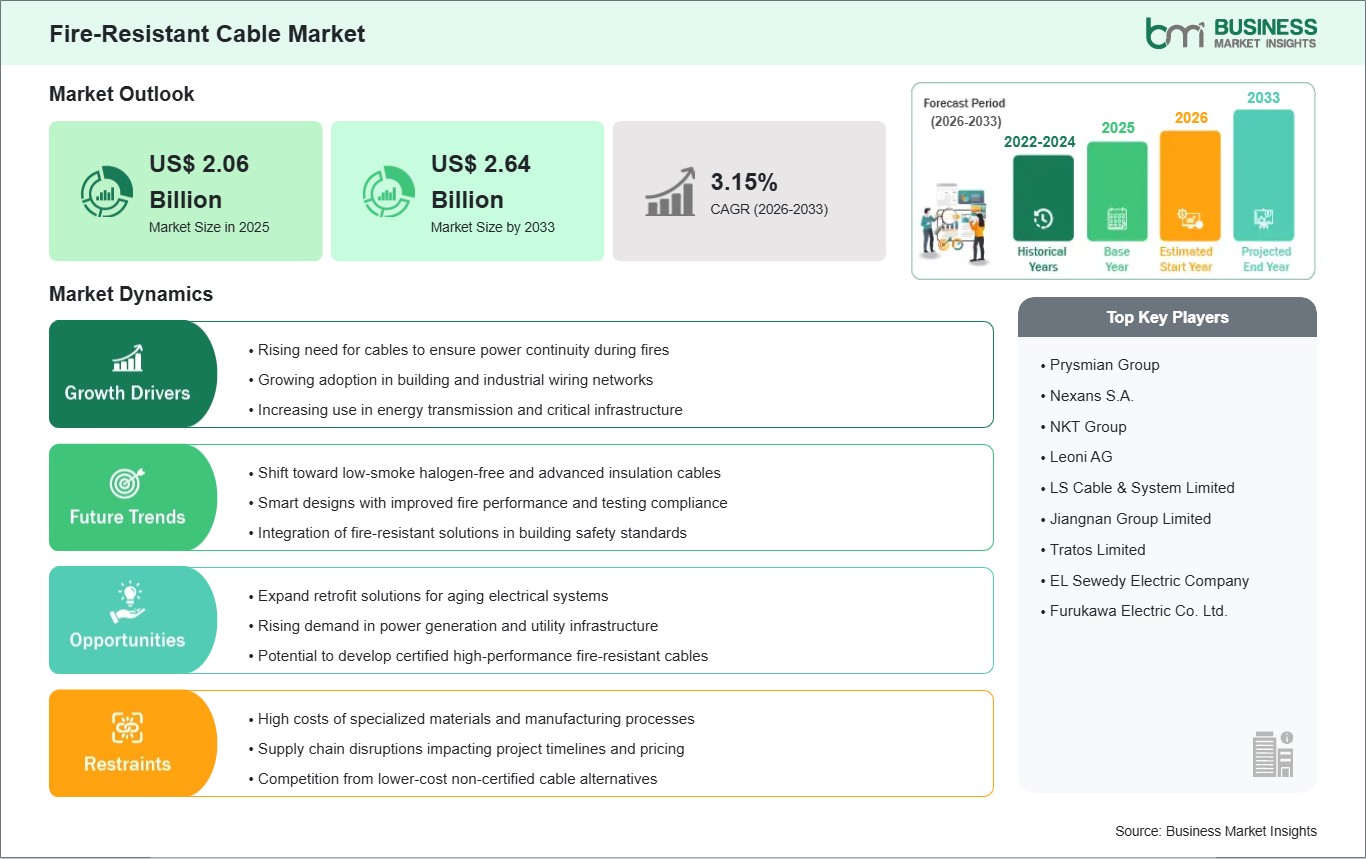
The global fire-resistant cable market is gaining more importance due to increased focus in various industrial and infrastructure projects on the reliability and security of electrical systems. Fire-resistant cables are specially designed to ensure uninterrupted functionality in extreme conditions of heat and fire. Such cables are essential in various industrial and infrastructure projects where reliability is paramount. These cables are particularly important in maintaining uninterrupted functionality in emergency systems in case of fire. Emergency systems include lighting systems, alarms, and communication systems. The fire-resistant cable market is witnessing increased growth due to stringent safety regulations and building codes that mandate fire-resistant cables in both industrial and public infrastructure projects. In addition to this, increased focus in urban cities due to increased urbanization and smart building concepts, along with industrial projects due to increased use of automated systems, is driving the fire-resistant cable market. At the same time, there are some challenges that the market is facing. First of all, manufacturing fire-resistant cables is more expensive than regular ones. Secondly, it is more complicated to make these cables comply with international safety standards. Finally, installation may be complicated. Still, the importance of these cables for human lives and operations is self-evident, ensuring that the market will continue to experience steady growth in terms of innovative technologies for fire-resistant cables.
Segment Analysis
Fire‑Resistant Cable Market Segmentation
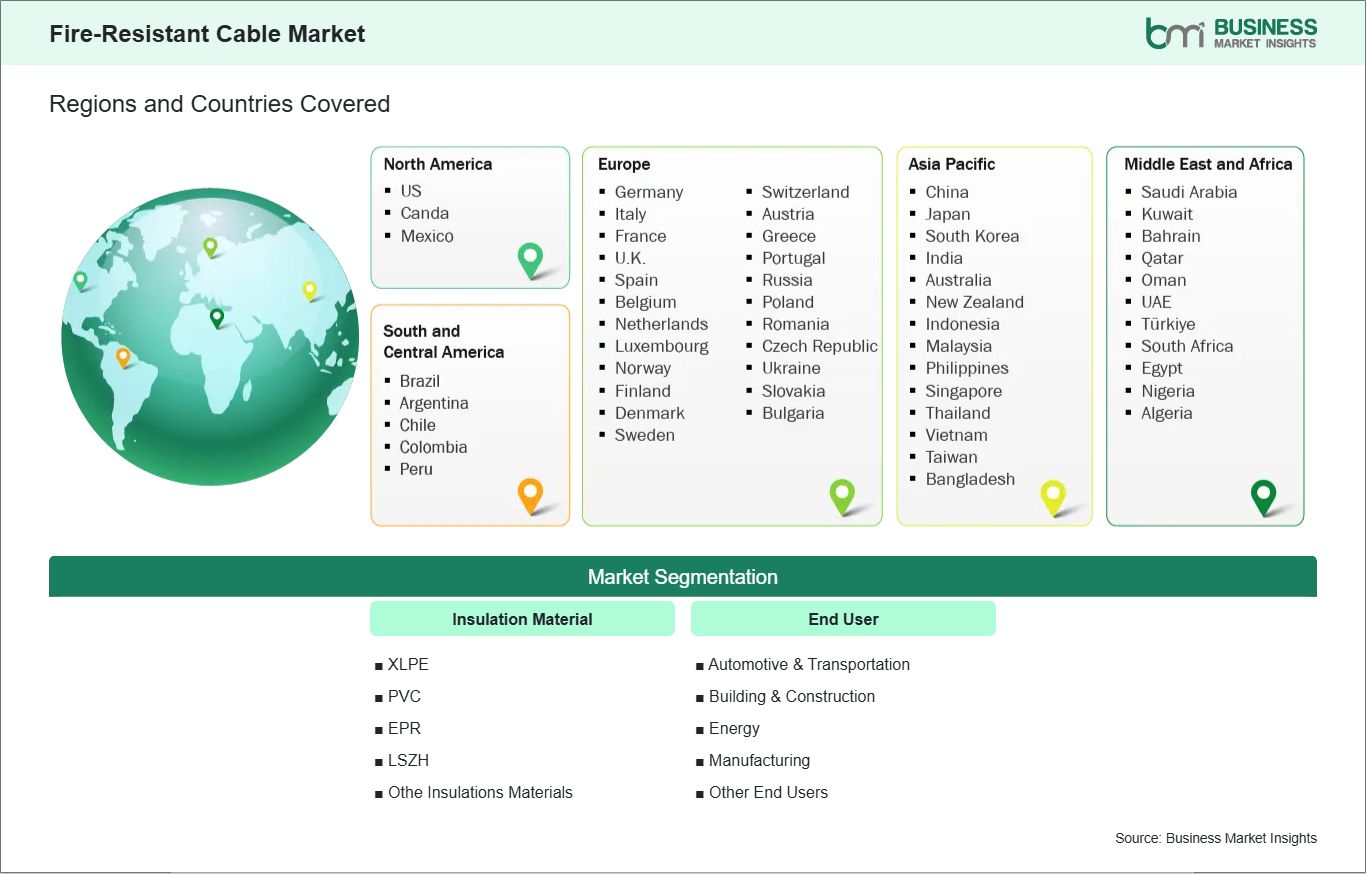
Key segments that contributed to the derivation of the fire‑resistant cable market analysis are insulation material and end user.
- By insulation material, the fire‑resistant cable market is segmented into XLPE, PVC, EPR, LSZH, and other insulation materials. The XLPE subsegment dominated the market in 2025.
- Based on end user, the fire‑resistant cable market is classified into automotive & transportation, building & construction, energy, manufacturing, and other end users. The building & construction subsegment dominated the market in 2025.
Market Forces
Fire‑Resistant Cable Market Drivers and Opportunities
Rising need for cables to ensure power continuity during fires
The need for fire-resistant cables has risen over the years as industries and operators of various facilities have become increasingly concerned about the safety of people within their premises. These cables are made to operate normally even under fire conditions. This ensures that power supply to emergency lighting, alarms, and other communication systems does not go off during fire outbreaks. This helps to maintain continuity of operations during such periods, which may help to prevent loss of life and property.
Fire-resistant cables are being used in various commercial facilities, hospitals, transportation hubs, and industries where power continuity is of critical importance. These cables are made of materials that can withstand fire, heat, and other mechanical conditions. They are made to remain operational even under fire conditions, which may be critical for facilities that have complex power systems.
Beyond safety, the use of fire-resistant cables also contributes to regulatory compliance and risk management. Many codes and standards now require critical infrastructure to be equipped with cables that meet stringent fire performance criteria. By providing a reliable solution for maintaining power in emergency situations, fire-resistant cables are increasingly seen as an integral component of both modern electrical installations and safety-focused operational strategies.
Expand retrofit solutions for aging electrical systems
The market is also benefiting from the need to upgrade aging electrical infrastructure with fire-resistant solutions. Older buildings and industrial facilities often rely on standard cables that may not meet current safety standards, leaving them vulnerable in case of fire. Retrofitting these systems with fire-resistant cables improves safety, extends the service life of electrical networks, and reduces the potential for catastrophic failures.
Retrofit projects provide an opportunity to develop practical solutions for facilities with limited downtime or space constraints. In most cases, fire-resistant cables can be installed side by side with existing cables without requiring extensive reconstruction. This provides an opportunity to achieve compliance with fire-resistant cable standards in an efficient manner.
The innovation in fire-resistant cable technology provides an opportunity to develop more practical solutions in retrofit projects. Modern fire-resistant cables are more flexible and easier to install while maintaining compatibility with existing cables. This provides an opportunity to upgrade existing facilities while maintaining high standards in electrical performance and fire resistance. By providing an opportunity to meet both safety and installation challenges, fire-resistant cable technology is becoming a popular solution for modernizing existing electrical infrastructure.
Size and Share Analysis
Fire‑Resistant Cable Market Size and Share Analysis
The fire‑resistant cable market is experiencing steady growth, with market size and share analysis reflecting evolving treatment preferences and competitive dynamics among key players. The report evaluates important subsegments categorized within insulation material and end user, highlighting their respective contributions to overall market performance.
By insulation material, the XLPE subsegment dominated the Fire‑Resistant Cable market in 2025. XLPE insulation offers excellent thermal stability, mechanical strength, and fire resistance, making it highly suitable for a wide range of industrial, commercial, and residential applications, which drives its widespread adoption.
Based on end user, the Building & Construction subsegment dominated the Fire‑Resistant Cable market in 2025. Construction applications require cables with high safety, durability, and fire protection standards, reinforcing the dominance of this segment in the market.
Report Coverage
Fire‑Resistant Cable Market Report Coverage and Deliverables
The "Fire‑Resistant Cable Market Size and Forecast (2022 - 2033)" report provides a detailed analysis of the market covering below areas:
- Fire‑Resistant Cable market size and forecast at global, regional, and country levels for all the key market segments covered under the scope
- Fire‑Resistant Cable market trends, as well as drivers, restraints, and opportunities
- Fire‑Resistant Cable market analysis covering key trends, regional framework, major players, regulations, and recent developments
- Industry landscape and competition analysis covering market concentration, heat map analysis, prominent players, and recent developments for the Fire‑Resistant Cable market
- Detailed company profiles, including SWOT analysis
Geographic Insights
Fire‑Resistant Cable Market Geographic Insights
The geographical scope of the Fire‑Resistant Cable market report is divided into five regions: North America, Asia Pacific, Europe, Middle East & Africa, and South & Central America. The Fire‑Resistant Cable market in North America is expected to grow during the forecast period.
North America remains the dominant market for fire-resistant cables, propelled by robust industrial infrastructure, stringent safety regulations, and widespread adoption in critical sectors. In both commercial and residential construction, these cables are extensively used to secure emergency systems, including fire alarms, evacuation lighting, and building communication networks. Industrial operations, particularly in energy, oil and gas, and chemical processing, rely on fire-resistant cables to prevent operational disruptions during fire hazards and ensure workplace safety. The region`s focus on building strong and smart infrastructure is another factor that fuels growth in fire-resistant cable usage. New-age structures, data centers, and transportation systems are increasingly incorporating smart fire-resistant cables to ensure they meet changing criteria for fire safety. The region`s manufacturers are constantly bringing innovation to fire-resistant cables with better thermal resistance, low smoke emission, and better mechanical properties to meet the complex demands of fire-prone locations. However, due to its mature regulatory environment and high safety consciousness, North America is likely to retain its position as a leader in fire-resistant cable usage.
Industry Activity
Recent Developments
The fire‑resistant cable market is evaluated by gathering qualitative and quantitative data post primary and secondary research, which includes important corporate publications, association data, and databases. A few of the key developments in the fire‑resistant cable market are:
- In October 2025, Nexans S.A. announced that it launched the Nexans Protect range of high‑performance fire safety low‑voltage cables designed for tertiary and high‑rise building applications in France; this initiative includes investments in production capacity and a new halogen‑free mixing unit at its Autun plant to support regulatory fire safety standards and enhanced cable performance.
- In September 2025, LS Cable & System Ltd. announced that it commercialized Korea`s first medium‑voltage (MV) fire‑resistant cable that meets the new international fire‑resistance standard (IEC 60331‑4), capable of maintaining power supply at temperatures ~830 degree Celsius designed to improve fire safety in high‑power critical infrastructure such as AI data centers and semiconductor facilities.
Trust & Transparency
Research Methodology
The market analysis combines proprietary research with secondary data from government agencies, company disclosures, regulatory filings, industry databases and expert interviews. Market estimates are validated through data triangulation, cross-market benchmarking and analyst
review.
View Full Research Methodology
Key Sources Referred:
International Organization for Standardization (ISO)American Society for Testing and Materials (ASTM International)Bureau of Indian Standards (BIS)Environmental Protection Agency (EPA), USAEuropean Chemicals Agency (ECHA)Central Pollution Control Board (CPCB), IndiaMinistry of Chemicals and Fertilizers, IndiaAmerican Chemistry Council (ACC)Indian Chemical Council (ICC)European Chemical Industry Council (Cefic)Specialty Chemical Association of India (SCAI)Company WebsitesCompany Annual ReportsCompany Investor Presentations