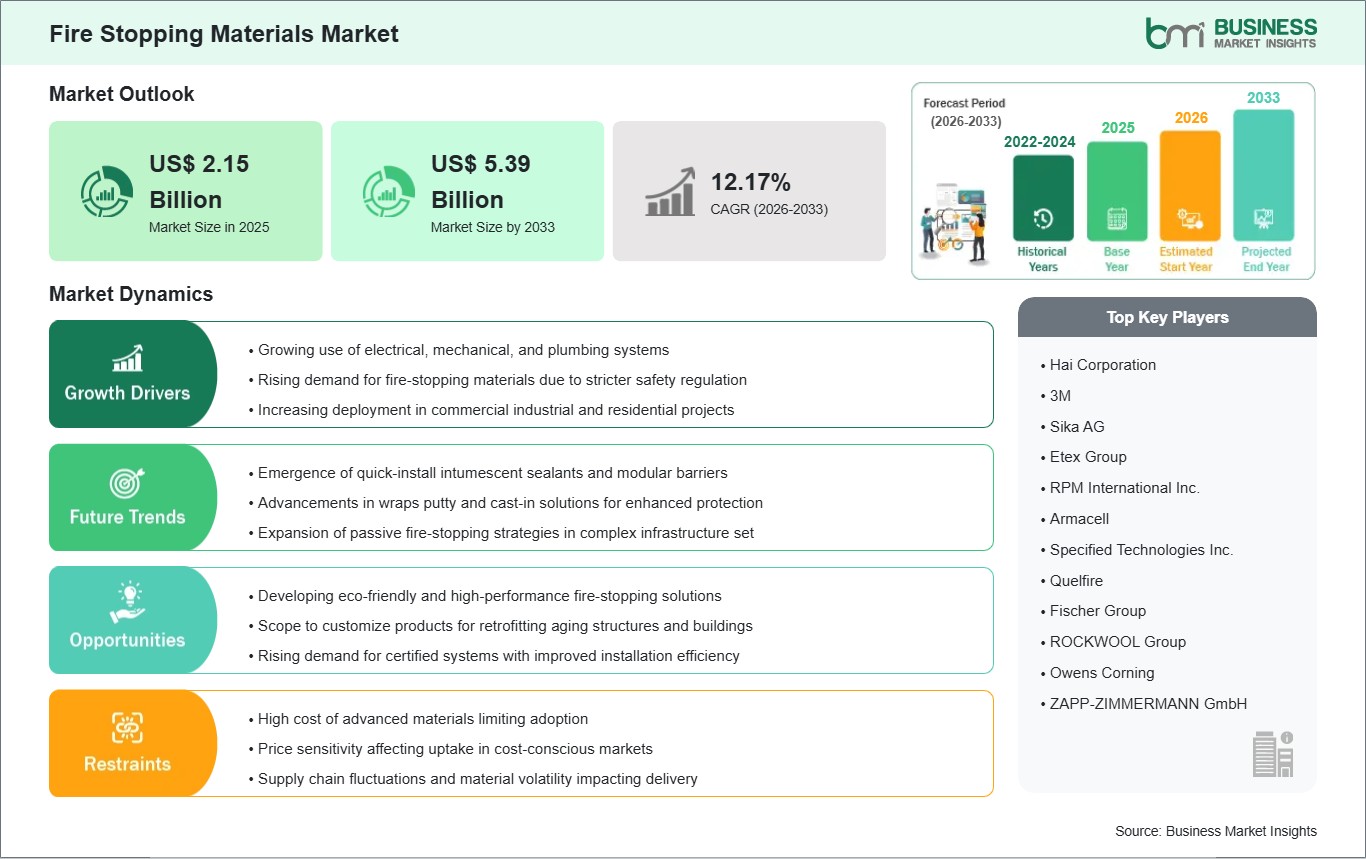
The Fire Stopping Materials Market size is expected to reach US$ 5.39 Billion by 2033 from US$ 2.15 Billion in 2025. The market is estimated to record a CAGR of 12.17% from 2026 to 2033.
The global fire stopping materials market is gaining momentum as safety, resilience, and regulatory compliance become central to construction and industrial design. Fire stopping materials—including intumescent sealants, fire collars, boards, and wraps—serve a critical function: they seal gaps, joints, and openings in walls, floors, and ceilings to prevent fire, smoke, and toxic gases from spreading. By maintaining structural integrity and protecting occupants during fire incidents, these materials are integral to modern life-safety strategies.
Growth in the market is largely driven by tightening fire safety codes and stricter building standards across commercial, residential, and industrial sectors. Rapid urbanization, the rise of high-rise developments, and increasingly complex infrastructure projects are boosting demand for effective fire containment solutions, particularly in densely populated or high-value spaces. Innovations in material composition, such as eco-friendly, fast-curing, and low-smoke options, are also enhancing installation efficiency and performance.
Despite these opportunities, challenges remain. Installing fire stopping materials in retrofit or unconventional structures can be complex, material compatibility must be carefully considered, and skilled labor is often required to ensure proper application. Nevertheless, heightened awareness of fire risks, regulatory enforcement, and the growing focus on occupant safety are positioning fire stopping materials as an essential investment for construction and industrial operations worldwide.

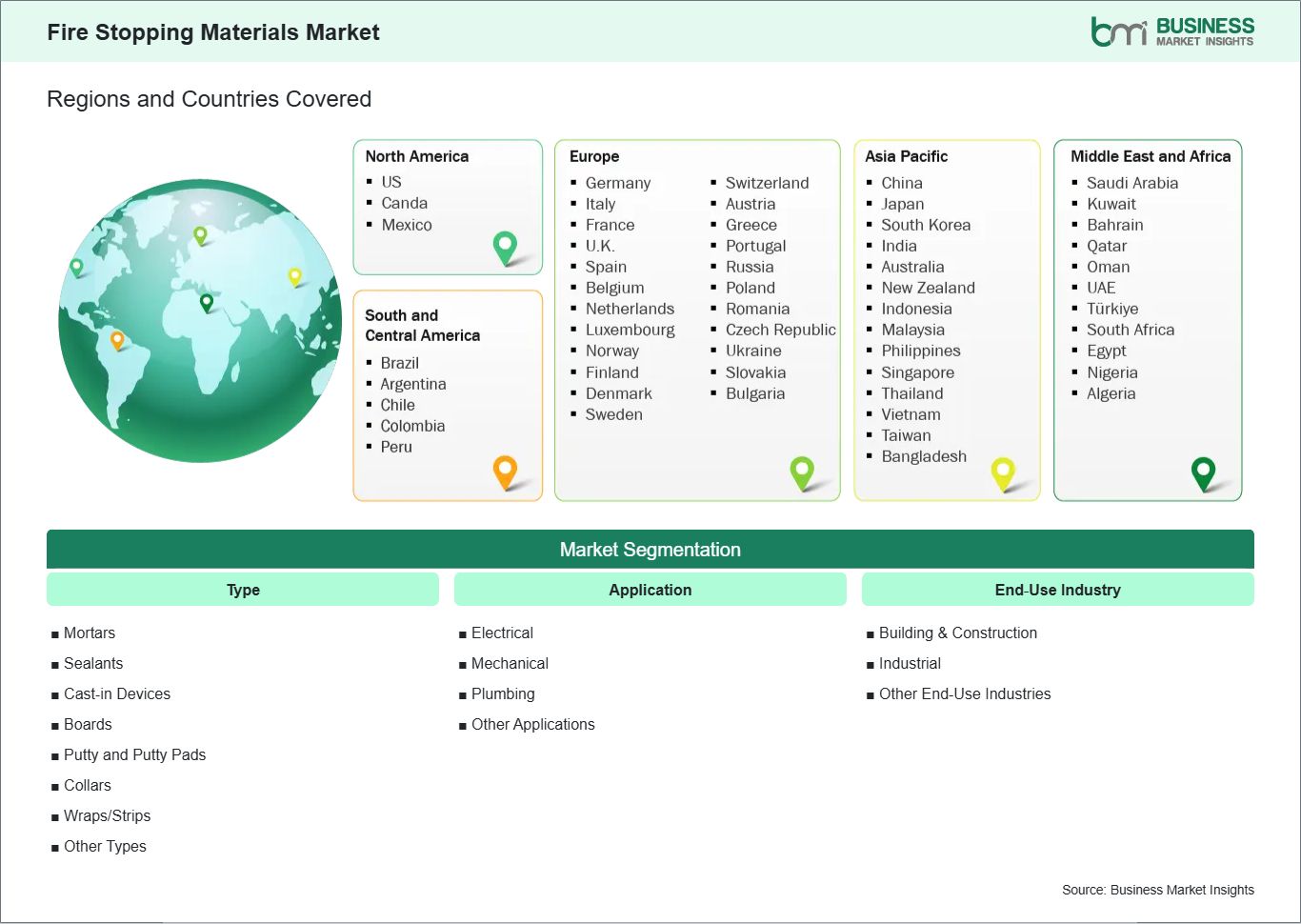
Key segments that contributed to the derivation of the fire stopping materials market analysis are type, application, and end user.
The use of fire-stopping materials is growing as electrical, mechanical, and plumbing systems are getting more complicated and interconnected in modern buildings. These systems have numerous penetrations through walls, floors, and ceilings that may serve as avenues for fire and smoke. Fire-stopping materials assist in sealing these penetrations to preserve the efficiency of fire-rated assemblies, thereby preventing the rapid spread of fire, smoke, and noxious gases. To engineers and building managers, efficient fire-stopping materials are critical to safeguarding both life and property. Electrical and mechanical systems, such as cable trays, HVAC ducts, and piping networks, are greatly helped by efficient fire-stopping applications. These materials are effective without interfering with system efficiency. Builders and managers may be able to meet building safety codes by using fire-stopping solutions.
The growing regulatory focus on building safety also reinforces the adoption of fire-stopping materials. Many modern construction standards require fire-rated continuity across all wall and floor penetrations, particularly in hospitals, commercial complexes, and high-rise buildings. By preventing fire and smoke from moving through service openings, these materials contribute to safer environments, reduced damage, and more controlled evacuation processes during emergencies.
Innovation in fire-stopping materials is focusing on combining high performance with environmental responsibility. Manufacturers are developing low-VOC sealants, halogen-free products, and recyclable solutions that meet stringent fire ratings without compromising sustainability. These eco-friendly materials appeal to builders and developers seeking compliance with green building standards while maintaining robust fire protection.
High-performance formulations have the added advantage of speeding up installation times and extending the product's lifespan. Advanced intumescent materials, fire-resistant collars, and modular sealing products have shown consistency in their fire protection abilities, regardless of penetration type or wall composition. The improvement in thermal, adhesion, and lifespan properties has reduced the need for maintenance, which is always a positive aspect, especially in critical infrastructure and busy buildings.
The current environmental concerns and improvements in product performance have brought new possibilities to building and retrofitting processes. Buildings seeking to incorporate sustainability certifications while upgrading fire protection systems have the advantage of working with products that are safe, reliable, and easy to use. The focus on fire protection and environmental design has placed fire-stopping products in a strategic position in modern building safety initiatives, from commercial to industrial to residential buildings.

The fire stopping materials market is experiencing steady growth, with market size and share analysis reflecting evolving treatment preferences and competitive dynamics among key players. The report evaluates important subsegments categorized within type, application, and end user, highlighting their respective contributions to overall market performance.
By type, the Sealants subsegment dominated the Fire Stopping Materials market in 2025. Sealants provide excellent adhesion, flexibility, and fire-resistant performance, making them highly suitable for a wide range of construction and industrial applications, which drives their widespread adoption.
Based on application, the Electrical subsegment dominated the Fire Stopping Materials market in 2025. Electrical applications require effective fire containment around cables, conduits, and wiring systems, reinforcing strong demand in safety-critical installations.
In terms of end user, the Commercial subsegment dominated the Fire Stopping Materials market in 2025. Commercial buildings demand reliable fire protection solutions for compliance, safety, and structural integrity, supporting the dominance of this segment in the market.
| Report Attribute | Details |
|---|---|
| Market size in 2025 | US$ 2.15 Billion |
| Market Size by 2033 | US$ 5.39 Billion |
| Global CAGR (2026 - 2033) | 12.17% |
| Historical Data | 2022-2024 |
| Forecast period | 2026-2033 |
| Segments Covered | By Type
|
|
Regions and Countries Covered
| |
| North America | US, Canada, Mexico |
| Europe | Belgium, Austria, Finland, Denmark, Greece, Poland, Romania, Russia, Ukraine, Czech Republic, Slovakia, Bulgaria, Italy, Luxembourg, Germany, Switzerland, France, Netherlands, Norway, Portugal, Spain, Sweden, United Kingdom |
| Asia-Pacific | Australia, China, India, Japan, South Korea, Indonesia, Malaysia, Philippines, Singapore, Thailand, Vietnam, Bangladesh, New Zealand, Taiwan |
| South and Central America | Brazil, Argentina, Peru, Chile, Colombia |
| Middle East and Africa | Bahrain, Kuwait, Oman, Qatar, Saudi Arabia, United Arab Emirates, Turkiye, South Africa, Egypt, Algeria, Nigeria |
| Market leaders and key company profiles |
|
The "Fire Stopping Materials Market Size and Forecast (2022 - 2033)" report provides a detailed analysis of the market covering below areas:
The geographical scope of the Fire Stopping Materials market report is divided into five regions: North America, Asia Pacific, Europe, Middle East & Africa, and South & Central America. The Fire Stopping Materials market in North America is expected to grow during the forecast period.
North America holds a strong position in the fire stopping materials market due to its adoption of advanced building practices, stringent fire safety codes, and high industrial and commercial infrastructure. Fire stopping materials are used in various sectors to prevent fire and smoke spread in hospitals, offices, airports, high-rise buildings, and industrial establishments. The use of modern building codes like LEED and other green building certifications has increased the consumption of fire stopping materials like intumescent sealants, mineral wool boards, and fire-resistant wraps. In addition to this, fire stopping materials are also being used in retrofit projects to upgrade old structures to meet current building codes.
Manufacturers in North America are also working towards innovation in fire stopping materials to provide faster-curing, more durable, and eco-friendly fire stopping materials to meet changing fire safety needs. The challenges are in the form of increased material and installation costs, as well as workforce training to ensure proper usage. However, with its robust regulatory environment, focus on robust infrastructure, and safety culture in North America, the region`s position at the pinnacle in fire stopping systems is not likely to change.

The fire stopping materials market is evaluated by gathering qualitative and quantitative data post primary and secondary research, which includes important corporate publications, association data, and databases. A few of the key developments in the fire stopping materials market are:
The Fire Stopping Materials Market is valued at US$ 2.15 Billion in 2025, it is projected to reach US$ 5.39 Billion by 2033.
As per our report Fire Stopping Materials Market, the market size is valued at US$ 2.15 Billion in 2025, projecting it to reach US$ 5.39 Billion by 2033. This translates to a CAGR of approximately 12.17% during the forecast period.
The Fire Stopping Materials Market report typically cover these key segments-
The historic period, base year, and forecast period can vary slightly depending on the specific market research report. However, for the Fire Stopping Materials Market report:
The Fire Stopping Materials Market is populated by several key players, each contributing to its growth and innovation. Some of the major players include:
The Fire Stopping Materials Market report is valuable for diverse stakeholders, including:
Essentially, anyone involved in or considering involvement in the Fire Stopping Materials Market value chain can benefit from the information contained in a comprehensive market report.
Please tell us your area of interest
(Market Segments/ Regions and Countries/ Companies)