
Fiberglass Fabric Market Outlook: Size, Share, Trends, Growth Analysis, Competitive Landscape & Forecast, 2026-2033

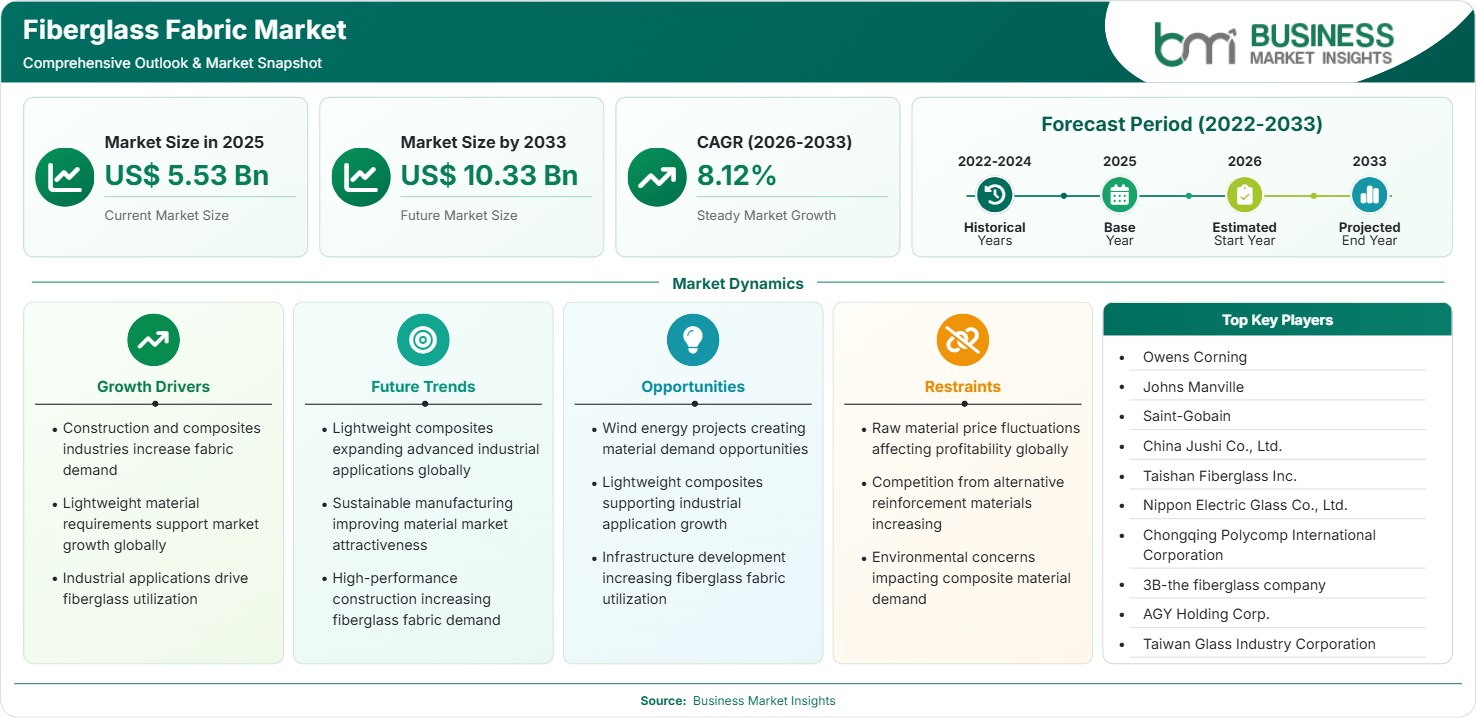
The Fiberglass Fabric Market size was valued at US$ 5.53 Billion in 2025 and is projected to reach US$ 10.33 Billion by 2033, growing at a CAGR of 8.12% during 2026–2033, driven by lightweight composites, infrastructure renewal, wind-energy expansion, and rising demand for durable reinforcement materials.

Report Coverage
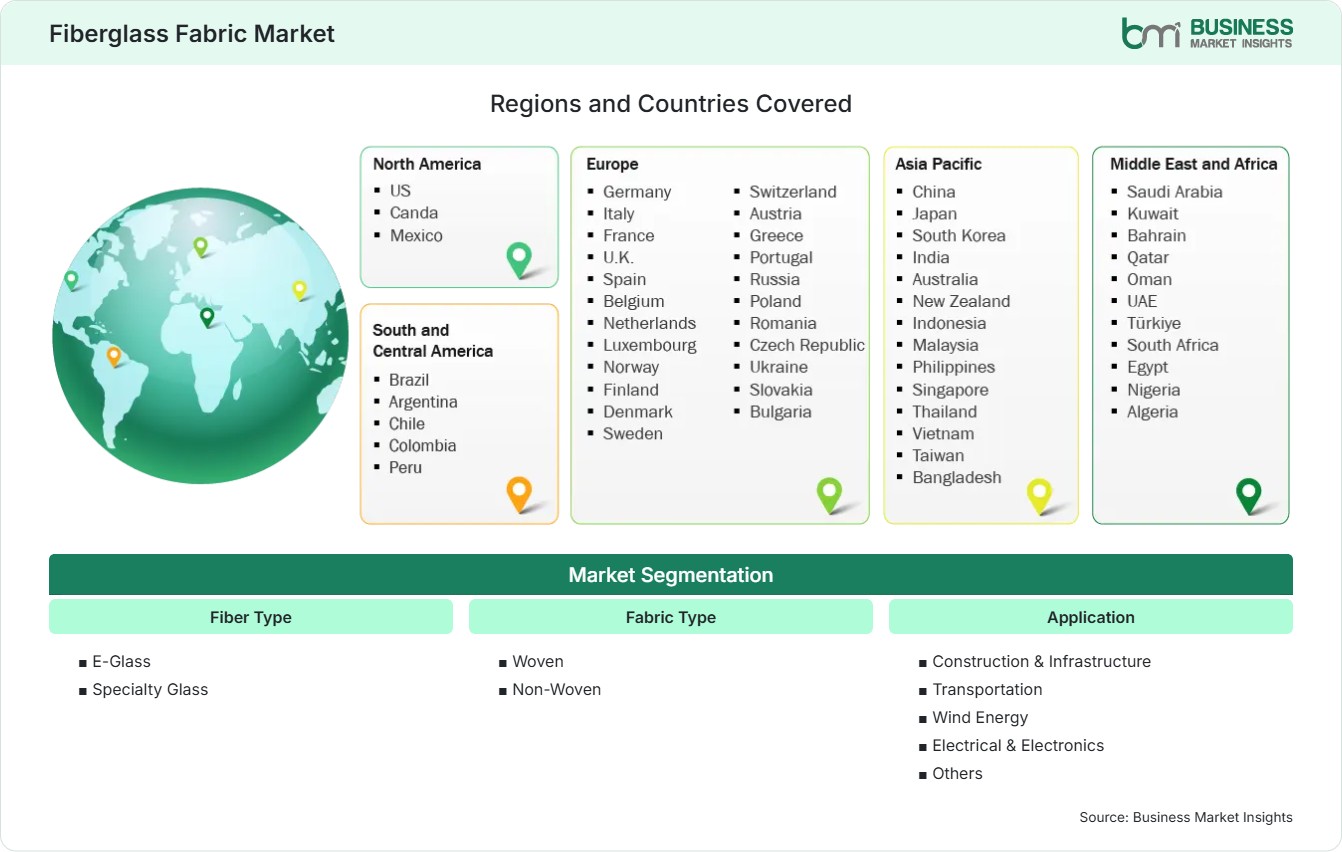
  • Fiber Type: E-Glass, Specialty Glass
  • Fabric Type: Woven, Non-Woven
  • Application: Construction & Infrastructure, Transportation, Wind Energy, Electrical & Electronics, Others
US$ 5.53 Bn Market size in 2025
US$ 10.33 Bn Market Size by 2033
8.12% CAGR, 2026 - 2033
2026-2033 Forecast Period

AI Overview

Fiberglass Fabric Market Summary

  • North America Region: North America holds a 20%–23% share in 2025, growing at a 6.8%–7.4% CAGR through 2033, supported by composite-intensive construction, transportation modernization, renewable-energy projects, infrastructure rehabilitation, and domestic manufacturing investments. The US market benefits from infrastructure spending, composite adoption, and industrial automation, recording a 6.7%–7.3% CAGR through 2033.
  • Fastest Growing Region: Asia Pacific holds a 39%–43% Fiberglass Fabric Market share in 2025, expanding at a 9.1%–9.7% CAGR, driven by manufacturing capacity, renewable-energy installations, electronics production, transportation investment, urbanization, infrastructure development, and increasing adoption of lightweight composite structures.
  • Leading Segment: Woven fabric holds a 58%–62% share in 2025, growing at a 7.6%–8.0% CAGR, supported by superior dimensional stability, load distribution, compatibility with resin systems, established processing infrastructure, and extensive use across transportation, construction, marine, and industrial applications.
  • High Growth Segment: Specialty glass holds a 12%–16% share in 2025, expanding at a 9.1%–9.8% CAGR, supported by demand for higher strength, thermal stability, electrical performance, corrosion resistance, lightweighting, advanced composites, aerospace components, electronics, and renewable-energy structures.
  • Key Market Opportunity: Demand for recyclable, lightweight reinforcement systems creates opportunities for specialized fabrics, automated manufacturing, high-performance glass chemistries, renewable-energy components, infrastructure rehabilitation, electric vehicles, and digitally controlled composite production.
  • Major Market Players: Owens Corning; Johns Manville; Saint-Gobain; China Jushi Co., Ltd.; Taishan Fiberglass Inc.; Nippon Electric Glass Co., Ltd.; Chongqing Polycomp International Corporation; 3B-the fibreglass company; AGY Holding Corp.; Taiwan Glass Industry Corporation.
Strategic Insights

Fiberglass Fabric Market: Strategic Insights

Fiberglass Fabric Market Strategic Framework
FREE PDF
Request your free sample
Request free sample
Stakeholder View

Key Takeaways

  • The value chain includes silica-rich mineral inputs, glass melting, fibreisation, sizing, yarn formation, weaving or non-woven conversion, resin processing, component fabrication, distributors, and end-use OEMs.
  • The widest range of applications is found in the field of construction and infrastructure, while greater value opportunities exist in the areas of wind-energy components, electrical and electronics applications, transportation lightweighting, and specialty composite structures—particularly because the performance requirements in these cases support the use of premium reinforcement fabrics.
  • The development of products is now focusing on higher-modulus fibers, special glass chemistries, improved sizing systems, thinner fabrics, multiaxial structures, compatibility with automated placement, and the use of recycled content, all without sacrificing mechanical consistency.
  • The Asia Pacific region has the most promising potential for growth since it features large manufacturing ecosystems which include infrastructure investment, electronics production, the deployment of renewable energy, the manufacturing of transport vehicles, and the expansion of domestic capabilities in the processing of composites.
  • The industry is advancing moves towards portfolio optimization, is carrying out acquisitions of regional capacity, and is making investments in specialized reinforcement technologies. Recent deals between the big producers show that more emphasis is being placed on capital efficiency and on strategically important supply chains.
  • Recycled glass being used, lower-energy melting, better furnace technology, longer lives for components, and the use of lightweight structures are now of commercial relevance since customers are increasingly assessing both the performance of the materials and their lifecycle impacts.
Geographic Outlook

Fiberglass Fabric Market Regional Highlights

North America Fiberglass Fabric Market

North America accounts for a 20%–23% Fiberglass Fabric Market share in 2025 and is projected to expand at a 6.8%–7.4% CAGR through 2033. Demand is supported by infrastructure renewal, transportation lightweighting, wind-energy components, industrial composites, and building modernization.

  • The need for corrosion-resistant reinforcement is being sustained across the region because of infrastructure rehabilitation in bridges, decks, facades, concrete repair systems, utility structures, and engineered building components.
  • Today, vehicle manufacturers are increasingly using glass-reinforced polymers because they offer weight reduction, corrosion resistance, dimensional stability, and competitive processing economics, which can lead to improved component performance and lower lifecycle costs.
  • The production of wind-energy components leads to a need for continuous reinforcement fabrics that are capable of supporting large structural laminates, particularly in the case of blade manufacturing where repeatable mechanical properties and a controlled fabric architecture are required.
  • Specialty fabrics are becoming more commercially important in such areas as electrical insulation, industrial equipment, filtration, and advanced composites since conventional E-glass is not able to meet the thermal, mechanical, or dielectric requirements fully.

US Fiberglass Fabric Market

The United States holds a substantial portion of North American demand, with a 20%–23% regional Fiberglass Fabric Market share and a 6.7%–7.3% CAGR through 2033. Infrastructure investment, domestic manufacturing, renewable-energy projects, transportation lightweighting, and building-envelope improvements support consumption.

  • Modernizing the infrastructure provides durable composite reinforcement for bridges, transportation structures, utility systems, the rehabilitation of concrete, and various building components that need corrosion resistance and a prolonged service life.
  • The manufacture of domestic composites provides specialized reinforcement for use in transportation, energy, industrial equipment, and engineered construction, since the performance specifications in these cases are more stringent than those required of standard fabrics.
  • As buyers look for more predictable lead times, less freight exposure, and greater technical cooperation with reinforcement manufacturers, local production and inventory policies have become more important.

Europe Fiberglass Fabric Market

Europe represents a 22%–25% Fiberglass Fabric Market share in 2025 and is expected to grow at a 7.4%–8.0% CAGR through 2033. Germany, France, Italy, Spain, and the United Kingdom form major demand centers, while Germany leads industrial and transportation applications.

  • Germany is still a leading industrial market due to its expertise in the automotive field, industrial machinery, electrical systems, the modernization of its infrastructure, and also because of its advanced abilities in the processing of composites, which demand a consistent standard of reinforcement.
  • Spain and Italy offer attractive opportunities for growth through the installation of wind energy, the manufacturing of vehicles, the rehabilitation of buildings, and the widening of uses for corrosion-resistant composite components.
  • As customers incorporate lifecycle considerations into their procurement decisions, European producers are giving greater priority to the use of recycled material, energy-efficient melting processes, lower-emission manufacturing methods, and the ability to track materials.
  • Manufacturers are now attracting interest in advanced woven and specialty glass products because they offer improved strength-to-weight ratios, better dimensional control, greater thermal stability, or enhanced electrical performance.

Asia Pacific Fiberglass Fabric Market

Asia Pacific commands a 39%–43% Fiberglass Fabric Market share in 2025 and records the strongest regional growth at a 9.1%–9.7% CAGR through 2033. China remains the principal production and consumption hub, while India, Japan, South Korea, Taiwan, and Southeast Asia broaden regional demand.

  • China holds its leading position due to its large-scale production of glass fiber, its integrated composite manufacturing, the extent of its domestic demand, its ability to export, and the growing use of these materials in the transportation, infrastructure, electronics, and wind sectors.
  • India is a market with great potential since the expansion of investment in infrastructure, the building of urban areas, the development of transportation systems, renewable-energy projects, and domestic manufacturing is increasing the demand for durable composite reinforcement materials.
  • Japan and South Korea promote the use of electronics, transportation systems, industrial equipment, specialty composites, and precise manufacturing processes, which demand a stable fabric structure and controlled material performance.
  • Southeast Asia is becoming a destination for manufacturing and investment, which is opening up opportunities for local fabric conversion, the production of renewable-energy components, construction materials, and the manufacture of composites for export.

Rest of World Fiberglass Fabric Market

South and Central America account for part of the 11%–15% Rest of World Fiberglass Fabric Market share in 2025, while the broader region grows at a 7.6%–8.3% CAGR through 2033. Brazil represents the principal South American opportunity, supported by construction, transportation, energy infrastructure, and industrial applications.

  • Brazil provides opportunities in the areas of construction, energy, transportation, agricultural equipment, and industrial applications where the use of materials that are resistant to corrosion and made from lightweight composites leads to improved performance over the product's lifecycle.
  • Mexico gains the advantages of being integrated into the North American transportation and industrial supply chains, which in turn increases the demand for reinforcement materials used in the automotive, infrastructure, and engineered components sectors.
  • Saudi Arabia and the United Arab Emirates are appealing since the large-scale infrastructure, water, energy, and urban development programs generate demand for durable composite reinforcement systems.
  • Turkey and Egypt offer opportunities in the fields of manufacturing and construction, whereas South Africa provides support for projects in infrastructure, mining, energy, transportation, and industrial equipment.
Global Market Geography
FREE PDF
Request your free sample
Request free sample
Segment Analysis

Fiberglass Fabric Market Segmentation

Fiber Type

Fiber Type is divided into E Glass and Specialty Glass, with E Glass representing the broader volume base because of established processing compatibility, competitive economics, and extensive construction demand. The segment maintains a 58%–62% Fiberglass Fabric Market share in 2025 and a 7.6%–8.0% CAGR through 2034. Specialty formulations are expanding faster as performance requirements diversify.

  • E Glass: E-glass remains the mainstream reinforcement choice because of balanced strength, electrical properties, cost efficiency, availability, and compatibility with construction, transportation, wind-energy, and industrial composite processing.
  • Specialty Glass: Specialty glass supports higher-performance applications requiring improved modulus, thermal stability, chemical resistance, dielectric behavior, or dimensional performance, encouraging adoption in advanced transportation, electronics, energy, and industrial composites.

Fabric Type

Fabric Type comprises Woven and Non-Woven products, with woven structures maintaining the leading position because they provide controlled fiber orientation, dimensional stability, load distribution, and established processing compatibility. The segment represents a 58%–62% share in 2025 and grows at a 7.6%–8.0% CAGR through 2034. Non-woven products remain important in selected applications.

  • Woven: Woven fabrics provide controlled reinforcement orientation and handling characteristics suited to structural laminates, transportation components, construction systems, marine structures, wind components, and industrial composite manufacturing.
  • Non-Woven: Non-woven reinforcement offers efficient coverage, conformability, surface reinforcement, and process flexibility for selected construction, filtration, insulation, industrial, and composite applications requiring economical material distribution.

Application

Application includes Construction and Infrastructure, Transportation, Wind Energy, Electrical & Electronics, and Others, with construction providing the broadest demand base while energy and transportation offer attractive expansion opportunities. The application segment reflects increasing preference for corrosion resistance, lightweighting, durability, electrical insulation, and improved lifecycle economics across major industrial systems.

  • Construction and Infrastructure: Composite reinforcement supports concrete rehabilitation, facades, roofing, pipes, panels, bridges, and structural systems where corrosion resistance, lightweight handling, and extended service life are important.
  • Transportation: Automotive, rail, marine, and commercial transportation manufacturers use fiberglass reinforcement to reduce weight while maintaining structural integrity, dimensional stability, fatigue resistance, and competitive production economics.
  • Wind Energy: Wind-energy components require consistent reinforcement architectures for large composite structures, creating demand for high-quality fabrics that support strength, fatigue resistance, processing efficiency, and blade durability.
  • Electrical & Electronics: Fiberglass fabrics provide electrical insulation, dimensional stability, thermal performance, and reinforcement in printed circuit materials, electrical equipment, industrial systems, and specialized electronic components.
Market Forces

Fiberglass Fabric Market Dynamics

Key Market Drivers

Infrastructure Modernization Expands Corrosion-Resistant Composite Adoption

Infrastructure rehabilitation is strengthening growth because composite reinforcement can extend service life while reducing corrosion exposure and installation complexity. Aging bridges, concrete structures, pipelines, utility assets, facades, and transportation infrastructure increasingly require materials that perform under moisture, chemicals, temperature changes, and mechanical loading. The resulting Fiberglass Fabric Market trends favor fabrics engineered for easier handling, stronger resin bonding, controlled architecture, and reliable field installation. Manufacturers that can demonstrate lifecycle advantages, consistent quality, and application-specific performance are positioned to capture infrastructure-related procurement.

Lightweighting Accelerates Reinforced Composite Use in Transportation

Transportation lightweighting is expanding demand for fiberglass reinforcement because manufacturers need materials that reduce component mass without sacrificing structural performance, dimensional stability, or manufacturing efficiency. Automotive, rail, marine, and specialty vehicle producers increasingly integrate reinforced polymer components into body structures, panels, enclosures, underbody systems, seating structures, and functional parts. The Fiberglass Fabric Market growth outlook therefore benefits from the convergence of lightweighting and cost optimization. Suppliers able to develop application-specific reinforcement systems can gain share by supporting OEM qualification, reducing material waste, and improving cycle times across increasingly automated composite manufacturing environments.

Renewable Energy Raises Demand for Durable Reinforcement Materials

Wind-energy expansion is increasing demand for durable reinforcement fabrics because blades and related structures require materials capable of handling cyclic loading, environmental exposure, and large-scale manufacturing constraints. Fiberglass remains widely attractive for wind structures because it combines mechanical performance with comparatively favorable economics and established processing routes. This trend supports the Fiberglass Fabric Market trends toward engineered fabrics rather than purely commodity products. Recycling challenges remain, but longer service life and improved manufacturing efficiency can strengthen the overall material proposition.

Key Market Opportunities

Specialty Glass Creates Premium Product Opportunities

Specialty glass provides a route toward higher-value applications where conventional E-glass cannot fully satisfy mechanical, thermal, electrical, or chemical requirements. Higher-modulus formulations can improve structural efficiency, while specialty chemistries can address demanding electrical insulation, temperature resistance, corrosion exposure, and advanced composite requirements. Fiberglass Fabric Market Forecasts increasingly depend on the industry's ability to migrate toward application-specific reinforcement. Investment in specialty furnaces, formulation research, automated conversion, and customer qualification can establish stronger margins and customer retention. Suppliers with technical support capabilities are particularly well positioned to convert performance requirements into differentiated product specifications.

Localized Production Strengthens Supply Security

Because manufacturing is carried out locally, it is possible to reduce exposure to freight costs, improve the ability to respond to customers, and make production match the growth in regional demand. Since composite manufacturing is susceptible to disruption from shortages, longer transportation times, or changes in regional capacity, large buyers of reinforcement materials are now considering supply continuity together with price. Setting up local weaving, finishing, or conversion operations offers a way of reducing the amount of capital needed as an alternative to establishing full glass-fiber melting capacity, while at the same time allowing suppliers to tailor fabric specifications. Collaborations with resin formulators, composite processors, distributors, and OEMs can help speed up entry into the market.

Recycled Content and Low-Emission Manufacturing Support Differentiation

Sustainability leads to commercial advantages by making use of recycled glass, adopting lower-energy furnace technologies, improving production processes, and employing more durable composite parts. Nowadays, customers tend to take into account not only the technical specifications but also the origin of the materials and their lifecycle effects, especially in the case of construction and infrastructure projects where environmental declarations have an impact on the purchasing process. Recycled glass cullet can decrease the need for virgin raw materials provided that adequate quality and supply are available, even though the economics of collection and regional availability are still important limitations.

Market Restraints and Challenges

Energy and Raw Material Volatility Pressures Manufacturing Economics

The fact that the melting of glass is an energy-intensive process means that producers are exposed to variations in the price of electricity, natural gas, furnace operating costs, and the prices of raw materials, as well as to transportation costs, all of which affect the economic viability of the fabric in different international markets. The impact of such cost fluctuations is that they can reduce profit margins, lead to greater pressure on prices charged to customers, and result in a lack of enthusiasm for expanding capacity whenever demand prospects are poor. Since the production of fiberglass involves the need for continuous high-temperature furnace operations, energy efficiency becomes a fundamental element of competitive advantage rather than just a temporary matter for cost control.

Qualification Requirements Slow Adoption of New Reinforcement Systems

The need for new types of fabrics and special glass products often involves carrying out extensive testing by the customer, assessing resin compatibility, carrying out structural validation, obtaining manufacturing qualification, and producing regulatory documentation before they can be used in safety-critical or high-value applications. This results in lengthy qualification cycles, which delay the realization of revenue and lead to higher development costs, especially when smaller suppliers are joining up with established supply chains in the areas of transportation, wind, infrastructure, or electronics.

Company Analysis

Competitive Landscape

The competitive Fiberglass Fabric Market analysis indicates a combination of integrated global manufacturers, regional producers, specialty glass specialists, and composite-material suppliers. Competition increasingly centers on production efficiency, technical performance, localized supply, specialty formulations, sustainability credentials, and application-specific fabric engineering.

Company Name

Overview

Products and Services relevant to this market

Owens Corning

Major global materials company with longstanding glass reinforcement capabilities and extensive composite-material expertise across industrial markets.

Glass reinforcements, fiberglass materials, engineered reinforcement solutions, composite inputs, technical support, and application development capabilities.

Johns Manville

Berkshire Hathaway company supplying engineered materials and fiberglass products across construction, industrial, filtration, and composite applications.

Fiberglass, engineered fibers, nonwovens, insulation materials, filtration media, reinforcement products, and composite-oriented technical solutions.

Saint-Gobain

Diversified materials group with strong glass-fiber and construction-material capabilities serving industrial and building applications globally.

Glass reinforcement materials, technical textiles, construction solutions, insulation-related products, specialty materials, and engineered composite applications.

China Jushi Co., Ltd.

Large-scale fiberglass producer with extensive global production, export, research, and product-development capabilities.

E-glass fibers, rovings, chopped strands, woven rovings, electronic fabrics, mats, specialty fibers, and composite reinforcement products.

Taishan Fiberglass Inc.

Major Chinese fiberglass producer serving construction, industrial, transportation, energy, and composite markets.

Glass fiber yarns, rovings, woven fabrics, mats, chopped strands, electronic materials, and reinforcement solutions.

Nippon Electric Glass Co., Ltd.

Japanese glass manufacturer specializing in advanced glass materials and technologies for demanding industrial applications.

Glass fibers, specialty glass materials, electronic glass, reinforcement products, advanced glass technologies, and manufacturing solutions.

Chongqing Polycomp International Corporation

Major Chinese composite-material producer with broad fiberglass product capabilities and international market reach.

Direct roving, assembled roving, chopped strands, glass yarn, woven fabrics, mats, multiaxial fabrics, and composite reinforcement.

3B-the fiberglass company

European specialty fiberglass producer focused on innovative reinforcement solutions for composite and industrial applications.

Fiberglass rovings, chopped strands, reinforcement products, specialty fibers, composite materials, and application-specific technical solutions.

AGY Holding Corp.

Specialty glass-fiber producer focused on high-performance reinforcement materials for demanding composite applications.

High-performance glass fibers, specialty reinforcement yarns, fabrics, rovings, and advanced composite material solutions.

Taiwan Glass Industry Corporation

Integrated glass manufacturer with fiberglass capabilities supporting construction, industrial, transportation, and composite applications.

Fiberglass yarn, rovings, fabrics, mats, glass products, reinforcement materials, and related industrial glass solutions.

Trust & Transparency

Research Methodology

The market analysis combines proprietary research with secondary data from government agencies, company disclosures, regulatory filings, industry databases and expert interviews. Market estimates are validated through data triangulation, cross-market benchmarking and analyst review.

View Full Research Methodology

Questions Answered

Frequently Asked Questions

What does a Fiberglass Fabric Market Report typically evaluate?

A Fiberglass Fabric Market Report generally evaluates market size, growth dynamics, regional demand, fiber and fabric types, application patterns, competitive positioning, manufacturing developments, technology trends, investment opportunities, supply-chain conditions, and factors affecting future adoption across major end-use industries.

How important is recycled glass to future production strategies?

Recycled glass can reduce virgin material requirements and support sustainability objectives when suitable cullet is available at competitive cost and consistent quality. Its importance will vary by geography because collection systems, transportation economics, contamination levels, and furnace compatibility determine practical utilization rates.

Which applications provide the strongest long-term demand potential?

Construction and infrastructure provide a broad demand foundation, while wind energy, transportation lightweighting, electrical systems, and specialty composites offer attractive long-term opportunities. Growth potential is particularly strong where reinforcement replaces heavier or corrosion-sensitive materials and where component durability can reduce maintenance requirements.

How does fiberglass fabric compare with carbon fiber reinforcement?

Fiberglass generally offers a lower material cost, good corrosion resistance, strong electrical insulation characteristics, and established processing economics. Carbon fiber provides substantially higher stiffness and lower density but typically carries a higher cost. The appropriate reinforcement depends on structural requirements, weight targets, manufacturing economics, and lifecycle priorities.

What factors determine the performance of fiberglass fabric in composite applications?

Performance depends on fiber chemistry, yarn construction, fabric architecture, areal weight, sizing chemistry, resin compatibility, fiber orientation, permeability, and manufacturing consistency. Application-specific optimization is important because transportation, wind, construction, and electrical components impose different mechanical, thermal, processing, and durability requirements.

Access the Full Fiberglass Fabric Market Report

Get segment-level forecasts, regional estimates, competitive benchmarking, company profiles and downloadable Excel datasets.

Access the full Fiberglass Fabric Market Report
350 pages PDF & Excel | 2026-10-21
Similar Research

Related Market Reports