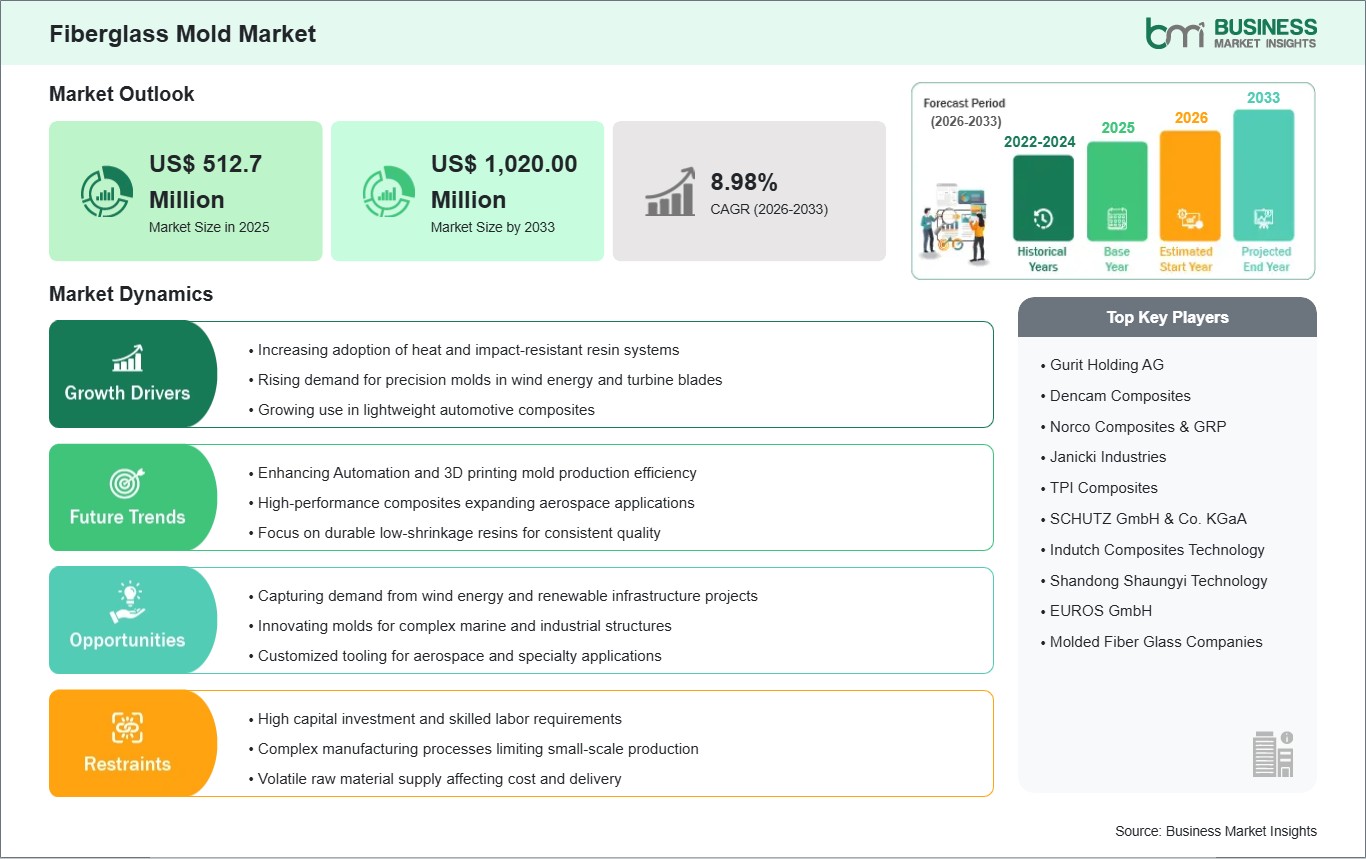
The Fiberglass Mold Market size is expected to reach US$ 1,020.00 Million by 2033 from US$ 512.7 Million in 2025. The market is estimated to record a CAGR of 8.98% from 2026 to 2033.
The global fiberglass mold market is gaining momentum as industries increasingly demand materials that deliver strength, precision, and adaptability. Fiberglass molds, made from reinforced composites, are prized for their ability to maintain shape and detail across repeated use, making them indispensable for applications where durability and accuracy matter. Industries ranging from automotive and aerospace to marine, construction, and renewable energy rely on these molds to produce both functional and visually intricate components.
The major driving force behind this market is the increasing demand for materials that are not only lightweight and strong but also have the potential to increase efficiency and reduce costs. Fiberglass molds enable manufacturers to duplicate complex designs with consistency, accelerate production cycles, and support prototyping. However, the fiberglass molds market is facing some challenges. The initial investment, skill set, and handling of resin materials are some of the key challenges in producing quality fiberglass molds. In addition, environmental regulations concerning resin materials, as well as the growing trend towards new mold materials like 3D printing and metal tooling, are some of the key challenges facing the fiberglass molds industry. Despite these challenges, fiberglass molds have been widely adopted by industries seeking molds with strength, reusability, and precision to support ever-evolving manufacturing processes.

Key segments that contributed to the derivation of the fiberglass mold market analysis are resin type and end user industry.
Fiberglass molds are increasingly being used with heat- and impact-resistant resin systems to meet the demands of high-performance manufacturing. These resin systems enhance the durability and longevity of molded components, allowing them to withstand extreme temperatures, repeated stress, and mechanical impact without deformation or failure. Industries such as automotive, aerospace, and industrial machinery are turning to these combinations to produce lightweight, strong, and reliable parts, where traditional materials might fail under continuous load or thermal exposure.
The combination of these advanced resin materials with fiberglass molds also provides increased precision and finish for the finished products. Dimensional accuracy is critical for products that require close-fitting assemblies. Fiberglass molds, when used in combination with these advanced resin materials, provide accurate finishes that are free of defects. This combination is critical for the development of complex geometries that require increased innovation in product development.
Durability is another factor that influences the increased use of fiberglass molds. The heat- and impact-resistant resin materials provide minimal maintenance requirements for the molds. This reduces the number of interruptions to the manufacturing process. Organizations are increasingly looking for materials that provide consistent performance under critical operating conditions. Fiberglass molds are critical for these applications.
Fiberglass molds are also playing a critical role in renewable energy projects as well as other infrastructure projects. For example, they are being utilized to manufacture wind turbine components, solar supports, and other structures that require strength and stability. The fact that fiberglass molds can replicate shapes of desired products with strength and stability is making them suitable for large-scale components such as wind turbine blades, housings, and panels. Through the use of fiberglass molds, it is easy to achieve the quality that is required for renewable energy projects.
The emphasis that is being placed on renewable energy has created a need for materials that are light, strong, and can resist environmental impacts. Fiberglass molds are being utilized to manufacture components that can meet these demands. For example, wind turbine blades require molds that can withstand repeated exposure to heat changes, exposure to moisture, and exposure to other forces. Fiberglass molds have the capability to provide the required strength to meet these demands.
Innovation in mold design and production techniques is also opening new possibilities. Fiberglass molds can be engineered for faster curing, better surface finish, and improved dimensional accuracy, allowing manufacturers to scale production for large renewable projects. This capability is helping suppliers capture growing demand in wind energy, solar installations, and other infrastructure applications, supporting the expansion of clean energy solutions while maintaining cost efficiency and high-quality output.

The fiberglass mold market is experiencing steady growth, with market size and share analysis reflecting evolving treatment preferences and competitive dynamics among key players. The report evaluates important subsegments categorized within resin type and end user industry, highlighting their respective contributions to overall market performance.
By resin type, the Epoxy subsegment dominated the Fiberglass Mold market in 2025. Epoxy resins offer superior mechanical strength, chemical resistance, and dimensional stability, making them highly suitable for a wide range of industrial and structural applications, which drives their widespread adoption.
Based on end user industry, the Wind Energy subsegment dominated the Fiberglass Mold market in 2025. Wind energy applications demand lightweight, durable, and high-performance molds for blades and components, reinforcing the dominance of this segment in the market.
| Report Attribute | Details |
|---|---|
| Market size in 2025 | US$ 512.7 Million |
| Market Size by 2033 | US$ 1,020.00 Million |
| Global CAGR (2026 - 2033) | 8.98% |
| Historical Data | 2022-2024 |
| Forecast period | 2026-2033 |
| Segments Covered | By Type
|
|
Regions and Countries Covered
| |
| North America | US, Canada, Mexico |
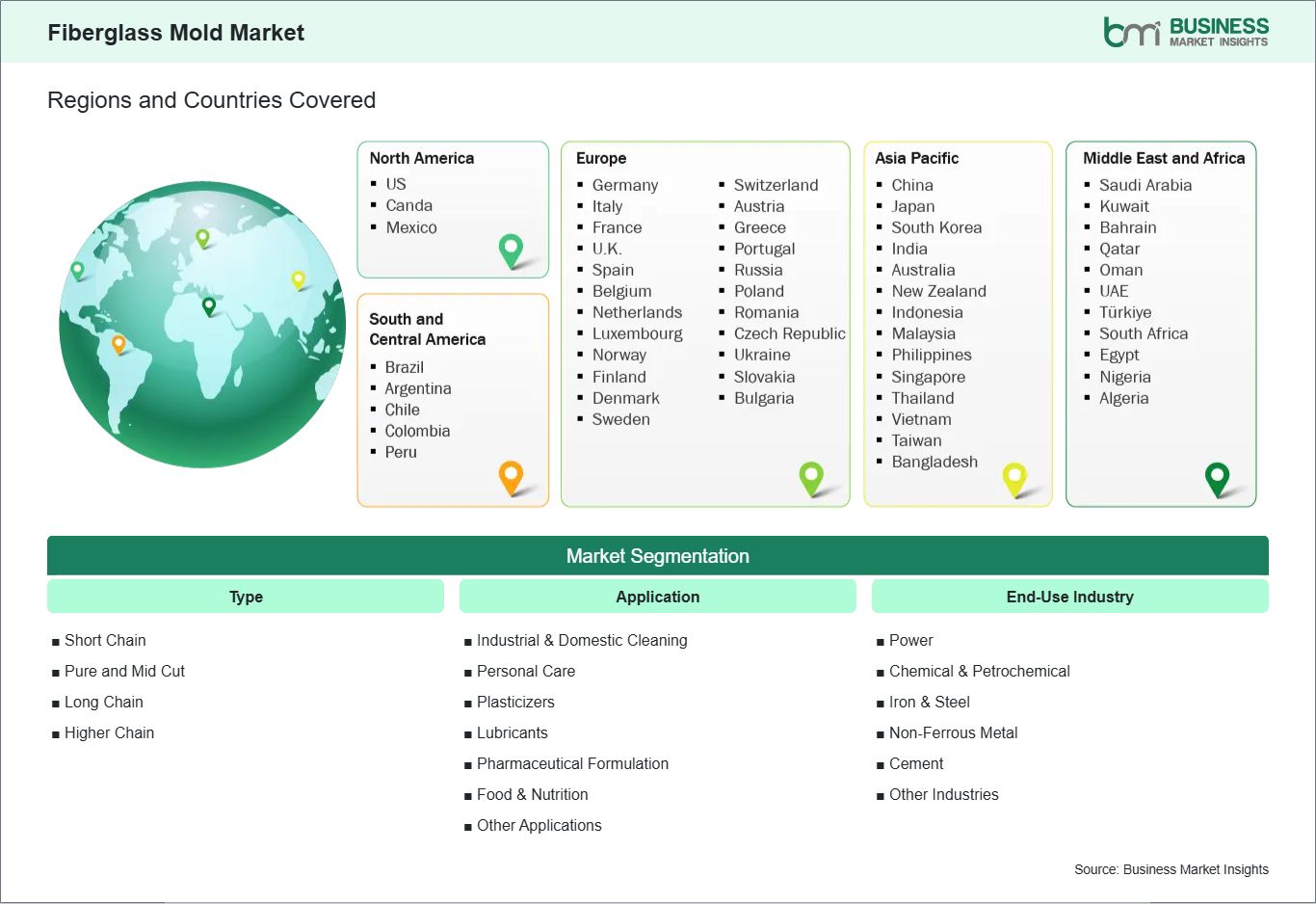
| Europe | Belgium, Austria, Finland, Denmark, Greece, Poland, Romania, Russia, Ukraine, Czech Republic, Slovakia, Bulgaria, Italy, Luxembourg, Germany, Switzerland, France, Netherlands, Norway, Portugal, Spain, Sweden, United Kingdom |
| Asia-Pacific | Australia, China, India, Japan, South Korea, Indonesia, Malaysia, Philippines, Singapore, Thailand, Vietnam, Bangladesh, New Zealand, Taiwan |
| South and Central America | Brazil, Argentina, Peru, Chile, Colombia |
| Middle East and Africa | Bahrain, Kuwait, Oman, Qatar, Saudi Arabia, United Arab Emirates, Turkiye, South Africa, Egypt, Algeria, Nigeria |
| Market leaders and key company profiles |
|
The "Fiberglass Mold Market Size and Forecast (2022 - 2033)" report provides a detailed analysis of the market covering below areas:
The geographical scope of the Fiberglass Mold market report is divided into five regions: North America, Asia Pacific, Europe, Middle East & Africa, and South & Central America. The Fiberglass Mold market in North America is expected to grow during the forecast period.
The region with the highest share in the fiberglass mold market is North America. This is because it is supported by its strong manufacturing base, its strong culture of innovation in its industries, and its high demand for precision-engineered components. In the automotive industry, fiberglass molds are used to create body parts and components where lightweight durability and precision engineering are required. The aerospace and defense industries also make use of fiberglass molds to create components where lightweight durability is required. In the marine and RV industry, fiberglass molds are used to create components where lightweight durability and precision engineering are required. In the construction and renewable energy industry, fiberglass molds are used to create components where precision engineering is required.
The challenges facing this region include higher production costs, environmental regulations on resin handling, and competition from digital mold technology. Despite these challenges, this region is at the forefront in terms of expertise in handling fiberglass, quality raw materials, and innovation. The region is the benchmark in the world in terms of producing rugged fiberglass molds with high performance, which dictates the trend in the industry.

The fiberglass mold market is evaluated by gathering qualitative and quantitative data post primary and secondary research, which includes important corporate publications, association data, and databases. A few of the key developments in the fiberglass mold market are:
The Fiberglass Mold Market is valued at US$ 512.7 Million in 2025, it is projected to reach US$ 1,020.00 Million by 2033.
As per our report Fiberglass Mold Market, the market size is valued at US$ 512.7 Million in 2025, projecting it to reach US$ 1,020.00 Million by 2033. This translates to a CAGR of approximately 8.98% during the forecast period.
The Fiberglass Mold Market report typically cover these key segments-
The historic period, base year, and forecast period can vary slightly depending on the specific market research report. However, for the Fiberglass Mold Market report:
The Fiberglass Mold Market is populated by several key players, each contributing to its growth and innovation. Some of the major players include:
The Fiberglass Mold Market report is valuable for diverse stakeholders, including:
Essentially, anyone involved in or considering involvement in the Fiberglass Mold Market value chain can benefit from the information contained in a comprehensive market report.
Please tell us your area of interest
(Market Segments/ Regions and Countries/ Companies)