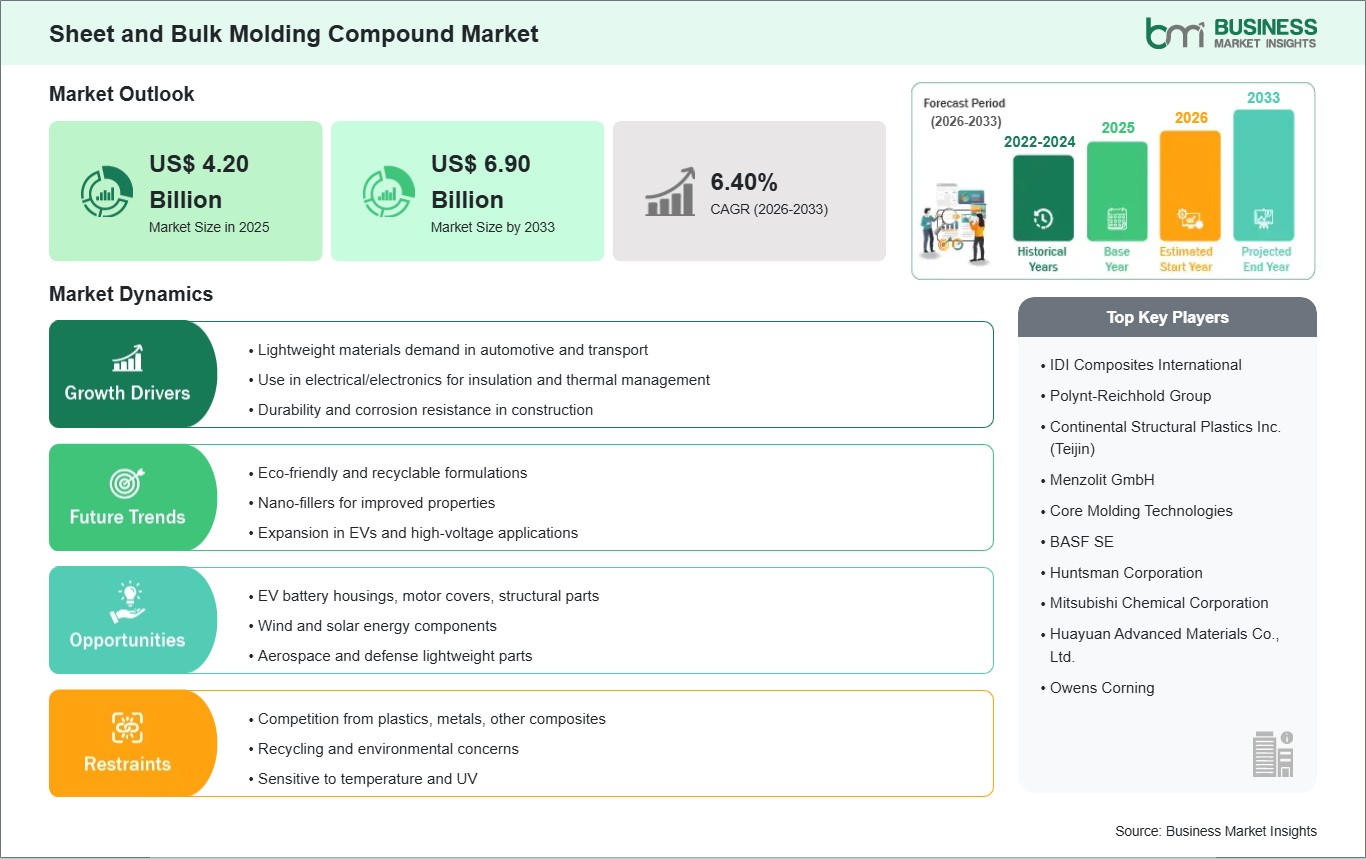
The Sheet and Bulk Molding Compound Market size is expected to reach US$ 6.9 billion by 2033 from US$ 4.2 billion in 2025. The market is estimated to record a CAGR of 6.40% from 2026 to 2033.
The global sheet and bulk molding compound market is a significant segment of the materials industry, acting as a key enabler for lightweight, strong, and high-performance materials in various automotive, electrical, electronics, construction, and industrial segments. SMC and BMC, being primarily resin-based materials, possess excellent mechanical properties, temperature resistance, and corrosion properties, making them suitable for various structural and functional applications.
The driving factors behind the growth of the SMC and BMC market include the increased trend toward lightweight materials to improve fuel efficiency in various automotive segments and reduce environmental impact, along with increased demand for high-performance electrical and electronic enclosures to achieve higher insulation properties. Moreover, the versatility of sheet and bulk molding compounds in custom molding and complex configurations makes them suitable for a wide variety of industrial applications.
However, this market is faced with challenges, which include high production costs and competition from other lightweight materials, such as thermoplastics and composites. The market is also limited by its dependency on raw materials, which are subject to fluctuations in prices. Finally, there is a challenge in controlling processes in order to ensure quality in the manufacture of these compounds, which is a barrier to new entrants in this market.

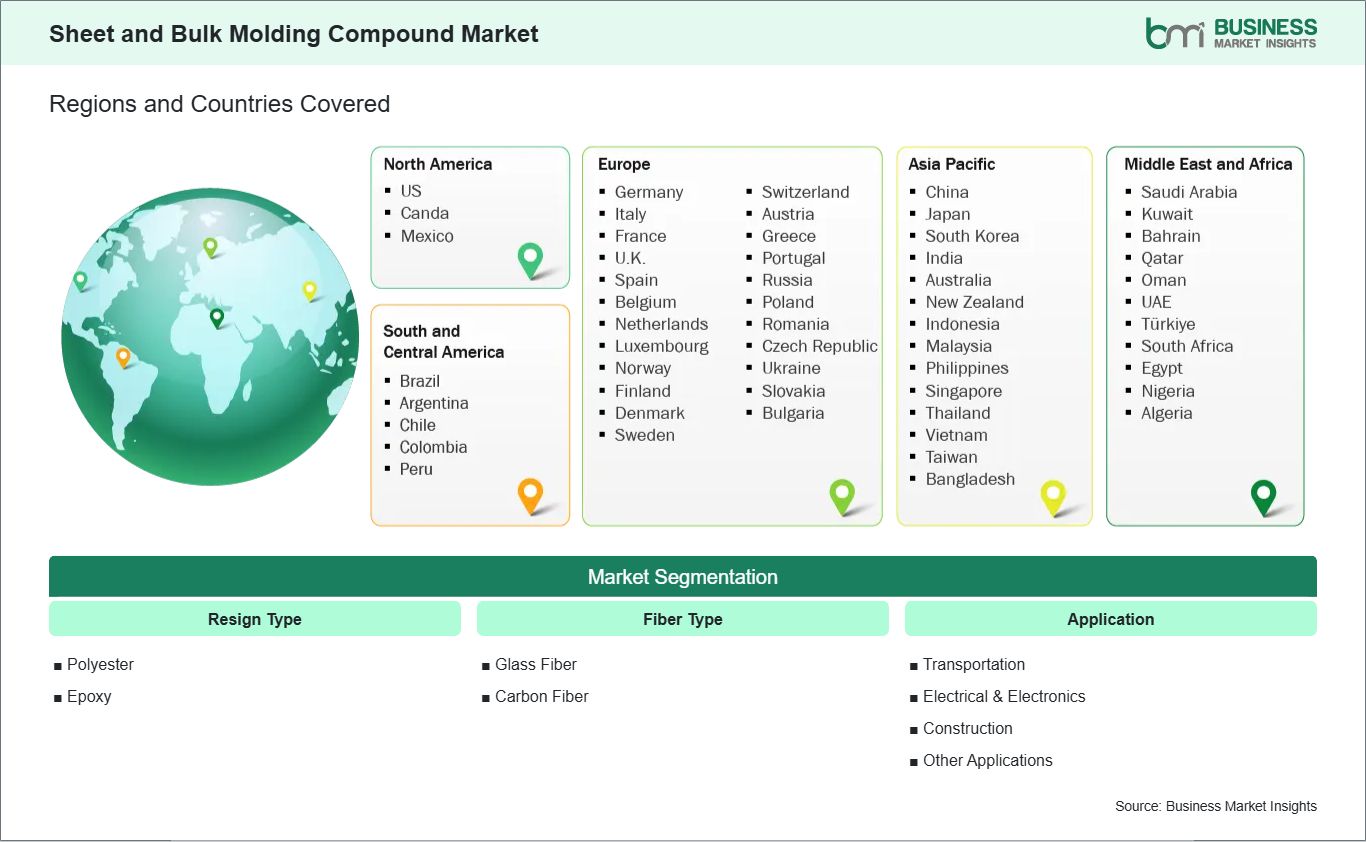
Key segments that contributed to the derivation of the Sheet and bulk molding compound market analysis are resign type, Fiber type, and application
The sheet and bulk molding compound market in Western Europe is being driven by the automotive and transport industry’s focus on lightweighting. Countries such as Germany, France, and Italy are among the leaders in the manufacture of vehicles. They are increasingly using composites to reduce the weight of vehicles to achieve greater fuel efficiency. Sheet molding compounds and bulk molding compounds are being used because they possess high strength-to-weight properties, design flexibility, and resistance to corrosion and heat. They can be used to replace metal with lightweight materials without compromising safety.
The demand for lightweight materials is also influenced by the region's strict regulatory requirements on carbon emissions and fuel efficiency. The OEMs and tier-one suppliers in the Western Europe automotive market are developing parts that comply with Euro 7 requirements as well as the region's environmental regulations. The use of SMC and BMC is also gaining traction in structural components, body parts, as well as under-hood components where high durability is required against mechanical as well as thermal stresses. The ability to create complex part geometry helps minimize the process steps involved in the manufacture of these components, thus enabling mass customization in the Western Europe automotive market.
In the Western Europe market, the commercial transport segment, as well as the rail segment, is also adopting composites to reduce energy consumption as well as enhance the efficiency of the operation. The lightweight SMC as well as BMC parts are used in the interior parts, housings, as well as the exterior parts of buses, trucks, as well as trains. The region's strict regulatory requirements, fuel efficiency, as well as performance requirements, ensure the growth of the sheet as well as bulk molding compound market.
The growth in the market for electric vehicles in Western Europe is one of the major driving forces behind the sheet and bulk molding compound market. The battery housing, motor cover, and other structural components of electric vehicles make use of SMC and BMC materials. This is because these materials have lightweight properties and can provide electrical insulation. This improves the range of vehicles, and SMC and BMC have fire resistance and thermal stability, which are important for the safety of the batteries. The German and French automobile industries make use of composite material housings and enclosures in electric vehicles.
Even motor covers and thermal management components are benefiting from the growing use of SMC and BMC materials. High-voltage motors require covers that offer a balance of mechanical strength and electrical insulation; molding materials offer a cost-effective and infinitely scalable solution. Their thermal performance makes these materials suitable for continuous operating temperatures, a necessity in traction motors, inverters, and other high-voltage components. European EV makers are standardizing these components across their range to facilitate performance consistency and manufacturing simplicity.
Structural components unrelated to EVs are also contributing to the growth of the European sheet molding compound and bulk molding compound market. Reinforcements, cross members, and load-carrying components in passenger and commercial vehicle chassis are being designed using these materials to minimize weight while maintaining structural rigidity and impact resistance. These requirements, combined with their thermal and electrical performance, make these materials a necessity in the future of automotive and transport manufacturing in Western Europe.

The global Sheet and bulk molding compound market is experiencing steady growth, with market size and share analysis reflecting evolving treatment preferences and competitive dynamics among key players. The report evaluates important subsegments categorized within resign type, fiber type, and application highlighting their respective contributions to overall market performance.
By resign type, the epoxy subsegment dominated the market in 2025 because they provide superior mechanical strength, thermal stability, and chemical resistance compared to polyester, making them preferable for higher‑performance applications. As industries demand lighter, more durable composite parts (especially in electrical insulation and automotive), epoxy’s performance advantage outweighs the lower cost of polyester.
By fiber type, the glass fiber segment subsegment dominated the market in 2025 due to its excellent strength‑to‑weight ratio, good dimensional stability, and lower cost versus alternatives like carbon fiber. It integrates well with SMC/BMC processes and fulfills most structural and electrical needs across industries without the premium pricing of carbon fiber
By application, the electrical & electronics subsegment dominated the market in 2025 because of SMC/BMC materials are widely used for insulators, switchgear housings, connectors, and high‑voltage components thanks to their excellent dielectric properties and flame retardance. As electrification and electronics manufacturing grow globally, this segment drives the largest material volume.
| Report Attribute | Details |
|---|---|
| Market size in 2025 | US$ 4.20 Billion |
| Market Size by 2033 | US$ 6.90 Billion |
| Global CAGR (2026 - 2033) | 6.40% |
| Historical Data | 2022-2024 |
| Forecast period | 2026-2033 |
| Segments Covered | By Resign Type
|
|
Regions and Countries Covered
| |
| North America | US, Canada, Mexico |
| Europe | Belgium, Austria, Finland, Denmark, Greece, Poland, Romania, Russia, Ukraine, Czech Republic, Slovakia, Bulgaria, Italy, Luxembourg, Germany, Switzerland, France, Netherlands, Norway, Portugal, Spain, Sweden, United Kingdom |
| Asia-Pacific | Australia, China, India, Japan, South Korea, Indonesia, Malaysia, Philippines, Singapore, Thailand, Vietnam, Bangladesh, New Zealand, Taiwan |
| South and Central America | Brazil, Argentina, Peru, Chile, Colombia |
| Middle East and Africa | Bahrain, Kuwait, Oman, Qatar, Saudi Arabia, United Arab Emirates, Turkiye, South Africa, Egypt, Algeria, Nigeria |
| Market leaders and key company profiles |
|
The "Sheet and Bulk Molding Compound Market Size and Forecast (2022 - 2033)" report provides a detailed analysis of the market covering below areas:
The geographical scope of the Sheet and bulk molding compound market report is divided into: North America, Asia Pacific, Europe, Middle East & Africa, and South & Central America. North America held the largest share in 2025.
North America dominates the global sheet and bulk molding compound market, driven by a mature industrial base and strong automotive and electronics sectors. The region benefits from advanced R&D capabilities that support the development of high-performance molding compounds tailored for specific applications, such as automotive interior and exterior parts, electrical enclosures, and industrial equipment. The growing trend toward lightweight vehicles, coupled with stricter environmental regulations, is increasing the use of SMC and BMC in both commercial and passenger vehicles to enhance fuel efficiency without compromising structural integrity.
Additionally, North America’s focus on domestic manufacturing and supply chain resilience encourages local production of high-quality molding compounds, reducing reliance on imports. The region also leads in adopting sustainable materials and eco-friendly manufacturing practices, aligning with growing environmental concerns. Despite its dominance, North America faces challenges from high material costs and competition from emerging alternative composites, prompting manufacturers to innovate in formulation, process efficiency, and material performance to maintain market leadership.

The sheet and bulk molding compound market is evaluated by gathering qualitative and quantitative data post primary and secondary research, which includes important corporate publications, association data, and databases. A few of the key developments in the Sheet and bulk molding compound market are:
The Sheet and Bulk Molding Compound Market is valued at US$ 4.20 Billion in 2025, it is projected to reach US$ 6.90 Billion by 2033.
As per our report Sheet and Bulk Molding Compound Market, the market size is valued at US$ 4.20 Billion in 2025, projecting it to reach US$ 6.90 Billion by 2033. This translates to a CAGR of approximately 6.40% during the forecast period.
The Sheet and Bulk Molding Compound Market report typically cover these key segments-
The historic period, base year, and forecast period can vary slightly depending on the specific market research report. However, for the Sheet and Bulk Molding Compound Market report:
The Sheet and Bulk Molding Compound Market is populated by several key players, each contributing to its growth and innovation. Some of the major players include:
The Sheet and Bulk Molding Compound Market report is valuable for diverse stakeholders, including:
Essentially, anyone involved in or considering involvement in the Sheet and Bulk Molding Compound Market value chain can benefit from the information contained in a comprehensive market report.
Please tell us your area of interest
(Market Segments/ Regions and Countries/ Companies)