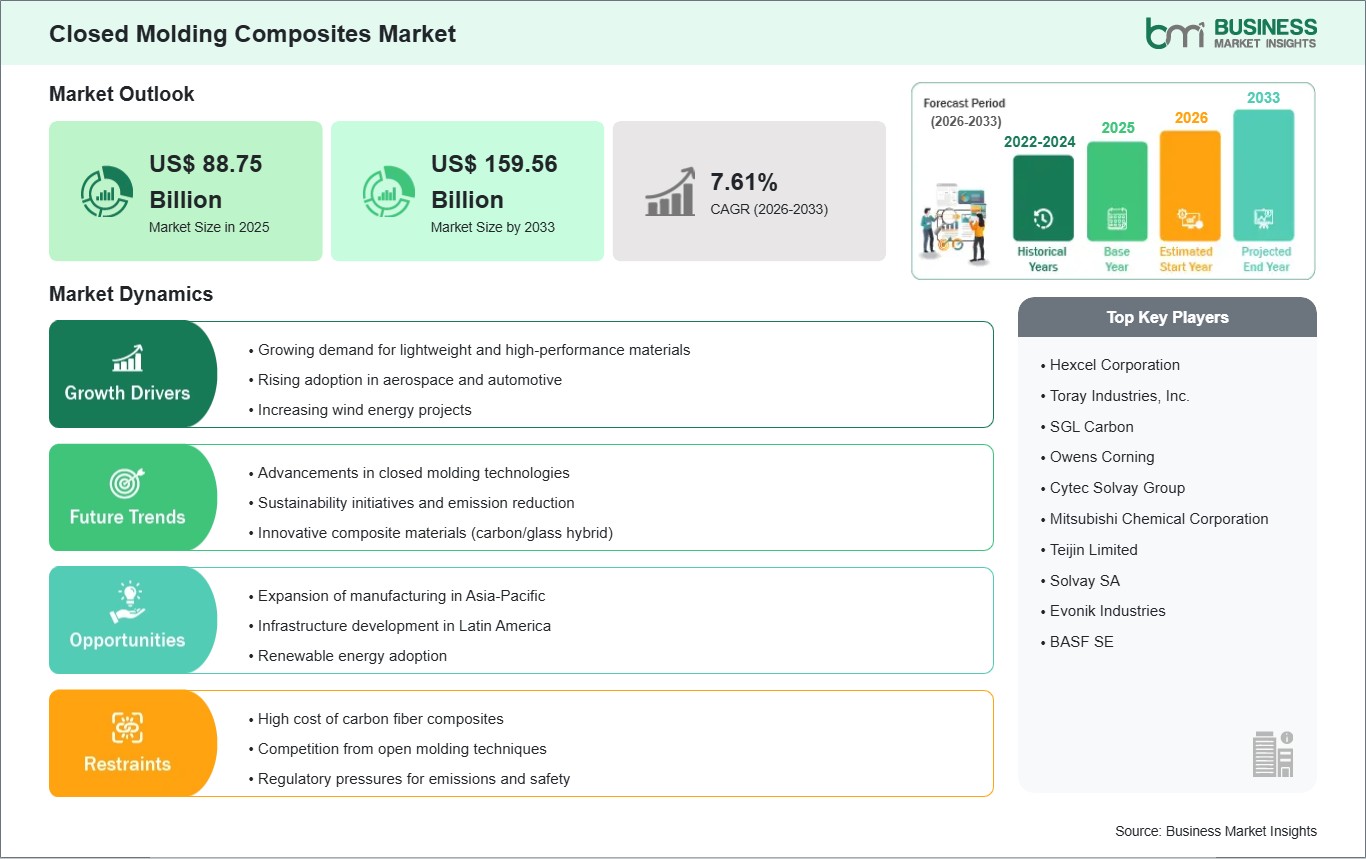
The Closed Molding Composites Market size is expected to reach US$ 159.56 Billion by 2033 from US$ 88.75 Billion in 2025. The market is estimated to record a CAGR of 7.61% from 2026 to 2033.
The global closed molding composites market is defined by the increasing adoption of advanced composite manufacturing techniques that offer superior product quality, reduced emissions, and improved material efficiency. Closed molding processes—such as vacuum infusion, compression molding, pultrusion, and injection molding—are widely used to produce high-performance composite components with consistent mechanical properties and minimal environmental impact.
The market is experiencing strong growth driven by the rising demand for lightweight, high-strength materials across industries such as aerospace, automotive, wind energy, and construction. Closed molding composites provide advantages such as reduced waste, improved fiber wet-out, and better surface finish compared to open molding techniques, making them increasingly preferred in industrial applications.
Competitive dynamics are shaped by technological advancements in processing methods, material innovation, and production scalability. Manufacturers are focusing on improving cycle times, automation, and cost efficiency to meet growing demand. Strategic partnerships with end-use industries are also accelerating the development of application-specific composite solutions.
Regulatory pressures related to emissions and workplace safety are further encouraging the shift from open to closed molding processes. These methods reduce volatile organic compound (VOC) emissions and improve operator safety, aligning with global environmental standards. As industries prioritize sustainability, performance, and efficiency, closed molding composites are becoming integral to next-generation manufacturing.

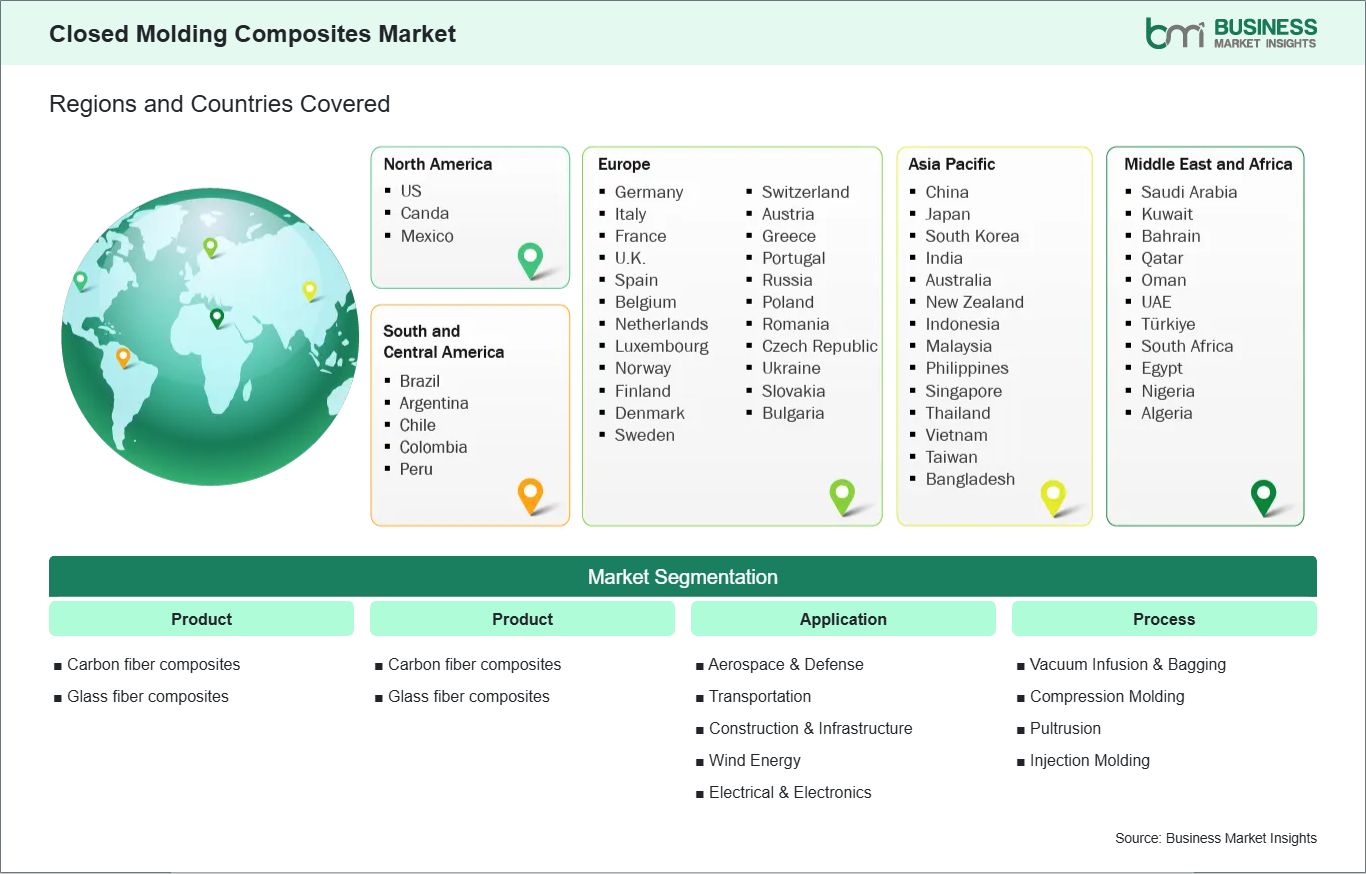
Key segments that contributed to the derivation of the closed molding composites market analysis are product, application, and process.
The closed molding composites market is largely influenced by the increasing need for lightweight, high-quality materials in industries like aerospace, automotive and wind energy. These industries look for materials that are strong yet light, resistant to corrosion, and durable; characteristics that are true of composite materials. The benefits of composite materials are enhanced through the uniformity of resin distribution, increased fiber alignment, and reduced void content that occur as a result of the closed molding process, all attributes that translate to improved mechanical properties.
In the aerospace and defense industries, its essential to reduce weight in order to improve fuel economy and increase payload capacity. As a result, closed molding composite materials have become a popular material choice for component parts of aircraft - fuselage sections, wings, and interiors - due to their lightness and high strength. In the automotive transportation industry, manufacturers of vehicles are using composite materials to reduce weight, in response to stringent regulations for vehicle emissions. This trend is prevalent today because of the growing prevalence of electric vehicles, in which lightweight materials will result in greater battery range and better performance.
Another driving force in this market is the wind energy industry where large composite structures are utilized as turbine blades. Commonly used techniques for creating turbine blades include vacuum infusion and other types of closed molding processes, which offer high strength and durability under extreme conditions.
The closed mold composite materials market is poised to take advantage of improved production processes and the growing concern for the environment and sustainability. One of the primary benefits of the closed mold process is that it reduces raw material loss and pollutant emissions compared to open mold (traditional) processes. Therefore, as the regulatory environment continues to tighten, manufacturers will increasingly use closed molding technology in order to adhere to environmental and health/safety regulations.
A key driver for expansion of the market is the continued advancement in technology with regard to manufacturing methods through the evolution of automation, robotics, and digital manufacturing. These advancements are being used to improve process capabilities (including cycle time reduction), improve product consistency, and create the means to manufacture complex composite parts on an industrial scale with high levels of precision. These improvements will enable the closed molding process to compete effectively in industrial applications.
The other major opportunity is the continued development of innovative materials, including high-performance resins and hybrid fiber composites. These materials will provide superior mechanical properties (strength, toughness, ductility, etc.), thermal resistance (temperature and thermal shock), and chemical resistance, which makes them well suited for applications in demanding environments like aerospace, defense, and the power industry. The emergence of composite materials using carbon fibers in high-performance applications represents a significant trend towards achieving high levels of performance with reduced weight in many of the industries where manufacturers will look to use closed molding.
The increasing focus on renewable and sustainable energy sources creates additional opportunities for closed mold composite material applications.

The Closed Molding Composites Market demonstrates steady growth, with size and share analysis highlighting evolving trends and competitive dynamics among key players. The report examines subsegments categorized within fiber type, application, and process, offering insights into their contribution to overall market performance.
By fiber type, the glass fiber composites subsegment dominated the market in 2025, driven by its cost efficiency and widespread industrial adoption. Carbon fiber composites are gaining traction in high-performance applications.
In terms of application, the transportation subsegment dominated the market in 2025, driven by increasing demand for lightweight materials in automotive and electric vehicles.
By process, the vacuum infusion & bagging subsegment dominated the market in 2025, owing to its ability to produce large, high-quality composite structures with reduced emissions and improved efficiency.
| Report Attribute | Details |
|---|---|
| Market size in 2025 | US$ 88.75 Billion |
| Market Size by 2033 | US$ 159.56 Billion |
| Global CAGR (2026 - 2033) | 7.61% |
| Historical Data | 2022-2024 |
| Forecast period | 2026-2033 |
| Segments Covered | By Product
|
|
Regions and Countries Covered
| |
| North America | US, Canada, Mexico |
| Europe | Belgium, Austria, Finland, Denmark, Greece, Poland, Romania, Russia, Ukraine, Czech Republic, Slovakia, Bulgaria, Italy, Luxembourg, Germany, Switzerland, France, Netherlands, Norway, Portugal, Spain, Sweden, United Kingdom |
| Asia-Pacific | Australia, China, India, Japan, South Korea, Indonesia, Malaysia, Philippines, Singapore, Thailand, Vietnam, Bangladesh, New Zealand, Taiwan |
| South and Central America | Brazil, Argentina, Peru, Chile, Colombia |
| Middle East and Africa | Bahrain, Kuwait, Oman, Qatar, Saudi Arabia, United Arab Emirates, Turkiye, South Africa, Egypt, Algeria, Nigeria |
| Market leaders and key company profiles |
|
The "Closed Molding Composites Market Size and Forecast (2022 - 2033)" report provides a detailed analysis of the market covering below areas:
The geographical scope of the Closed Molding Composites Market report is divided into North America, Asia Pacific, Europe, Middle East & Africa, and South & Central America. North America held the largest share in 2025.
North America shows strong growth driven by aerospace and defense applications and technological advancements in composite manufacturing. Europe follows closely, supported by sustainability regulations and automotive innovation.
Asia Pacific market is growing due to strong manufacturing capabilities, expanding automotive and construction industries, and increasing investments in renewable energy. Countries such as China, Japan, and India are key contributors.
Emerging regions such as Latin America and the Middle East & Africa are gradually expanding due to infrastructure development and industrial growth.

The Closed Molding Composites Market is evaluated by gathering qualitative and quantitative data post primary and secondary research, which includes important corporate publications, association data, and databases. A few of the key developments in the closed molding composites market are:
The Closed Molding Composites Market is valued at US$ 88.75 Billion in 2025, it is projected to reach US$ 159.56 Billion by 2033.
As per our report Closed Molding Composites Market, the market size is valued at US$ 88.75 Billion in 2025, projecting it to reach US$ 159.56 Billion by 2033. This translates to a CAGR of approximately 7.61% during the forecast period.
The Closed Molding Composites Market report typically cover these key segments-
The historic period, base year, and forecast period can vary slightly depending on the specific market research report. However, for the Closed Molding Composites Market report:
The Closed Molding Composites Market is populated by several key players, each contributing to its growth and innovation. Some of the major players include:
The Closed Molding Composites Market report is valuable for diverse stakeholders, including:
Essentially, anyone involved in or considering involvement in the Closed Molding Composites Market value chain can benefit from the information contained in a comprehensive market report.
Please tell us your area of interest
(Market Segments/ Regions and Countries/ Companies)