
Fabric Softeners Market Outlook: Size, Share, Trends, Growth Analysis, Competitive Landscape & Forecast, 2026-2033

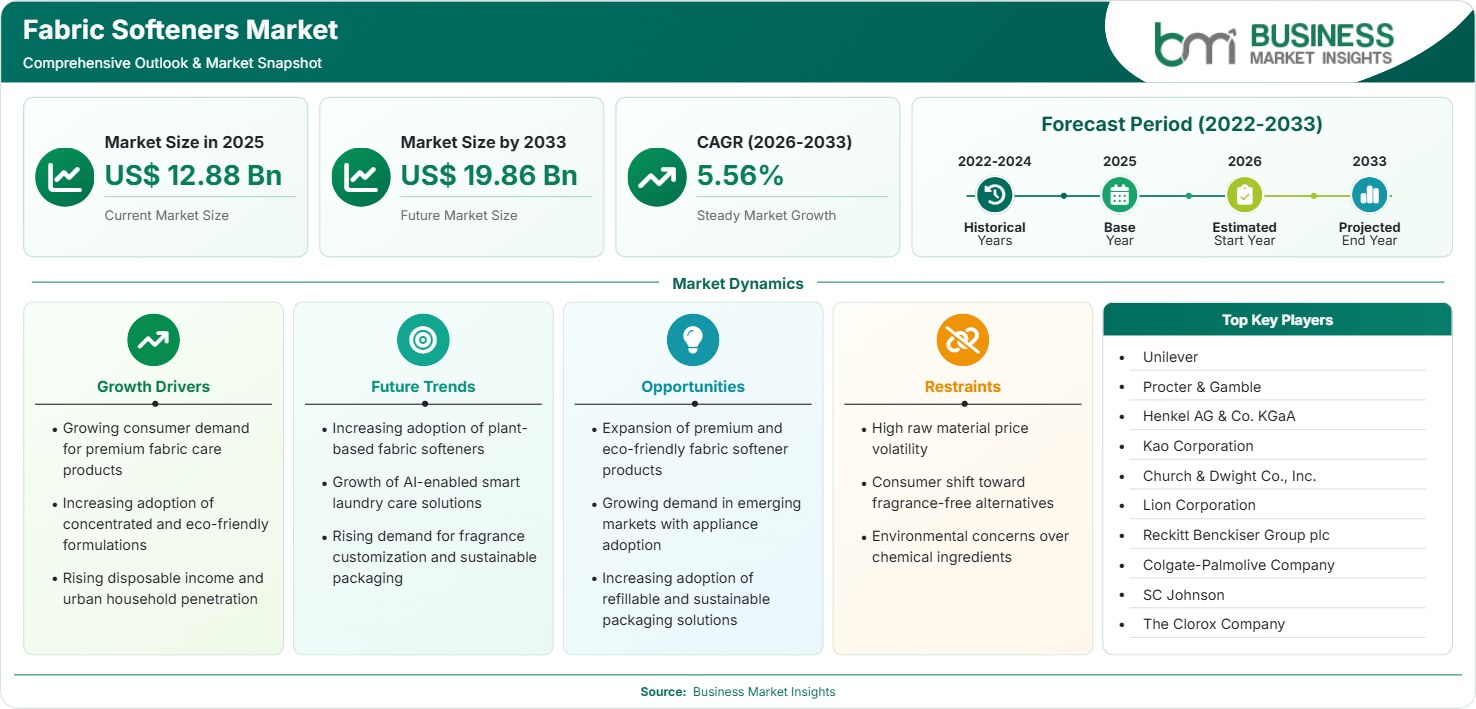
The Fabric Softeners Market size was valued at US$ 12.88 Billion in 2025 and is projected to reach US$ 19.86 Billion by 2033, growing at a CAGR of 5.56% during 2026–2033. Rising demand for premium fabric care solutions, growing adoption of concentrated and eco-friendly formulations, and increasing household appliance penetration are shaping market expansion.

Report Coverage
  • Product: Liquid Fabric Softeners, Dryer Sheets, Dryer Bars, Tablets/Pods, Others
  • Formulation: Conventional, Organic
  • Price Range: Mass, Mid-Range, Premium
  • End User: Household, Hospitality Settings, Laundry Services, Others
  • Distribution Channel: Supermarkets & Hypermarkets, Convenience Stores, Specialty Stores, Online Retail, Others
US$ 12.88 Bn Market size in 2025
US$ 19.86 Bn Market Size by 2033
5.56% CAGR, 2026 - 2033
2026-2033 Forecast Period

AI Overview

Fabric Softeners Market Summary

  • North America Region: North America holds a 32%–36% share in 2025, growing at a CAGR of 5.2%–5.7% during 2026–2033, supported by premium laundry product adoption, established retail networks, higher household spending, and demand for sustainable fabric care solutions. The U.S. market is expanding at a CAGR of 5.3%–5.8% during 2026–2033, driven by concentrated formulations, fragrance innovation, and strong brand presence.
  • Fastest Growing Region: Asia Pacific accounts for a 28%–32% share in 2025 and is expected to register a CAGR of 6.1%–6.7% during 2026–2033, supported by urbanization, rising disposable income, appliance ownership growth, and increasing awareness of premium household care products.
  • Leading Segment: Liquid Fabric Softeners represent a 55%–59% share in 2025 and are projected to grow at a CAGR of 5.1%–5.6% during 2026–2033, supported by convenience, widespread household adoption, and availability across multiple retail channels.
  • High Growth Segment: Organic Formulation holds a 18%–22% share in 2025 and is projected to expand at a CAGR of 6.8%–7.4% during 2026–2033, driven by consumer preference for sustainable ingredients, environmentally responsible products, and clean-label household solutions.
  • Key Market Opportunity: Growth opportunities are emerging from eco-friendly formulations, refillable packaging, premium product launches, and expanding adoption in developing economies where washing machine penetration continues increasing.
  • Major Market Players: Unilever, Procter & Gamble, Henkel AG & Co. KGaA, Kao Corporation, Church & Dwight Co., Inc., Reckitt Benckiser Group plc, Colgate-Palmolive Company, SC Johnson, and The Clorox Company.
Strategic Insights

Fabric Softeners Market: Strategic Insights

Fabric Softeners Market Strategic Framework
FREE PDF
Request your free sample
Request free sample
Stakeholder View

Key Takeaways

  • The value chain is evolving from traditional chemical-based formulations toward sustainable ingredient sourcing, efficient manufacturing processes, and packaging innovations focused on environmental responsibility.
  • Premium and organic fabric softener products represent attractive growth areas as consumers increasingly prioritize fabric protection, fragrance quality, and safer ingredient profiles.
  • Product innovation is shifting toward concentrated liquids, refill solutions, plant-derived ingredients, and specialized formulations designed for sensitive fabrics and skin-conscious consumers.
  • Asia Pacific offers strong expansion potential due to rising urban populations, increasing appliance adoption, growing middle-class households, and improving access to organized retail channels.
  • Leading companies are focusing on portfolio expansion, sustainable product launches, and strategic brand positioning to strengthen competitiveness in mature and emerging markets.
  • Online retail is becoming an important distribution channel by enabling direct consumer engagement, subscription purchasing models, and wider availability of specialized fabric care products.
Geographic Outlook

Fabric Softeners Market Regional Highlights

North America Fabric Softeners Market

North America accounted for 32%–36% of the market share in 2025 and is projected to grow at a CAGR of 5.2%–5.7% during 2026–2033. The region maintains a strong position due to high household penetration of laundry appliances, established consumer brands, and demand for premium fabric care products. The United States represents the largest contributor, supported by strong retail availability and innovation in concentrated and sustainable formulations. The Fabric Softeners Market share remains influenced by consumer preference for convenience, fragrance variety, and enhanced fabric protection benefits.

  • Premium laundry care demand is rising as consumers seek enhanced softness, fragrance, and fabric protection.
  • Sustainable formulations are gaining traction through biodegradable ingredients, eco-friendly packaging, and concentrated products.
  • Organized retail and e-commerce channels are expanding brand visibility and market reach.
  • Sensitive skin and hypoallergenic solutions are creating new growth opportunities among health-conscious consumers.

US Fabric Softeners Market

The United States represented 82%–86% of North America's market share in 2025 and is expected to expand at a CAGR of 5.3%–5.8% during 2026–2033. Strong brand recognition, high household laundry product consumption, and demand for premium fabric enhancement solutions continue supporting market development in fabric softeners market.

  • Leading consumer goods companies continue launching innovative fabric softeners featuring advanced fragrance technologies, plant-based ingredients, and improved product efficiency.
  • Online retail growth is expanding consumer access to specialized fabric care products while supporting subscription-based purchasing and direct-to-consumer strategies.
  • Rising preference for eco-conscious household products is encouraging manufacturers to develop sustainable packaging and environmentally responsible formulations.
  • Demand for premium laundry experiences continues supporting higher-value product adoption across urban and higher-income consumer groups.

Europe fabric softeners market

Europe held 26%–30% of the market share in 2025 and is projected to register a CAGR of 5.0%–5.5% during 2026–2033. The region benefits from strong sustainability awareness, mature household care markets, and increasing demand for environmentally responsible products in fabric softeners market. Germany, the United Kingdom, and France remain key markets, while Nordic countries show higher adoption of eco-friendly formulations.

  • Germany continues supporting demand through strong retail infrastructure, premium household care consumption, and increasing adoption of sustainable laundry solutions.
  • The United Kingdom market benefits from growing interest in concentrated products, fragrance innovation, and online purchasing of household care products.
  • France is witnessing increased demand for natural and organic fabric care products as consumers prioritize environmentally conscious purchasing decisions.
  • European manufacturers are investing in recyclable packaging, biodegradable ingredients, and lower-impact production processes to align with sustainability targets.

Asia Pacific Fabric Softeners Market

Asia Pacific represented 28%–32% of the market share in 2025 and is expected to achieve the fastest CAGR of 6.1%–6.7% during 2026–2033. Expanding urban populations, rising disposable income, growing washing machine adoption, and increasing awareness of premium household products are supporting fabric softeners market expansion. China, India, and Southeast Asian countries represent major growth opportunities as consumers transition from basic laundry products toward specialized fabric care solutions.

  • China remains a significant market due to rising household spending, expanding e-commerce penetration, and increasing demand for branded fabric care products.
  • India is experiencing increased adoption as urban households gain access to washing machines, organized retail channels, and premium household care brands.
  • Southeast Asian markets are benefiting from improving living standards, appliance ownership growth, and increasing consumer awareness of fabric conditioning benefits.
  • Local and international manufacturers are expanding affordable premium product offerings to capture demand from emerging middle-class consumers.

Rest of World Fabric Softeners Market

The Rest of the World held a 6%–10% market share in 2025 and is projected to grow at a CAGR of 4.6%–5.2% during 2026–2033. The fabric softeners market growth is supported by rising household consumption, expanding retail networks, hospitality demand, urbanization, and increasing availability of international brands.

  • Brazil and Mexico represent important markets in Latin America due to expanding household care consumption and increasing penetration of branded laundry products.
  • Middle Eastern countries are generating demand through hospitality expansion, premium household consumption, and increasing preference for imported fabric care solutions.
  • African markets are gradually developing as urban households gain improved access to modern retail channels and appliance-based laundry practices.
  • Manufacturers are focusing on affordable packaging formats and localized product strategies to improve accessibility across developing markets.
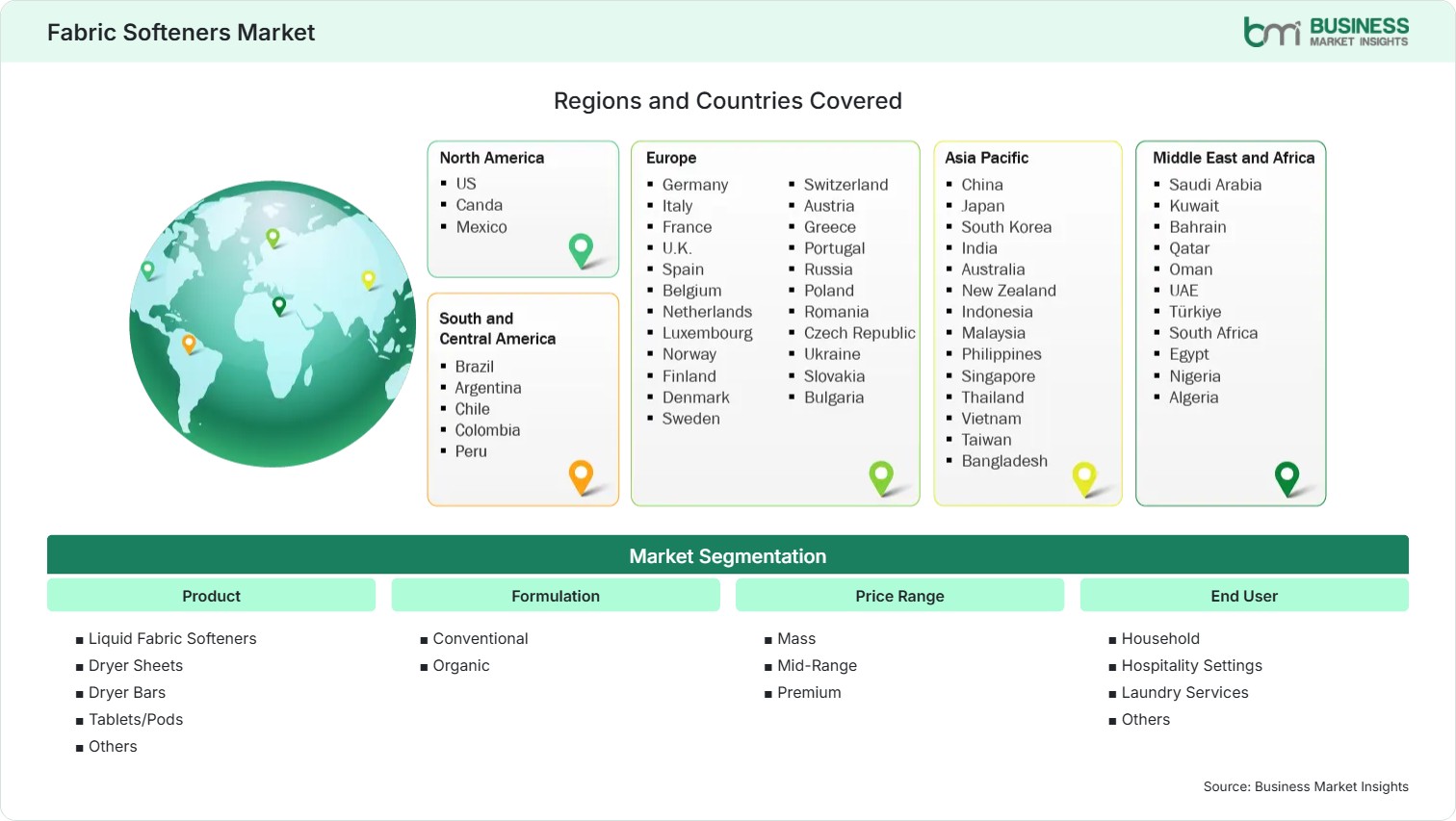
Global Market Geography
FREE PDF
Request your free sample
Request free sample
Segment Analysis

Fabric Softeners Market Segmentation

Product

Product segmentation is driven by demand for convenience, fragrance performance, and fabric protection. Liquid Fabric Softeners led the fabric softeners market with a 55%–59% share in 2025 and are projected to grow at a CAGR of 5.1%–5.6% during 2026–2033, supported by household adoption, retail availability, and compatibility with washing systems.

  • Liquid Fabric Softeners: Liquid formats remain widely preferred due to easy application, broad availability, fragrance variety, and compatibility with automatic washing machines across household and commercial users.
  • Dryer Sheets: Dryer sheets provide convenience, static reduction, and fragrance benefits, supporting adoption among consumers seeking simple fabric care solutions with minimal application effort.
  • Dryer Bars: Dryer bars offer long-lasting conditioning performance and reduced packaging requirements, attracting consumers interested in reusable and cost-effective laundry care alternatives.
  • Tablets/Pods: Tablets and pods are gaining attention through precise dosage, convenience, reduced wastage, and growing demand for compact laundry care formats.

Formulation

Formulation segmentation is influenced by increasing consumer awareness regarding ingredient safety, sustainability, and environmental impact. Organic Formulation represented the high-growth segment with an 18%–22% share in 2025 and is projected to grow at a CAGR of 6.8%–7.4% during 2026–2033, supported by rising demand for plant-based ingredients, clean-label products, and environmentally responsible household solutions in fabric softeners market.

  • Conventional: Conventional formulations maintain strong market presence due to affordability, established consumer familiarity, extensive availability, and effective softening and fragrance performance.
  • Organic: Organic formulations are gaining traction among environmentally conscious consumers seeking biodegradable ingredients, sustainable production methods, and products with reduced chemical impact.

Price Range

Price range segmentation reflects differences in consumer purchasing power, product positioning, and demand for enhanced laundry experiences. Premium products represented the high-value segment with a 22%–26% share in 2025 and are projected to grow at a CAGR of 6.2%–6.8% during 2026–2033, supported by demand for advanced fragrances, specialty formulations, and sustainable product attributes.

  • Mass: Mass-priced products attract broad consumer adoption through affordability, accessibility, and availability across supermarkets, convenience stores, and general retail channels.
  • Mid-Range: Mid-range products balance performance and affordability, attracting consumers seeking improved fabric care benefits without premium pricing levels.
  • Premium: Premium products focus on luxury fragrances, specialized fabric protection, eco-friendly ingredients, and differentiated consumer experiences.

End User

End user segmentation is influenced by household consumption patterns, commercial laundry requirements, and increasing adoption across hospitality environments. Household represented the leading segment with a 68%–72% share in 2025 and is projected to grow at a CAGR of 5.3%–5.8% during 2026–2033, supported by increasing laundry frequency, appliance adoption, and consumer preference for enhanced fabric care.

  • Household: Household users represent the largest consumer base due to regular laundry activities, rising awareness of fabric maintenance, and increasing demand for premium laundry solutions.
  • Hospitality Settings: Hotels and hospitality facilities use fabric softeners to maintain linen quality, improve guest experience, and support consistent textile care standards.
  • Laundry Services: Professional laundry providers adopt fabric softeners to enhance service quality, improve textile softness, and meet customer expectations for premium cleaning outcomes.

Distribution Channel

Distribution channel segmentation is evolving due to changing purchasing behavior, digital commerce expansion, and increasing product accessibility. Supermarkets & Hypermarkets represented the leading channel with a 38%–42% share in 2025 and are projected to grow at a CAGR of 4.9%–5.4% during 2026–2033, supported by strong consumer reach, product visibility, and established shopping patterns.

  • Supermarkets & Hypermarkets: These channels provide extensive product assortment, promotional opportunities, and convenient access for household consumers purchasing regular laundry care products.
  • Convenience Stores: Convenience stores support quick purchase decisions through neighborhood accessibility and availability of commonly used fabric care products.
  • Specialty Stores: Specialty retailers provide premium household care products and support consumers seeking specialized, sustainable, or high-performance fabric softener solutions.
  • Online Retail: Online platforms are expanding through wider product selection, subscription models, competitive pricing, and increasing consumer preference for convenient home delivery.
Market Forces

Fabric Softeners Market Dynamics

Key Market Drivers

Growing Consumer Demand for Premium Fabric Care Products

Consumer trends are gradually moving towards value-added laundry systems which would offer better softening properties, improved scent holding capabilities, fabric protection and special care. The use of premium fabric softener products is gradually catching on among consumers who want to increase the life span of their clothes. The growth is further supported by increasing brand innovation and rising consumer willingness to spend on household products offering convenience and improved performance. The Fabric Softeners Market trends indicate continued movement toward multifunctional products that combine softness, freshness, and sustainability.

Increasing Adoption of Concentrated and Eco-Friendly Formulations

Environmental consciousness is motivating consumers and manufactures to move towards concentrated and environmentally friendly fabric softener formulations. The benefits of concentrated formulations include reduced amount of packaging material used, lower transportation costs, lower quantity of product used and the same performance standards. Manufacturers are coming up with plant based ingredients, biodegradable softeners and environmentally friendly packaging options to meet the demands of consumers. Sustainability oriented formulation is fast becoming an important competitive parameter as more regulation is placed on the composition of the chemicals used. This change has motivated product innovation not only in developed markets but developing ones as well.

Rising Disposable Income and Urban Household Penetration

The rising trend in disposable income and urbanization is driving greater demand for fabric care products, especially in emerging economies. The growing use of washing machines, a higher standard of living, and increased awareness of laundry care products are prompting consumers to shift their focus from general detergents to more sophisticated fabric care products. Consumers with an urban lifestyle and a very busy schedule tend to prefer convenient, advanced laundry options. The companies are using affordable premium products, regional fragrances, and varied packaging sizes to target these markets.

Key Market Opportunities

Expansion of Premium and Eco-Friendly Fabric Softener Products

Premium and eco-friendly fabric softener products have vast potential because consumers tend to focus on product quality and ingredient integrity and also consider environmental issues. The industry is focused on developing plant-based products, refills, and special formulas for sensitive skins and fabrics. The Fabric Softeners Market Forecasts indicate that demand for differentiated products will continue increasing as brands focus on premium positioning and sustainable innovation. The rising consumer segments offer opportunities for firms to develop products equipped with cutting-edge fragrance technologies, biodegradable features, and minimized ecological footprint. It is anticipated that such trends will facilitate the use of higher value-added products around the world.

Growing Demand in Emerging Markets with Appliance Adoption

Emerging markets are creating new growth avenues as washing machine ownership increases and household purchasing power improves. Countries across Asia Pacific, Latin America, and Africa are experiencing rising demand for branded laundry products due to urban expansion, modern retail growth, and changing lifestyles. Manufacturers can explore the possibilities of launching cost-effective products that meet local tastes, in terms of packaging as well as other elements. The growth of organized retail, as well as the rise of e-commerce, provides access to consumers who were previously out of reach, while increased understanding of the advantages of fabric care will further drive penetration.

Increasing Adoption of Refillable and Sustainable Packaging Solutions

Innovation in sustainable packaging is emerging as an opportunity due to growing efforts by consumers and businesses to reduce plastic waste. Reusable pouches, recyclable packaging, and lighter packaging are among the innovations attracting interest in the household care industry. Companies are looking for ways to create packaging that has minimal environmental impact while remaining convenient for consumers and attractive to purchase. This is also a way to achieve cost efficiency through material savings and improved logistics. The commitment of major consumer goods companies to sustainability should foster the growth of circular economy packaging solutions.

Market Restraints and Challenges

High Raw Material Price Volatility

Factor: Fabric softener production depends on raw materials including surfactants, fragrances, conditioning agents, and specialty chemicals, which are affected by fluctuations in commodity prices and supply chain conditions. Impact: Rising input costs can increase manufacturing expenses, pressure profit margins, and create challenges in maintaining competitive pricing. Producers can face problems ensuring product value for money in conjunction with formulation effectiveness. Cost fluctuations in raw materials affect production sourcing, product stocking, and long-term formulation planning. Manufacturers are shifting their attention towards supplier diversification, cost-effective formulations, and use of substitute raw materials to ensure protection against cost fluctuations.

Consumer Shift Toward Fragrance-Free Alternatives

Factor: Growing consumer awareness regarding allergies, sensitive skin concerns, and preference for minimal-ingredient products is increasing interest in fragrance-free laundry care alternatives. Impact: This shift can limit demand for traditional fabric softeners that rely heavily on fragrance-based differentiation. Manufacturers need to evolve by formulating hypoallergenic, perfume-free, and sensitive-skin-compatible products in response to changing consumer preferences. Evolving into this will require more investments in research and development and put companies under pressure to offer diversified product lines. Companies that achieve a good balance between fragrance innovation and health-conscious formulations can effectively meet changing consumer preferences.

Company Analysis

Competitive Landscape

The Fabric Softeners Market analysis reflects a competitive environment shaped by product innovation, sustainability initiatives, brand expansion, and increasing focus on premium household care solutions. Leading companies are investing in concentrated formulations, eco-friendly ingredients, refill packaging, and digital commerce strategies to strengthen their market presence.

Company Name

Overview

Products and Services relevant to this market

Unilever

Global consumer goods company with a broad household care portfolio and strong presence across developed and emerging markets.

Fabric softeners, laundry care products, sustainable formulations, concentrated softening solutions, and household cleaning products.

Procter & Gamble

Leading consumer products manufacturer offering established laundry brands with extensive global distribution networks.

Fabric conditioners, liquid softeners, scent-enhancing laundry products, concentrated formulas, and premium fabric care solutions.

Henkel AG & Co. KGaA

German chemical and consumer goods company specializing in adhesives, beauty care, and laundry solutions.

Fabric softeners, laundry detergents, sustainable laundry formulations, and specialized textile care products.

Kao Corporation

Japanese consumer goods company providing household care products with strong innovation capabilities.

Fabric softeners, fragrance-based laundry solutions, concentrated formulations, and household hygiene products.

Church & Dwight Co., Inc.

Consumer products company known for household brands and specialized cleaning solutions.

Fabric softeners, laundry additives, household care products, and consumer-focused fabric treatment solutions.

Lion Corporation

Japanese manufacturer offering personal care and household products across Asian markets.

Fabric conditioners, laundry care products, fragrance solutions, and environmentally focused household products.

Reckitt Benckiser Group plc

Global consumer health and hygiene company with extensive household product expertise.

Laundry care solutions, fabric treatment products, hygiene-focused household formulations, and specialty cleaning products.

Colgate-Palmolive Company

Global consumer products company operating across household, personal care, and hygiene categories.

Laundry care products, household cleaning solutions, sustainable consumer products, and fabric treatment offerings.

SC Johnson

Family-owned consumer goods company focused on household cleaning and care products.

Fabric care products, household solutions, specialty cleaning products, and environmentally conscious formulations.

The Clorox Company

Consumer products company specializing in cleaning, disinfecting, and household care categories.

Laundry care solutions, fabric treatment products, household cleaning products, and sustainable product innovations.

Trust & Transparency

Research Methodology

The market analysis combines proprietary research with secondary data from government agencies, company disclosures, regulatory filings, industry databases and expert interviews. Market estimates are validated through data triangulation, cross-market benchmarking and analyst review.

View Full Research Methodology

Questions Answered

Frequently Asked Questions

What does the Fabric Softeners Market Report include?

The report covers market size, regional insights, segmentation analysis, competitive landscape, growth drivers, opportunities, restraints, industry developments, and forecasts from 2026 to 2033.

How is online retail affecting fabric softener sales?

Online retail is expanding product accessibility by offering wider choices, competitive pricing, subscription purchasing options, and convenient home delivery, allowing brands to reach consumers beyond traditional physical retail channels.

Why are organic fabric softeners gaining popularity?

Organic fabric softeners are gaining attention due to increasing consumer awareness regarding sustainable ingredients, biodegradable formulations, environmental concerns, and preference for products perceived as safer for households and ecosystems.

Which product segment dominates the Market?

Liquid Fabric Softeners represent the leading product segment due to widespread household usage, convenience, compatibility with automatic washing machines, and availability across supermarkets, specialty stores, and online retail platforms.

What factors are influencing the Fabric Softeners Market growth?

Growth is influenced by increasing demand for premium laundry experiences, rising washing machine adoption, urban household expansion, sustainable formulation development, and consumer preference for products offering improved softness, fragrance, and fabric protection.

Access the Full Fabric Softeners Market Report

Get segment-level forecasts, regional estimates, competitive benchmarking, company profiles and downloadable Excel datasets.

Access the full Fabric Softeners Market Report
350 pages PDF & Excel | 2026-08-06
Similar Research

Related Market Reports