
Excavators Market Outlook: Size, Share, Trends, Growth Analysis, Competitive Landscape & Forecast, 2026-2033

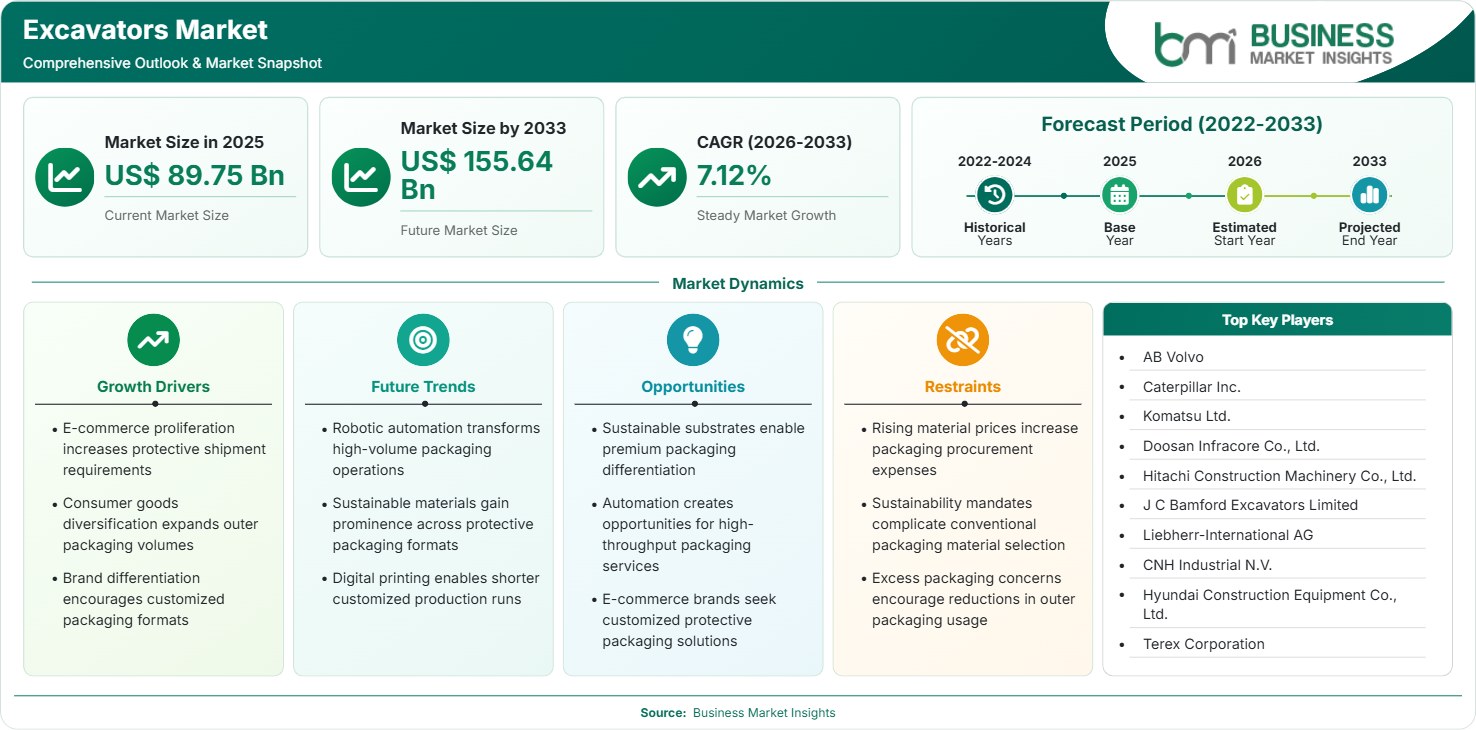
The Excavators Market size was valued at US$ 89.75 Billion in 2025 and is projected to reach US$ 155.64 Billion by 2033, growing at a CAGR of 7.12% during 2026–2033. Rising infrastructure investments, mining expansion, urban redevelopment projects, equipment electrification, automation technologies, and government-backed construction initiatives are creating substantial opportunities across developed and emerging economies worldwide.

Report Coverage
  • Type: Mini/Compact Excavator, Crawler Excavator, Wheeled Excavator, Other Excavator
  • End-Use Industry: Construction, Forestry & Agriculture, Mining, Others
US$ 89.75 Bn Market size in 2025
US$ 155.64 Bn Market Size by 2033
7.12% CAGR, 2026 - 2033
2026-2033 Forecast Period

AI Overview

Excavators Market Summary

  • North America Region: North America holds a market share of 28%–31% in 2025, growing with a CAGR of 6.4%–6.8% during 2026–2033. Infrastructure modernization, residential construction recovery, quarry expansion, and adoption of intelligent machinery support equipment demand and fleet replacement opportunities across contractors and rental operators. The US market benefits from transportation investments and equipment modernization, advancing at a CAGR of 6.5%–6.9%.
  • Fastest Growing Region: Asia Pacific holds a market share of 39%–42% in 2025, growing with a CAGR of 8.1%–8.6% during 2026–2033. Large-scale urbanization, industrial corridor development, mining investments, and public infrastructure programs create substantial opportunities for equipment manufacturers, dealers, and rental service providers across rapidly developing economies.
  • Leading Segment: Crawler Excavator holds a market share of 48%–52% in 2025, growing with a CAGR of 7.0%–7.4% during 2026–2033. Superior stability, heavy-duty earthmoving capability, mining suitability, and extensive use in infrastructure projects continue to support strong procurement across public and private sectors.
  • High Growth Segment: Construction holds a market share of 46%–50% in 2025, growing with a CAGR of 7.8%–8.3% during 2026–2033. Accelerating urban development, transportation projects, commercial construction activity, and government spending programs sustain equipment utilization and replacement demand globally.
  • Key Market Opportunity: Growing deployment of electric and hybrid excavators creates opportunities for manufacturers to address emission regulations, lower operating costs, improve sustainability performance, and strengthen participation in urban construction environments.
  • Major Market Players: AB Volvo, Caterpillar Inc., Komatsu Ltd., Doosan Infracore Co., Ltd., Hitachi Construction Machinery Co., Ltd., J C Bamford Excavators Limited, Liebherr-International AG, CNH Industrial N.V., Hyundai Construction Equipment Co., Ltd., and Terex Corporation.
Strategic Insights

Excavators Market: Strategic Insights

Excavators Market Strategic Framework
FREE PDF
Request your free sample
Request free sample
Stakeholder View

Key Takeaways

  • The value chain in the industry is now bringing together component suppliers, telematics providers, equipment manufacturers, rental companies, and construction contractors, thus forming a more connected ecosystem which is focused on productivity optimization and lifecycle management.
  • The construction linked with transportation corridors, smart cities, industrial parks, and renewable energy projects offers equipment suppliers the most promising chances for growth during the forecast period.
  • The shift in technological innovation is now taking place in the areas of electric powertrains, support for autonomous operation, advanced hydraulics, machine guidance systems, and predictive maintenance platforms, all of which contribute to increased efficiency and lower ownership costs.
  • The Asia Pacific region has the greatest potential for investment because of the fact that urbanization is continuing, government programs for infrastructure spending are in place, industrial expansion is taking place, and the government is providing continued support for construction activities.
  • Strategic partnerships, the expansion of the dealership network, manufacturing being localised, and a number of acquisitions intended at strengthening the companies' presence in various regions are still influencing the competitive landscape among the major equipment manufacturers.
  • As the equipment rental business model grows in importance, contractors are looking for greater flexibility, better cost efficiency, and access to highly technological machinery, all without having to make large capital commitments.
Geographic Outlook

Excavators Market Regional Highlights

North America Excavators Market

North America accounts for 28%–31% of global revenue in 2025 and is projected to register a CAGR of 6.4%–6.8% through 2033. Federal infrastructure spending, energy investments, and residential construction recovery continue to support equipment demand. Strong dealer networks, advanced rental ecosystems, and increasing adoption of telematics-enabled machinery reinforce regional competitiveness. The Excavators Market share in North America remains supported by replacement demand and modernization initiatives among contractors seeking productivity improvements and lower lifecycle operating costs.

  • Infrastructure investment schemes are still leading the way with regard to the purchasing of large earthmoving machinery for transportation corridors, bridges, highways, airports, and projects involving the expansion of utilities in the United States and Canada.
  • Equipment rental companies are expanding their fleets by using more advanced machines which are fitted with telematics, machine control systems, and fuel-efficient technologies in order to increase utilization and customer productivity.
  • Mining and quarrying activities in major regions known for resource production require crawler types that are capable of carrying out large-scale excavation and material handling operations efficiently.
  • Stricter environmental rules push companies to use equipment that gives off less pollution. These rules also lead to more spending on hybrid and electric machines that work well in city projects.
  • The lack of workers is causing faster acceptance of operator-assistance technologies, automated machine guidance systems, and remote diagnostics features that enhance jobsite efficiency.

US Excavators Market

The United States accounts for about 72% to 76% of the regional demand and is anticipated to grow at a compound annual growth rate of 6.5% to 6.9% over the forecast period. This growth is supported by substantial funding for public infrastructure, ongoing commercial construction projects, and investments in the energy sector, all of which in turn lead to continued equipment purchases. There is a growing trend among contractors to choose connected machinery and technologies that improve productivity. Fleet modernization remains a major driver of equipment purchases, with owners focusing on fuel efficiency, compliance, and operational reliability across construction, mining, and utilities.

  • Across the United States transportation modernization projects are still creating a great deal of demand for earthmoving equipment on road, rail, airport, and bridge building work.
  • The construction of utility networks and the development of renewable energy sources require excavation equipment for use on transmission infrastructure, solar installations, and energy storage facilities.
  • Advanced fleet management solutions are helping increase machine uptime through predictive maintenance, remote diagnostics, and real-time operational monitoring.
  • The increasing preference for renting equipment enables the use of highly technological machinery and at the same time, reduces the capital outlays that contractors have to make.

Europe Excavators Market

In 2025, Europe's market share will be between 22% and 25%, and it is expected to grow at a compound annual growth rate of 6.7% to 7.1% until 2033. Demand for equipment is being fueled by sustainability regulations, upgrades to infrastructure, and urban redevelopment programs. Germany accounts for the highest level of revenue in the region, whereas the Eastern European countries show a faster rate of expansion due to infrastructure investments. To meet changing environmental requirements without compromising productivity in both construction and industrial projects, manufacturers are increasingly likely to offer low-emission machinery and electrified equipment solutions.

  • Germany remains the largest national market, due to improvements in its transportation infrastructure, the implementation of industrial projects, and high activity in the construction sector.
  • Poland and Romania are among the most rapidly growing markets, the result of public infrastructure investments and industrial development initiatives.
  • Because of the stringent environmental standards and urban emissions regulations contractors are now considering electrification strategies when making decisions about equipment purchases.
  • Machine control and telematics are becoming more and more a part of the ways in which fleets are managed in order to enhance operational efficiency.
  • The development of renewable energy needs excavation machinery for wind, solar, and grid infrastructure projects in many countries in Europe.

Asia Pacific Excavators Market

Asia Pacific is expected to account for 39% to 42% of global revenue in 2025 and will see the highest compound annual growth rate, ranging from 8.1% to 8.6%, up to 2033. The demand for equipment is still being supported by rapid urbanization, industrialization, and the development of transportation infrastructure. China remains the largest market, while India shows the most promising growth. Long-term demand prospects in the region are being reinforced by government-supported infrastructure programs, manufacturing expansion, and increasing mechanization in construction activities.

  • China preserves its position of leadership by carrying out extensive investment in infrastructure, conducting urban redevelopment programs, and continuing its industrial construction activities.
  • India is expected to be the fastest-growing among the major markets, due to transportation projects, the smart city initiatives, and the development of industrial corridors.
  • Investments in mining throughout Australia and Southeast Asia result in a continuous demand for heavy-duty crawler excavation equipment.
  • Strategies for localizing equipment enable manufacturers to boost their competitiveness, lower their costs, and enhance their distribution capabilities in emerging economies.
  • The greater the adoption of digital technologies, the more benefits are gained in terms of fleet optimization, predictive maintenance, and higher machine productivity within construction companies.

Rest of World Excavators Market

The Rest of World region accounts for 8%–11% of global revenue in 2025 and is expected to expand at a CAGR of 7.2%–7.7% through 2033. Infrastructure development, mining investments, and energy projects continue driving machinery demand. South & Central America benefit from mining and transportation projects, while the Middle East & Africa growth is supported by urban expansion and diversification initiatives. Excavators Market growth across these regions reflects increasing mechanization and sustained government investment in economic development programs.

  • Brazil is leading South and Central America by making investments in mining, carrying out road construction projects, and developing agricultural infrastructure.
  • Chile is still a major demand centre because of its extensive mining activities, which require large-capacity excavation equipment and material handling capabilities.
  • Saudi Arabia drives strong equipment demand with big projects, city development plans, and efforts to broaden its economy.
  • The United Arab Emirates is still making investments in transportation infrastructure, logistics facilities, and commercial developments which require advanced machinery solutions.
  • The development of mining projects in Africa and that of transportation corridors leads to greater use of equipment in a number of resource-rich economies.

Global Market Geography
FREE PDF
Request your free sample
Request free sample
Segment Analysis

Excavators Market Segmentation

Type

The Type segment accounted for 100% of market demand and reflects diverse equipment requirements across construction, mining, infrastructure, and utility applications. Crawler excavators held the largest market share of 48%–52% in 2025 and are projected to expand at a CAGR of 7.0%–7.4% through 2033. Increasing mechanization, productivity requirements, and project complexity continue to broaden the Excavators Market scope across equipment categories serving distinct operational environments.

  • Mini/Compact Excavator: Widely utilized in urban construction, landscaping, residential development, and utility maintenance projects where maneuverability, reduced ground disturbance, and operation in confined spaces are critical requirements.
  • Crawler Excavator: Preferred for large-scale infrastructure, mining, quarrying, and heavy earthmoving applications due to superior stability, digging performance, and the capability to operate effectively across challenging terrain conditions.
  • Wheeled Excavator: Gaining adoption in municipal projects, road maintenance, and utility applications where mobility between job sites, operational flexibility, and lower transportation requirements deliver significant advantages.
  • Other Excavator: Includes specialized equipment designed for demolition, material handling, forestry operations, and niche excavation tasks requiring customized attachments and application-specific performance capabilities.

End-use Industry

The End-use Industry segment demonstrates strong diversification across infrastructure, resource extraction, and land development activities. Construction maintained the leading position with a market share of 46%–50% in 2025 and is anticipated to record a CAGR of 7.8%–8.3% through 2033. Growing urbanization, industrial expansion, and public infrastructure investments continue shaping Excavators Market trends while supporting sustained demand from multiple industry verticals.

  • Construction: Represents the largest demand source due to extensive use in residential, commercial, industrial, transportation, and public infrastructure projects requiring earthmoving and site preparation activities.
  • Forestry & Agriculture: Equipment supports land clearing, drainage development, irrigation projects, forestry management, and agricultural infrastructure improvements aimed at enhancing operational productivity.
  • Mining: Demand remains strong for excavation, overburden removal, material handling, and extraction activities across metal, mineral, coal, and aggregate mining operations worldwide.
Market Forces

Excavators Market Dynamics

Key Market Drivers

Global Infrastructure Expansion Accelerating Equipment Demand

Governments worldwide continue prioritizing transportation networks, urban infrastructure, energy facilities, and public utility modernization. Major investments in highways, rail corridors, airports, ports, and smart city developments are creating sustained demand for earthmoving machinery. According to multilateral development agencies and infrastructure investment assessments, global infrastructure spending requirements continue expanding across both developed and emerging economies. Excavators Market growth is closely linked to these capital-intensive projects because excavation activities form a foundational stage of most infrastructure developments. Contractors increasingly seek technologically advanced equipment to improve productivity, shorten project timelines, and support efficient resource utilization in large-scale construction environments.

Technology Integration Enhancing Productivity and Fleet Efficiency

These technological solutions include telematics, machine control systems, predictive maintenance systems, and autonomous operation capabilities being included in contemporary machinery. Such technological solutions increase fuel efficiency, decrease downtime, schedule maintenance effectively, and improve operator performance. Digital fleet management technologies allow contractors to monitor the usage, health status, and productivity of their machines in real-time. Excavators Market trends indicate growing demand for intelligent equipment solutions as construction firms face labor shortages, cost pressures, and increasingly complex project requirements. The adoption of connected machinery technologies strengthens the value propositions of equipment while improving operational outcomes across infrastructure, mining, and industrial applications globally.

Mining Sector Investments Supporting Heavy Equipment Utilization

With the increasing demand for critical minerals, industrial metals, aggregates, and energy sources, investments in mining facilities around the globe continue to be on the rise. The rising trend in the expansion of projects for mining copper, lithium, nickel, iron ore, and aggregates underscores the need for highly productive excavators that can operate efficiently in difficult conditions. Mining corporations seek durable equipment that offers both productivity and longevity in challenging conditions. Crawler excavators remain highly relevant for stripping, mining, and material-handling processes.

Key Market Opportunities

Electrification of Construction Equipment Fleets

The transition toward low-emission construction practices presents a significant opportunity for equipment manufacturers. Electric and hybrid excavators are increasingly attracting attention from contractors operating in urban environments, where emissions and noise restrictions are becoming more stringent. Advances in battery technology, charging infrastructure, and energy management systems are improving operational feasibility. Excavators Market Forecasts indicate increasing investment in sustainable equipment portfolios as governments and private organizations pursue carbon reduction objectives. Manufacturers capable of delivering reliable electric models with competitive operating performance can strengthen market positioning while capturing emerging demand across municipal, infrastructure, and commercial construction applications.

Growth of Equipment Rental and Leasing Ecosystems

The rental and leasing options are still becoming more popular as contractors look for flexibility and a cost-effective way to get access to sophisticated machinery. Instead of making large capital outlays to own the equipment, smaller and medium-sized construction companies are increasingly choosing to rent it. Rental companies are growing their fleets by adding more technologically advanced machines, which in turn lead to greater productivity and better operational reliability. The fact that this trend is developing offers manufacturers the chance to form strategic partnerships with rental operators, and at the same time increases the rate at which the equipment is put into use. The growth of these rental ecosystems also speeds up the introduction of new technologies into the market by lowering the financial obstacles for end users in a wide range of construction and industrial fields.

Emerging Market Urbanization and Industrial Development

Rapid expansion of urban areas in Asia, Africa, the Middle East, and certain parts of Latin America is still creating a great deal of demand for construction machinery. The need to invest in transportation networks, industrial sites, housing projects, and utility infrastructure leads to ongoing equipment purchases. Since governments are giving priority to economic development schemes that involve large-scale earthmoving and site preparation work, this is driving the need for such machinery. Companies that are expanding their local production, dealer networks, and after-sales service capabilities can take advantage of these opportunities. The increasing degree of mechanization in developing economies also improves the likelihood of continued equipment adoption and fleet modernization programs over the forecast period.

Market Restraints and Challenges

High Equipment Ownership and Operating Costs

Factor: Excavators require significant capital investment, ongoing maintenance expenditures, skilled operators, fuel consumption, and periodic component replacement.

Impact: The cost of ownership may hinder purchases by small contracting firms and developers, especially in regions that are price-sensitive. In addition, economic unpredictability and limited finances may further discourage purchase decisions. Whereas hiring equipment helps solve some of the financial problems, ownership is difficult for companies that have constrained funds. Increasing costs of production materials such as steel, hydraulics, electronics, and logistics contribute to the rising price of equipment.

Supply Chain Volatility and Component Availability Risks

Factor: Global equipment production relies on complex supply chains involving steel, semiconductors, hydraulic systems, powertrain components, and electronic modules sourced from multiple regions.

Impact: Disruptions affecting component availability can increase manufacturing lead times, elevate production costs, and delay equipment deliveries. Geopolitical tensions, transportation bottlenecks, raw material price fluctuations, and trade restrictions can influence operational efficiency throughout the value chain. Extended delivery schedules may affect contractor project planning and fleet expansion strategies. Manufacturers must therefore invest in supply chain diversification, inventory management, and sourcing resilience to mitigate operational risks effectively.

Company Analysis

Competitive Landscape

The competitive environment is characterized by technological innovation, manufacturing scale, dealer network expansion, and aftermarket service capabilities. Excavators Market analysis indicates that leading manufacturers are prioritizing electrification, telematics integration, autonomous machine functions, and fuel-efficient hydraulic systems to strengthen competitiveness and address evolving customer requirements.

Company Name

Overview

Products and Services relevant to this market

AB Volvo

Global construction equipment manufacturer with strong presence across infrastructure, mining, and earthmoving machinery segments.

Excavators, wheel loaders, articulated haulers, telematics solutions, fleet management services, and construction productivity technologies.

Caterpillar Inc.

Leading heavy equipment producer serving construction, mining, quarrying, and industrial customers worldwide.

Hydraulic excavators, autonomous technologies, machine control systems, aftermarket support, maintenance services, and digital fleet solutions.

Komatsu Ltd.

Major construction and mining equipment manufacturer with extensive global distribution and technology capabilities.

Excavators, mining equipment, intelligent machine control technologies, telematics systems, and productivity optimization services.

Doosan Infracore Co., Ltd.

Construction machinery provider recognized for durable earthmoving equipment and expanding international operations.

Excavators, wheel loaders, engine technologies, equipment monitoring systems, and aftermarket support solutions.

Hitachi Construction Machinery Co., Ltd.

Global supplier of advanced construction and mining machinery with strong engineering expertise.

Hydraulic excavators, mining excavators, digital construction solutions, telematics platforms, and maintenance support services.

J C Bamford Excavators Limited

International equipment manufacturer known for construction, agricultural, and earthmoving machinery innovation.

Excavators, backhoe loaders, compact equipment, powertrain technologies, and machine productivity solutions.

Liebherr-International AG

Diversified engineering group with strong capabilities in construction and mining equipment manufacturing.

Crawler excavators, wheeled excavators, mining machinery, automation technologies, and equipment lifecycle services.

CNH Industrial N.V.

Global industrial equipment company operating across construction, agriculture, and commercial vehicle sectors.

Construction machinery, excavators, fleet management tools, equipment financing, and aftermarket support programs.

Hyundai Construction Equipment Co., Ltd.

Heavy equipment manufacturer serving infrastructure, industrial, and mining sectors globally.

Hydraulic excavators, compact excavators, smart machine technologies, telematics systems, and maintenance services.

Terex Corporation

Industrial equipment company providing machinery solutions for construction and material handling industries.

Excavation equipment, lifting solutions, infrastructure support machinery, aftermarket services, and equipment technologies.

Trust & Transparency

Research Methodology

The market analysis combines proprietary research with secondary data from government agencies, company disclosures, regulatory filings, industry databases and expert interviews. Market estimates are validated through data triangulation, cross-market benchmarking and analyst review.

View Full Research Methodology

Questions Answered

Frequently Asked Questions

How does the Excavators Market Report support strategic planning?

The Excavators Market Report provides detailed insights into technology developments, regional opportunities, competitive dynamics, investment priorities, equipment demand patterns, and emerging growth areas that influence strategic business decisions.

Which region offers the strongest growth opportunities?

Asia Pacific presents the most attractive opportunities due to extensive infrastructure spending, rapid urbanization, industrial expansion, mining investments, and increasing mechanization of construction activities across developing economies.

How is electrification influencing the industry?

Electric excavators help contractors reduce emissions, comply with environmental regulations, lower operating costs, and improve suitability for urban construction projects where noise and pollution restrictions are increasingly important.

What is the most widely used excavator type?

Crawler excavators represent the most widely used category because of their stability, digging capability, durability, and suitability for infrastructure, mining, and heavy earthmoving projects across diverse operating environments.

What factors are driving demand for excavators worldwide?

Infrastructure investments, urbanization, mining expansion, transportation projects, industrial development, and growing adoption of mechanized construction practices are the primary factors supporting long-term equipment demand across global markets.

Access the Full Excavators Market Report

Get segment-level forecasts, regional estimates, competitive benchmarking, company profiles and downloadable Excel datasets.

Access the full Excavators Market Report
350 pages PDF & Excel | 2026-09-15
Similar Research

Related Market Reports