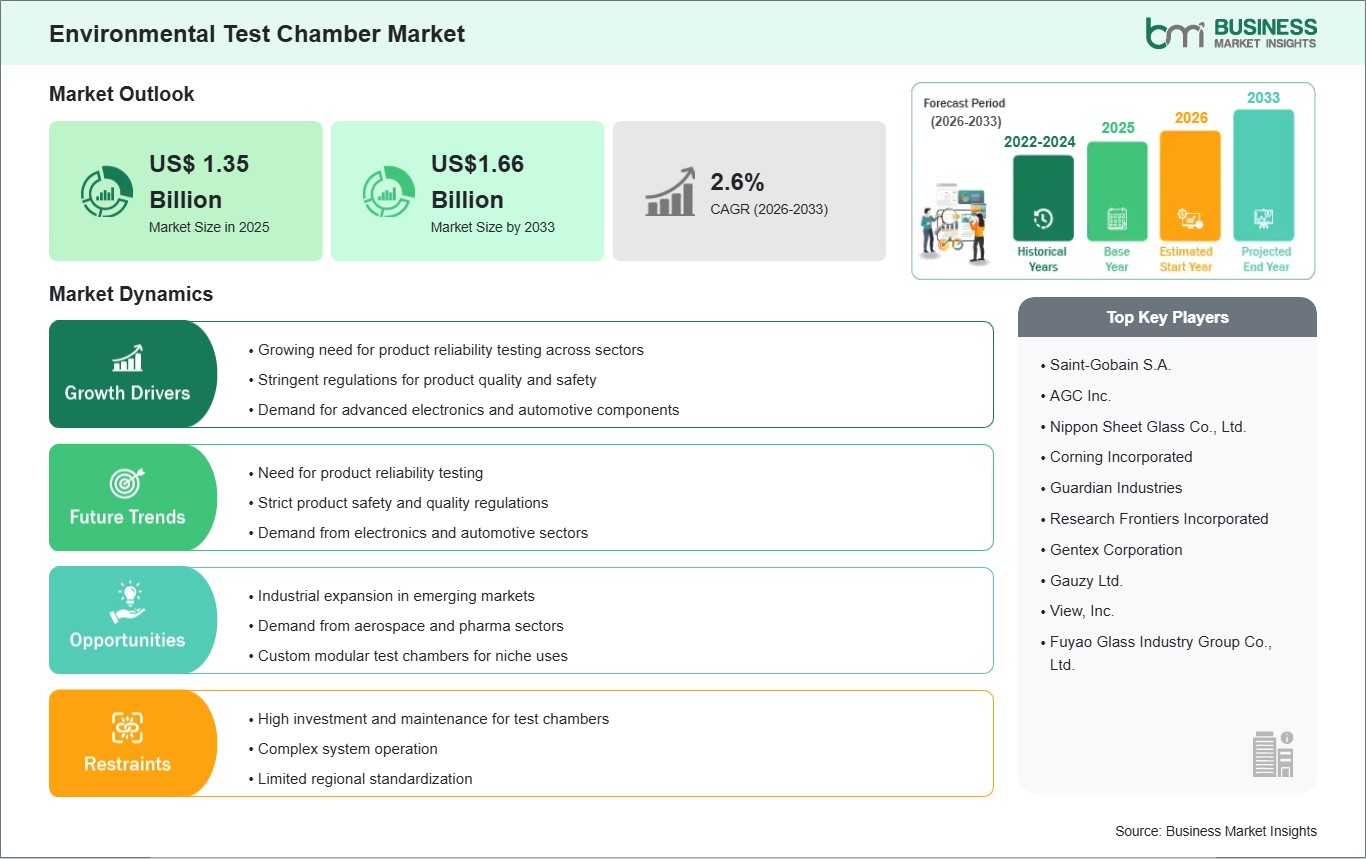
The environmental test chamber market size is expected to reach US$ 1.66 billion by 2033 from US$ 1.35 billion in 2025. The market is estimated to record a CAGR of 2.6% from 2025 to 2033.
Environmental test chambers have emerged as an essential component across industries worldwide for evaluating product performance under controlled environmental conditions and ensuring compliance with regulatory standards. These chambers—including temperature & humidity chambers, thermal shock test chambers, walk-in chambers, customized chambers, and vibration chambers—are increasingly deployed across research and development (R&D) laboratories, production and inspection facilities, aerospace and defense units, automotive manufacturing plants, electronics and telecommunications industries, and medical and pharmaceutical sectors. Environmental test chambers provide multiple advantages, including simulation of extreme environmental conditions, accelerated product testing, early detection of design or material failures, improved product reliability, and enhanced adherence to industry regulations and quality standards. Growing demand for high-quality, durable, and compliant products, combined with stringent international testing standards, has intensified the focus on adopting advanced environmental testing solutions.
However, the environmental test chamber market faces certain challenges that may restrain its growth. These include high initial procurement costs, complex installation and maintenance requirements, calibration challenges, energy consumption, and integration difficulties with existing production or R&D workflows. Capital expenditure constraints, limited technical expertise, and evolving international testing regulations also influence purchasing decisions. Despite these challenges, the market presents strong growth opportunities, primarily driven by the rising emphasis on R&D and quality testing, increasing adoption of customized and automated test chambers, expansion of high-tech industries, integration of IoT-enabled monitoring systems for real-time data analytics, and growing global demand for reliable and regulatory-compliant products.

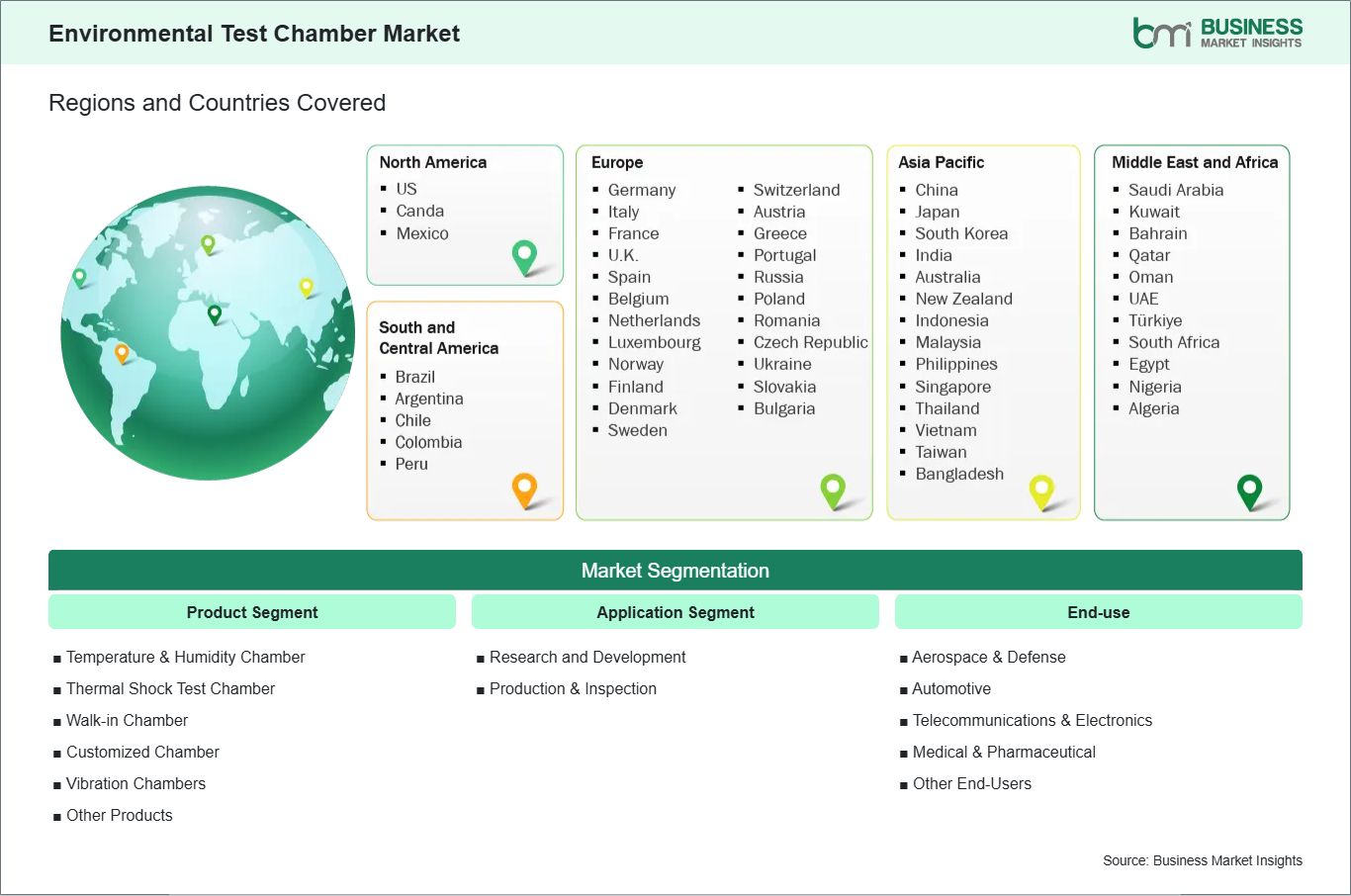
Key segments that contributed to the derivation of the environmental test chamber market analysis are product type, application, end-use, and business model.
The increasing emphasis on product reliability, durability, and compliance with global standards is a major driver for the environmental test chambers market. Industries such as aerospace, automotive, electronics, and pharmaceuticals require rigorous testing under controlled environmental conditions to ensure that products can withstand extreme temperatures, humidity, vibration, and thermal shocks. Regulatory mandates and quality certifications further compel manufacturers to adopt advanced testing solutions. By enabling accelerated testing and early identification of design or material weaknesses, environmental test chambers help companies reduce product failures, maintain brand reputation, and comply with international standards, thereby driving market growth.
The integration of IoT, automation, and real-time analytics presents a significant opportunity for the environmental test chambers market. Smart chambers equipped with connected sensors and monitoring systems allow remote control, predictive maintenance, and continuous performance tracking, improving efficiency and reducing operational downtime. Automated data collection and analysis enhance accuracy and enable faster decision-making during R&D and production testing. Companies can also offer subscription-based monitoring and service contracts, creating recurring revenue streams. As industries increasingly focus on digitalization and intelligent testing solutions, IoT-enabled environmental test chambers provide a competitive edge and open avenues for innovation and market expansion.
By product type, the market is segmented into temperature & humidity chambers, thermal shock test chambers, walk-in chambers, customized chambers, vibration chambers, and others. Temperature & humidity chambers held a significant share in 2025 due to their widespread use across R&D laboratories, production facilities, automotive and aerospace testing, and electronics manufacturing, driven by strong demand for product reliability, compliance with international standards, and accelerated testing of materials and components under controlled environmental conditions. These chambers enable precise simulation of temperature and humidity variations, making them essential for quality assurance and regulatory adherence.
By application, the market is segmented into research and development (R&D) and production & inspection. The R&D segment dominated in 2025, supported by increasing investments in product innovation, material testing, and pre-production validation across high-tech industries.
By end-use, the market is segmented into aerospace & defense, automotive, telecommunications & electronics, medical & pharmaceutical, and others. Aerospace & defense led the market in 2025 due to the critical need for reliability testing under extreme environmental conditions.
By business model, the market is segmented into product and service. The product segment accounted for the largest share in 2025, driven by strong demand for high-performance testing chambers and associated installation solutions.
| Report Attribute | Details |
|---|---|
| Market size in 2025 | US$ 1.35 Billion |
| Market Size by 2033 | US$1.66 Billion |
| Global CAGR (2026 - 2033) | 2.6% |
| Historical Data | 2022-2024 |
| Forecast period | 2026-2033 |
| Segments Covered | By Product Segment
|
|
Regions and Countries Covered
| |
| North America | US, Canada, Mexico |
| Europe | Belgium, Austria, Finland, Denmark, Greece, Poland, Romania, Russia, Ukraine, Czech Republic, Slovakia, Bulgaria, Italy, Luxembourg, Germany, Switzerland, France, Netherlands, Norway, Portugal, Spain, Sweden, United Kingdom |
| Asia-Pacific | Australia, China, India, Japan, South Korea, Indonesia, Malaysia, Philippines, Singapore, Thailand, Vietnam, Bangladesh, New Zealand, Taiwan |
| South and Central America | Brazil, Argentina, Peru, Chile, Colombia |
| Middle East and Africa | Bahrain, Kuwait, Oman, Qatar, Saudi Arabia, United Arab Emirates, Turkiye, South Africa, Egypt, Algeria, Nigeria |
| Market leaders and key company profiles |
|
The "Environmental Test Chamber Market Size and Forecast (2022-2033)" report provides a detailed analysis of the market covering below areas:
The geographical scope of the environmental test chamber market report is divided into five regions: North America, Asia Pacific, Europe, Middle East & Africa, and South & Central America. The environmental test chamber market in Asia Pacific is expected to grow significantly during the forecast period.
The Asia-Pacific environmental test chambers market is segmented into China, Japan, South Korea, India, Australia, New Zealand, Indonesia, Malaysia, the Philippines, Singapore, Thailand, Vietnam, Taiwan, Bangladesh, and the Rest of Asia. The region is witnessing strong growth, driven by rapid industrialization, expanding R&D activities, and increasing investments in advanced manufacturing, aerospace, automotive, and electronics sectors. Major economies such as China, Japan, and India are leading market growth due to rising demand for product testing, reliability validation, and compliance with international quality and safety standards.
The region is also experiencing growing adoption of advanced testing technologies, including IoT-enabled chambers, customized walk-in chambers, thermal shock test chambers, and vibration testing solutions. Increasing awareness of product quality, stricter regulatory compliance requirements, and government initiatives supporting industrial innovation and smart manufacturing are further boosting market demand. Additionally, rising investments in R&D infrastructure, technological advancements in automation and chamber monitoring systems, and expansion of high-tech industries are positioning Asia-Pacific as a key growth region in the global environmental test chambers market.

The environmental test chamber market is evaluated by gathering qualitative and quantitative data post primary and secondary research, which includes important corporate publications, association data, and databases. A few of the key developments in the environmental test chamber market are:
The Environmental Test Chamber Market is valued at US$ 1.35 Billion in 2025, it is projected to reach US$1.66 Billion by 2033.
As per our report Environmental Test Chamber Market, the market size is valued at US$ 1.35 Billion in 2025, projecting it to reach US$1.66 Billion by 2033. This translates to a CAGR of approximately 2.6% during the forecast period.
The Environmental Test Chamber Market report typically cover these key segments-
The historic period, base year, and forecast period can vary slightly depending on the specific market research report. However, for the Environmental Test Chamber Market report:
The Environmental Test Chamber Market is populated by several key players, each contributing to its growth and innovation. Some of the major players include:
The Environmental Test Chamber Market report is valuable for diverse stakeholders, including:
Essentially, anyone involved in or considering involvement in the Environmental Test Chamber Market value chain can benefit from the information contained in a comprehensive market report.
Please tell us your area of interest
(Market Segments/ Regions and Countries/ Companies)