Market Summary
Executive Summary and Global Market Analysis
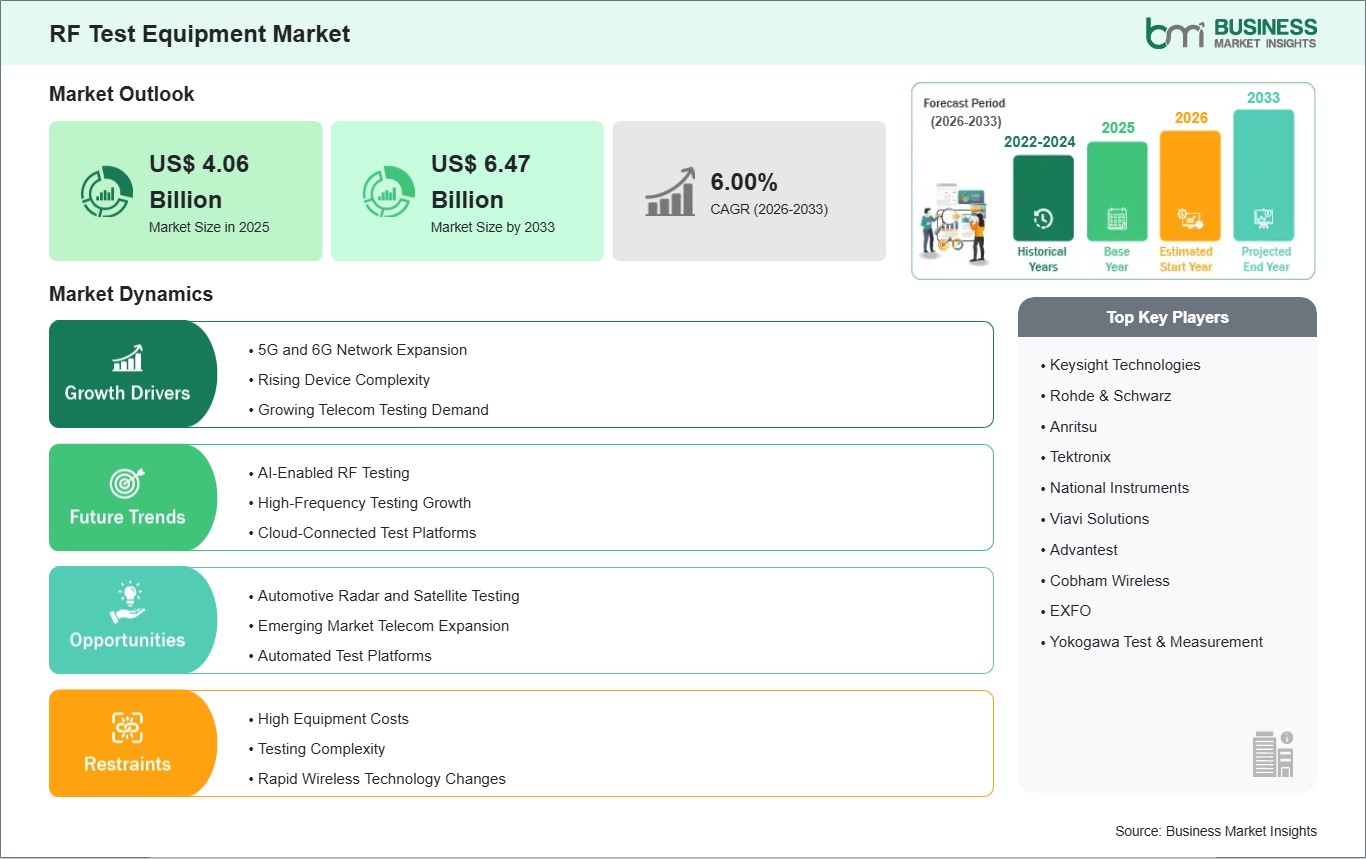
The global RF test equipment market is driven by the continuous expansion of wireless communication infrastructure and the rapid adoption of advanced connectivity technologies such as 5G and emerging 6G systems. RF test instruments including oscilloscopes, spectrum analyzers, signal generators, and network analyzers play a crucial role in evaluating signal performance, spectrum efficiency, and device reliability across a wide range of frequencies.
As connected technologies expand across industries, RF testing has become increasingly essential for ensuring compatibility, performance, and regulatory compliance of electronic systems. Consumer electronics manufacturers, telecommunications operators, and semiconductor companies rely on RF test equipment to validate wireless communication modules, integrated circuits, and high-frequency components.
In recent years, advancements in mmWave technologies, satellite communications, and radar systems have further increased demand for high-precision RF testing platforms. These technologies require accurate signal generation and measurement capabilities across complex frequency bands.
Manufacturers are also integrating software-defined capabilities, AI-assisted analytics, and automated test workflows into RF testing platforms. These innovations allow engineers to accelerate testing cycles, improve measurement accuracy, and optimize product development processes across distributed R&D environments.
Segment Analysis
RF Test Equipment Market Segmentation
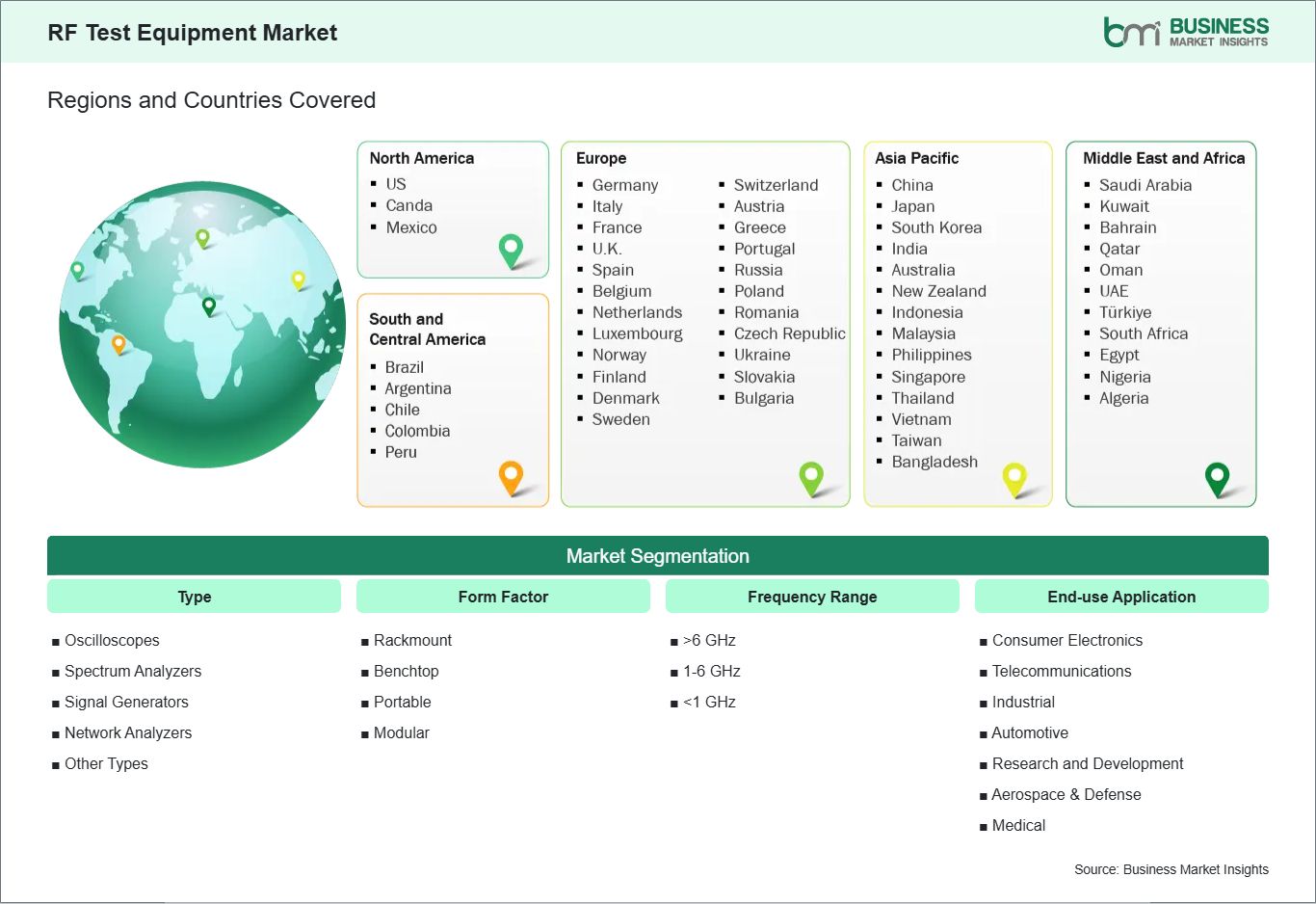
Key segments that contributed to the derivation of the RF test equipment market analysis are type, form factor, frequency range, and end-use application.
- By type, the RF test equipment market is segmented into oscilloscopes, spectrum analyzers, signal generators, network analyzers, and other types. Oscilloscopes dominated the market in 2025.
- By form factor, the market is segmented into rackmount, benchtop, portable, and modular. Benchtop instruments dominated the market in 2025.
- Based on frequency range, the market is segmented into more than 6 GHz, 1–6 GHz, and less than 1 GHz. The more than 6 GHz segment dominated the market in 2025.
- In terms of end-use application, the market is segmented into consumer electronics, telecommunications, industrial, automotive, research and development, aerospace & defense, and medical. The telecommunications segment dominated the market in 2025.
Market Forces
RF Test Equipment Market Drivers and Opportunities
Expanding Wireless Networks and Device Complexity
The expansion of advanced wireless networks, including global 5G deployment and early-stage 6G development, is a major driver for the RF test equipment market. Telecommunications providers and electronics manufacturers require high-precision testing solutions to validate signal quality, spectrum usage, and device interoperability across multiple frequency bands.
With the increasing number of connected devices and IoT-enabled systems, wireless environments have become more complex and crowded. RF testing equipment enables engineers to analyze signal behavior, detect interference, and verify compliance with global communication standards.
Modern RF testing platforms incorporate automated workflows, AI-driven analytics, and cloud-based data management systems that enhance testing efficiency. These innovations allow manufacturers to perform high-volume device validation while maintaining high accuracy and reducing testing time.
Growing Cross-Industry Applications Creating Opportunities
RF testing technologies are expanding beyond telecommunications into sectors such as automotive, aerospace, industrial automation, and medical electronics. Automotive manufacturers increasingly rely on RF testing for radar sensors, vehicle-to-everything communication systems, and advanced driver assistance systems.
Similarly, aerospace and defense applications require precise RF testing for satellite communications, radar systems, and secure communication networks. As industries adopt advanced wireless technologies, demand for high-performance RF testing platforms continues to increase.
Size and Share Analysis
RF Test Equipment Market Size and Share Analysis
The RF Test Equipment Market demonstrates steady growth, with size and share analysis highlighting evolving trends and competitive dynamics among key players. The report examines subsegments categorized within type, form factor, frequency range, and end-use application.
By type, the spectrum analyzers subsegment dominated the market in 2025 driven by its ability to analyze complex signal spectra across advanced wireless communication standards.
Based on form factor, the benchtop subsegment dominated the market in 2025 due to its widespread use in laboratories and production testing environments.
In terms of frequency range, the 1 to 6 GHz subsegment dominated the market in 2025 owing to its extensive use in mainstream wireless communication technologies.
By end-use application, the telecommunications sector dominated the market in 2025 driven by increasing investments in wireless network testing and validation.
Report Coverage
RF Test Equipment Market Report Coverage and Deliverables
The "RF Test Equipment Market Size and Forecast (2022 - 2033)" report provides a detailed analysis of the market covering below areas:
- RF Test Equipment Market size and forecast at global, regional, and country levels for all the key market segments covered under the scope
- RF Test Equipment Market trends, as well as drivers, restraints, and opportunities
- RF Test Equipment Market analysis covering key trends, global and regional framework, major players, regulations, and recent developments
- Industry landscape and competition analysis covering market concentration, heat map analysis, prominent players, and recent developments
- Detailed company profiles including SWOT analysis
Geographic Insights
RF Test Equipment Market Geographic Insights
The geographical scope of the RF Test Equipment Market report is divided into North America, Asia Pacific, Europe, Middle East & Africa, and South & Central America. North America held the largest share in 2025.
North America leads the market due to the presence of major telecommunications infrastructure providers, semiconductor companies, and advanced R&D ecosystems focused on wireless communication technologies.
Europe demonstrates strong demand for RF testing solutions driven by regulatory frameworks, industrial modernization initiatives, and aerospace technology development.
The Asia Pacific region is experiencing rapid growth due to large-scale electronics manufacturing and widespread deployment of 5G infrastructure across China, South Korea, Japan, and India.
Emerging markets in Latin America and the Middle East & Africa are gradually adopting RF testing technologies as wireless communication networks expand.
Industry Activity
Recent Developments
The RF Test Equipment Market is evaluated by gathering qualitative and quantitative data post primary and secondary research, which includes important corporate publications, association data, and databases. A few of the key developments in the RF test equipment market are:
- In February 2025, Keysight launched compact RF and microwave signal generators, RF synthesizers, and source analyzers supporting frequencies up to 54 GHz, improving wireless, defense, and aerospace testing efficiency.
- In July 2025, Anritsu launched software for MT8000A enabling enhanced 5G NR DL 1024QAM RF testing capabilities, improving validation of high-throughput devices.
Trust & Transparency
Research Methodology
The market analysis combines proprietary research with secondary data from government agencies, company disclosures, regulatory filings, industry databases and expert interviews. Market estimates are validated through data triangulation, cross-market benchmarking and analyst
review.
View Full Research Methodology
Key Sources Referred:
International Telecommunication Union (ITU)Institute of Electrical and Electronics Engineers (IEEE)Federal Communications Commission (FCC)European Telecommunications Standards Institute (ETSI)International Electrotechnical Commission (IEC)National Institute of Standards and Technology (NIST)International Trade Administration