Market Summary
Executive Summary and Global Market Analysis
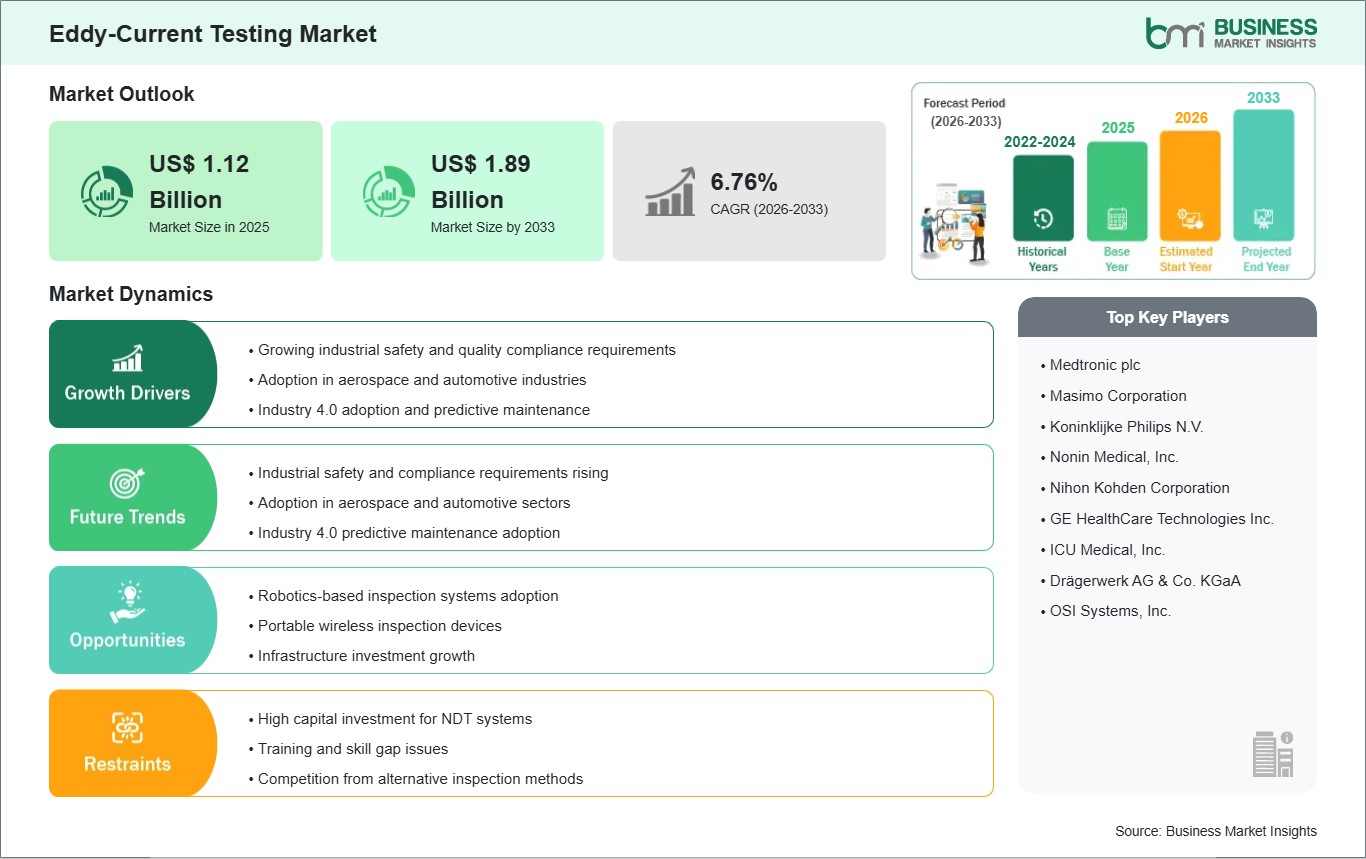
The global eddy-current testing (ECT) market is a vital segment within the non-destructive testing (NDT) industry, valued for its ability to detect surface and near-surface flaws in conductive materials without causing damage. ECT works on the principle of electromagnetic induction, where a coil carrying an alternating current generates eddy currents in a conductive test material; variations in these currents caused by flaws or material changes are detected and analyzed. The market is experiencing steady growth driven by stringent safety and quality assurance regulations across critical industries, the increasing need for preventive maintenance to extend asset lifespan, and the advancement of portable and automated ECT systems. Key sectors such as aerospace, power generation, and automotive rely heavily on ECT for inspecting components like aircraft fuselages, turbine blades, heat exchanger tubes, and critical welds, where failure is not an option. The technology’s advantages—including no requirement for couplant, suitability for high-temperature applications, and ability to detect minute cracks—solidify its position in the NDT portfolio.
However, the market faces constraints including the technique's limitation to conductive materials, the need for highly skilled technicians to interpret complex signals, and competition from other NDT methods like ultrasonic and phased array testing for certain applications. Despite these challenges, significant opportunities are emerging from the integration of ECT with robotics and automated scanning systems for large-scale inspections, the development of advanced multi-frequency and array probes for higher resolution, and the growing demand for in-situ inspection in aging infrastructure across the energy and manufacturing sectors.
Eddy-Current Testing Market Segmentation Analysis:
Segment Analysis
Eddy-Current Testing Market Segmentation
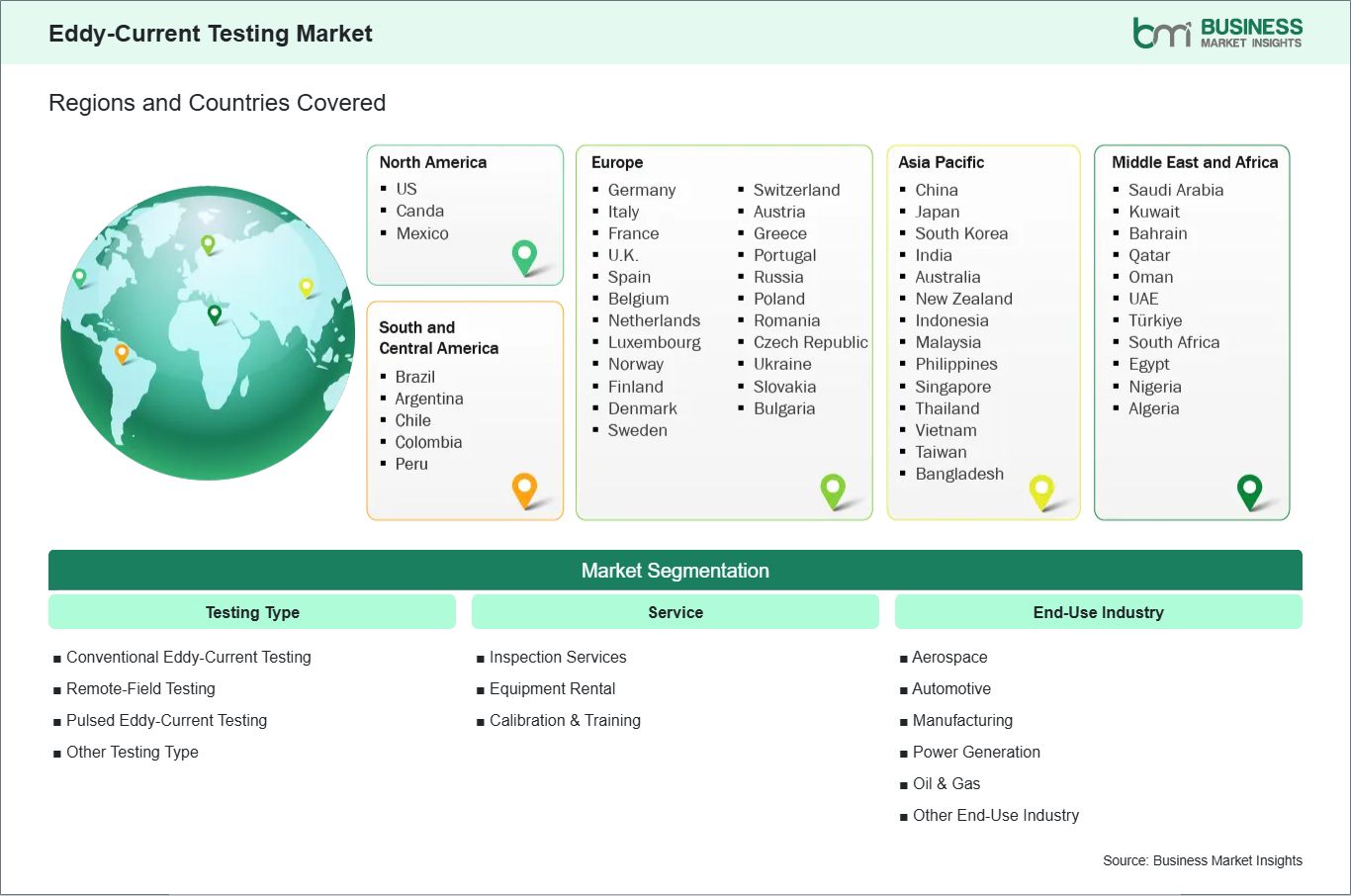
Key segments that contributed to the derivation of the eddy-current testing market analysis are testing type, service, and end-use industry.
- By testing type, the market is segmented into conventional eddy-current testing, remote-field testing, pulsed eddy-current testing, and others. Conventional ECT held the largest market share in 2025, as it is the most widely adopted and versatile method for surface crack detection and conductivity measurements.
- By service, the market is categorized into inspection services, equipment rental, and calibration & training. The inspection services segment dominated in 2025, as many end-users, especially in oil & gas and power generation, outsource specialized NDT inspections to certified service providers rather than maintaining in-house capabilities.
- By end-use industry, the market is segmented into aerospace, automotive, manufacturing, power generation, oil & gas, and others. The aerospace sector was the largest end-user in 2025, driven by the mandatory and frequent inspection of aircraft structures and engines to meet rigorous aviation safety standards from bodies like the FAA and EASA.
Market Forces
Eddy-Current Testing Market Drivers and Opportunities
Stringent Safety Regulations and Asset Integrity Management
The primary driver for the ECT market is the uncompromising focus on safety and regulatory compliance in asset-intensive industries. Regulatory bodies worldwide mandate regular non-destructive inspections of critical infrastructure. In aerospace, for example, continuous airworthiness requirements dictate strict inspection schedules. In the energy sector, regulations like the American Society of Mechanical Engineers (ASME) Boiler and Pressure Vessel Code enforce regular inspections. ECT is a preferred method for many of these applications due to its speed, sensitivity, and reliability. Concurrently, the industrial shift towards predictive and condition-based asset integrity management is driving demand. Companies are moving from reactive repairs to scheduled maintenance based on inspection data to prevent catastrophic failures, optimize downtime, and extend the operational life of high-value assets, creating a recurring need for ECT services.
Automation and Advanced Probe Technology
A significant market opportunity lies in the automation of ECT and the development of advanced probe technologies. The integration of ECT probes with robotic crawlers, drones, and automated scanning systems allows for the inspection of large, complex, or hazardous areas (e.g., offshore platforms, aircraft wings, refinery columns) with greater consistency, speed, and safety, reducing human error and exposure. Furthermore, innovations in probe design, such as eddy-current array (ECA) probes and combined ECT/ultrasonic probes, are expanding the technique’s capabilities. ECA probes, with their multiple coils, provide wider coverage and detailed imaging, making them ideal for weld inspection and corrosion mapping. These technological advancements are opening new applications in additive manufacturing (3D-printed part inspection) and the semiconductor industry, driving growth beyond traditional sectors.
Size and Share Analysis
Eddy-Current Testing Market Size and Share Analysis
By testing type, conventional ECT remains the workhorse technology due to its established protocols and broad applicability. Pulsed eddy-current testing is gaining substantial traction in the oil & gas and petrochemical industries for corrosion under insulation (CUI) screening and is the fastest-growing segment by technology type.
By service, inspection services constitute the bulk of the market's value, as the expertise and certification of personnel are critical. The equipment segment is competitive, with growth driven by the adoption of portable, digital instruments with data logging capabilities. Calibration and training are essential, niche segments that support the overall ecosystem.
By end-use industry, aerospace is the highest-value segment due to the criticality of components and the premium on reliability. Power generation (including nuclear) is another high-stakes sector with steady demand. The manufacturing sector uses ECT for quality control in production lines, representing consistent volume demand. The automotive industry is a growing adopter for testing material properties and inspecting high-strength alloys and welds in electric vehicle components.
Report Coverage
Eddy-Current Testing Market Report Coverage and Deliverables
The "Eddy-Current Testing Market Size and Forecast (2022-2033)" report provides a detailed analysis of the market covering below areas:
- Eddy-Current Testing Market size and forecast at global, regional, and country levels for all the key market segments covered under the scope
- Eddy-Current Testing Market trends, as well as market dynamics such as drivers, restraints, and key opportunities
- Eddy-Current Testing Market analysis covering key market trends, global and regional framework, major players, regulations, and recent market developments
- Industry landscape and competition analysis covering market concentration, heat map analysis, prominent players, and recent developments for the eddy-current testing market
- Detailed company profiles, including SWOT analysis
Geographic Insights
Eddy-Current Testing Market Geographic Insights
The geographical scope of the eddy-current testing market report is divided into five regions: North America, Europe, Asia Pacific, Middle East & Africa, and South & Central America. North America and Europe are the leading markets in terms of technological adoption and stringent regulatory enforcement, while Asia Pacific is projected to be the fastest-growing region.
North America, led by the United States, is a mature and technologically advanced market. A strong aerospace & defense sector, extensive oil & gas infrastructure, and strict safety regulations from bodies like the FAA and OSHA drive consistent, high-value demand for advanced ECT services and equipment.
Europe follows a similar pattern, with a robust aerospace industry (Airbus), a significant power generation base, and rigorous EU-wide industrial safety standards. Countries like Germany, France, and the UK are key markets where quality assurance is paramount across manufacturing sectors.
Asia Pacific is expected to exhibit the highest growth rate, fueled by rapid industrialization, expanding aerospace MRO (Maintenance, Repair, and Overhaul) activities, and massive investments in energy and infrastructure in China, India, Japan, and Southeast Asia. The growing manufacturing base, particularly in automotive and heavy machinery, is also contributing to increased adoption of quality control NDT methods like ECT.
Industry Activity
Recent Developments
The eddy-current testing market is evaluated by gathering qualitative and quantitative data post primary and secondary research, which includes important corporate publications, association data, and databases. A few of the key developments in the eddy-current testing market are:
- In February 2026, Welding and fabrication technology company ESAB Corporation has agreed to acquire Eddyfi Technologies, a specialist in non-destructive testing instrumentation and integrity management solutions, for US$1.45 billion.
- In October 2022, UniWest announces the introduction of the new EddyView II portable Eddy Current flaw detector at the ASNT Annual 2022 Conference. The innovative EddyView II features a large 8-inch touch screen display with gesture adjustments for key parameters such as gain and rotation, ability to drive conventional probes or array probes, an independent channel that monitors probe to part coupling (liftoff), and UniWest’s industry-leading signal performance with extremely low signal-to-noise.
Trust & Transparency
Research Methodology
The market analysis combines proprietary research with secondary data from government agencies, company disclosures, regulatory filings, industry databases and expert interviews. Market estimates are validated through data triangulation, cross-market benchmarking and analyst
review.
View Full Research Methodology
Key Sources Referred:
World Bank - Global Trade IndicatorsWorld Trade Organization (WTO)International Monetary Fund (IMF)International Trade Administration (ITA)Company websiteCompany annual reportsCompany investor presentations