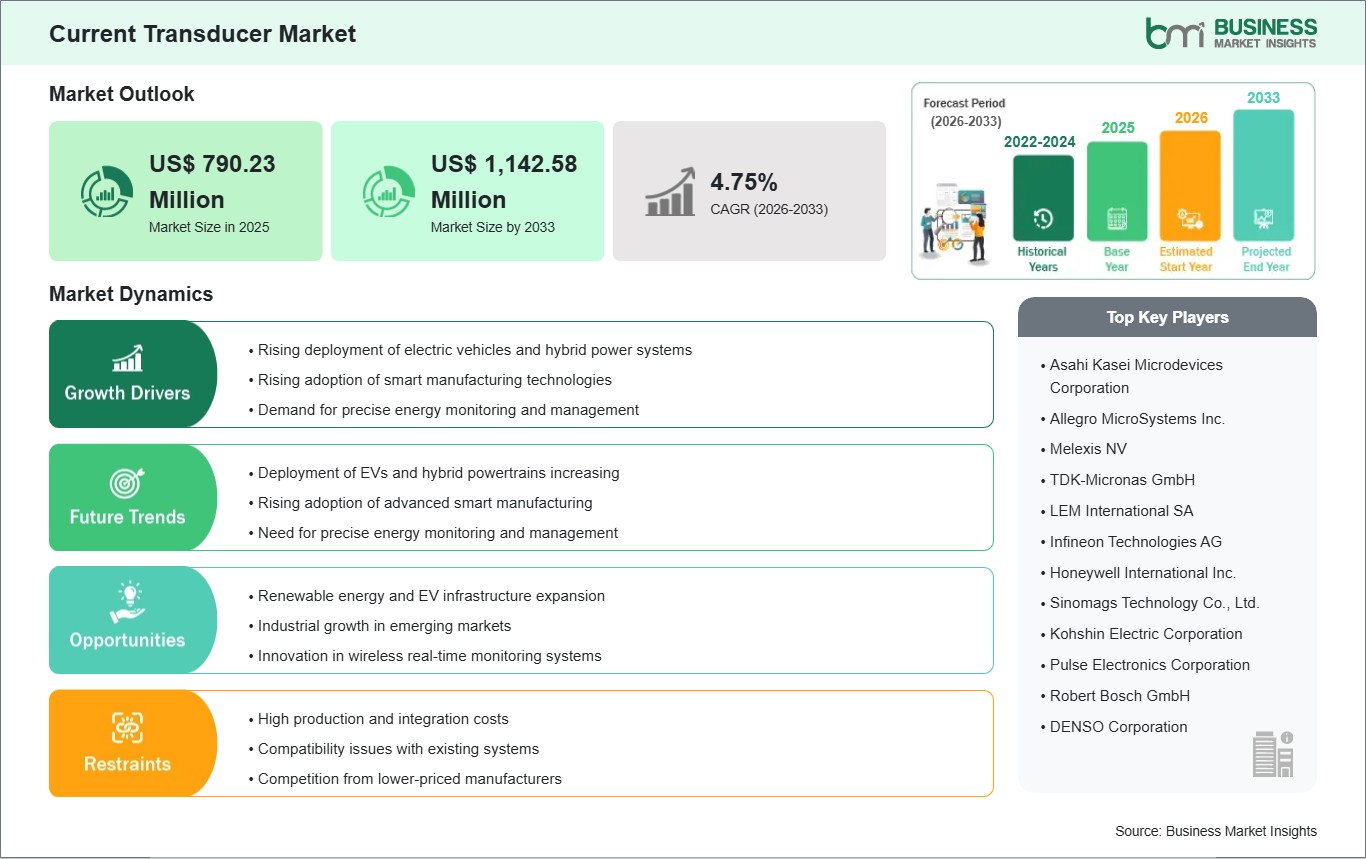
The Current Transducer size is expected to reach US$ 1,142.58 million by 2033 from US$ 790.23 million in 2025. The market is estimated to record a CAGR of 4.75% from 2026 to 2033.
The Current Transducer Market refers to a spectrum of devices and technologies that convert an electrical current in a system into a corresponding output signal, usually voltage or current, for the purposes of measurement, monitoring, or control. Such devices play an essential role in safety, accuracy, and energy, efficient operation in various sectors, e.g., industrial automation, automotive, energy and utilities, renewable energy, transportation, and commercial electronics. Current transducers are compatible with AC, DC, and pulsed current applications and are used to facilitate accurate energy monitoring, protective relaying, fault detection, motor control, and system optimization. Current Transducer Market is growing almost exponentially due to several factors. One of the main reasons for this trend is the increased use of electric vehicles (EVs) and hybrid vehicles that demand extremely accurate current measurements for battery management and powertrain efficiency. In the same way, the installation of renewable energy facilities, especially solar and wind, has pushed up the need for transducers that can effectively monitor the power flows of energy generation and storage systems.

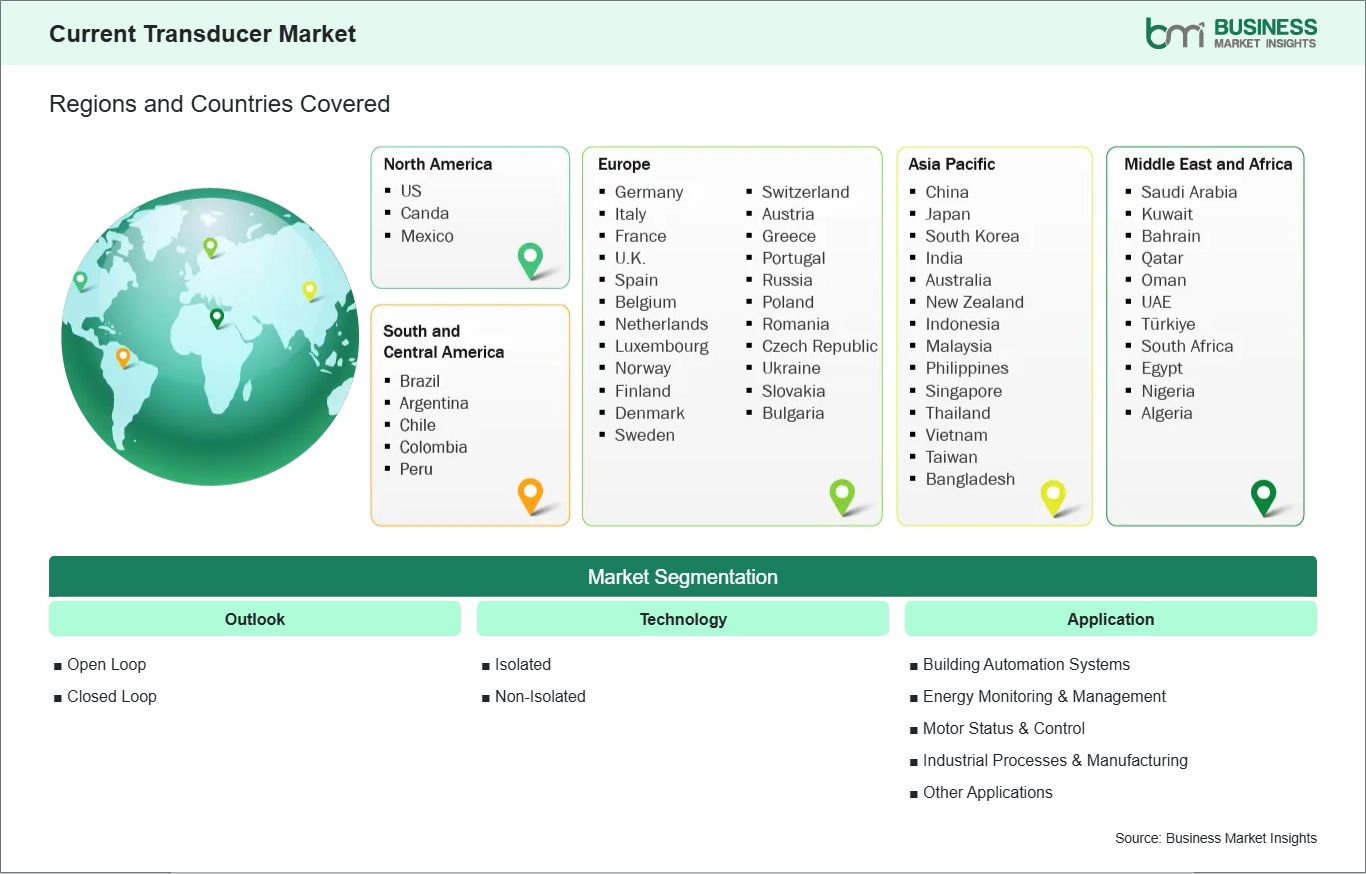
Key segments that contributed to the derivation of the Current Transducer analysis are technology, wafer size, and application.
A key factor which is pushing the transducer market today is the electrification trend worldwide, the increased use of electric vehicles (EVs), their charging infrastructure, and the industrial automation systems. Present day transducers play a very significant role in the components of an electric vehicle (EV) such as battery management systems, inverters and charging stations, where they help monitor currents for charging/discharging as well as control safety and energy efficiency. The more the production and sale of electric vehicles increase globally, the higher will be the number of high, precision current transducers needed per vehicle. At the same time, the increased industrial automation in sectors such as manufacturing, robotics, motor drives, and energy management systems stimulates the market growth since these systems are designed to use accurate, real, time current measurements for the optimization of their operation, the prevention of equipment failures, and the facilitation of predictive maintenance. Moreover, accurate current sensing is basically needed in solar inverters and wind turbines where grid integration and power quality are being controlled. All such factors combined act as a lever for the expansion of transducer usage in the automotive, energy, and industrial domains.
A growth prospect is to capitalize on for the transducer market currently is smart grid modernization and the energy ecosystems enabled by IoT. When utilities and commercial properties with advanced metering infrastructure (AMI), distributed energy resources (DER) integration, intelligent grid management invest, transducers of the present become necessity components for realtime current monitoring, fault detection, load balancing, and power quality analysis. The people who make energy systems connected will thus find transducers much more valuable as IoT integration first makes possible remote monitoring, data analytics, and predictive maintenance. Besides that, the growth of renewable energy and energy storage systems like large battery installations, microgrids, hybrid power plants not only help supply clean energy but also create a need for precise current measurement to power optimization and system stability. Even in the factory environment, integrating transducers with IoT can not only improve the efficiency of operations but also reduce the time lost to breakdowns and enable smart factories to make data, backed decisions. Hence, the fusion of automation, connectivity, and energy digitization creates considerable, scalable opportunities for the manufacturers of transducers, especially in those regions which are heavily investing in the energy transition and digital infrastructure.
By Outlook, the Current Transducer market is segmented into open loop, closed loop. Closed loop transducers have overtaken the market because of their accuracy, excellent linearity, and stable performance even in high, current applications. They employ a feedback system that cancels the magnetic field of the flowing current, and thus, even in strong dynamic or high, power conditions, the measurements remain accurate. Various application sectors of closed, loop transducers are industrial drives, high, voltage utility monitoring, electric vehicle charging systems, renewable energy infrastructure, and precision laboratory instruments. They offer several benefits such as outstanding accuracy, a wide frequency range suitable for dynamic current measurement, great isolation, and very low thermal drift; hence, they are very significant especially in safety, sensitive, high, performance, and energy, efficient segments. With the continuous rise of industrial automation, smart grids, electric vehicles, and high, voltage energy systems, the demand for closed, loop transducers is further increased thus solidifying their market dominance.
By Technology, the Current Transducer market is segmented as isolated, non-isolated. A major part of the market for non-isolated current sensing solutions is in low to medium voltage applications where it is permissible to have direct electrical contact. The very efficient and accurate measurement of current flow is achieved by using these methods like shunt resistors and low, side current sensing, which are at the same time cost, effective and compact. These sensors are extensively employed in EV battery management systems, industrial motor control, and energy monitoring of small and medium power electronics. Non-isolated sensors can achieve high precision and very fast response times, however, to manage safety concerns and avoid interference they need to be designed carefully. Considering the increase in EV demand, microgrids, and energy, efficient industrial systems, non, isolated sensing keeps being appealing for situations that prioritize cost, size, and accuracy over isolation, especially for embedded or integrated electronics.
By Application, the Current Transducer market is segmented as building automation systems, energy monitoring & management, motor status & control, industrial processes & manufacturing, others. In the current market for transducers and Current Transducer, the Industrial Processes & Manufacturing application segment holds the largest share and is the most influential. This significant share is largely due to the extensive use of machines automations, robotics, CNC equipment, conveyors, and industrial drives, all of which are heavily dependent on real, time current monitoring for operational efficiency and safety. Current sensors play a crucial role in detecting overcurrent conditions, preventing equipment failures, and optimizing energy consumption in both high, voltage and low, voltage industrial systems. Both isolated (high, voltage machinery protection) and non, isolated (low, voltage control circuits) current sensing technologies are being used in great numbers. Moreover, the trend toward smart factories and Industry 4.0, which brings together IoT, predictive maintenance, and real, time energy management, is fueling the growth of the industrial manufacturing sector's use of direct and indirect current sensing solutions, thereby maintaining its leading position in the market.

| Report Attribute | Details |
|---|---|
| Market size in 2025 | US$ 790.23 Million |
| Market Size by 2033 | US$ 1,142.58 Million |
| Global CAGR (2026 - 2033) | 4.75% |
| Historical Data | 2022-2024 |
| Forecast period | 2026-2033 |
| Segments Covered | By Outlook
|
|
Regions and Countries Covered
| |
| North America | US, Canada, Mexico |
| Europe | Belgium, Austria, Finland, Denmark, Greece, Poland, Romania, Russia, Ukraine, Czech Republic, Slovakia, Bulgaria, Italy, Luxembourg, Germany, Switzerland, France, Netherlands, Norway, Portugal, Spain, Sweden, United Kingdom |
| Asia-Pacific | Australia, China, India, Japan, South Korea, Indonesia, Malaysia, Philippines, Singapore, Thailand, Vietnam, Bangladesh, New Zealand, Taiwan |
| South and Central America | Brazil, Argentina, Peru, Chile, Colombia |
| Middle East and Africa | Bahrain, Kuwait, Oman, Qatar, Saudi Arabia, United Arab Emirates, Turkiye, South Africa, Egypt, Algeria, Nigeria |
| Market leaders and key company profiles |
|
The "Current Transducer Size and Forecast (2022 - 2033)" report provides a detailed analysis of the market covering below areas:
The geographical scope of the Current Transducer report is divided into five regions: North America, Asia Pacific, Europe, the Middle East & Africa, and South & Central America.
During the forecast period, the transducer market in Asia Pacific region is projected to grow at the fastest rate and currently holds the largest market share. The major factors attributing to this growth are massive industrialization, urbanization, electrification that have been accompanied by the implementation of various large, scale renewable energy projects in countries such as China, India, Japan, South Korea, and Australia. The development of EV infrastructure, smart grids, and energy storage systems are also fueling strong market demand for current transducers within the automotive, utility, and industrial industries. Besides that, government policies aimed at energy efficiency, grid modernization, and sustainable power generation are also immensely helping in the adoption of high, precision transducers.
North America has a significant market share as well, which is led by the United States and Canada. Here, the demand is propelled by the grid infrastructure upgrade, smart meters, and renewable energy integration. In addition to that, the highly industrialized region combines the use of electric mobility and safety, critical applications to increase the need for accurate and reliable current transducers, most especially closed, loop devices, to confidently meet the requirements of systems and regulatory standards at the highest levels. Efficiency of the system and compliance with stringent regulatory standards are thus ensured.

The Current Transducer is evaluated by gathering qualitative and quantitative data post primary and secondary research, which includes important corporate publications, association data, and databases. A few of the key developments in the Current Transducer are:
The Current Transducer Market is valued at US$ 790.23 Million in 2025, it is projected to reach US$ 1,142.58 Million by 2033.
As per our report Current Transducer Market, the market size is valued at US$ 790.23 Million in 2025, projecting it to reach US$ 1,142.58 Million by 2033. This translates to a CAGR of approximately 4.75% during the forecast period.
The Current Transducer Market report typically cover these key segments-
The historic period, base year, and forecast period can vary slightly depending on the specific market research report. However, for the Current Transducer Market report:
The Current Transducer Market is populated by several key players, each contributing to its growth and innovation. Some of the major players include:
The Current Transducer Market report is valuable for diverse stakeholders, including:
Essentially, anyone involved in or considering involvement in the Current Transducer Market value chain can benefit from the information contained in a comprehensive market report.
Please tell us your area of interest
(Market Segments/ Regions and Countries/ Companies)