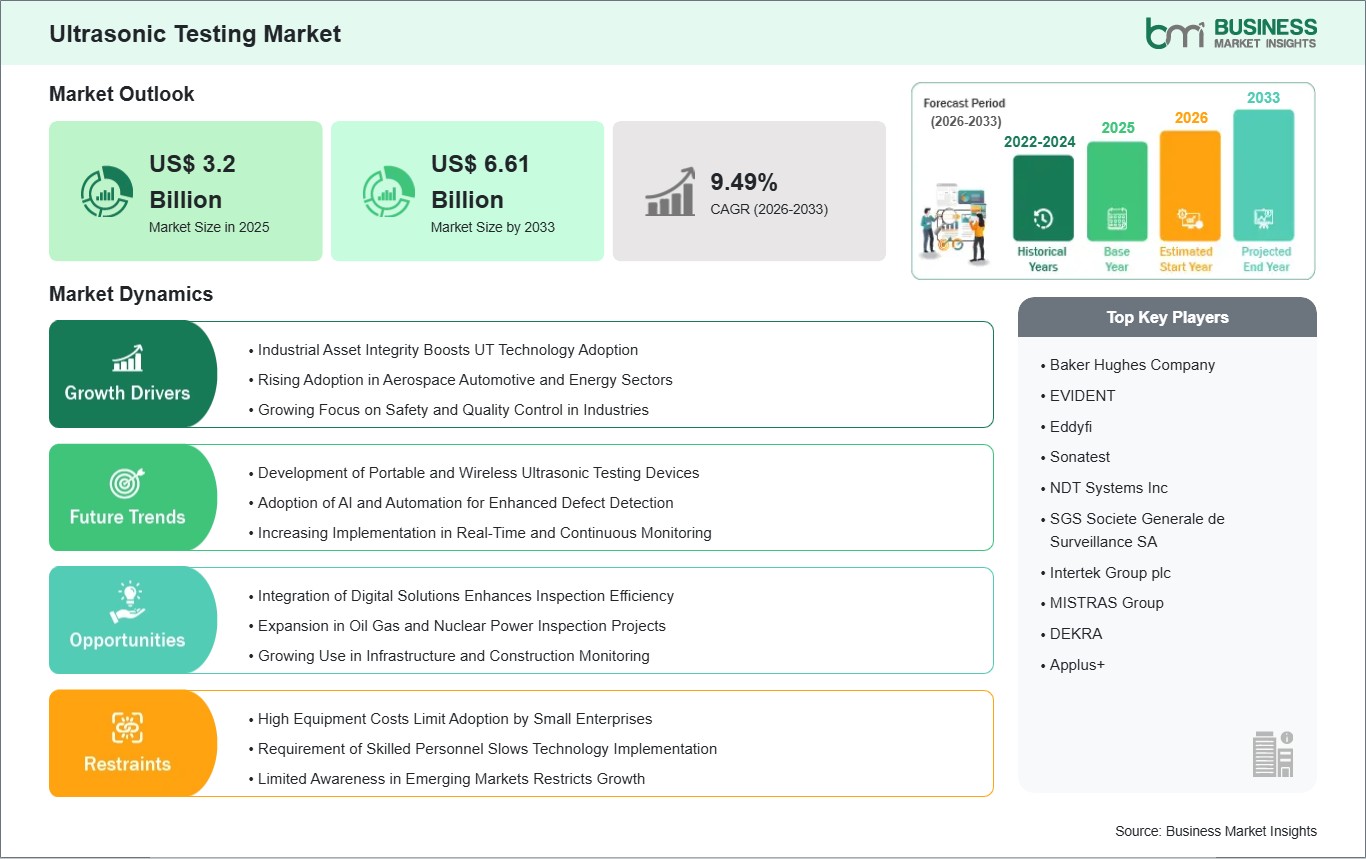
The Ultrasonic Testing Market size is expected to reach US$ 6.61 billion by 2033 from US$ 3.2 billion in 2025. The market is estimated to record a CAGR of 9.49% from 2026 to 2033.
The global ultrasonic testing (UT) market plays a crucial role in the non-destructive testing (NDT) industry. It helps organizations evaluate material integrity, detect hidden defects, and ensure structural safety without damaging assets. UT is becoming increasingly important in fields like aerospace, automotive, oil and gas, energy, and manufacturing. This growth stems from a stronger emphasis on industrial safety standards, aging infrastructure in developed countries, and the need for proactive maintenance strategies. Companies are putting money into ultrasonic testing solutions to improve operational efficiency, reduce unexpected downtime, and enhance the reliability of critical equipment. This makes UT a vital part of modern quality assurance processes. Technological advances are driving market growth. Innovations like phased array ultrasonic testing, portable and handheld devices, automated scanning solutions, and digital integration with asset management platforms are improving accuracy, inspection speed, and data traceability. These developments enable industries to shift from reactive maintenance to predictive and condition-based methods, highlighting the increasing strategic importance of ultrasonic testing worldwide. However, some challenges still affect market growth.
Advanced UT equipment requires a large capital investment, which can discourage small and medium-sized businesses from adopting it. Additionally, interpreting ultrasonic inspection data needs skilled operators, and the limited number of certified NDT professionals poses a global issue. Despite these obstacles, the push for regulatory compliance, better asset integrity, and the use of digital inspection technologies will likely maintain strong demand for ultrasonic testing solutions across various industries worldwide.

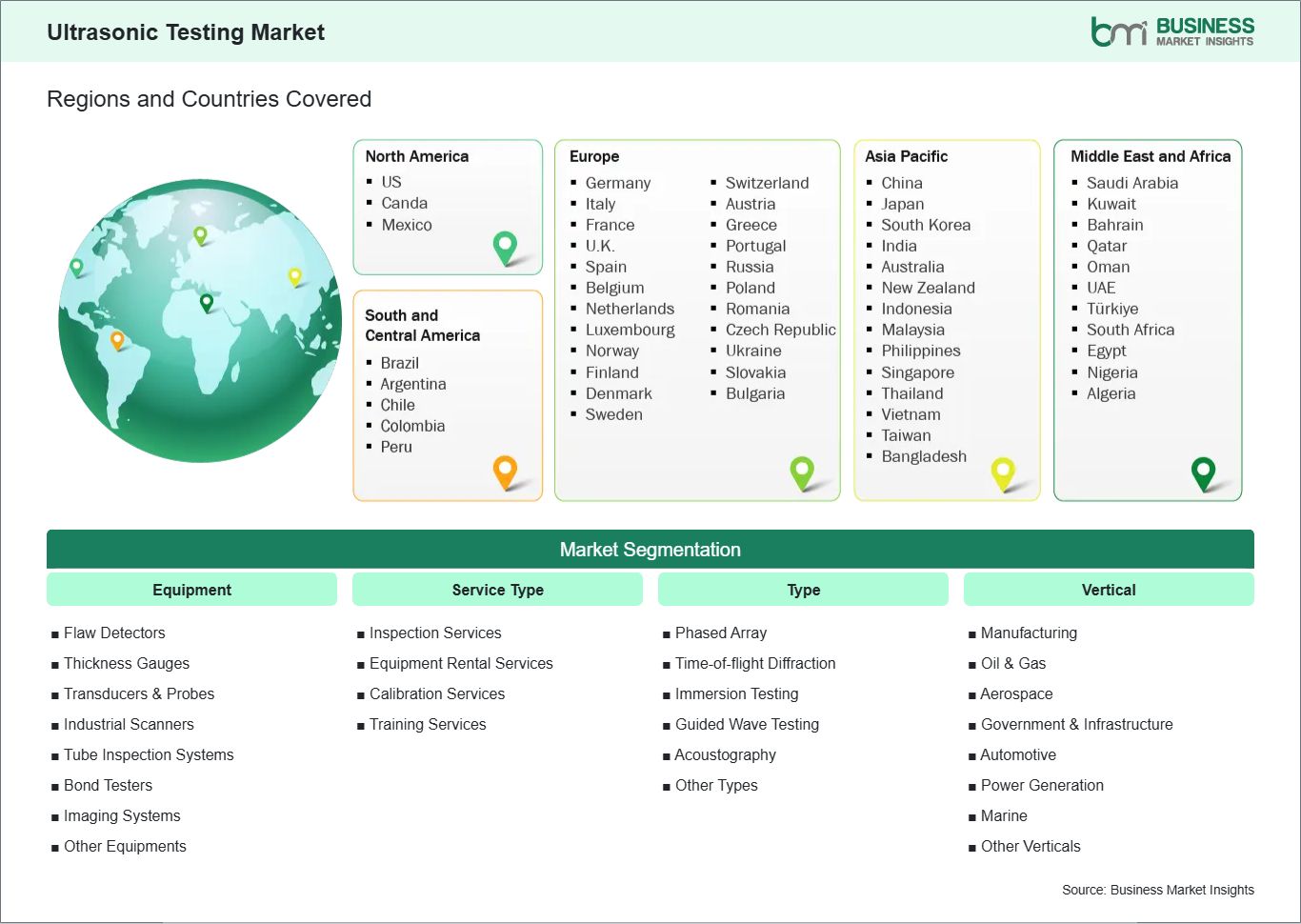
Key segments that contributed to the derivation of the ultrasonic testing market analysis are equipment, service type, type and vertical.
Maintaining industrial asset integrity has become a crucial element in the global humidity sensor market. Companies are increasingly aware of the risks that uncontrolled moisture poses to equipment, production processes, and stored goods. Industries like semiconductors, pharmaceuticals, food processing, and heavy manufacturing rely on precise environmental monitoring to prevent corrosion, product damage, and operational failures. As a result, humidity sensors are now used throughout production lines, storage areas, and clean rooms to keep conditions optimal and protect valuable assets. Manufacturers around the world are incorporating humidity sensors into preventive maintenance programs to improve equipment reliability and lower unexpected downtime.
In semiconductor fabrication plants, strict moisture control is essential for wafer quality. Pharmaceutical and biotech facilities depend on accurate humidity monitoring to comply with regulations and ensure product safety. These examples highlight the growing significance of humidity sensors as vital tools for safeguarding industrial operations, rather than just optional monitoring devices. To meet this demand, sensor manufacturers are focusing on durability, precision, and compatibility with industrial automation systems. Modern humidity sensors are designed to integrate well with existing asset management and monitoring systems, providing real-time visibility and valuable insights. By linking environmental sensing to broader industrial reliability efforts, humidity sensors are becoming essential for operational success and global quality assurance strategies.
The digital transformation of industrial operations is changing the humidity sensor market by enabling faster, smarter, and more efficient environmental monitoring. Companies are connecting sensors to cloud platforms, IoT networks, and analytics tools. This connection allows real-time data collection and centralized monitoring across multiple facilities worldwide. It improves visibility, reduces manual checks, and provides actionable insights that improve decision-making. Remote monitoring and automated alerts are especially useful for global companies managing operations across continents. Maintenance teams can quickly spot changes in humidity levels, allowing for fast responses that avoid damage to equipment or spoilage of products. By reducing the need for manual inspections, digital solutions simplify workflows and promote proactive maintenance, saving time and money.
Additionally, combining humidity sensors with machine learning and predictive analytics helps organizations predict potential risks instead of reacting afterward. Predictive insights help anticipate moisture-related problems, prompting preventive measures and supporting compliance reporting. This ensures operational efficiency and meets regulatory standards. As a result, digital-ready humidity sensors are increasingly seen not just as measuring devices but as strategic tools that strengthen industrial resilience and improve global operational intelligence.
The ultrasonic testing market demonstrates steady growth, with size and share analysis highlighting evolving trends and competitive dynamics among key players. The report examines subsegments categorized within equipment, service type, type and vertical, offering insights into their contribution to overall market performance.
By Equipment, the flaw detectors subsegment dominated the market in 2025, driven by their widespread use in detecting internal defects across various materials, making them the core equipment in ultrasonic testing.
Based on service type, the inspection services subsegment dominated the market in 2025, driven by high demand for expert third-party testing and compliance verification across industries, generating the largest revenue within UT services.
On the basis of type, the phased array ultrasonic testing (PAUT) subsegment dominated the market in 2025, driven by its advanced imaging capabilities, faster inspections, and ability to detect complex flaws compared with conventional UT methods.
In terms of vertical, the oil & gas subsegment dominated the market in 2025, driven by extensive use of ultrasonic testing for pipelines, vessels, and infrastructure inspections to ensure safety and compliance.
| Report Attribute | Details |
|---|---|
| Market size in 2025 | US$ 3.2 Billion |
| Market Size by 2033 | US$ 6.61 Billion |
| Global CAGR (2026 - 2033) | 9.49% |
| Historical Data | 2022-2024 |
| Forecast period | 2026-2033 |
| Segments Covered | By Equipment
|
|
Regions and Countries Covered
| |
| North America | US, Canada, Mexico |
| Europe | Belgium, Austria, Finland, Denmark, Greece, Poland, Romania, Russia, Ukraine, Czech Republic, Slovakia, Bulgaria, Italy, Luxembourg, Germany, Switzerland, France, Netherlands, Norway, Portugal, Spain, Sweden, United Kingdom |
| Asia-Pacific | Australia, China, India, Japan, South Korea, Indonesia, Malaysia, Philippines, Singapore, Thailand, Vietnam, Bangladesh, New Zealand, Taiwan |
| South and Central America | Brazil, Argentina, Peru, Chile, Colombia |
| Middle East and Africa | Bahrain, Kuwait, Oman, Qatar, Saudi Arabia, United Arab Emirates, Turkiye, South Africa, Egypt, Algeria, Nigeria |
| Market leaders and key company profiles |
|
The "Ultrasonic Testing Market Size and Forecast (2022 - 2033)" report provides a detailed analysis of the market covering below areas:
The geographical scope of the Ultrasonic Testing Market report is divided into North America, Asia Pacific, Europe, Middle East & Africa, and South & Central America. North America held the largest share in 2025.
North America leads the global ultrasonic testing market. This is due to its strong industrial base, early use of new inspection technologies, and strict regulations in areas like aerospace, automotive, oil and gas, and power generation. The region emphasizes automated ultrasonic systems, phased array technologies, and digital inspection platforms. It also has a wide network of certified NDT service providers and training centers, which helps in the effective use of ultrasonic testing solutions.
In contrast, the Asia-Pacific region is quickly growing. This is driven by fast industrial growth, major infrastructure projects, and increased use of ultrasonic testing in countries like China, India, and Japan. Here, the focus is on improving inspection efficiency and keeping quality standards high in large-scale production, while gradually introducing newer ultrasonic testing technologies.
Europe remains stable, supported by strict safety and environmental regulations, especially in the aerospace, energy, and precision manufacturing sectors, where reliability is crucial. Countries like Germany, France, and the UK are investing significantly in research and development to improve ultrasonic testing methods and capabilities. In the
Middle East and Africa, market growth is picking up due to ongoing investments in oil and gas projects and energy infrastructure, as well as large construction efforts.
However, progress is sometimes limited by a lack of skilled operators and advanced equipment. South and Central America are seeing slow but steady market growth. Governments and private companies are investing in industrial modernization, infrastructure upgrades, and oil and gas exploration. There is a particular interest in portable and cost-effective ultrasonic testing solutions to meet local needs. These regional trends show North America's leadership while pointing out diverse growth opportunities and technology use that shape the global ultrasonic testing market.

The Ultrasonic Testing Market is evaluated by gathering qualitative and quantitative data post primary and secondary research, which includes important corporate publications, association data, and databases. A few of the key developments in the ultrasonic testing market are:
The Ultrasonic Testing Market is valued at US$ 3.2 Billion in 2025, it is projected to reach US$ 6.61 Billion by 2033.
As per our report Ultrasonic Testing Market, the market size is valued at US$ 3.2 Billion in 2025, projecting it to reach US$ 6.61 Billion by 2033. This translates to a CAGR of approximately 9.49% during the forecast period.
The Ultrasonic Testing Market report typically cover these key segments-
The historic period, base year, and forecast period can vary slightly depending on the specific market research report. However, for the Ultrasonic Testing Market report:
The Ultrasonic Testing Market is populated by several key players, each contributing to its growth and innovation. Some of the major players include:
The Ultrasonic Testing Market report is valuable for diverse stakeholders, including:
Essentially, anyone involved in or considering involvement in the Ultrasonic Testing Market value chain can benefit from the information contained in a comprehensive market report.
Please tell us your area of interest
(Market Segments/ Regions and Countries/ Companies)