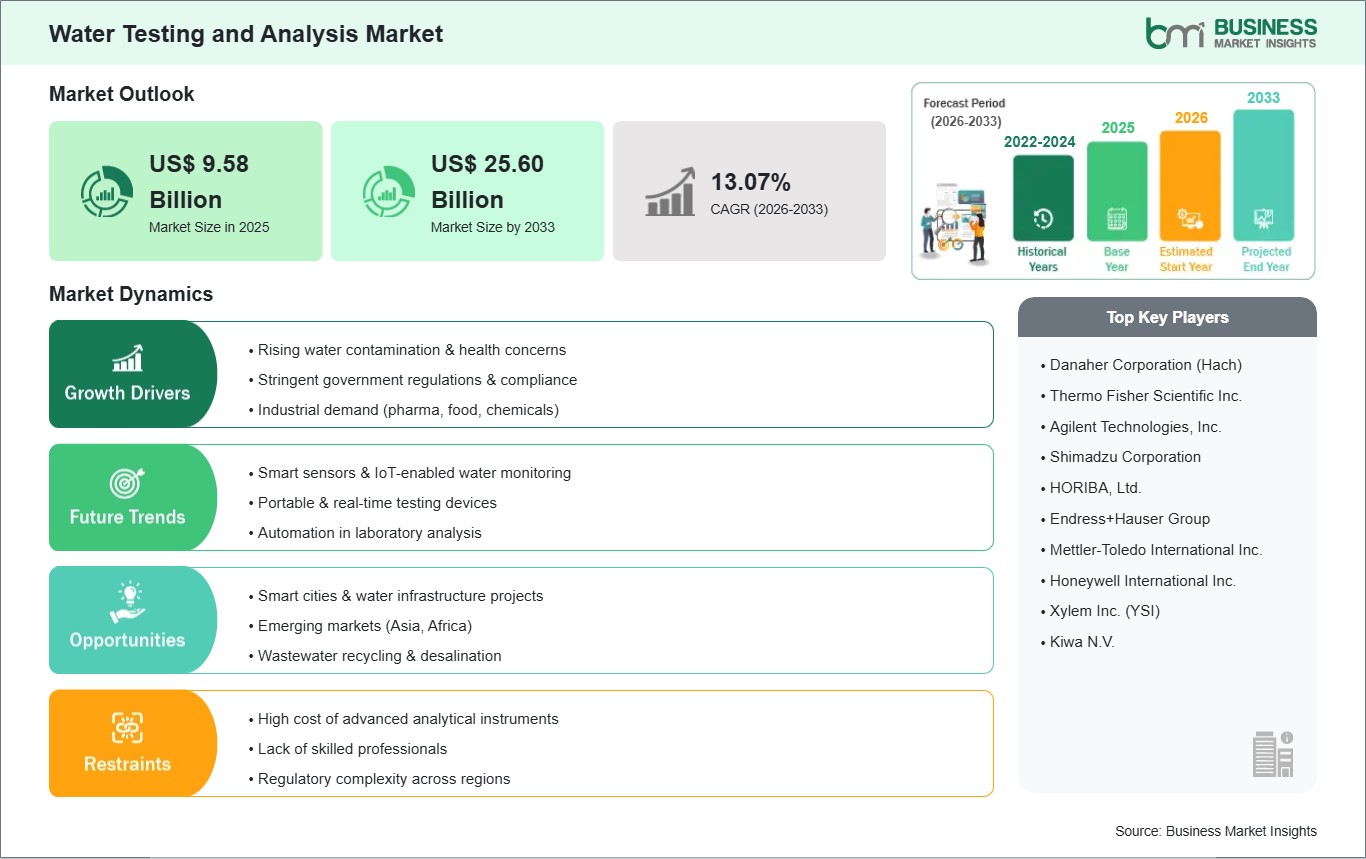
The Water Testing and Analysis Market size is expected to reach US$ 25.6 billion by 2033 from US$ 9.58 billion in 2025. The market is estimated to record a CAGR of 13.07% from 2026 to 2033.
Water testing and analysis refers to the integrated application of specialized instruments, chemical reagents, and laboratory methodologies designed to quantify the physical, chemical, and microbiological characteristics of water. By measuring variables such as pH, dissolved oxygen, turbidity, and the presence of heavy metals or pathogens, these systems ensure that water quality meets stringent safety and environmental standards. This technology is fundamental to the operational integrity of the pharmaceutical, food and beverage, and municipal power sectors. Market expansion is being propelled by the rising incidence of waterborne diseases, the global transition toward sustainable wastewater reuse, and the increasing institutional demand for high-throughput, automated analyzers that facilitate real-time regulatory compliance.
However, several factors may restrain market progression. The high capital intensity associated with advanced analytical hardware, particularly high-performance liquid chromatography (HPLC) and mass spectrometry systems, remains a significant hurdle for smaller utilities and laboratories in developing regions. The industry also faces technical challenges regarding regulatory fragmentation, where diverse regional standards for contaminant thresholds necessitate separate validation procedures for multinational operators. Additionally, a persistent global scarcity of skilled professionals proficient in operating sophisticated spectrometry and bacteriological testing equipment complicates the interpretation of complex datasets. These hurdles, compounded by the rising cost of specialized consumables and calibration standards, increase the total cost of ownership and necessitate strategic focus on portable, user-friendly field-testing solutions.
Despite these hurdles, the market outlook remains favorable. Opportunities are emerging through the adoption of artificial intelligence and machine learning, which enable predictive water quality management by identifying optical impurities and contamination patterns before they escalate into public health crises. The expansion into PFAS testing services is gaining significant traction; the market is witnessing a surge in demand for sub-parts-per-trillion detection capabilities to comply with evolving environmental mandates in the United States and Europe. Furthermore, the growth of Internet of Things-enabled sensors and cloud-connected dashboards aligns with global goals for decentralized and transparent water monitoring. Collectively, these innovations position the water testing and analysis industry for sustained long-term development as a cornerstone of the modern, resilient, and health-centric global infrastructure.

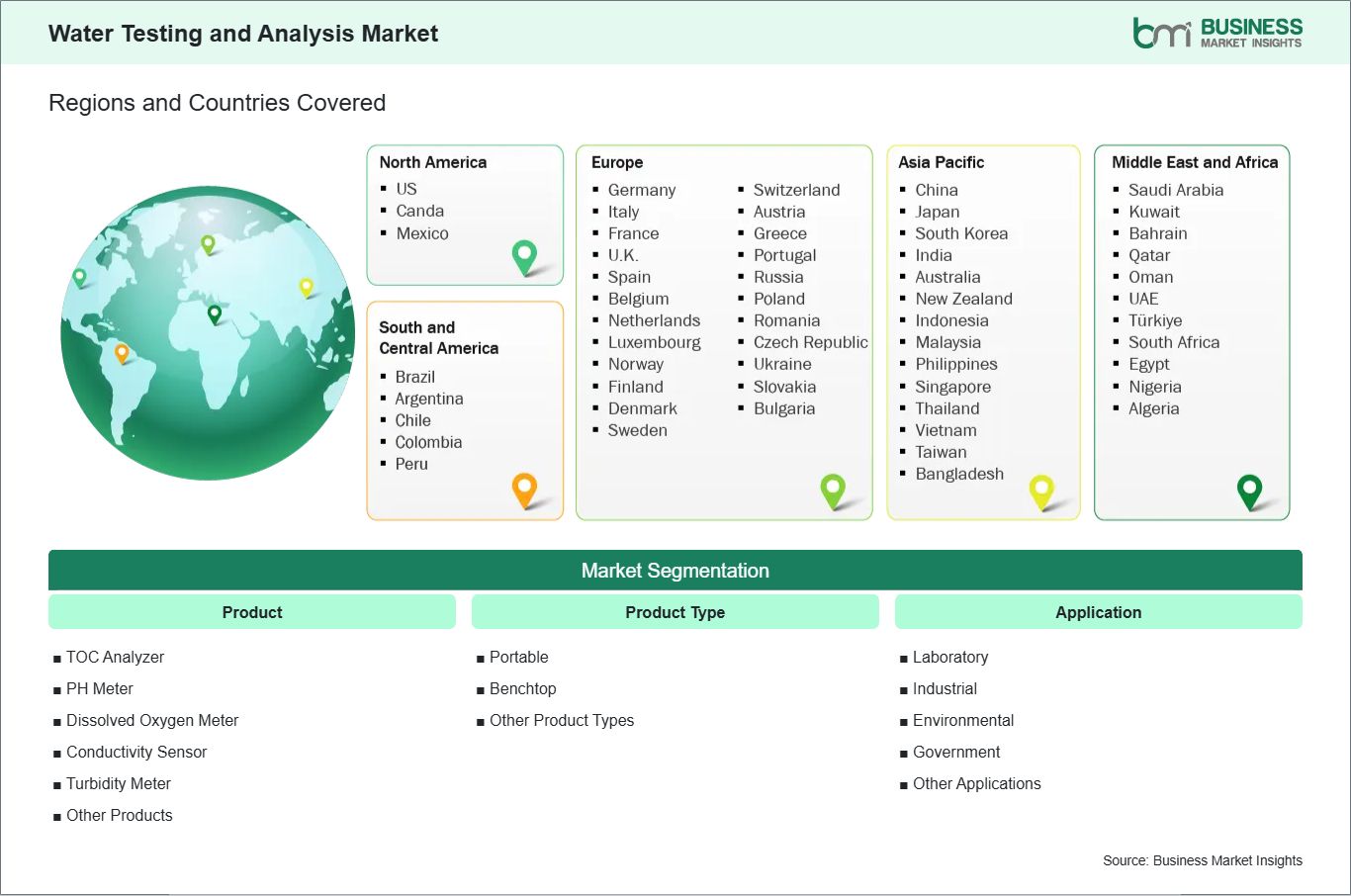
Key segments that contributed to the derivation of the Water Testing and Analysis market analysis are product, product type, and application.
The water testing and analysis market is being driven by the growing need for safe drinking water, environmental protection, and regulatory compliance across industries such as municipal utilities, pharmaceuticals, food & beverage, and chemicals. Increasing concerns about waterborne diseases, industrial pollution, and contamination from heavy metals, pesticides, and microplastics are amplifying adoption of advanced testing solutions. Governments worldwide are enforcing stricter water quality standards, reinforcing demand for reliable testing technologies that ensure compliance with regulations such as WHO guidelines, EPA standards, and EU directives.
The expansion of industrialization and urbanization is further driving adoption, as wastewater treatment and monitoring become critical for sustainable development. Rising consumer awareness of health and hygiene is also fueling demand for household and commercial water testing kits. Additionally, climate change and scarcity of freshwater resources are pushing organizations to adopt advanced monitoring systems to optimize water usage and ensure safety. Collectively, regulatory mandates, public health concerns, and sustainability goals are propelling sustained growth in the global water testing and analysis market.
Opportunities in the water testing and analysis market are expanding through the integration of IoT connectivity, artificial intelligence, and advanced sensor technologies. IoT‑enabled water testing systems are gaining traction, offering real‑time monitoring, predictive analytics, and seamless data sharing across municipal networks, industrial plants, and residential facilities. AI‑driven platforms are opening lucrative opportunities by enabling automated detection of contaminants, predictive maintenance of treatment systems, and adaptive water quality management. The growing emphasis on smart cities and digital transformation is fueling demand for interoperable water testing solutions that integrate with broader environmental monitoring systems. Emerging applications in agriculture are also driving innovation, as water testing ensures irrigation quality and crop safety. Additionally, the expansion of desalination projects, renewable energy initiatives, and sustainable manufacturing is creating demand for advanced water analysis technologies. Vendors who focus on cost‑effective, AI‑driven, and portable testing solutions are well‑positioned to capture growth. The convergence of IoT, AI, and sustainability underscores a transformative trajectory for the global water testing and analysis market.
The Water Testing and Analysis market demonstrates steady growth, with size and share analysis revealing evolving trends and competitive positioning among key players. The report examines subsegments categorized within product, product type, and application, offering insights into their contribution to overall market performance.
Based on Product, the TOC Analyzer subsegment holds a strong presence in the market. These analyzers are indispensable for measuring total organic carbon in water, ensuring compliance in industries such as pharmaceuticals, food & beverages, and environmental monitoring. The pH Meter subsegment is essential for routine water quality testing, widely adopted in laboratories, industrial processes, and municipal water treatment. The Dissolved Oxygen Meter subsegment anchors demand in aquaculture, wastewater treatment, and environmental studies, where oxygen levels are critical for ecosystem health. The Conductivity Sensor subsegment is indispensable for monitoring ionic content in water, ensuring quality in industrial and laboratory applications. The Turbidity Meter subsegment is essential for detecting suspended particles, widely used in drinking water treatment and environmental monitoring.

The Water Testing and Analysis market demonstrates steady growth, with size and share analysis revealing evolving trends and competitive positioning among key players. The report examines subsegments categorized within product, product type, and application, offering insights into their contribution to overall market performance.
Based on Product, the TOC Analyzer subsegment holds a strong presence in the market. These analyzers are indispensable for measuring total organic carbon in water, ensuring compliance in industries such as pharmaceuticals, food & beverages, and environmental monitoring. The pH Meter subsegment is essential for routine water quality testing, widely adopted in laboratories, industrial processes, and municipal water treatment. The Dissolved Oxygen Meter subsegment anchors demand in aquaculture, wastewater treatment, and environmental studies, where oxygen levels are critical for ecosystem health. The Conductivity Sensor subsegment is indispensable for monitoring ionic content in water, ensuring quality in industrial and laboratory applications. The Turbidity Meter subsegment is essential for detecting suspended particles, widely used in drinking water treatment and environmental monitoring.
| Report Attribute | Details |
|---|---|
| Market size in 2025 | US$ 9.58 Billion |
| Market Size by 2033 | US$ 25.60 Billion |
| Global CAGR (2026 - 2033) | 13.07% |
| Historical Data | 2022-2024 |
| Forecast period | 2026-2033 |
| Segments Covered | By Product
|
|
Regions and Countries Covered
| |
| North America | US, Canada, Mexico |
| Europe | Belgium, Austria, Finland, Denmark, Greece, Poland, Romania, Russia, Ukraine, Czech Republic, Slovakia, Bulgaria, Italy, Luxembourg, Germany, Switzerland, France, Netherlands, Norway, Portugal, Spain, Sweden, United Kingdom |
| Asia-Pacific | Australia, China, India, Japan, South Korea, Indonesia, Malaysia, Philippines, Singapore, Thailand, Vietnam, Bangladesh, New Zealand, Taiwan |
| South and Central America | Brazil, Argentina, Peru, Chile, Colombia |
| Middle East and Africa | Bahrain, Kuwait, Oman, Qatar, Saudi Arabia, United Arab Emirates, Turkiye, South Africa, Egypt, Algeria, Nigeria |
| Market leaders and key company profiles |
|
The "Water Testing and Analysis Market Size and Forecast (2022 - 2033)" report provides a detailed analysis of the market covering below areas:
The geographical scope of the Water Testing and Analysis market report is divided into five regions: North America, Asia Pacific, Europe, Middle East & Africa, and South & Central America.
North America maintains a preeminent position within the global industry, a status reinforced by the region's advanced technological infrastructure and a comprehensive regulatory framework. The regional landscape is characterized by high-density investments in the United States and Canada, where the transition toward Real-Time Monitoring and Online Analytical Systems has become a strategic priority for municipal utilities and industrial operators. This market leadership is further supported by stringent federal standards, such as those established by the U.S. Environmental Protection Agency, which mandate rigorous testing for a broad spectrum of contaminants, including lead, nitrates, and emerging per- and polyfluoroalkyl substances.
Technological progression in the United States and Canada is largely driven by a decisive shift toward High-Sensitivity Laboratory Instrumentation and Automated Workflows. These advanced systems utilize Liquid Chromatography-Mass Spectrometry and Total Organic Carbon analyzers to achieve sub-part-per-trillion detection levels, satisfying the increasing demand for precision in pharmaceutical and semiconductor manufacturing. Furthermore, the region is witnessing an increasing utilization of Cloud-Integrated Data Management Platforms, as organizations seek to automate compliance reporting and enhance the transparency of water quality data. This focus on Digital Water Quality Assurance allows North American institutions to mitigate the risks associated with waterborne diseases while optimizing the operational efficiency of large-scale treatment facilities.

The Water Testing and Analysis market is evaluated by gathering qualitative and quantitative data post primary and secondary research, which includes important corporate publications, association data, and databases. A few of the key developments in the Water Testing and Analysis market are:
The Water Testing and Analysis Market is valued at US$ 9.58 Billion in 2025, it is projected to reach US$ 25.60 Billion by 2033.
As per our report Water Testing and Analysis Market, the market size is valued at US$ 9.58 Billion in 2025, projecting it to reach US$ 25.60 Billion by 2033. This translates to a CAGR of approximately 13.07% during the forecast period.
The Water Testing and Analysis Market report typically cover these key segments-
The historic period, base year, and forecast period can vary slightly depending on the specific market research report. However, for the Water Testing and Analysis Market report:
The Water Testing and Analysis Market is populated by several key players, each contributing to its growth and innovation. Some of the major players include:
The Water Testing and Analysis Market report is valuable for diverse stakeholders, including:
Essentially, anyone involved in or considering involvement in the Water Testing and Analysis Market value chain can benefit from the information contained in a comprehensive market report.
Please tell us your area of interest
(Market Segments/ Regions and Countries/ Companies)