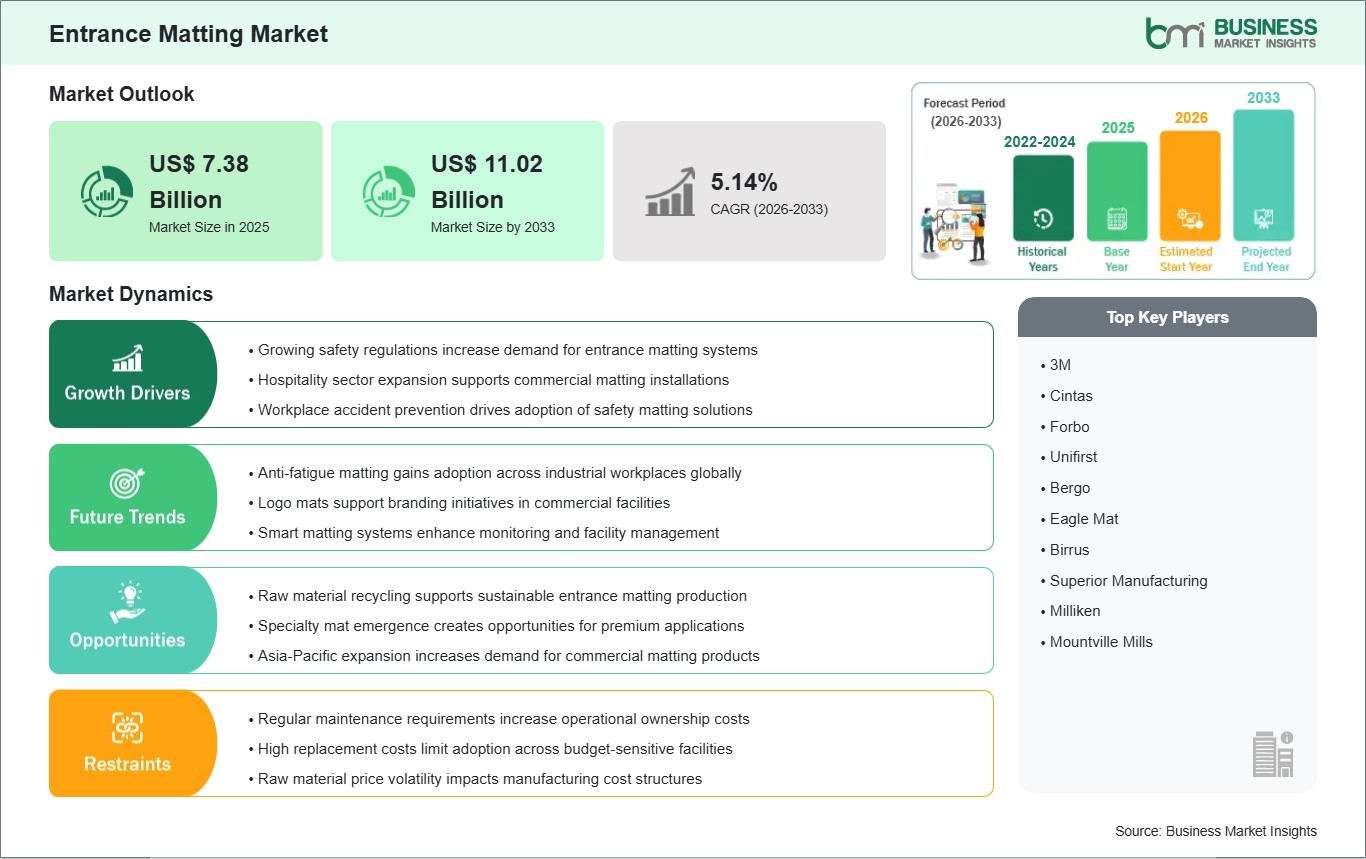
The entrance matting market size is expected to reach US$ 11.02 billion by 2033 from US$ 7.38 billion in 2025. The market is estimated to record a CAGR of 5.14% during 2026 to 2033.
Market for entrance mats refers to all types of flooring products or materials that protect floors at the point of entry into a building from dirt, moisture, and particles entering the floor of a building when someone steps onto the floor of a building. Entrance matting products have combined properties of both moisture absorbing and scraping to help keep the floors inside a building cleaner, help reduce wear and tear of the floors, and help provide for safer walking conditions for people walking through residential, commercial, and institutional buildings.
The entrance matting market has been increasing as a result of industries placing greater emphasis on hygiene management, improving facility maintenance efficiencies, and reducing the chance of accidents. An increasing number of commercial buildings, transportation terminals, health care facilities, and hotel/motels have purchased entrance matting systems to minimize the time and effort involved in cleaning floor surfaces and to reduce the risk that someone would slip on the floor surface of the building because it is wet or dirty.
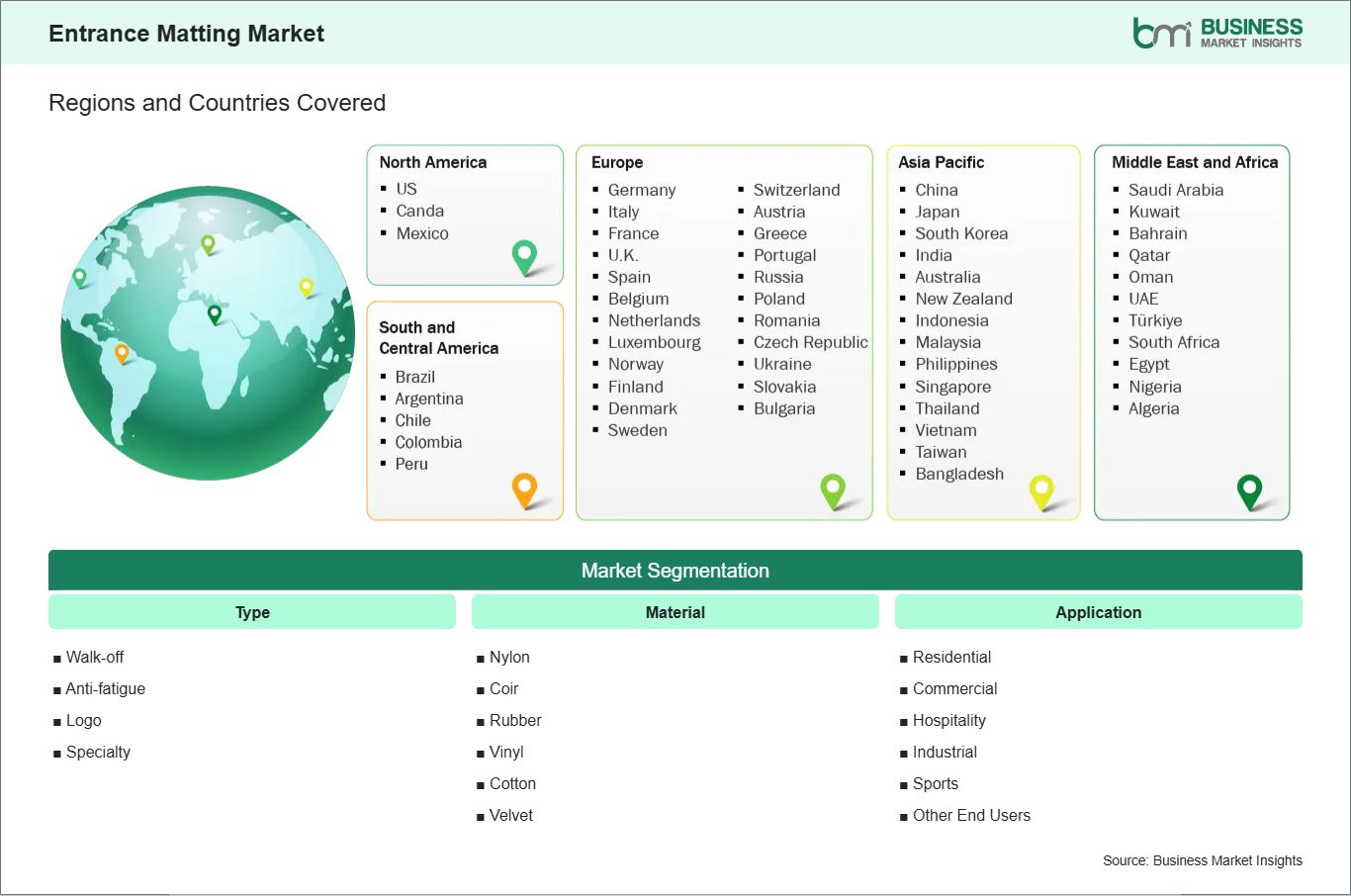
The entrance matting market is organized into segments based on both the type of product, material type and expected end-use application of the product. These different segments meet different operational requirements. Walk-off or debris control mats; anti-fatigue mats provide comfort in the workplace; logo mats provide branding opportunities; specialty mats fill specific performance or environmental needs; and there are many other types of materials used in mechanting entrance mats that provide different durability and use characteristics, including: nylon, coir, rubber, vinyl, cotton, and velvet.
Product development continues to focus on improved material performance, sustainability, and design flexibility. Manufacturers are introducing advanced backing systems, multi-layer constructions, and enhanced surface textures to improve longevity and moisture retention. Competitive differentiation is increasingly centered on customization capabilities, aesthetic integration, and compliance with safety and building maintenance standards.

The entrance matting market is segmented by type, material, and application, reflecting distinct performance characteristics, material preferences, and end-user requirements across residential, commercial, and industrial settings.
There is more emphasis on providing a safer workplace and public space through the implementation of entrance matting systems in commercial, institutional, and public facilities. As regulations get established to minimize slip and fall accidents, building owners and facility managers are searching for these types of floor solutions to improve their pedestals to provide traction, as well as keep dirt and moisture out of the facility at all entry points. Entrance matting systems are installed to assist in preventing wet or contaminated floors from causing an accident within a building by improving safety; therefore, installing a dedicated area for matting has become increasingly common in work environments such as offices, hospitals, schools, retail centers, and any other location with very high traffic.
The emphasis on preventing accidents as well as reducing liability will also assist with the widespread use of engineered matting. Structured flooring systems have increased within high-traffic environments such as transportation terminals, shopping malls, and public buildings because of the ability to manage heavy pedestrian traffic while maintaining safety performance. The entrance matting products will enable to perform effective removal of debris, absorb moisture, and last for a long time; they play a key role in implementing a facility management strategy. With the evolution of safety regulations and operators of buildings emphasizing risk management, demand for advanced entrance matting systems for newly constructed and existing properties will continue to rise.
As sustainability and resource conservation gain momentum, the entrance matting marketplace has benefited from an increase in the use of recyclable base materials. As part of their efforts to lessen their environmental footprint, manufacturers include recycled polymers, reclaimed rubber, and regenerated fibers in their entrance mat products while also providing high-quality and high-performing matting options. A focus on material recycling is leading to changes in the way products are designed and manufactured, resulting in the production of durable entrance mats that support waste reduction objectives. Advances in recycling technologies will also support the development of resource-efficient entrance mats that can withstand the rigors of heavy-traffic environments.
With the increasing adoption of circular economy principles, it is expected that the demand for entrance mats constructed from recyclable materials will continue to grow. As commercial real estate developers, corporations, and public sector entities implement policies encouraging the use of more sustainable procurement processes for environmentally responsible product development, increased adoption of recycled-content flooring products will follow suit. As construction and facility management are progressively prioritizing sustainability in their decision-making processes, manufacturers are likely to shift their focus toward increased use of recyclable materials and environmentally friendly production methods. Ultimately, the transition to circular economies will have a long-lasting positive impact on the environment and will alter how materials are sourced throughout the building infrastructure sector.
The entrance matting market size is expected to reach US$ 11.02 billion by 2033 from US$ 7.38 billion in 2025. The market is estimated to record a CAGR of 5.14% during 2026 to 2033.
By technology, the market is segmented into walk-off, anti-fatigue, logo, and specialty mats. Walk-off mats hold a dominant position due to their effectiveness in trapping dirt, moisture, and debris at building entrances, helping maintain interior cleanliness and reduce floor maintenance requirements. Logo mats also maintain a notable presence by combining branding opportunities with functional floor protection. Specialty mats address specific operational requirements such as enhanced safety, moisture control, or environmental resistance.
By material, the market is categorized into nylon, coir, rubber, vinyl, cotton, and velvet. Nylon accounts for a substantial share owing to its durability, wear resistance, and suitability for high-traffic environments. Rubber mats represent an important segment due to their slip-resistant properties and suitability for wet or demanding environments. Coir mats continue to be preferred for effective debris removal and natural fiber composition, while vinyl products are valued for flexibility and cost efficiency. Cotton mats contribute through superior moisture absorption capabilities, and velvet mats serve premium applications where aesthetics and appearance are key considerations.
By application, the market is segmented into residential, commercial, hospitality, industrial, sports, and other end users. Commercial represents the leading application segment due to extensive utilization of entrance matting systems in offices, retail centers, educational institutions, and public facilities. Hospitality accounts for a significant share as hotels, resorts, and entertainment venues implement matting solutions to enhance guest experience and maintain attractive interiors. Industrial applications also contribute notably to market demand through workplace safety and contamination control requirements, while residential, sports, and other end-user segments support additional market expansion through diverse usage needs.
| Report Attribute | Details |
|---|---|
| Market size in 2025 | US$ 7.38 Billion |
| Market Size by 2033 | US$ 11.02 Billion |
| Global CAGR (2026 - 2033) | 5.14% |
| Historical Data | 2022-2024 |
| Forecast period | 2026-2033 |
| Segments Covered | By Type
|
|
Regions and Countries Covered
| |
| North America | US, Canada, Mexico |
| Europe | Germany, Italy, France, U.K., Spain, Belgium, Netherlands, Luxembourg, Norway, Finland, Denmark, Sweden, Switzerland, Austria, Greece, Portugal, Russia, Poland, Romania, Czech Republic, Ukraine, Slovakia, Bulgaria |
| Asia-Pacific | China, Japan, South Korea, India, Australia, New Zealand, Indonesia, Malaysia, Philippines, Singapore, Thailand, Vietnam, Taiwan, Bangladesh |
| South and Central America | Brazil, Argentina, Chile, Colombia, Peru |
| Middle East and Africa | Saudi Arabia, United Arab Emirates, Kuwait, Bahrain, Qatar, Oman, Turkiye, South Africa, Egypt, Nigeria, Algeria |
| Market leaders and key company profiles |
|
The "Entrance Matting Market Size and Forecast (2022-2033)" report provides a detailed analysis of the market covering below areas:
The entrance matting market shows diverse regional adoption patterns influenced by construction activity, hygiene standards, infrastructure modernization, and commercial facility expansion. Demand behavior varies across regions based on building density, climate conditions, and institutional safety requirements shaping flooring system selection.
North America demonstrates structured adoption supported by commercial real estate expansion and stringent workplace safety expectations. Building operators emphasize standardized entry systems to improve maintenance efficiency and indoor cleanliness. Retail and corporate infrastructure upgrades further support consistent utilization across high-traffic environments.
Asia Pacific reflects growing installation activity driven by rapid urban development and the expansion of hospitality and commercial complexes. Increasing construction of shopping centers, transport hubs, and institutional facilities supports broader product integration. Rising attention to facility hygiene in densely populated urban zones further strengthens adoption.
Europe shows steady integration supported by architectural standards emphasizing safety and sustainability in building design. Emerging markets across the Middle East, Africa, and South America are gradually increasing adoption as commercial infrastructure expands. Long-term opportunities remain linked to the modernization of public facilities and the growth of the hospitality sector.

The entrance matting market is evaluated by gathering qualitative and quantitative data post primary and secondary research, which includes important corporate publications, association data, and databases. Recent developments and news in the market include:
The Entrance Matting Market is valued at US$ 7.38 Billion in 2025, it is projected to reach US$ 11.02 Billion by 2033.
As per our report Entrance Matting Market, the market size is valued at US$ 7.38 Billion in 2025, projecting it to reach US$ 11.02 Billion by 2033. This translates to a CAGR of approximately 5.14% during the forecast period.
The Entrance Matting Market report typically cover these key segments-
The historic period, base year, and forecast period can vary slightly depending on the specific market research report. However, for the Entrance Matting Market report:
The Entrance Matting Market is populated by several key players, each contributing to its growth and innovation. Some of the major players include:
The Entrance Matting Market report is valuable for diverse stakeholders, including:
Essentially, anyone involved in or considering involvement in the Entrance Matting Market value chain can benefit from the information contained in a comprehensive market report.
Please tell us your area of interest
(Market Segments/ Regions and Countries/ Companies)