
Enterprise Content Management (ECM) Market Outlook: Size, Share, Trends, Growth Analysis, Competitive Landscape & Forecast, 2026-2033

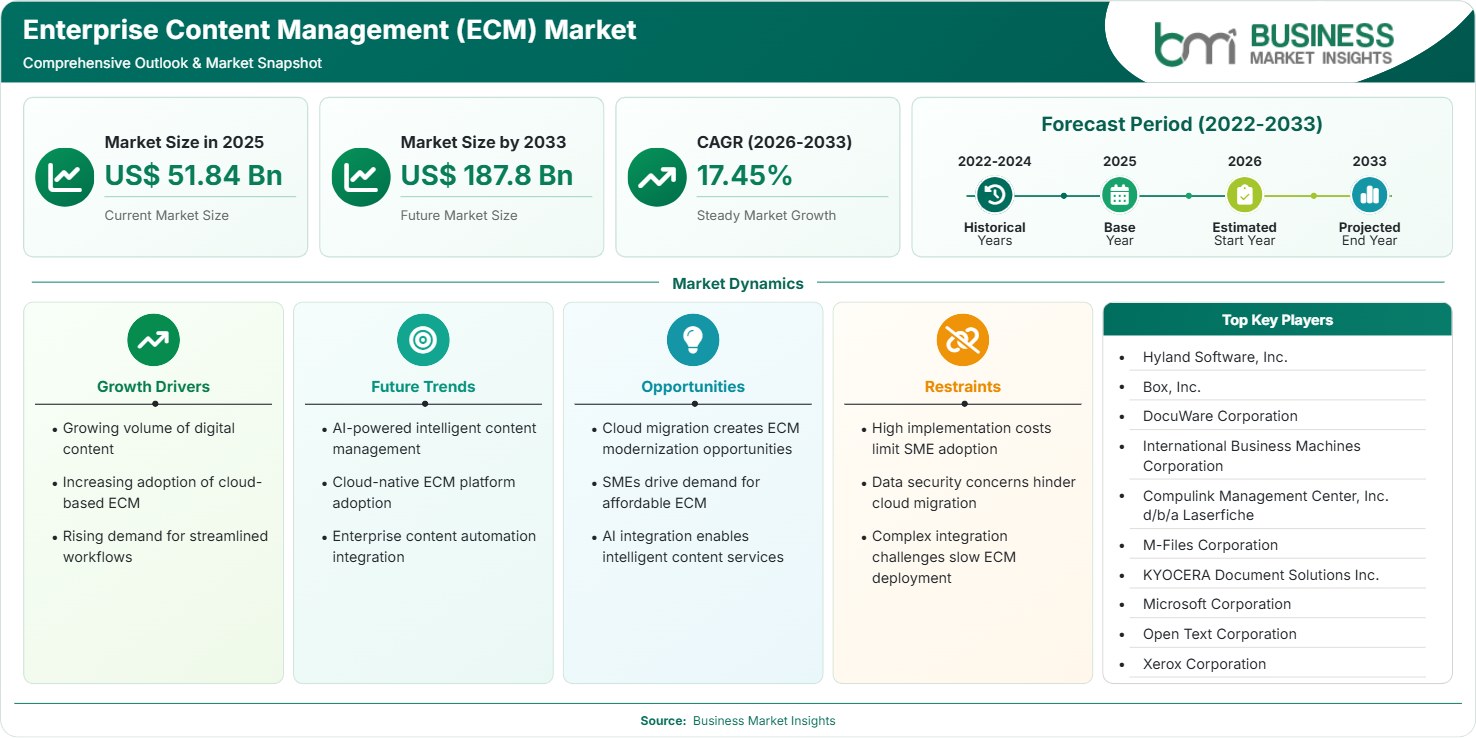
The Enterprise Content Management (ECM) Market size was valued at US$ 51.84 Billion in 2025 and is projected to reach US$ 187.8 Billion by 2033, growing at a CAGR of 17.45% during 2026–2033, driven by AI adoption, cloud migration, workflow automation, information governance, repository consolidation, and enterprise demand for AI ready content.

Report Coverage
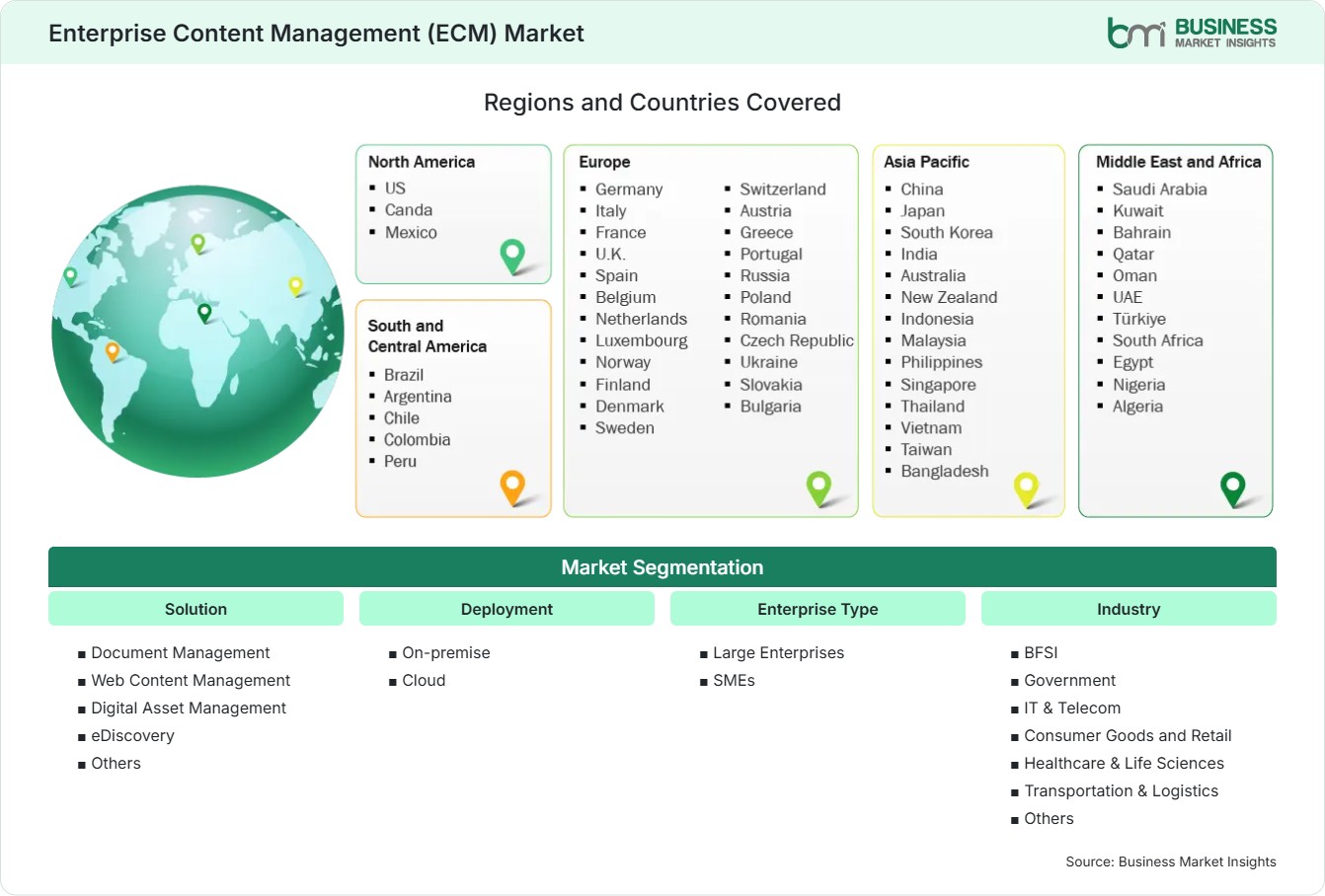
  • Solution: Document Management, Web Content Management, Digital Asset Management, eDiscovery, Others
  • Deployment: On-premise, Cloud
  • Enterprise Type: Large Enterprises, SMEs
  • Industry: BFSI, Government, IT & Telecom, Consumer Goods and Retail, Healthcare & Life Sciences, Transportation & Logistics, Others
US$ 51.84 Bn Market size in 2025
US$ 187.8 Bn Market Size by 2033
17.45% CAGR, 2026 - 2033
2026-2033 Forecast Period

AI Overview

Enterprise Content Management (ECM) Market Summary

  • North America Region: North America accounted for 35%–40% of the market share in 2025 and is projected to grow at a 12.8%–13.8% CAGR during 2026–2033, driven by cloud migration, AI-enabled content management, compliance modernization, and workflow automation. The U.S. market is expected to register a 13%–15% CAGR, supported by strong enterprise software spending, regulatory requirements, repository integration, and mature ECM adoption.
  • Fastest Growing Region: Asia Pacific holds Enterprise Content Management (ECM) Market share of 19%–24% in 2025, expanding at a CAGR of 15.2%–16.1% during 2026–2033, supported by rapid digitization, cloud first deployments, AI investment, expanding enterprise data volumes, government modernization, and growing demand for automated information workflows across banking, healthcare, manufacturing, telecommunications, and public services.
  • Leading Segment: Structure holds market share of 42%–46% in 2025, growing at a CAGR of 17%–19% during 2026–2033, influenced by repository consolidation, standardized workflows, information governance, cloud migration, AI readiness, enterprise integration, and demand for controlled access to increasingly distributed business information.
  • High Growth Segment: At-grade ECM holds share of 19%–22% in 2025, expanding at a CAGR of 20%–22% during 2026–2033, supported by flexible deployment, decentralized operations, mobile access, rapid digitization, lower implementation barriers, workflow integration, and increasing demand for intelligent enterprise information retrieval.
  • Key Market Opportunity: The strongest opportunity is converting fragmented enterprise content into governed, AI ready information assets that support intelligent search, autonomous workflows, compliance, knowledge discovery, customer service, analytics, and industry specific automation.
  • Major Market Players: Hyland Software, Inc.; Box, Inc.; DocuWare Corporation; International Business Machines Corporation; Compulink Management Center, Inc. d/b/a Laserfiche; M-Files Corporation; KYOCERA Document Solutions Inc.; Microsoft Corporation; Open Text Corporation; Xerox Corporation.
Strategic Insights

Enterprise Content Management (ECM) Market: Strategic Insights

Enterprise Content Management (ECM) Market Strategic Framework
FREE PDF
Request your free sample
Request free sample
Stakeholder View

Key Takeaways

  • Value chain is shifting from document management to ecosystems which includes content platform, cloud service, AI solution provider, systems integration, cybersecurity, application provider, and managed services partner.
  • There is maximum opportunity in artificial intelligence-powered content intelligence, intelligent document processing, workflow automation, enterprise search, records governance, and vertical application, where information is converted to operational decision-making.
  • Innovation is headed toward information-based generation, agentic processes, metadata creation, smart capturing, semantic categorization, and AI-based process execution with consent and auditing.
  • The Indian, Southeast Asian, Chinese, Middle Eastern, and some Latin American markets present excellent investment opportunities because of the parallel progress of enterprise digitalization, cloudification, implementation of AI, and legalization.
  • Increasingly, investments are directed at platform consolidation, AI technologies, cloud subscriptions, governance, and ecosystem integration. Box and IBM, for instance, announced their partnership in regards to enterprise AI models and content productivity in 2025.
  • The assessment of ECM is more often based on the performance results rather than on its features. These include quicker processing, quicker access to information, minimized manual input, greater compliance, higher employee productivity, etc.
Geographic Outlook

Enterprise Content Management (ECM) Market Regional Highlights

North America Enterprise Content Management (ECM) Market

North America held 35%–40% share in 2025 and is projected to grow at a 12.8%–13.8% CAGR from 2026–2033. It remains the leading regional Enterprise Content Management (ECM) Market scope because large enterprises have mature digital infrastructure, extensive content estates, strong cloud adoption, and demanding governance requirements. Financial services, healthcare, government, technology, and professional services remain important users.

  • Cloud migration trends are leading to the consolidation of fragmented repository systems into integrated platforms offering content management, workflow management, governance, search and analytics, and AI capabilities.
  • Increasing use of AI in enterprises is boosting the need for metadata, permissioning, semantic search, intelligent extraction, and source information that will power enterprise AI systems.
  • Regulated businesses are still focusing on records management, retention, auditing, and access control and other information lifecycle practices in the context of growing digital content.
  • Legacy vendors derive strength from their installed base, integration partners, and enterprise procurement expertise, which drives revenue in terms of upgrading and scaling investments.

US Enterprise Content Management (ECM) Market

The US represented approximately 72%–75% of North American revenue in 2025, with a projected 13%–15% CAGR through 2033. Enterprise technology spending, cloud penetration, AI investment, and mature software ecosystems provide a strong foundation in Enterprise Content Management (ECM) Market.

  • Large US organizations increasingly connect enterprise content with AI assistants, making permissions, metadata quality, information lineage, search relevance, and governance central technology requirements.
  • Financial services and healthcare remain durable demand centers because regulated records require controlled retention, traceability, secure access, and auditable processing alongside increasing automation.
  • Microsoft, Box, IBM, OpenText, Hyland, Laserfiche, and other providers compete through cloud services, AI capabilities, workflow automation, governance, integrations, and industry specific solutions.

Europe Enterprise Content Management (ECM) Market

Europe Enterprise held approximately 20%–27% share in 2025 and is projected to grow at 10.9%–13.2% through 2033. Germany remains a major national market, with the UK and France also providing substantial enterprise demand. Privacy regulation, information governance, digital workplace modernization, healthcare digitization, and cross border data management increase the strategic value of controlled content platforms.

  • Germany utilizes the combination of industrial digitization and robust information governance, thus requiring document management solutions, engineering information management, process integration, compliance, and enterprise-level repositories.
  • The UK market has great prospects within the financial services, government, healthcare, and professional services sectors where cloud content and process automation enable operational modernization.
  • The French market offers growth prospects due to digitization within the public sector and enterprise investment in document automation, collaboration, information management, and engineering information management.
  • Operational modernization in the healthcare sector emphasizes the need for interoperability, privacy, data quality, and trusted information management, especially when organizations introduce AI.

Asia Pacific Enterprise Content Management (ECM) Market

Asia Pacific represented 19%–24% share in 2025 and is projected to expand at 15.2%–16.1% through 2033, making it the fastest growing major region. China has scale through large enterprises and government digitization, and India offers strong growth opportunities. Demand for enterprise technology solutions is mature in Japan, whereas Southeast Asia has advantages in cloud, digital banking, public-sector digitalization, and growing investment in technology. There is rising demand for enterprise information governance due to AI adoption.

  • There is strong demand in China from the financial, government, manufacturing industries and large companies upgrading their information governance and document processes to digital forms.
  • India is a high growth market due to the rapid adoption of AI and digitization within organizations where there is growing demand for information infrastructure to support automation.
  • Japan presents mature enterprise IT systems coupled with demand for secure document management, compliance, information governance and efficiency.
  • Southeast Asian economies are adopting cloud-first modernization within banking, government, telecommunications, manufacturing and shared services.

Rest of World Enterprise Content Management (ECM) Market

Rest of World represented approximately 10%–15% share in 2025, with modeled growth of 12%–15% through 2033. Latin America is supported by Brazil led digitization and cloud adoption, while Middle Eastern markets benefit from government modernization and enterprise technology investment.

  • Brazil has high Latin American growth potential due to enterprise digitalization, adoption of the cloud, modernization of processes, financial technology, and increasing need for information governance.
  • UAE and Saudi Arabia have significant Middle Eastern growth potential due to government digitalization, smart infrastructure initiatives, cloud spending, and regulated enterprise modernization.
  • African markets offer longer term potential as organizations formalize digital records, automate workflows, strengthen governance, and reduce reliance on fragmented paper based information.
  • Middle Eastern buyers increasingly seek secure information infrastructure that can support multilingual content, digital government services, compliance, enterprise collaboration, and AI enabled operations.
Global Market Geography
FREE PDF
Request your free sample
Request free sample
Segment Analysis

Enterprise Content Management (ECM) Market Segmentation

Solution

Solution holds a modeled 44%–48% share in 2025, representing a significant Enterprise Content Management (ECM) Market size, and is projected to grow at a modeled CAGR of 17%–19% during 2026–2033. Growth is driven by increasing enterprise demand for digital content governance, regulatory compliance, workflow automation, AI-enabled document processing, and secure information management across distributed business environments.

  • Document Management: Represents the largest solution segment, supporting document capture, storage, version control, records management, workflow automation, and secure retrieval of business-critical information across departments.
  • Web Content Management: Enables organizations to create, manage, publish, and optimize digital content across websites, portals, and customer engagement platforms while ensuring content consistency and governance.
  • Digital Asset Management: Supports centralized management of images, videos, marketing materials, and multimedia assets, improving asset utilization, brand consistency, and collaboration across content-intensive operations.
  • eDiscovery: Facilitates identification, preservation, collection, and analysis of electronically stored information for legal, regulatory, compliance, and risk management requirements.

Deployment

Deployment in the Enterprise Content Management (ECM) Market is led by Cloud, which holds a modeled 60%–64% share in 2025 and is projected to grow at a CAGR of 18%–20% during 2026–2033, driven by scalability, remote accessibility, and lower infrastructure costs.

  • On-premise: Preferred by organizations requiring high levels of control over content repositories, data sovereignty, security protocols, and regulatory compliance, particularly in highly regulated industries.
  • Cloud: Experiencing the fastest growth due to scalability, lower upfront investment, remote accessibility, subscription-based pricing, continuous updates, and seamless integration with digital transformation initiatives.

Enterprise Type

Enterprise Type in the Enterprise Content Management (ECM) Market is led by Large Enterprises, holding a modeled 68%–72% share in 2025 and projected to grow at a CAGR of 16%–18% during 2026–2033, driven by high content volumes, complex compliance requirements, and extensive digital transformation initiatives..

  • Large Enterprises: Account for the dominant market share due to extensive document volumes, complex governance frameworks, global operations, regulatory obligations, and investments in advanced ECM platforms integrated with AI and analytics capabilities.
  • SMEs: Demonstrate strong growth potential as cloud-based ECM solutions reduce implementation barriers and enable smaller organizations to enhance collaboration, document security, workflow efficiency, and regulatory compliance.

Industry

Industry adoption in the Enterprise Content Management (ECM) Market is led by BFSI, holding a modeled 22%–26% share in 2025 due to stringent compliance, records management, and document security requirements. Healthcare & Life Sciences and Government collectively account for a significant share, driven by digital recordkeeping, regulatory mandates, and process automation initiatives.

  • BFSI: Leads adoption through regulatory compliance, customer document management, risk monitoring, and secure content storage requirements.
  • Government: Utilizes ECM solutions for records digitization, public document management, transparency initiatives, and citizen service modernization.
  • IT & Telecom: Supports knowledge sharing, contract management, project documentation, and management of large volumes of digital content.
  • Consumer Goods & Retail: Leverages ECM for product information management, supplier documentation, marketing asset control, and omnichannel operations.
  • Healthcare & Life Sciences: Relies on ECM for patient records, clinical documentation, research data management, and regulatory compliance.
  • Transportation & Logistics: Uses ECM to manage shipment records, operational documents, compliance reporting, and supply chain workflows.
Market Forces

Enterprise Content Management (ECM) Market Dynamics

Key Market Drivers

AI Converts Repositories Into Operational Knowledge

The advent of AI technology has led to changes in ECM economics through conversion of documents, pictures, letters, contracts, and records to searchable data. The ECM Market is now dependent on activities like classification, extraction, summarization, retrieval, metadata enrichment, and workflow execution as opposed to storage alone. Hyland’s Knowledge Enrichment solution is meant to turn unstructured content into structured information for AI applications. The technology used is capable of handling more than 600 different file formats and document context preservation.

Cloud Migration Expands Recurring Content Services

Cloud migrations are driving ECM into subscriptions to content services, where cloud computing makes integrations with productivity applications, APIs, identity solutions, analytics, workflow engines, and artificial intelligence solutions easy and enables continuous feature development. Increasingly, customers demand features such as governance, security, records management, search, metadata, automation, and regional deployments, which make the Enterprise Content Management (ECM) Market trends favor vendors who can offer content management services with other enterprise platforms. Cloud delivery is also an opportunity for the development of recurring revenue streams and vendor service extensions.

Governance Requirements Increase Strategic ECM Value

Governance needs result in the need for systems that show where data is, who can access the data, what is done to data, and whether it must be kept or purged. Governance needs tend to be especially high in healthcare, financial services, government, law firms, and insurance organizations. The importance of governance is heightened by AI, which increases the risk of sensitive data being compromised through unmanaged data stores, and also results in inaccurate outcomes based on outdated data. Therefore, Enterprise Content Management (ECM) Market growth depends upon combining content management with cybersecurity, privacy, retention, lineage, governance, and AI management.

Key Market Opportunities

AI Agent Governance Creates A New Platform Layer

AI agents have presented a new avenue for ECM providers to serve as governance layers within the autonomous workflow of an enterprise. The organizations require agents that will seek out approved information, respect permission levels, recognize authentic documents, perform controlled workflow processes, and log activities. Box released agent guardrails, third-party agent monitoring, quick detection of injections, and access policies by classification in July 2026.

Industry Specific Content Intelligence Can Raise Contract Value

Vertical applications provide an opportunity because generic repository functionality is increasingly becoming a platform capability. Healthcare can apply intelligent content services to clinical records and compliance, while financial institutions can automate contracts, onboarding, regulatory files, and customer correspondence. Insurance can process claims, legal organizations can accelerate document discovery, and manufacturers can manage engineering records. Combining reusable AI capabilities with industry taxonomies, workflows, controls, and integrations can increase account penetration and switching costs while creating higher value solutions.

Emerging Economies Offer Cloud First Expansion Paths

The emerging economies have an advantage of bypassing the existing legacy system and adopting cloud-based information services. India provides a good opportunity since according to the IMF report, almost 60% of the companies employ artificial intelligence. Vendors can overcome implementation issues through partnerships, managed services, workflows, industry-specific solutions, and integration. Similar situations prevail in Southeast Asia, the Middle East, and certain parts of Latin America with the development of digital governments, finance sectors, health sector transformation, and enterprise cloud computing.

Market Restraints and Challenges

Legacy Integration Complexity Raises Implementation Costs

Factor: fragmented repositories, inconsistent metadata, custom applications, incompatible formats, and acquired systems increase ECM modernization complexity. Impact: Implementation programs might entail a large amount of migration, cleansing, integration, testing, and change management until the advantages are measurable. Businesses can run several repositories within their departments, geographic locations, and regulatory regimes, thus raising the stakes in terms of migration. Unstructured information and content fragmentation are among the major hurdles to AI adoption, according to Hyland. Hence, vendors require connectors, migration solutions, metadata mapping, APIs, and services. Otherwise, businesses could delay consolidation despite the obvious benefits.

AI Governance And Data Quality Limit Autonomous Workflows

Factor: incomplete metadata, outdated records, duplicate documents, privacy restrictions, uncontrolled permissions, and uncertain AI outputs reduce confidence in autonomous content workflows. Impact: Organizations may also choose to have human oversight, limit the use of automation, or delay implementation until improvements have been made to the governance process and the quality of the data. This is particularly true in healthcare and financial institutions since the wrong data can expose an organization to risks related to both compliance and operations. It is essential for ECM vendors to focus on provenance, access controls, validation, human oversight, and auditability.

Company Analysis

Competitive Landscape

The Enterprise Content Management (ECM) Market analysis shows competition moving beyond document storage toward AI readiness, cloud delivery, governance, workflow automation, integration breadth, and installed base strength.

Company Name

Overview

Products and Services relevant to this market

Hyland Software, Inc.

Enterprise content and process technology provider focused on intelligent content, automation, governance, and information intensive workflows.

OnBase, Alfresco, Content Innovation Cloud, Knowledge Enrichment, Knowledge Discovery, IDP, governance, automation, and AI agent capabilities.

Box, Inc.

Cloud content platform provider combining secure collaboration, governance, workflow automation, and AI for enterprise customers.

Box Content Cloud, Box AI, Box Automate, Box Governance, Box Shield, Box Zones, integrations, and agent security controls.

DocuWare Corporation

Document management and workflow specialist serving organizations modernizing paper based and manual processes.

DocuWare Cloud, document management, intelligent indexing, workflow automation, forms, integrations, and digital processing.

International Business Machines Corporation

Global technology provider combining enterprise content, AI, automation, hybrid cloud, and consulting capabilities.

IBM FileNet, watsonx, content services, document processing, workflow automation, records management, and AI governance.

Compulink Management Center, Inc. d/b/a Laserfiche

Content and process automation provider focused on document management, workflow, forms, and intelligent information processing.

Laserfiche Cloud, document management, workflow, forms, records management, intelligent capture, and AI enabled content services.

M-Files Corporation

Information management provider emphasizing metadata driven organization, intelligent access, workflow, and lifecycle control.

M-Files Platform, metadata driven document management, workflow, governance, integrations, and AI capabilities.

KYOCERA Document Solutions Inc.

Document solutions provider combining hardware, software, workflow applications, and enterprise document services.

ECM solutions, capture, workflow applications, multifunction devices, document processing, and managed document services.

Microsoft Corporation

Global software provider whose Microsoft 365 ecosystem makes SharePoint a major enterprise content and collaboration platform.

SharePoint, Microsoft Purview, Microsoft 365, Copilot, Power Platform, records management, governance, and workflow automation.

Open Text Corporation

Enterprise information management provider serving complex organizations through cloud content, governance, integration, and AI.

OpenText Content Management, Content Aviator, Extended ECM, capture, records management, workflow, governance, and cloud services.

Xerox Corporation

Document technology and services provider extending into digital workflow, capture, automation, and information management.

Xerox DocuShare, digital document management, capture, workflow automation, digitization, and managed document services.

Trust & Transparency

Research Methodology

The market analysis combines proprietary research with secondary data from government agencies, company disclosures, regulatory filings, industry databases and expert interviews. Market estimates are validated through data triangulation, cross-market benchmarking and analyst review.

View Full Research Methodology

Questions Answered

Frequently Asked Questions

What should buyers evaluate before selecting an ECM Report?

Buyers should assess integration architecture, security, governance, AI controls, migration capabilities, workflow functionality, APIs, deployment flexibility, industry features, implementation support, scalability, and total lifecycle cost.

Which industries offer strong ECM opportunities?

Financial services, healthcare, government, insurance, legal services, manufacturing, and transportation generate substantial regulated or operational content requiring secure access, lifecycle control, traceability, workflow automation, and governance.

How should organizations measure ECM return on investment?

Useful measures include processing time, information retrieval time, manual data entry reduction, workflow cycle time, automation rates, compliance exceptions, repository consolidation, user adoption, and operating cost reduction.

How will AI influence future ECM adoption?

AI will increasingly connect enterprise content with search, automation, analytics, and agentic workflows. The Enterprise Content Management (ECM) Market forecast reflects rising demand for governed, AI ready information environments that can support intelligent decision-making while maintaining security, permissions, compliance, and auditability.

What role does metadata play in modern ECM?

According to the analysis presented in the Enterprise Content Management (ECM) Market report, Metadata controls how content is classified, searched, routed, governed, retained, and interpreted by AI systems

Access the Full Enterprise Content Management (ECM) Market Report

Get segment-level forecasts, regional estimates, competitive benchmarking, company profiles and downloadable Excel datasets.

Access the full Enterprise Content Management (ECM) Market Report
350 pages PDF & Excel | 2026-09-22
Similar Research

Related Market Reports