
Endodontics Market Outlook: Size, Share, Trends, Growth Analysis, Competitive Landscape & Forecast, 2026-2033

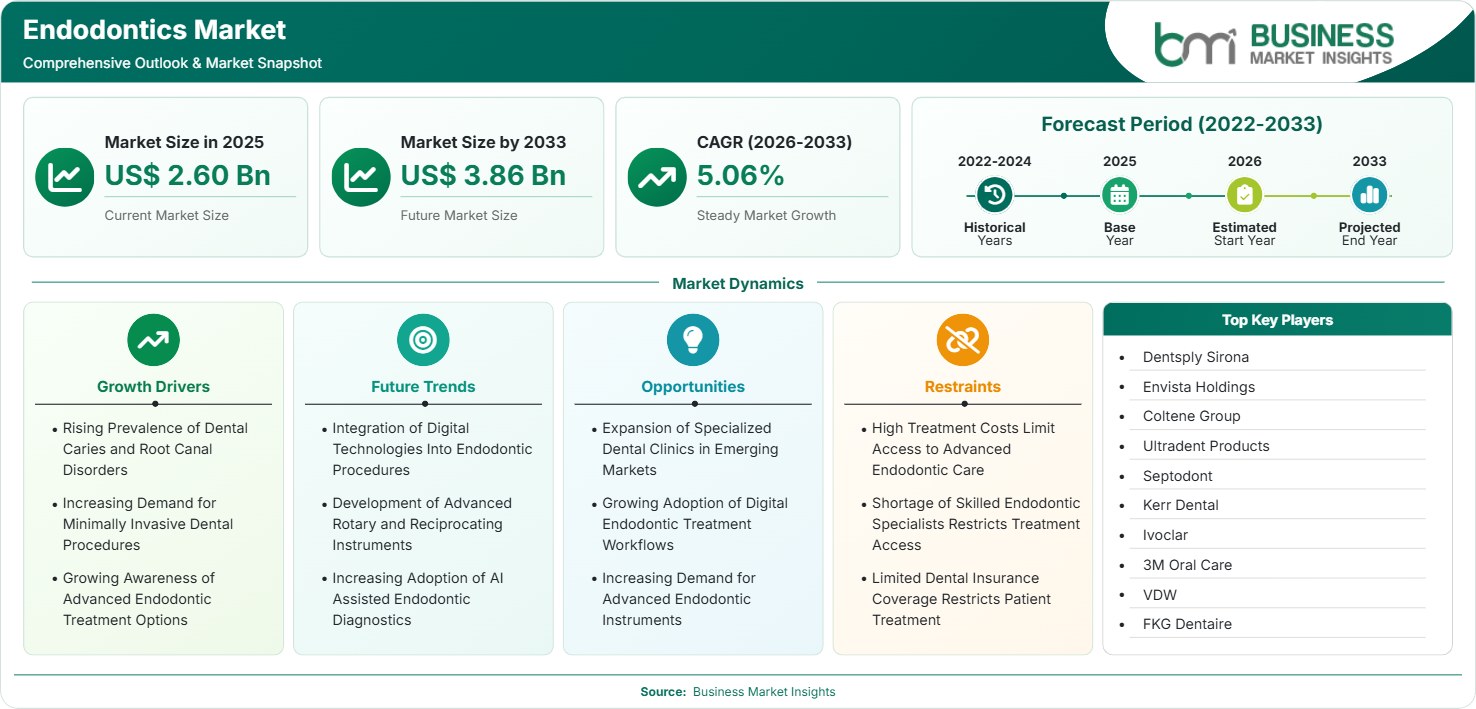
The Endodontics Market size was valued at US$ 2.60 billion in 2025 and is projected to reach US$ 3.86 billion by 2033, growing at a CAGR of 5.06% during 2026–2033, supported by rising dental disease prevalence, minimally invasive procedures, digital workflows, specialized clinics, and advanced endodontic instruments.

Report Coverage
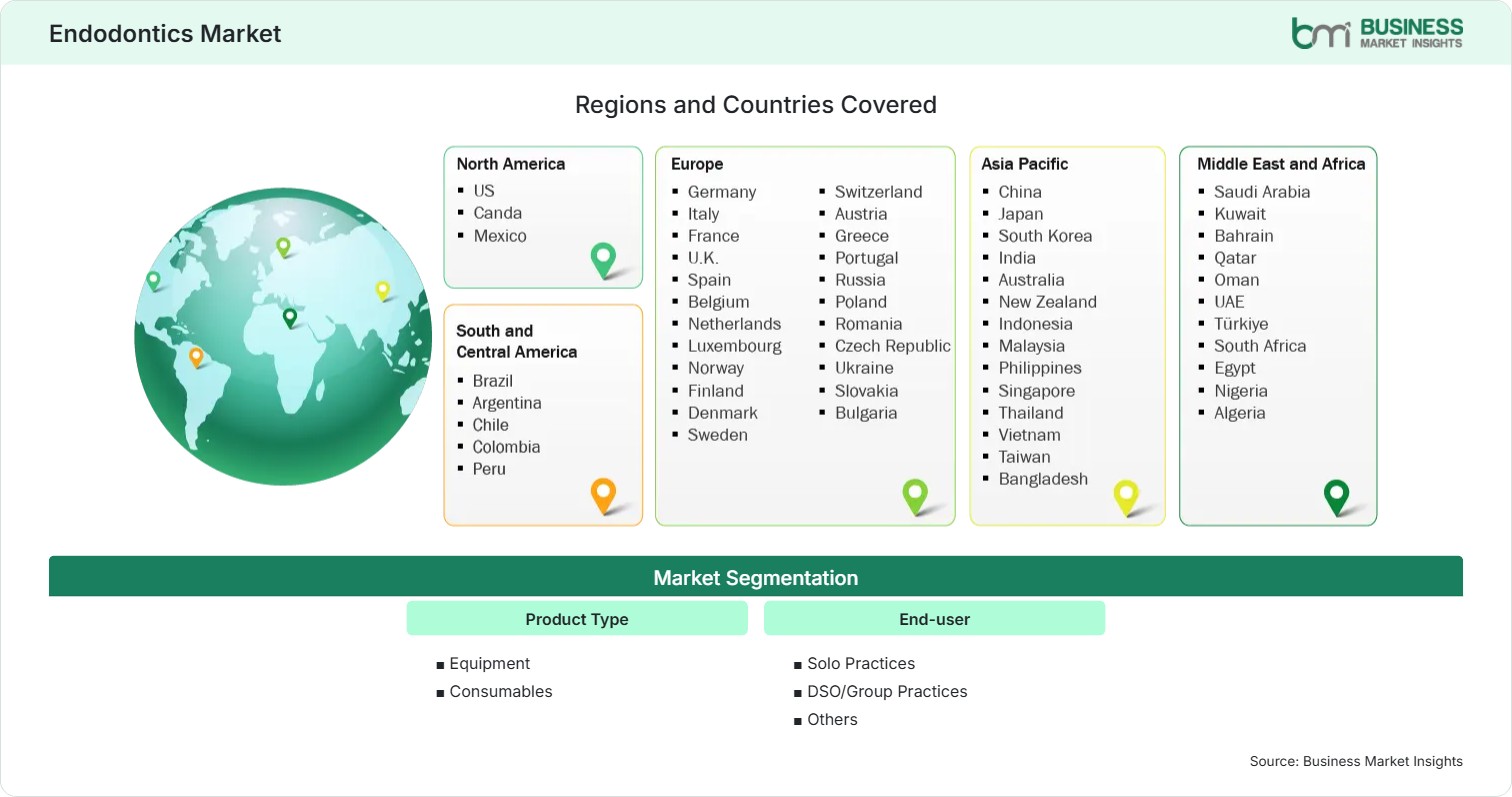
  • Product Type: Equipment, Consumables
  • End-user: Solo Practices, DSO/Group Practices, Others
US$ 2.60 Bn Market size in 2025
US$ 3.86 Bn Market Size by 2033
5.06% CAGR, 2026 - 2033
2026-2033 Forecast Period

01 AI Overview

Endodontics Market Summary

  • North America Region: North America held an estimated 34%–38% share in 2025 and is projected to grow at a 4.8%–5.2% CAGR, supported by advanced dental infrastructure, high procedural volumes, specialist availability, digital treatment adoption, and demand for technologically advanced endodontic equipment and consumables. The U.S. Endodontics Market is projected to grow at a 4.9%–5.3% CAGR, supported by specialist care and technology adoption.
  • Fastest Growing Region: Asia Pacific held an estimated 23%–27% share in 2025 and is projected to grow at a 6.2%–6.6% CAGR, supported by expanding dental infrastructure, increasing oral healthcare awareness, growing private clinic networks, rising disposable incomes, and improving access to advanced root canal procedures.
  • Leading Segment: Consumables held an estimated 63%–67% share in 2025 and are projected to grow at a 5.3%–5.7% CAGR, supported by recurring procedural demand for files, gutta-percha points, sealers, dental dams, burs, and drills.
  • High Growth Segment: Digital Endodontic Treatment Workflows held an estimated 18%–22% share in 2025 and are projected to grow at a 7.0%–7.4% CAGR, driven by digital imaging, electronic apex location, rotary instrumentation, workflow integration, and treatment precision.
  • Key Market Opportunity: Digital integration across endodontic procedures offers attractive opportunities for equipment manufacturers and dental practices by improving treatment planning, procedural consistency, workflow efficiency, and patient experience.
  • Major Market Players: Dentsply Sirona Inc., Envista Holdings Corporation, COLTENE Group, Ultradent Products, Inc., Septodont, Kerr Dental, Ivoclar Vivadent AG, 3M Oral Care, VDW GmbH, FKG Dentaire Sàrl.
02 Strategic Insights

Endodontics Market: Strategic Insights

endodontics-market-market-strategic-framework
FREE PDF
Request your free sample
Request free sample
03 Stakeholder View

Key Takeaways

  • The value chain spans equipment manufacturers, consumable suppliers, dental distributors, specialist clinicians, general dentists, group practices, and dental service organizations, creating opportunities for integrated product portfolios.
  • Consumables provide recurring revenue potential because root canal procedures require replacement files, burs, sealers, gutta-percha points, and other procedural materials.
  • Digital workflow integration is becoming a key innovation direction as manufacturers connect imaging, apex location, instrumentation, and treatment documentation to improve procedural efficiency.
  • Asia Pacific offers a strong investment case as dental infrastructure expands and more patients gain access to specialized treatment through private clinics and organized healthcare networks.
  • Competitive activity is increasingly centered on product innovation, specialist education, distribution partnerships, and portfolio expansion rather than equipment sales alone.
  • Training and clinical support can differentiate suppliers in markets where advanced endodontic technologies are available but specialist expertise remains unevenly distributed.
04 Geographic Outlook

Endodontics Market Regional Highlights

North America Endodontics Market

North America held an estimated 34%–38% share in 2025 and is projected to grow at a 4.8%–5.2% CAGR through 2033. The region benefits from developed dental infrastructure, established specialist networks, high awareness of tooth preservation, and broad availability of advanced equipment. The U.S. represents the largest regional Endodontics Market, while Canada contributes through expanding access to modern dental technologies and organized clinical practices.

  • The U.S. dental sector supports demand for advanced endodontic equipment as practitioners increasingly use electronic apex locators, rotary systems, digital imaging, and improved obturation technologies.
  • Specialist endodontic practices remain important technology adopters, creating demand for precise instruments and equipment that can support complex root canal procedures.
  • Group dental practices are increasingly standardizing clinical workflows, supporting demand for compatible equipment and consumable portfolios across multiple practice locations.
  • Dental manufacturers are emphasizing clinician education and technical support to accelerate adoption of advanced instruments and improve confidence among general dentists performing endodontic procedures.

US Endodontics Market

The U.S. represented an estimated 31%–35% share in 2025 and is projected to grow at a 4.9%–5.3% CAGR through 2033. Demand is supported by established specialist care, advanced dental technologies, and high awareness of tooth-preserving procedures. Solo practices, group practices, and dental service organizations provide diverse purchasing channels, while continuing innovation in instrumentation supports replacement and upgrade cycles.

  • Advanced equipment adoption is supported by established dental practices seeking greater precision, workflow efficiency, and predictable outcomes in root canal treatment.
  • Dental service organizations are creating opportunities for standardized equipment procurement and consumable purchasing across growing networks of affiliated and managed practices.
  • Endodontic specialists continue influencing technology adoption by evaluating advanced instrumentation, imaging, and obturation systems for complex clinical procedures.
  • Ongoing clinician education supports wider adoption of advanced endodontic techniques among general dentists seeking to perform more predictable root canal treatments.

Europe Endodontics Market

Europe held an estimated 27%–31% share in 2025 and is projected to grow at a 4.6%–5.0% CAGR through 2033. Germany, the UK, France, and Italy are leading Endodontics Markets, supported by established dental care systems and advanced clinical capabilities. Germany is projected to grow at a 4.9%–5.3% CAGR, while Poland offers comparatively faster growth through expanding private dental services and technology adoption.

  • Germany's advanced dental technology ecosystem supports demand for sophisticated endodontic equipment, instruments, and consumables across specialist and general dental practices.
  • The UK provides opportunities through increasing adoption of digital treatment workflows and growing emphasis on preserving natural teeth through evidence-based endodontic care.
  • France benefits from established dental infrastructure and specialist capabilities, supporting continued demand for advanced instrumentation and high-quality consumables.
  • Poland is emerging as a higher-growth market as private dental clinic development and investments in modern equipment improve access to specialized endodontic treatment.

Asia Pacific Endodontics Market

Asia Pacific represented an estimated 23%–27% Endodontics Market share in 2025 and is projected to grow at a 6.2%–6.6% CAGR through 2033. China, Japan, India, and South Korea are important markets, with India projected to grow at a 7.0%–7.4% CAGR. Expanding dental clinics, improving awareness, rising disposable incomes, and greater access to advanced treatment are supporting regional demand.

  • China offers significant potential as private dental clinics expand and practitioners increasingly invest in modern equipment, digital imaging, and advanced root canal instrumentation.
  • India is experiencing rising demand for endodontic services as urban dental infrastructure develops and awareness of tooth preservation and specialized care improves.
  • Japan benefits from an established dental care system and technologically sophisticated practices, supporting demand for precision instruments and advanced endodontic equipment.
  • South Korea's advanced healthcare technology ecosystem supports digital workflow adoption and demand for sophisticated dental equipment across specialist and group practices.

Rest of World Endodontics Market

South and Central America accounted for an estimated 7%–9% share in 2025 and are projected to grow at a 5.3%–5.7% CAGR through 2033. Brazil and Mexico lead regional opportunities. The Middle East and Africa represented an estimated 5%–7% share and are projected to grow at a 5.8%–6.2% CAGR, supported by private healthcare investment.

  • Brazil offers opportunities through its extensive private dental sector, growing specialist networks, and increasing availability of advanced endodontic instruments and consumables.
  • Mexico benefits from expanding private dental services and cross-border dental care, creating demand for modern equipment and efficient root canal treatment technologies.
  • The UAE is developing advanced private healthcare infrastructure, supporting adoption of sophisticated dental equipment and specialist treatment capabilities in major urban centers.
  • Saudi Arabia's healthcare modernization programs are expanding private medical and dental infrastructure, creating opportunities for suppliers of advanced endodontic technologies and consumables.
global-market-geography
FREE PDF
Request your free sample
Request free sample
05 Segment Analysis

Endodontics Market Segmentation

Product Type

Consumables held an estimated 63%–67% share in 2025 and are projected to grow at a 5.3%–5.7% CAGR between 2026–2034. Recurring procedural use supports demand for files, burs, gutta-percha points, sealers, and dental dams. Equipment remains important as practices invest in apex locators, motors, handpieces, and lasers to improve procedural accuracy and efficiency.

  • Equipment: Endodontic equipment supports diagnosis, canal preparation, visualization, and treatment precision, with digital and motorized technologies increasingly improving workflow efficiency across dental practices.
    • Apex Locator: Apex locators help clinicians determine working length more accurately, supporting efficient root canal preparation and reducing reliance on conventional radiographic estimation.
    • Motor: Endodontic motors provide controlled rotary and reciprocating instrumentation, supporting efficient canal shaping and helping clinicians achieve consistent preparation performance.
    • Dental Handpiece: Dental handpieces support precision access preparation and instrumentation, with ergonomic designs improving clinician control and procedural efficiency.
    • Dental Laser: Dental lasers offer specialized applications in endodontic procedures, supporting disinfection and tissue management while creating opportunities for technology-focused dental practices.
    • Others: Other equipment includes specialized visualization and treatment technologies that support clinicians seeking improved procedural control, diagnosis, and workflow efficiency.
  • Consumables: Consumables generate recurring demand because root canal procedures require multiple disposable or replaceable products, creating stable revenue opportunities for specialized dental suppliers.
    • Dental Burs & Drills: Burs and drills support access preparation and tooth structure management, with demand influenced by procedure volumes and clinician preferences for precision instruments.
    • Endodontic Files: Endodontic files are essential for canal cleaning and shaping, with advanced rotary and reciprocating designs supporting efficient and predictable treatment workflows.
    • Dental Dams: Dental dams provide isolation during root canal procedures, supporting infection control, moisture management, and improved visibility throughout treatment.
    • Gutta-Percha Points: Gutta-percha points are widely used for canal obturation, generating recurring demand alongside root canal procedures and supporting consistent filling techniques.
    • Dental Sealers: Dental sealers support obturation by filling spaces between canal walls and core materials, with advanced formulations targeting improved sealing performance.
    • Others: Other consumables include specialized materials used during cleaning, irrigation, obturation, and restorative stages of endodontic procedures.

End-user

Solo Practices held an estimated 42%–46% share in 2025 and are projected to grow at a 4.8%–5.2% CAGR between 2026–2034. Independent dentists remain important purchasers of consumables and selected equipment. DSO and group practices are gaining influence through centralized procurement and standardized workflows, while other end users include institutional and specialized dental care settings.

  • Solo Practices: Independent practices remain major users of endodontic consumables and equipment, with purchasing decisions influenced by clinical needs, affordability, workflow efficiency, and technology familiarity.
  • DSO/Group Practices: Group practices and dental service organizations increasingly centralize procurement and standardize treatment protocols, creating opportunities for suppliers offering scalable equipment and consumable portfolios.
  • Others: Other end users include institutional and specialized dental facilities where endodontic treatment demand supports purchases of instruments, equipment, and recurring procedural consumables.
06 Market Forces

Endodontics Market Dynamics

Key Market Drivers

Rising Prevalence of Dental Caries and Root Canal Disorders

Dental caries and pulpal diseases continue to play an important role in tooth loss and the need for dental restorations, supporting the demand for endodontic treatments. With the increasing number of people preferring to preserve their teeth rather than have them removed, the market will also depend on the availability of high-quality endodontic tools, diagnostic equipment, and consumables. The Endodontics Market growth will thus be driven not only by the procedure volume but also by improved diagnosis and increased access to treatment. Increased attention towards oral care is leading to more frequent visits, and the advancement of treatment techniques is helping to treat a broader range of teeth.

Increasing Demand for Minimally Invasive Dental Procedures

More patients and professionals are now turning their attention to treatments that preserve tooth structure and reduce the number of interventions. Endodontic therapy is one approach that reflects such patient preferences and allows dentists to save the tooth rather than extract it immediately. The introduction of magnification, imaging, rotary instrumentation, and treatment planning is leading to more accurate endodontic therapies. Manufacturers of the equipment are starting to develop smaller and more flexible tools, which will help with the treatment. The minimally invasive dentistry trend also motivates general dentists to acquire advanced equipment, which might increase their confidence in the procedure. Thus, the market for the specialized consumables and equipment will stay closely linked to innovations in restorative dentistry.

Growing Awareness of Advanced Endodontic Treatment Options

Increased patient awareness of modern root canal treatments is helping to drive demand for specialty care along with advanced technology. More and more patients understand that modern endodontic treatments can save their natural teeth and reduce the need for extractions and replacements. In addition to this, dentists are educating patients about the advantages of advanced imaging systems, rotary instruments, apex localization, and better obturation techniques. The Endodontics Market trend is thus shifting towards higher levels of technology adoption due to the desire of practices to provide more predictable results. Additional factors, such as training courses, continuing education, and referrals from specialists, are also helping in raising awareness.

Key Market Opportunities

Expansion of Specialized Dental Clinics in Emerging Markets

Emerging economies present several opportunities, as private dental clinics have begun operating and healthcare infrastructure has developed. It is possible to open specialized endodontic clinics that will provide advanced treatment and create concentrated demand for the equipment and consumable goods. Companies may succeed by developing regional distribution alliances, creating efficient product lines, and training clinicians. Emerging markets with urban population growth and rising disposable incomes are especially promising, as more and more people need specialized dental care. Those companies that know about the local buying behavior and offer appropriate goods can make use of these chances.

Growing Adoption of Digital Endodontic Treatment Workflows

The advent of digital technology is presenting possibilities for integration of imaging, electronic apex determination, treatment planning, rotary instrumentation, and documentation. Interconnected processes will allow professionals to increase treatment efficiency and consistency, as well as reduce manual interventions. The manufacturers of the equipment will be able to benefit from creating interconnected technologies capable of functioning in various practice settings and fitting into a wider ecosystem of dental software. The potential goes beyond specialist practices, since general dentists might use some of the technologies to improve their confidence in performing root canal treatments.

Increasing Demand for Advanced Endodontic Instruments

The demand for modern instruments is rising due to the growing need for more flexible, precise, durable, and effective tools in root canal therapy. The use of rotary and reciprocating files, upgraded handpieces, modern apex locators, and special obturation systems may contribute to solving the issue of complicated anatomical cases. The Endodontics Market forecasts remain because dentists are adopting more technologies, ensuring predictable results and a smooth workflow. Companies should be able to create instruments tailored to specific needs and offer them alongside their education programs. New markets are also promising in this regard due to the opportunity to provide affordable advanced instruments.

Market Restraints and Challenges

High Treatment Costs Limit Access to Advanced Endodontic Care

Factor: Advanced endodontic treatment can involve specialist consultation, diagnostic imaging, sophisticated equipment, and multiple procedural materials, increasing the total cost of care. Impact: Higher treatment expenses can discourage patients from pursuing timely root canal procedures, particularly in markets with limited dental insurance coverage or high out-of-pocket spending. Cost sensitivity can also delay treatment, potentially increasing disease severity and requiring more complex interventions. Manufacturers and dental providers can address this challenge through efficient workflows and cost-conscious product portfolios. However, advanced technology adoption may remain concentrated in higher-income markets and urban centers where patients and practices have greater capacity to absorb treatment expenses.

Shortage of Skilled Endodontic Specialists Restricts Treatment Access

Factor: The availability of trained endodontic specialists varies considerably across countries and is often concentrated in major urban areas. Impact: Limited specialist capacity can restrict access to complex root canal treatment and slow adoption of advanced technologies that require specialized clinical expertise. General dentists may perform routine procedures, but complex cases often require specialist referral. Manufacturers can help address this challenge through clinician education, training programs, intuitive device design, and technologies that simplify selected treatment steps. Nevertheless, workforce shortages remain a structural challenge, particularly in emerging markets where dental infrastructure is expanding faster than specialist capacity.

07 Company Analysis

Competitive Landscape

The competitive environment includes global dental technology companies, specialist endodontic manufacturers, consumable suppliers, and diversified oral care businesses. The Endodontics Market analysis indicates that competition increasingly centers on integrated equipment and consumable portfolios, product innovation, clinical education, digital workflow compatibility, and strong distributor relationships.

Company Name

Overview

Products and Services relevant to this market

Dentsply Sirona Inc.

Global dental technology company offering extensive equipment and consumable solutions for dental professionals.

Endodontic files, motors, apex locators, obturation systems, sealers, and treatment technologies.

Envista Holdings Corporation

Diversified dental products company serving clinicians through multiple established dental brands.

Endodontic instruments, consumables, dental equipment, and specialized treatment solutions.

COLTENE Group

Global dental company specializing in consumables, instruments, and treatment solutions.

Endodontic files, obturation products, dental dams, instruments, and treatment materials.

Ultradent Products, Inc.

Dental products company focused on innovative clinical solutions and specialized procedural technologies.

Endodontic materials, irrigation solutions, obturation products, instruments, and clinical accessories.

Septodont

Global dental healthcare company with expertise in dental therapeutics and clinical treatment products.

Endodontic materials, dental therapeutics, sealers, and specialized procedural products.

Kerr Dental

Dental technology brand providing products for restorative and endodontic clinical procedures.

Endodontic files, sealers, obturation systems, irrigation products, and procedural instruments.

Ivoclar Vivadent AG

Global dental company offering restorative and preventive technologies for professional dental care.

Endodontic-related materials, dental equipment, consumables, and integrated clinical solutions.

3M Oral Care

Oral healthcare business providing dental products and technologies across clinical applications.

Endodontic materials, dental solutions, instruments, and products supporting root canal procedures.

VDW GmbH

Specialist endodontic company focused on instruments and systems for root canal treatment.

Endodontic motors, rotary files, reciprocating systems, apex locators, and accessories.

FKG Dentaire Sàrl

Swiss dental manufacturer specializing in innovative endodontic instruments and treatment solutions.

Rotary files, reciprocating systems, obturation solutions, endodontic instruments, and accessories.

10 Trust & Transparency

Research Methodology

The market analysis combines proprietary research with secondary data from government agencies, company disclosures, regulatory filings, industry databases and expert interviews. Market estimates are validated through data triangulation, cross-market benchmarking and analyst review.

View Full Research Methodology

11 Questions Answered

Frequently Asked Questions

What limits access to advanced endodontic care?

High treatment costs and shortages of trained specialists can limit access, particularly in emerging markets. Uneven dental infrastructure and concentration of specialists in urban areas can further restrict availability.

Which end users offer attractive opportunities for the Endodontics Market?

DSOs and group practices offer attractive opportunities because centralized procurement and standardized clinical workflows can support larger equipment purchases and recurring consumable demand across multiple locations.

How are digital technologies changing endodontic treatment?

Digital imaging, electronic apex locators, rotary instrumentation, and integrated workflows can improve treatment planning, working-length determination, procedural efficiency, and documentation.

Why are consumables important to the industry?

Consumables generate recurring demand because most root canal procedures require products such as files, burs, gutta-percha points, sealers, and dental dams, creating repeat purchasing opportunities for manufacturers.

What is driving demand for endodontic treatment?

The Endodontics Market report identifies dental caries, pulpal disorders, tooth preservation preferences, increasing awareness of root canal treatment, and improvements in endodontic technology as key factors supporting demand.

Access the Full Endodontics Market Report

Get segment-level forecasts, regional estimates, competitive benchmarking, company profiles and downloadable Excel datasets.

Access the full Endodontics Market Report
350 pages PDF & Excel | 2026-08-04