Dyes Pigments Market Regional Highlights
North America Dyes Pigments Market
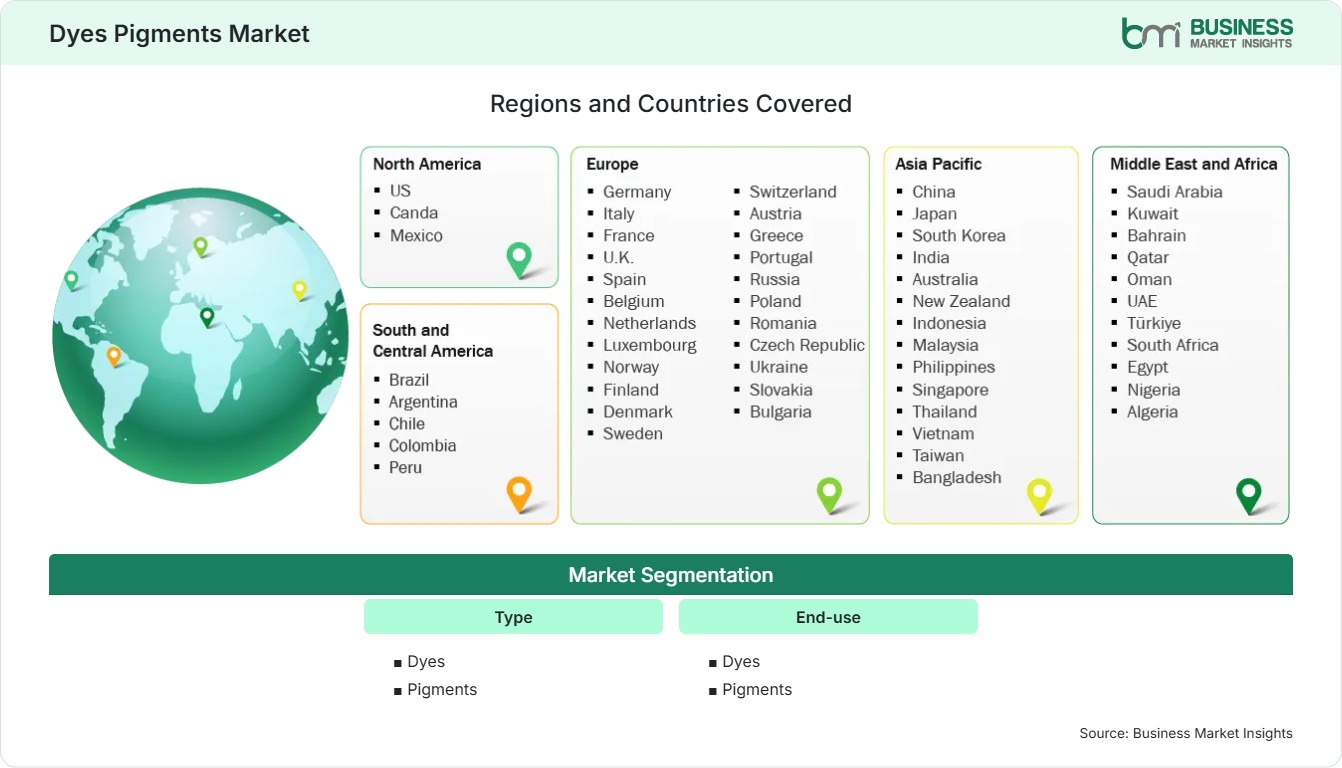
North America holds a 13%–16% share in 2025 and records a 4.5%–5.2% CAGR through 2033. Demand is related to coatings, packaging, plastics, automotive coatings, and specialized inks. The high-end use leads to higher value gain despite small volume gain. Market Share of Dyes Pigments Market makes use of the established network of technical services, replacement demand, and formulation abilities. Growth of the Market will remain dependent on construction repainting, manufacturing process, packaging innovations, car manufacturing, and industrial coatings.
- Waterborne coatings drive demand for pigments and colorants that can be dispersed efficiently in environmentally-friendly formulation systems.
- Applications in the automotive industry call for weatherfast pigments, effect pigments, and pigments which deliver good color consistency through complex coating systems.
- Packaging converters place an emphasis on printability, migration, regulatory compliance, and substrate compatibility.
- Speciality plastics applications drive demand for heat-stable pigments and colorants.
US Dyes Pigments Market
The United States represents 68%–72% of North American demand and records a 4.4%–5.1% CAGR from 2026 to 2033. Specified purchase practices have become more prevalent in coatings, plastics, printing inks, automotive finishes, and packaging. The Dyes Pigments Market share is due to quality usage and proven formulation capabilities. In terms of competition, domestic producers and importers now compete using supply security, technical services, regulations, and application performance, not only pricing.
- Refurbishment and maintenance of construction and industry provide architectural, protective, and functional coatings.
- Requirements of packaging indicate high performance inks which will give color reproduction, printability, and compatibility.
- Specialized plastics demand thermal stability, migration resistance, and uniform dispersion of pigments at high temperatures.
Europe Dyes Pigments Market
The European region accounts for 15% to 18% market share, with a growth rate of 4.2% to 5.0% through 2033. Germany, Italy, France, Spain, and UK continue to be major consumers. Germany stands first in terms of the demand for industrial coatings and speciality chemicals. Poland and Turkey present better prospects, with a CAGR of 5.0% to 5.7% and 5.2% to 6.0%, respectively.
- These water-based and low-VOC paints drive demand for sophisticated dispersion technologies and pigment systems.
- There is growing need for restricted substances screening as well as supplier information for textile and leather makers.
- Durable organic, inorganic and effect pigments are needed for automotive and industrial applications.
- There are advantages in specialty applications due to technological expertise.
Asia Pacific Dyes Pigments Market
Asia Pacific holds a 63%–66% share in 2025 and records the fastest 6.2%–7.0% CAGR through 2033. China and India lead production and consumption, while Japan and South Korea provide advanced specialty applications. India records an estimated 7.0%–7.8% CAGR, Indonesia 6.8%–7.5%, and Vietnam 6.7%–7.4%. The region combines textile exports, plastics conversion, construction, coatings, and integrated chemical supply chains.
- The largest production hub is China, as the environmental regulations favor consolidation among already existing players.
- India is taking advantage of dye intermediates synthesis, textile exports, speciality chemical investments, and established foreign clients.
- Southeast Asia is growing in importance as the apparel, plastics, and manufacturing logistics become diversified.
- The demand for high performance pigments is rising along with automotive, packaging, electronics, plastics, and coatings production.
Rest of World Dyes Pigments Market
South and Central America account for approximately 4%–5% of global demand and grow at 5.0%–6.0%. Brazil leads consumption through coatings, plastics, packaging, textiles, and industrial applications. Mexico remains strategically important because of its integration with North American manufacturing, recording estimated growth of 5.3%–6.1%.
Middle East and Africa represent approximately 3%–4% of global demand and grow at 5.2%–6.2%. Saudi Arabia, the United Arab Emirates, South Africa, and Egypt provide important opportunities through construction coatings, plastics, packaging, and industrial diversification.
- Brazil supports broad pigment demand across coatings, plastics, packaging, and agricultural applications.
- Mexico benefits from localized manufacturing, plastics processing, packaging, and North American supply-chain integration.
- Gulf markets provide opportunities through infrastructure investment and expanding coatings and plastics capacity.
- African markets offer incremental demand from construction, consumer packaging, textiles, and plastics conversion.