Market Summary
Executive Summary and Global Market Analysis
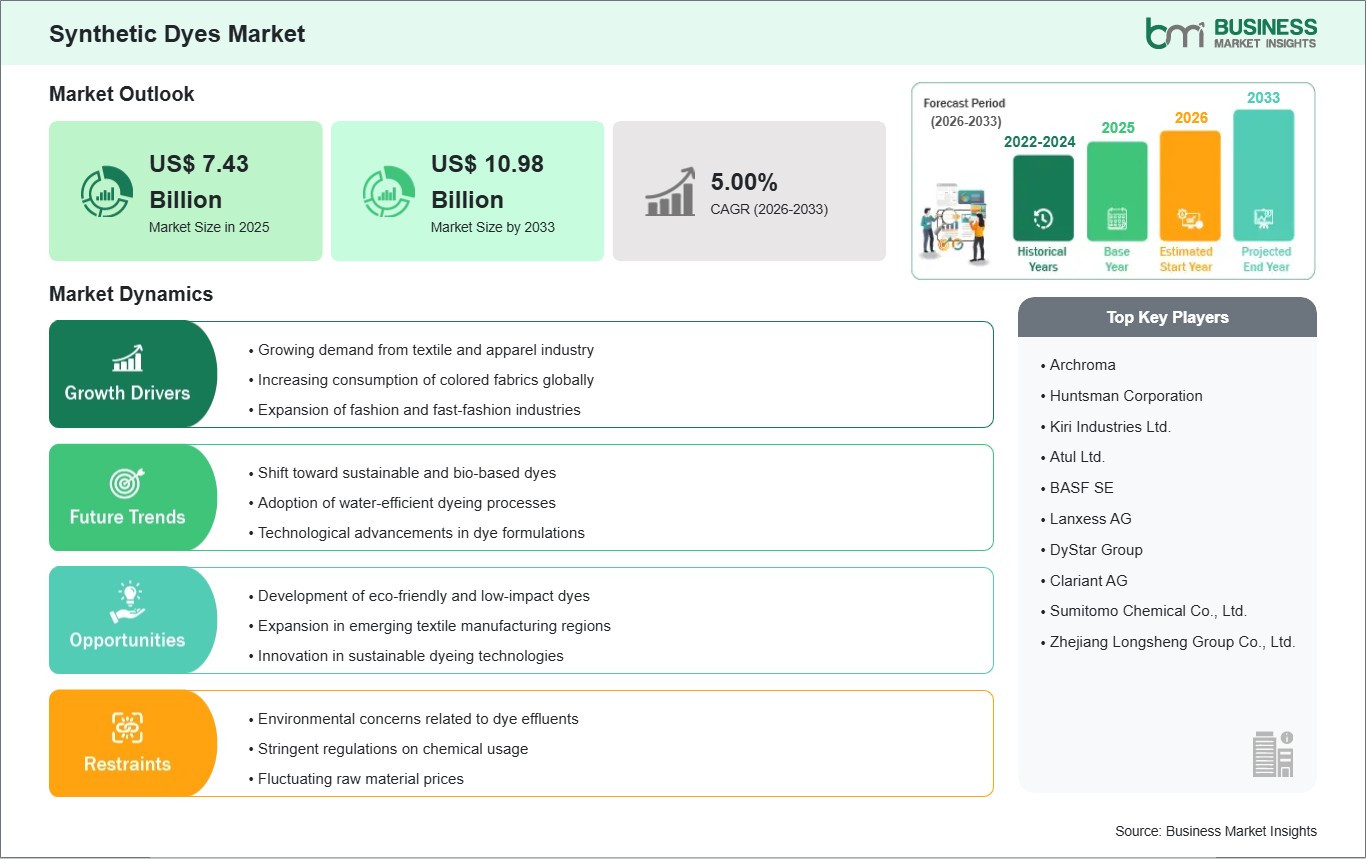
The market for synthetic dyes is growing at a steady rate due to increasing demand from the textile and apparel industry. Synthetic dyes are largely employed in the textile and apparel industry for their attractive colors, long-lasting properties, and cost-effectiveness. The most widely employed synthetic dye in the market is reactive dyes, as these are better at bonding and colorfastness. The textile industry leads in the end-use segment for synthetic dyes. The market for synthetic dyes is also affected by the increasing demand from consumers for colored textiles and the growing apparel industry. The market for synthetic dyes, however, faces challenges in terms of environmental concerns and regulatory challenges regarding effluent disposal. The market for synthetic dyes is also benefiting from the increasing emphasis on sustainable technologies and the introduction of sustainable dyes. The market for synthetic dyes is growing and looks promising, backed by the increasing demand from the textile industry and the growing technologies.
Segment Analysis
Synthetic Dyes Market Segmentation
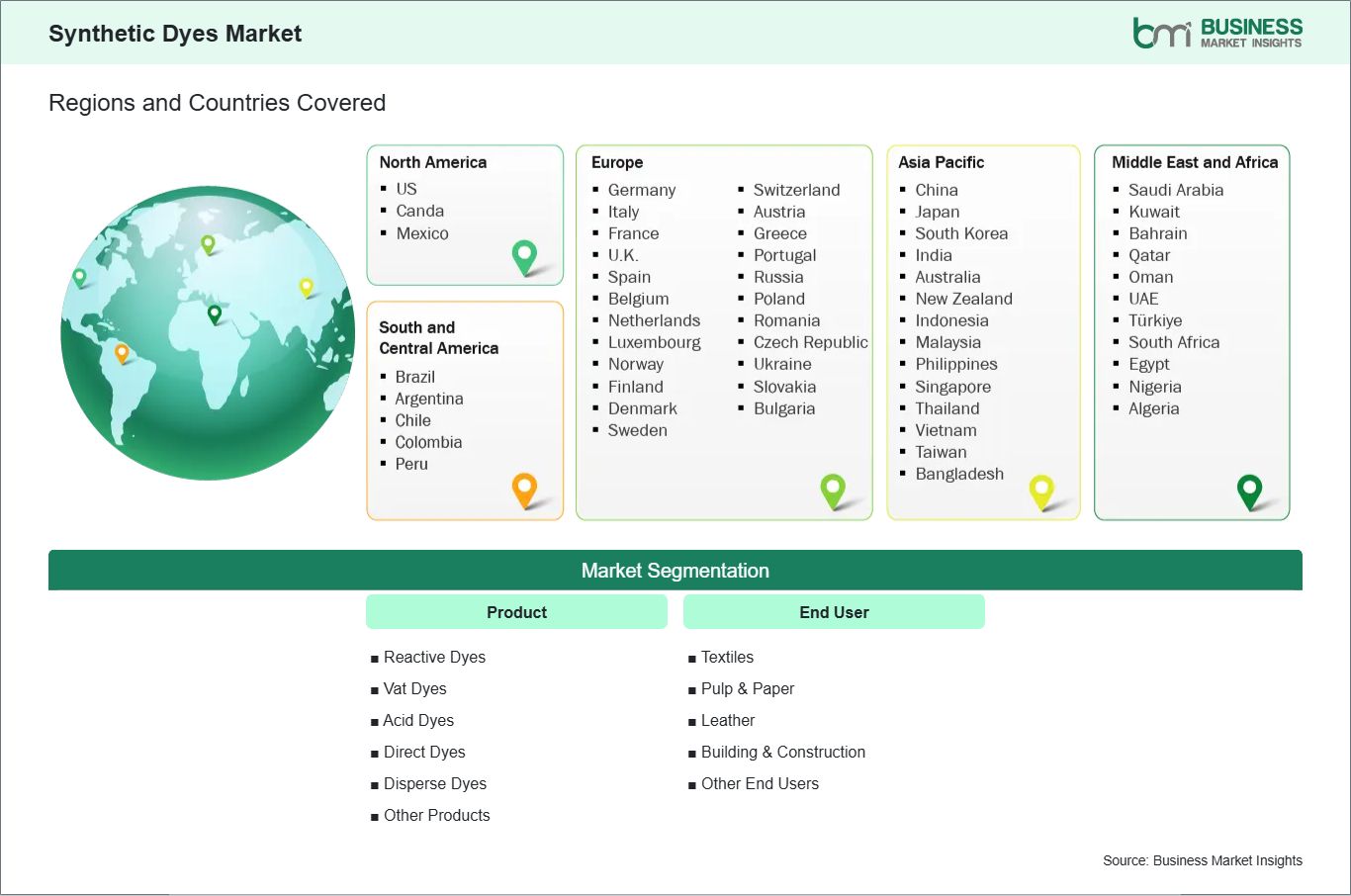
Key segments that contributed to the derivation of the Synthetic Dyes market analysis are product and end user.
- By product, the synthetic dyes market is segmented into Reactive Dyes, Vat Dyes, Acid Dyes, Direct Dyes, Disperse Dyes, and Others. The Reactive Dyes segment dominated the market in 2025.
- By end user, the synthetic dyes market is segmented into Textiles, Pulp & Paper, Leather, Building & Construction, and Others. The Textiles segment dominated the market in 2025.
Market Forces
Synthetic Dyes Market Drivers and Opportunities
Growing demand from textile and apparel industry
The textile and apparel industry is one of the strongest drivers of the synthetic dyes market. Rising global population, increasing disposable incomes, and rapidly changing fashion trends are fueling higher consumption of textiles, which directly boosts demand for dyes. Synthetic dyes are preferred by manufacturers because they deliver vibrant colors, durability, and cost efficiency compared to natural alternatives. Reactive dyes, in particular, are widely used due to their ability to form strong chemical bonds with fibers, ensuring long-lasting color retention. This makes them indispensable in modern textile production, where consistency and quality are critical.
The rise in fast-fashion outlets and the increased production in emerging markets also contribute to the market`s growth. With the rise in textile production worldwide, the market for high-performance synthetic dyes also holds a promising future. The short lifespan of fashion and the increasing variety in consumer tastes mean that synthetic dyes will continue to be an essential part of the textile industry`s growth and development.
Development of eco-friendly and low-impact dyes
The development of eco-friendly and low-impact dyes is emerging as a transformative opportunity within the synthetic dyes market. Growing environmental concerns, coupled with stricter regulatory frameworks, are pushing manufacturers to adopt sustainable alternatives that minimize ecological damage. Traditional dyeing processes are often criticized for their heavy water consumption and chemical discharge, which contribute to pollution. In response, companies are investing in innovative dye solutions that require less water, reduce effluent loads, and lower overall environmental impact. These sustainable dyes are particularly important in the textile industry, which faces increasing scrutiny for its contribution to global pollution.
Advancements in green chemistry and sustainable dyeing technologies are enabling the creation of high-performance dyes that balance environmental responsibility with durability and color vibrancy. For example, low-impact dyes are being engineered to work efficiently under milder conditions, reducing energy consumption during the dyeing process. As industries adopt more eco-conscious practices, demand for these dyes is expected to grow steadily. Beyond regulatory compliance, eco-friendly dyes also appeal to environmentally aware consumers, giving brands a competitive edge in the marketplace. This shift toward sustainability is not only reshaping the synthetic dyes industry but also creating new opportunities for innovation, differentiation, and long-term market expansion.
Size and Share Analysis
Synthetic Dyes Market Size and Share Analysis
The global Synthetic Dyes market is experiencing steady growth, with market size and share analysis reflecting evolving treatment preferences and competitive dynamics among key players. The report evaluates important subsegments categorized within product and end user highlighting their respective contributions to overall market performance.
By material, the Polypropylene subsegment dominated the market in 2025 because its low density significantly reduces the overall weight of finished parts while maintaining the structural rigidity needed for heavy-duty industrial use, offering a superior cost-to-performance ratio compared to other polymers.
By application, the Automotive subsegment dominated the market in 2025 driven by the material's ability to replace heavy metal parts with lightweight foam structures that provide excellent crashworthiness, acoustic insulation, and vibration damping in modern vehicle architectures.
Report Coverage
Synthetic Dyes Market Report Coverage and Deliverables
The "Synthetic Dyes Market Size and Forecast (2022 - 2033)" report provides a detailed analysis of the market covering below areas:
- Synthetic Dyes market size and forecast at the regional and country levels for segments covered under the scope
- Synthetic Dyes market trends, as well as drivers, restraints, and opportunities
- Synthetic Dyes market analysis covering key trends, regional framework, major players, regulations, and recent developments
- Industry landscape and competition analysis covering market concentration, heat map analysis, prominent players, and recent developments for the Synthetic Dyes market
- Detailed company profiles, including SWOT analysis
Geographic Insights
Synthetic Dyes Market Geographic Insights
The geographical scope of the Synthetic Dyes market report is divided into: North America, Asia Pacific, Europe, Middle East & Africa, and South & Central America. North America held the largest share in 2025.
North America is the leading market for synthetic dyes due to the increasing demand from the textile, paper, and industrial sectors. The North American market is benefiting from the presence of sophisticated manufacturing infrastructure and the supply chain for the production and use of synthetic dyes. The increasing trend of sustainable practices and compliance with regulations is boosting the market for environmentally friendly synthetic dyes. Moreover, technological advancements and the increasing focus on research and development activities are helping to produce synthetic dyes with enhanced properties and minimal environmental impacts. The presence of key players and the continuous efforts for innovation are also contributing to the growth of the synthetic dyes market in North America. The increasing demand from the textile, construction, and packaging industries is also boosting the synthetic dyes market in North America.
Industry Activity
Recent Developments
The Synthetic Dyes market is evaluated by gathering qualitative and quantitative data post primary and secondary research, which includes important corporate publications, association data, and databases. A few of the key developments in the Synthetic Dyes market are:
- In September 2025, Archroma announced that it had launched a new range of sustainable synthetic dyes under its EarthColors® brand, made from non-edible agricultural waste streams, targeting textile manufacturers seeking eco-friendly alternatives.
- In June 2024, Huntsman Textile Effects announced that it had expanded its synthetic dye portfolio with high-performance disperse dyes designed for polyester and blends, emphasizing improved fastness and reduced water consumption in dyeing processes.
Trust & Transparency
Research Methodology
The market analysis combines proprietary research with secondary data from government agencies, company disclosures, regulatory filings, industry databases and expert interviews. Market estimates are validated through data triangulation, cross-market benchmarking and analyst
review.
View Full Research Methodology
Key Sources Referred:
Society of Dyers and Colourists (SDC) American Association of Textile Chemists and Colorists (AATCC) International Color Association (AIC) European Association of Textile Chemists and Colorists (ETCC) China Dyestuff Industry Association (CDIA) Indian Dyestuff Manufacturers Association (IDMA) Japan Dyestuff and Pigment Manufacturers Association (JDPA) Company Websites Company Annual Reports Company Investor Presentations