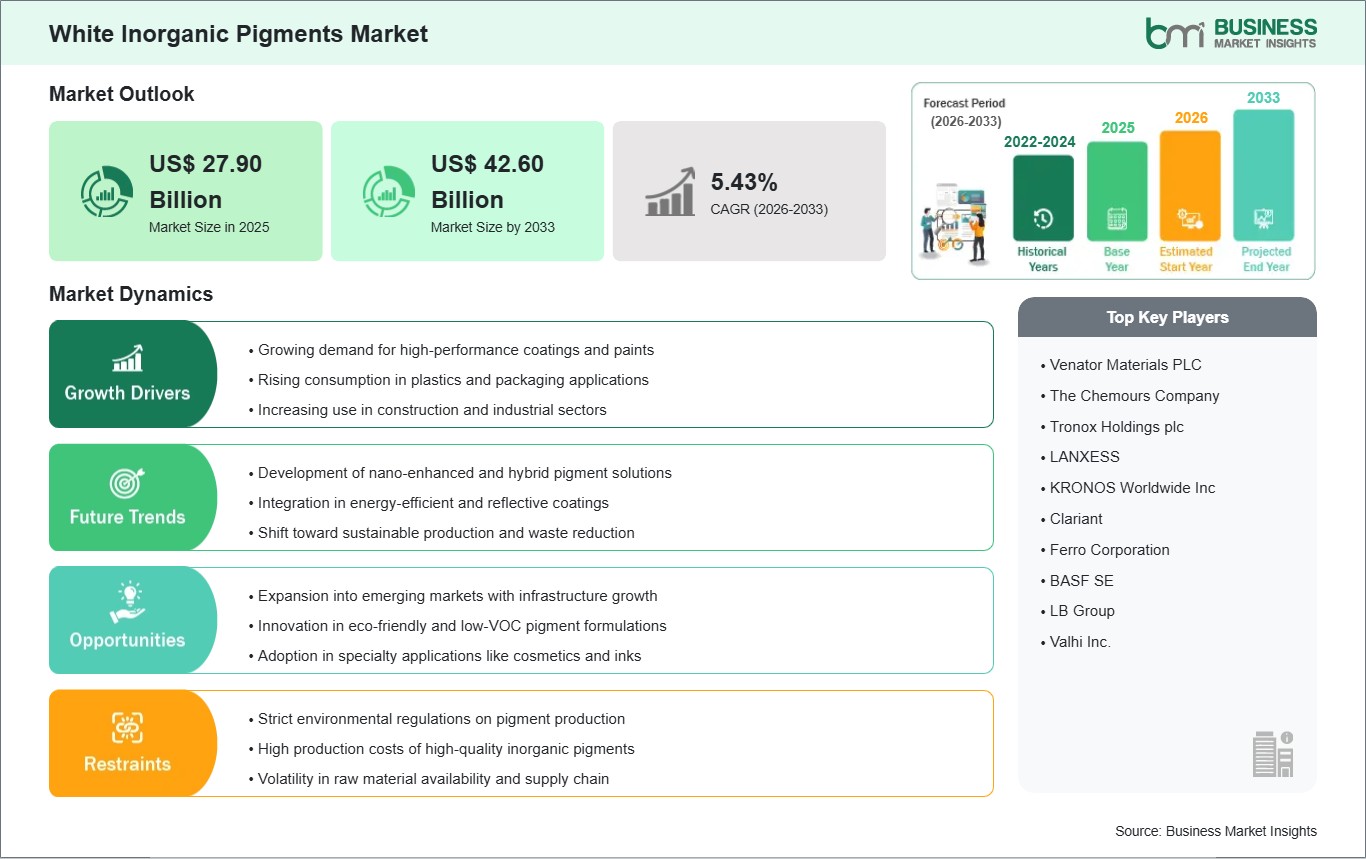
The White Inorganic Pigments Market size is expected to reach US$ 42.6 billion by 2033 from US$ 27.9 billion in 2025. The market is estimated to record a CAGR of 5.43% from 2026 to 2033.
The global white inorganic pigments market functions as a fundamental component for industrial operations that require materials to deliver opacity, brightness, durability and color consistency. White inorganic pigments, which include titanium dioxide (TiO₂), zinc oxide (ZnO) and lithopone, serve as essential functional additives for coatings and plastics, paper, cosmetics and specialty inks. The primary white pigment used in architectural paints, automotive coatings and high-performance plastics belongs to titanium dioxide because it displays better whiteness, opacity and UV-reflective capabilities than other white pigments. Worldwide industrial operations demand white inorganic pigments because they require materials that exhibit bright colors, long-lasting performance, and low energy consumption.
The construction and infrastructure sector drives market expansion because white inorganic pigments serve as essential components in paints and coatings and surface finishes, which protect buildings from weather damage while delivering bright visual appeal. Urbanization in emerging economies has fueled residential and commercial building activity, while renovation cycles in developed markets have sustained demand for high‑performance coatings. The plastics industry uses white inorganic pigments to create uniform color and better mechanical strength and UV resistance, which customers need in their consumer goods, packaging and automotive parts. The increasing popularity of high-end cosmetics and personal care products has driven up demand for white pigments, which enhance product stability and create better skin coverage and formulation opacity.
The market experiences fundamental limitations that restrict its development. Environmental and health concerns associated with pigment production and handling have prompted stricter regulatory oversight, especially in regions that prioritize air and water quality. The manufacturing sector has begun to adopt cleaner production technologies and safer alternatives because these methods increase their operational costs. The end users face difficulties with pigment acquisition and price control because of supply chain interruptions and fluctuations in raw material prices. The white inorganic pigments market will continue to be vital for global industrial value chains because of new pigment formulation innovations, the development of new application fields, and the increasing need for sustainable high-performance materials.

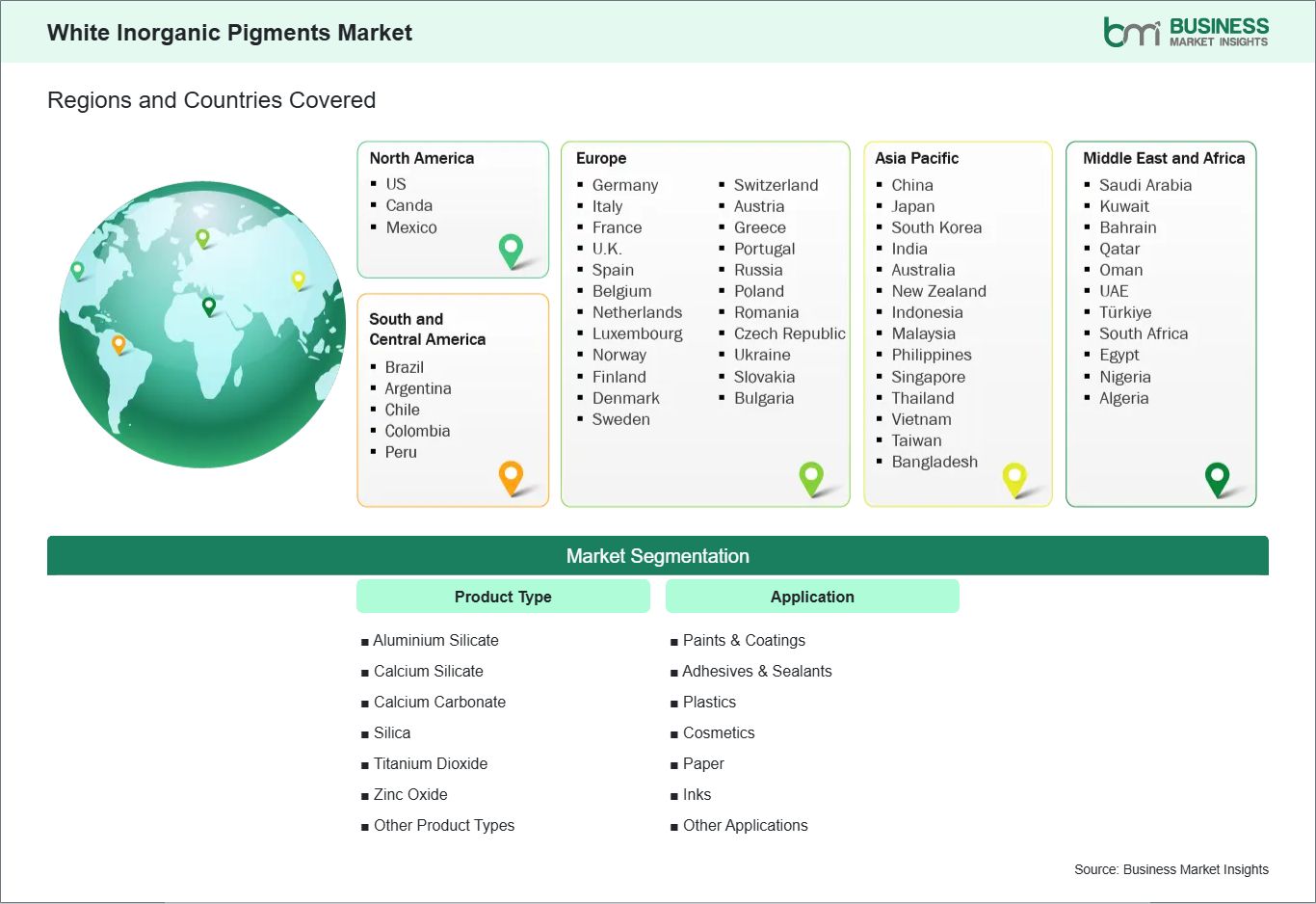
Key segments that contributed to the derivation of the white inorganic pigments market analysis are product type and application.
The global white inorganic pigments market exists because manufacturers need materials that provide better hiding strength, color stability and product durability for their high-performance coating and paint requirements. The production of architectural coatings that need protection against weathering, UV damage and yellowing requires white inorganic pigments, which include titanium dioxide and zinc oxide. North America and Europe use regulatory standards that demand low-VOC and high-efficiency coatings to force formulators into using superior pigments that maintain their beauty while meeting compliance needs. The paint producers in these regions focus on creating formulas that deliver superior hiding capabilities and complete protection of surfaces that face different weather conditions during their outdoor use.
The rapid urban growth in the Asia Pacific creates more construction projects, which increases the need for ornamental and protective coating materials. The production of both residential and commercial paints depends on white inorganic pigments, which create visual effects and functional performance. The manufacturers from China, India and Southeast Asia develop advanced pigment technologies to achieve performance and cost targets that can be used throughout their entire market range.
The worldwide trend toward sustainable coating solutions shows that white inorganic pigments hold special strategic value for all areas of application. The products remain essential to high-performance coating lines because they extend paint durability and cut down on maintenance needs and help businesses meet regulatory standards.
Expansion into emerging markets with infrastructure growth presents a significant opportunity for players in the global white inorganic pigments market, as governments and private developers increase investment in roads, bridges, housing, and industrial facilities. In regions like Southeast Asia and Latin America, infrastructure development is a key priority, prompting demand for durable coatings and construction materials that can withstand environmental stressors. White inorganic pigments are central to producing paints and protective coatings that maintain brightness, provide corrosion resistance, and support long‑term asset performance in these large‑scale projects. As economic growth accelerates, local manufacturers are expanding production capacities to supply these fast‑growing markets with quality pigment products.
In Africa and the Middle East, burgeoning industrial zones and urban redevelopment initiatives are driving demand for white inorganic pigments in industrial coatings, automotive finishes, and consumer products. Countries investing in energy and transportation infrastructure require pigments that contribute to coatings designed for harsh climates and long service intervals. Local industry stakeholders are increasingly collaborating with global suppliers to ensure availability of high‑performance pigments that align with project specifications.
The broader adoption of white inorganic pigments in emerging markets reflects a shift toward materials that balance cost efficiency with performance, creating a sustainable pathway for expansion as infrastructure build‑outs continue worldwide.
The white inorganic pigments market demonstrates steady growth, with size and share analysis highlighting evolving trends and competitive dynamics among key players. The report examines subsegments categorized within product type and application, offering insights into their contribution to overall market performance.
By product type, the titanium dioxide subsegment dominated the market in 2025, driven by its superior whiteness, opacity, and ability to provide bright, durable finishes across multiple industries.
Based on application, the paints & coatings subsegment dominated the market in 2025, driven by the high demand for protective and decorative coatings that require excellent color, coverage, and durability.
| Report Attribute | Details |
|---|---|
| Market size in 2025 | US$ 27.90 Billion |
| Market Size by 2033 | US$ 42.60 Billion |
| Global CAGR (2026 - 2033) | 5.43% |
| Historical Data | 2022-2024 |
| Forecast period | 2026-2033 |
| Segments Covered | By Product Type
|
|
Regions and Countries Covered
| |
| North America | US, Canada, Mexico |
| Europe | Belgium, Austria, Finland, Denmark, Greece, Poland, Romania, Russia, Ukraine, Czech Republic, Slovakia, Bulgaria, Italy, Luxembourg, Germany, Switzerland, France, Netherlands, Norway, Portugal, Spain, Sweden, United Kingdom |
| Asia-Pacific | Australia, China, India, Japan, South Korea, Indonesia, Malaysia, Philippines, Singapore, Thailand, Vietnam, Bangladesh, New Zealand, Taiwan |
| South and Central America | Brazil, Argentina, Peru, Chile, Colombia |
| Middle East and Africa | Bahrain, Kuwait, Oman, Qatar, Saudi Arabia, United Arab Emirates, Turkiye, South Africa, Egypt, Algeria, Nigeria |
| Market leaders and key company profiles |
|
The "White Inorganic Pigments Market Size and Forecast (2022 - 2033)" report provides a detailed analysis of the market covering below areas:
The geographical scope of the White Inorganic Pigments Market report is divided into North America, Asia Pacific, Europe, Middle East & Africa, and South & Central America. North America held the largest share in 2025.
The North American market for white inorganic pigments presently leads the global white inorganic pigments market because its established coatings, plastics and construction sectors require pigments that meet performance standards and regulatory needs. The United States and Canada use titanium dioxide as their main pigment because it provides better opacity and brightness and UV stability than other pigments in architectural coatings, automotive finishes and industrial applications. The demand exists because environmental regulations require low-VOC durable coatings, and consumers want products that maintain high quality through prolonged use.
The European market stands as the next major market because sustainability efforts and urban development projects create demand for white inorganic pigments in paints and plastics, and specialized industrial uses. Germany, France and the U.K. concentrate on developing high-performance pigments that produce energy-saving reflective coatings that withstand the test of time while adhering to REACH and environmental regulations.
The Asia Pacific region experiences strong demand for white inorganic pigments because its industrial and urban development, automotive, packaging, and construction industries create demand for these pigments in China, India and Japan, where manufacturers require products to have consistent quality, full opacity and UV protection capabilities. The Middle East and Africa market expansion is happening at a slow pace because infrastructure projects, industrial coatings and new manufacturing centers create chances for pigment use, which depends on environmental conditions and the presence of top-quality materials.
South and Central America experience continuous growth of white inorganic pigments, which Brazil and Mexico drive for use in residential and commercial construction, automotive coatings and packaging applications, because infrastructure development and durable material investment have increased.
All regions of the market develop through the combination of governmental regulations, industrial expansion, urban development and new technological advancements in pigment production and design. The North American market maintains its leading position because of its established industrial base, research and development capabilities and ability to meet regulations, while emerging markets adopt white inorganic pigments because of their long-lasting quality, dense covering ability and positive environmental impact, which creates a worldwide market system that exists in various regions.

The White Inorganic Pigments Market is evaluated by gathering qualitative and quantitative data post primary and secondary research, which includes important corporate publications, association data, and databases. A few of the key developments in the white inorganic pigments market are:
The White Inorganic Pigments Market is valued at US$ 27.90 Billion in 2025, it is projected to reach US$ 42.60 Billion by 2033.
As per our report White Inorganic Pigments Market, the market size is valued at US$ 27.90 Billion in 2025, projecting it to reach US$ 42.60 Billion by 2033. This translates to a CAGR of approximately 5.43% during the forecast period.
The White Inorganic Pigments Market report typically cover these key segments-
The historic period, base year, and forecast period can vary slightly depending on the specific market research report. However, for the White Inorganic Pigments Market report:
The White Inorganic Pigments Market is populated by several key players, each contributing to its growth and innovation. Some of the major players include:
The White Inorganic Pigments Market report is valuable for diverse stakeholders, including:
Essentially, anyone involved in or considering involvement in the White Inorganic Pigments Market value chain can benefit from the information contained in a comprehensive market report.
Please tell us your area of interest
(Market Segments/ Regions and Countries/ Companies)