Market Summary
Executive Summary and Global Market Analysis
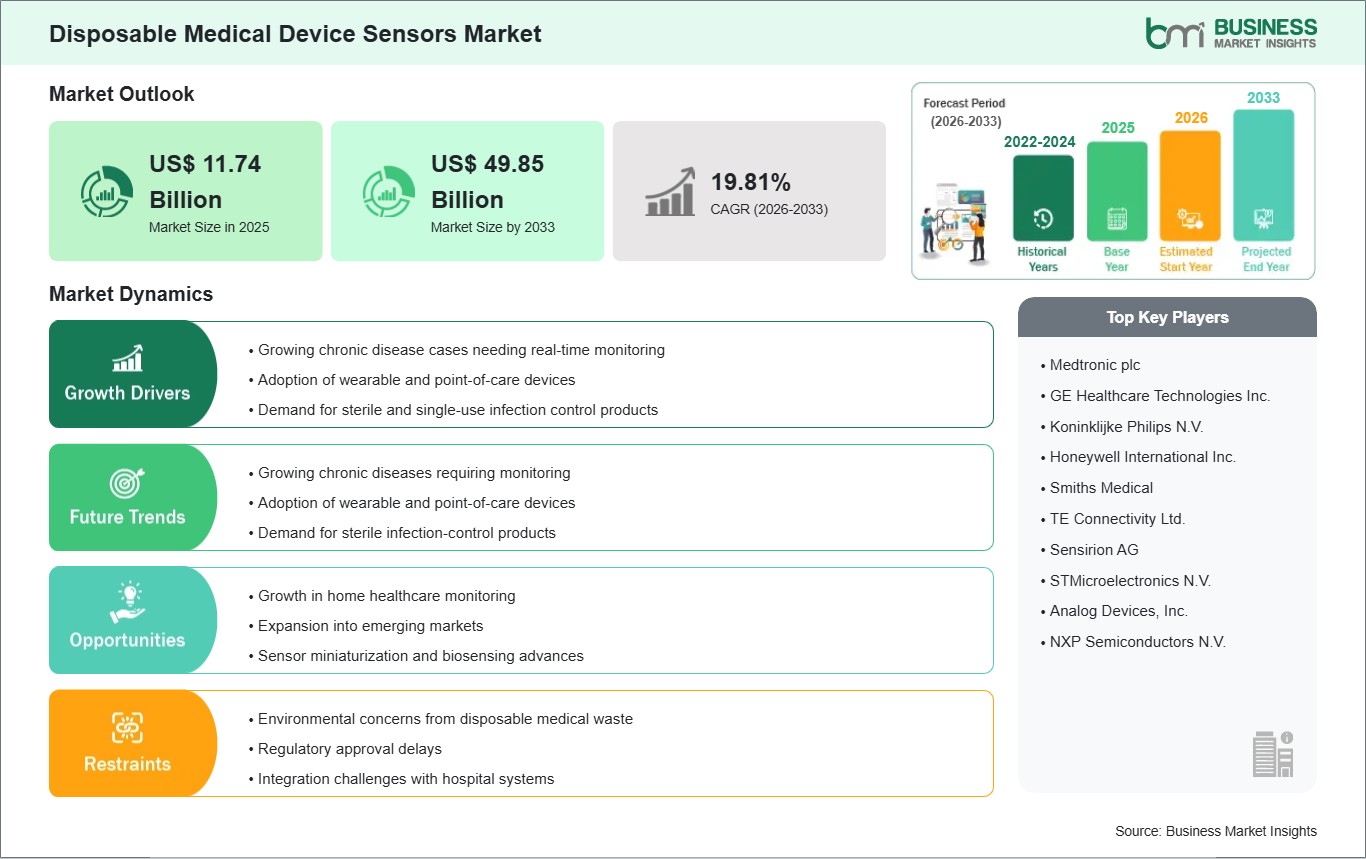
The sensors used in single-use medical devices function as essential components in contemporary healthcare systems because they provide precise patient health status assessments without introducing cross-contamination hazards. Hospitals use these sensors in their medical devices which include catheters and syringes and wearable patches and glucose monitoring strips and diagnostic test kits to detect various physical and chemical elements through their ability to monitor pressure and temperature and flow and oxygen saturation and biochemical markers. The design of these medical devices as single-use products which include multiple advantages for critical care units and home healthcare services and point-of-care systems provides patients with enhanced safety measures while hospitals can prevent the transmission of hospital-acquired infections through their use.
The global market for disposable medical device sensors currently shows steady growth because more people develop chronic illnesses and patients prefer less invasive treatment options and home monitoring systems become more popular. The market continues to grow because there is a rising demand for patient monitoring solutions which healthcare facilities need to function properly. Healthcare organizations now prefer disposable sensor systems because doctors understand infection control better and regulatory bodies implement strict patient safety requirements. The market faces multiple obstacles including high production expenses and challenges related to medical waste disposal and pricing difficulties that arise in regions with restricted budgets. The upcoming years will experience market growth because sensor technology has reached new heights through better wireless capabilities and biocompatible materials.
Segment Analysis
Disposable Medical Device Sensors Market Segmentation
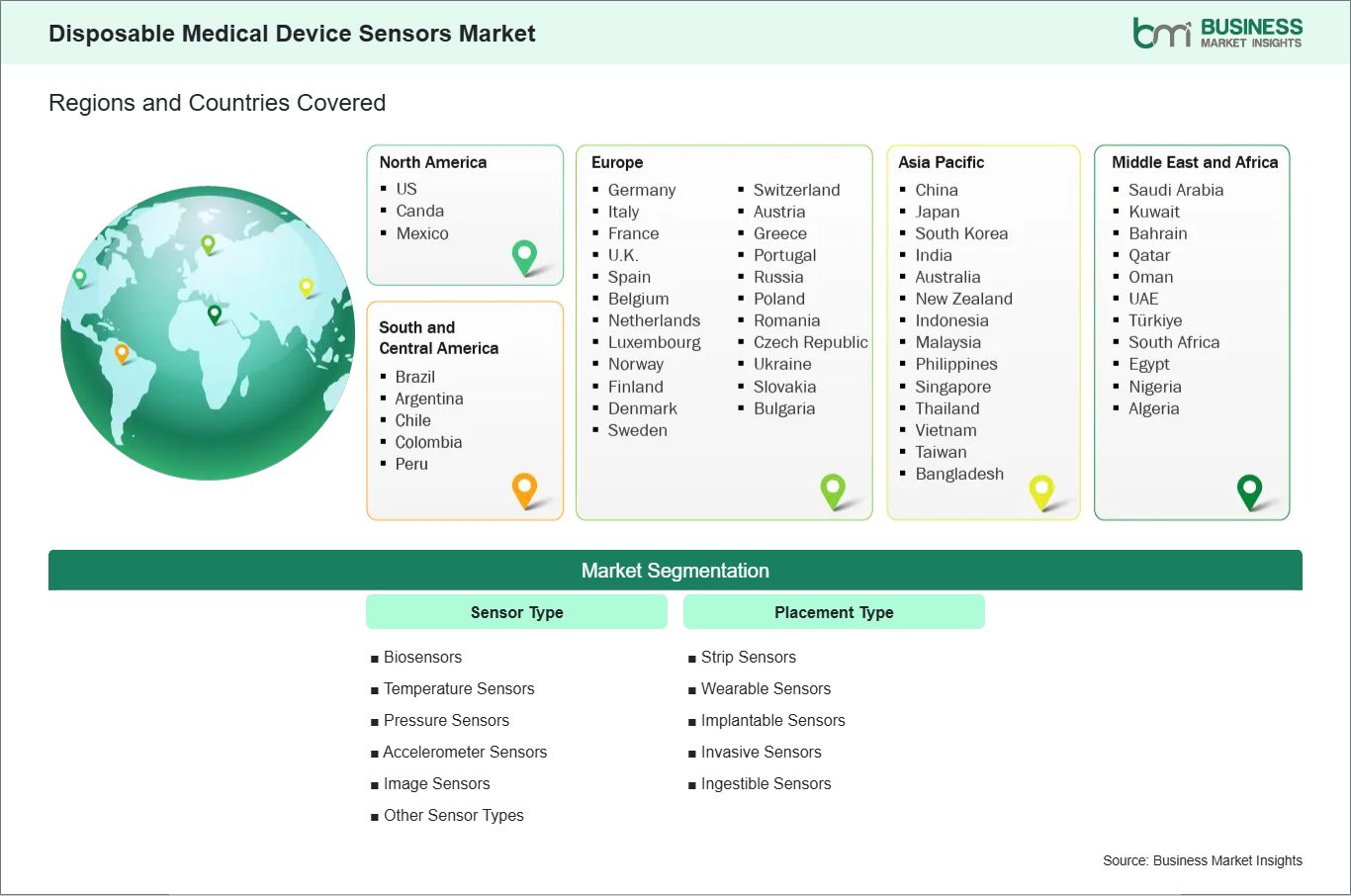
Key segments that contributed to the derivation of disposable medical devices sensors market analysis are sensor type, placement type, and application.
- By sensor type, the disposable medical devices sensors market is segmented into biosensors, temperature sensors, pressure sensors, accelerometer sensors, image sensors, and others. The biosensors segment dominated the market in 2025.
- By placement type, the market is segmented into strip sensors, wearable sensors, implantable sensors, invasive sensors, and ingestible sensors. The strip sensors segment held the largest market share in 2025.
- By application, the disposable medical devices sensors market is segmented into diagnostics, therapeutics, patient monitoring, and imaging. The diagnostics segment dominated the market in 2025.
Market Forces
Disposable Medical Device Sensors Market Drivers and Opportunities
Rising Prevalence of Chronic Diseases and Demand for Patient Monitoring
The market for disposable medical device sensors experiences strong growth because chronic diseases like diabetes and cardiovascular disorders and respiratory diseases and kidney diseases create a growing worldwide health problem. To avoid medical complications and achieve better health results patients with these conditions need their body functions to be continuously tracked. Hospitals and home-care facilities use disposable glucose sensors and blood pressure sensors and pulse oximetry sensors and temperature sensors to measure health data with high precision and timely results.
The growth of remote patient monitoring programs together with telehealth services led to higher demand for disposable sensor technologies. Single-use sensors become the preferred choice for patients and healthcare providers because they minimize infection dangers while delivering dependable functionality that does not require calibration like reusable devices. The higher volume of surgical procedures together with critical care admissions creates a rising demand for sterile disposable sensors which need high accuracy for medical use thus driving continuous market expansion.
Technological Advancements and Expanding Applications
The disposable medical device sensors market creates its main growth potential through ongoing advancements in technology. Microelectromechanical systems (MEMS) and flexible electronics and biosensor technologies and wireless communication systems have created new opportunities to build small sensors which operate with high sensitivity at low production costs. The system offers users the capacity to analyze data in real time through its connection to digital health platforms and cloud data systems and artificial intelligence tools, which enhance clinical decision-making processes.
The manufacturers work to develop sustainable materials while creating sensor designs that consume less power, which helps them deal with the environmental problems caused by medical waste. The development of point-of-care diagnostics together with wearable health monitoring devices has extended disposable sensor usage beyond its previous hospital-only application. Modern medical devices now use these sensors as vital components which support neonatal monitoring and chronic disease management and infectious disease testing.
Size and Share Analysis
Disposable Medical Device Sensors Market Size and Share Analysis
By sensor type, the disposable medical devices sensors market is segmented into biosensors, temperature sensors, pressure sensors, accelerometer sensors, image sensors, and others. The biosensors segment dominated the market in 2025. High demand for rapid diagnostics, rising chronic disease prevalence, integration with point-of-care devices, growing adoption in glucose monitoring, cost-effectiveness, miniaturization, and increased use in personalized medicine drive biosensor segment leadership.
By placement type, the market is segmented into strip sensors, wearable sensors, implantable sensors, invasive sensors, and ingestible sensors. The strip sensors segment held the largest market share in 2025. Convenience in home-based monitoring, affordability, widespread use in glucose and diagnostic tests, high accuracy, patient-friendly design, minimal training required, and strong adoption in chronic disease management support strip sensor market dominance.
By application, the disposable medical devices sensors market is segmented into diagnostics, therapeutics, patient monitoring, and imaging. The diagnostics segment dominated the market in 2025. The rising need for early disease detection, expansion of point-of-care testing, increasing prevalence of infectious and chronic diseases, demand for rapid results, technological innovation, and integration with digital healthcare platforms are boosting the diagnostic application segment.
Report Coverage
Disposable Medical Device Sensors Market Report Coverage and Deliverables
The "Disposable Medical Devices Sensors Market Size and Forecast (2022&2033)" report provides a detailed analysis of the market covering below areas:
- Disposable medical devices sensors market size and forecast at global, regional, and country levels for all the key market segments covered under the scope
- Disposable medical devices sensors market trends, as well as market dynamics such as drivers, restraints, and key opportunities
- Disposable medical devices sensors market analysis covering key market trends, global and regional framework, major players, regulations, and recent market developments
- Industry landscape and competition analysis covering market concentration, heat map analysis, prominent players, and recent developments for the Disposable medical devices sensors market
- Detailed company profiles, including SWOT analysis
Geographic Insights
Disposable Medical Device Sensors Market Geographic Insights
The geographical scope of the disposable medical devices sensors market report is divided into five regions: North America, Asia Pacific, Europe, Middle East & Africa, and South & Central America. The Disposable medical devices sensors market in Asia Pacific is expected to grow significantly during the forecast period.
The Asia-Pacific Disposable medical devices sensors market is segmented into China, Japan, South Korea, India, Australia, New Zealand, Indonesia, Malaysia, the Philippines, Singapore, Thailand, Vietnam, Taiwan, Bangladesh, and the Rest of Asia. The Asia-Pacific market for disposable medical device sensors is growing quickly because of better healthcare facilities and increased healthcare spending and greater public understanding of methods to prevent infections. The countries of China, Japan, India, South Korea, and Australia are developing digital healthcare systems and building new hospital facilities to accommodate their growing patient needs. The largest potential for market development exists in China and India because both countries have major patient bases and their residents are beginning to use low-cost medical testing and monitoring products. Regional market development receives additional support from government programs that aim to improve public health systems and extend health insurance access and encourage local production of medical devices. The Asia-Pacific market for disposable medical device sensors will experience high growth throughout the forecast period because healthcare providers are increasing their use of advanced monitoring equipment.
Industry Activity
Recent Developments
The disposable medical devices sensors market is evaluated by gathering qualitative and quantitative data post primary and secondary research, which includes important corporate publications, association data, and databases. A few of the key developments in the Disposable medical devices sensors market are:
- In March 2024, A team from Tokyo University of Science (TUS) has developed a groundbreaking flexible paper-based AI health sensor. This innovative device integrates nanocellulose and zinc oxide (ZnO) nanoparticles to deliver real-time optical input, offering significant potential in health monitoring technologies due to its flexibility, lightweight design, and advanced sensing capabilities
- In January 2024, Medtronic plc, a global leader in healthcare innovation, announced the CE (Conformit Europe) mark approval for its MiniMed 780G system with Simplera Sync. This system introduces a disposable, all-in-one continuous glucose monitor (CGM) that eliminates the need for over-tape or finger sticks, providing seamless diabetes management and enhanced patient comfort.
Trust & Transparency
Research Methodology
The market analysis combines proprietary research with secondary data from government agencies, company disclosures, regulatory filings, industry databases and expert interviews. Market estimates are validated through data triangulation, cross-market benchmarking and analyst
review.
View Full Research Methodology
Key Sources Referred:
World Bank – Global Trade IndicatorsAmerican Medical Association (AMA)National Center for Biotechnology Information (NCBI)National Library of Medicine (NLM)Centers for Disease Control and Prevention (CDC)Company websiteNational Institutes of Health (NIH)International Hospital Federation (IHF)Company annual reportsCompany investor presentations