
Decanter Centrifuge Market Outlook: Size, Share, Trends, Growth Analysis, Competitive Landscape & Forecast, 2026-2033

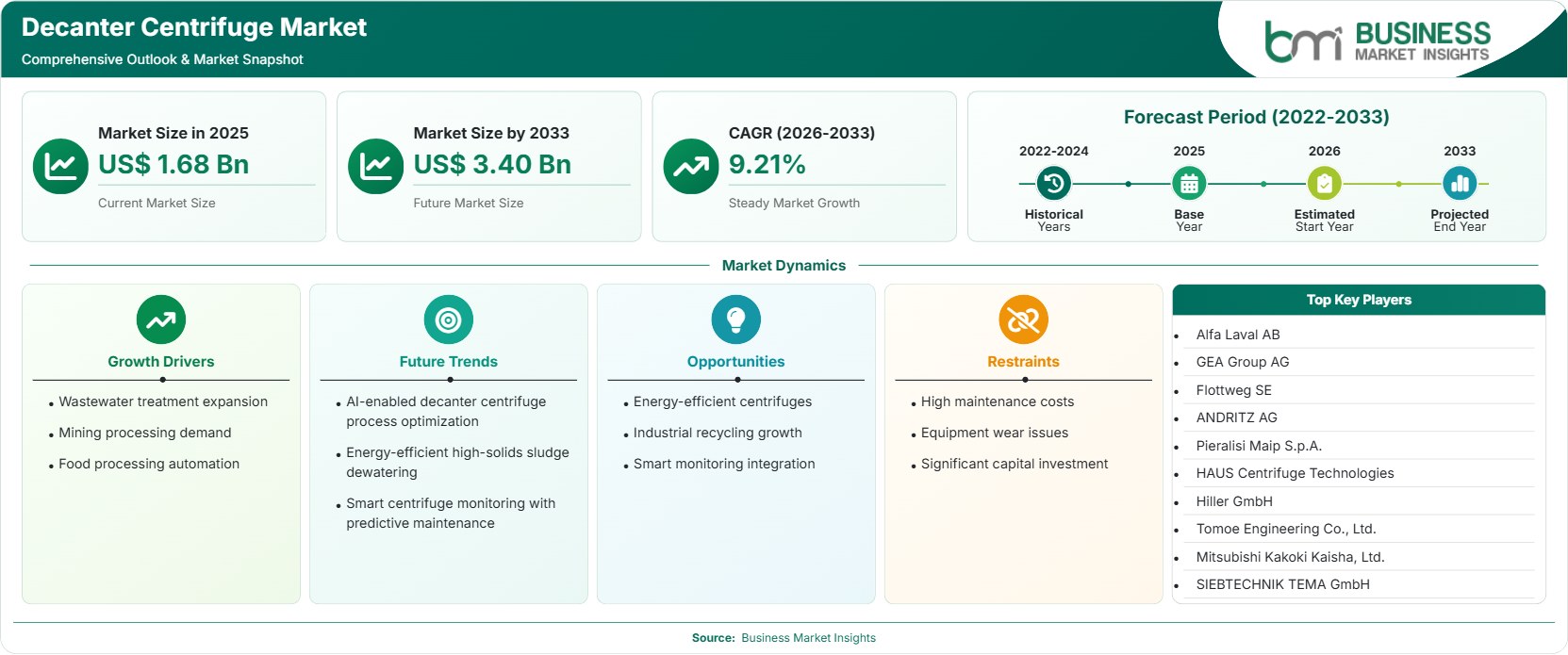
The Decanter Centrifuge Market size was valued at US$ 1.68 billion in 2025 and is projected to reach US$ 3.40 billion by 2033, growing at a CAGR of 9.21% during 2026–2033. Market expansion is driven by wastewater treatment investments, rising mining processing requirements, food processing automation, industrial recycling initiatives, and increasing adoption of efficient solid-liquid separation technologies.

Report Coverage
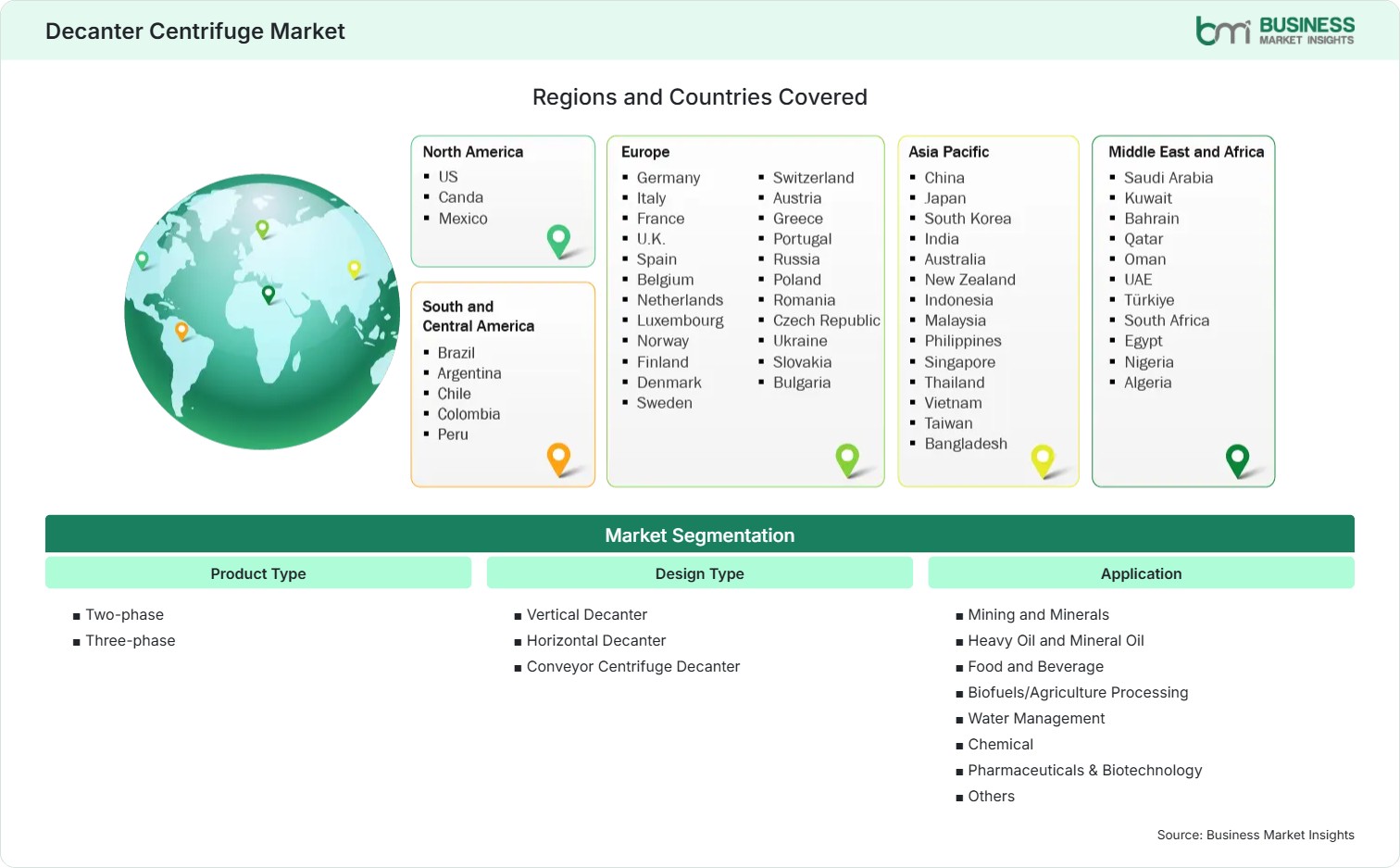
  • Product Type: Two-phase, Three-phase
  • Design Type: Vertical Decanter, Horizontal Decanter, Conveyor Centrifuge Decanter
  • Application: Mining and Minerals, Heavy Oil and Mineral Oil, Food and Beverage, Biofuels/Agriculture Processing, Water Management, Chemical, Pharmaceuticals & Biotechnology, Others
US$ 1.68 Bn Market size in 2025
US$ 3.40 Bn Market Size by 2033
9.21% CAGR, 2026 - 2033
2026-2033 Forecast Period

01 AI Overview

Decanter Centrifuge Market Summary

  • North America Region: North America holds 31%–34% share in 2025 and is projected to expand at 8%–9% CAGR during 2026–2033. Growth is supported by wastewater infrastructure modernization, mining activities, industrial automation, and demand for advanced separation equipment. The U.S. market benefits from strong environmental compliance requirements, industrial processing demand, and adoption of efficient centrifuge technologies during decanter centrifuge market forecasts, with growth projected at 8%–9% CAGR through 2033.
  • Fastest Growing Region: Asia Pacific represents 34%–37% share in 2025 and is expected to grow at a 10%–11% CAGR during 2026–2033. Growth is driven by expanding water treatment infrastructure, mining activities, industrialization, food processing expansion, and increasing investments in advanced separation technologies.
  • Leading Segment: Horizontal Decanter accounts for 55%–58% share in 2025 and is projected to grow at a 9%–10% CAGR during 2026–2033. Demand is supported by continuous processing capabilities, industrial scalability, wastewater applications, and broad adoption across multiple industries.
  • High Growth Segment: Three-phase Decanter Centrifuge represents 35%–38% of the Decanter Centrifuge Market share in 2025 and is expected to grow at a 10%–11% CAGR through 2033. Growth is driven by increasing demand for simultaneous separation of solids, liquids, and multiple phases in complex industrial processes.
  • Key Market Opportunity: Development of energy-efficient centrifuge systems, smart monitoring capabilities, and industrial recycling applications creates opportunities for manufacturers to improve operational efficiency and expand into sustainable processing environments.
  • Major Market Players: Alfa Laval AB, GEA Group AG, Flottweg SE, ANDRITZ AG, Pieralisi Maip S.p.A., HAUS Centrifuge Technologies, Hiller GmbH, Tomoe Engineering Co., Ltd., Mitsubishi Kakoki Kaisha, Ltd., SIEBTECHNIK TEMA GmbH.
02 Strategic Insights

Decanter Centrifuge Market: Strategic Insights

Decanter Centrifuge Market Strategic Framework
FREE PDF
Request your free sample
Request free sample
03 Stakeholder View

Key Takeaways

  • The market ecosystem is becoming more technology-driven, with equipment manufacturers integrating automation, monitoring systems, and advanced controls to improve separation efficiency and operational reliability, aligning with decanter centrifuge market trends.
  • Wastewater treatment and mining applications represent major growth opportunities due to increasing environmental requirements, resource recovery initiatives, and industrial process optimization needs.
  • Innovation is shifting toward energy-efficient centrifuge designs, smart sensors, remote monitoring capabilities, and solutions that reduce maintenance requirements.
  • Asia Pacific presents strong investment opportunities due to rapid industrialization, infrastructure development, water management requirements, and expanding manufacturing activities.
  • Competitive strategies are focused on product innovation, global service networks, customized equipment solutions, and partnerships with industrial operators.
  • Sustainability-focused industrial practices are increasing demand for centrifuge systems that support recycling, waste reduction, and efficient resource utilization across multiple sectors.
04 Geographic Outlook

Decanter Centrifuge Market Regional Highlights

North America Decanter Centrifuge Market

North America accounted for a 31%–34% share in 2025 and is projected to grow at a 8%–9% CAGR from 2026–2033. The region benefits from established wastewater treatment infrastructure, mining operations, industrial processing capabilities, and strict environmental standards. The Decanter Centrifuge Market share reflects strong adoption across municipal water management, oil processing, food manufacturing, and chemical industries requiring reliable separation technologies.

  • The U.S. contributes significantly through wastewater infrastructure upgrades, industrial automation adoption, and demand for efficient sludge processing solutions.
  • Canada supports demand through mining activities, mineral processing operations, and investments in advanced resource recovery technologies.
  • Industrial facilities are increasingly adopting automated centrifuge systems to improve operational efficiency and reduce processing costs.
  • Environmental compliance requirements are encouraging adoption of advanced solid-liquid separation equipment across multiple industries.

US Decanter Centrifuge Market

The U.S. market represented 27%–30% share in 2025 and is expected to expand at a 8%–9% CAGR between 2026–2033. The country benefits from strong industrial infrastructure, advanced wastewater management systems, and significant demand from mining, food processing, and chemical sectors. The Decanter Centrifuge Market growth is supported by sustainability initiatives, automation investments, and increasing focus on resource recovery.

  • Municipal wastewater treatment facilities are upgrading equipment to improve sludge handling efficiency and meet environmental standards.
  • Mining companies are adopting advanced separation systems to enhance mineral recovery and optimize processing operations.
  • Food manufacturers are investing in automated processing equipment to improve productivity and maintain consistent quality.

Europe Decanter Centrifuge Market

Europe held 25%–28% share in 2025 and is forecast to grow at a 8%–10% CAGR during 2026–2033. The region benefits from strong environmental regulations, advanced industrial infrastructure, and increasing focus on sustainable processing technologies. Germany, the United Kingdom, France, and Italy represent key markets, with Germany and Italy demonstrating strong adoption due to industrial manufacturing capabilities.

  • Germany supports market growth through advanced engineering expertise, wastewater technology adoption, and industrial automation investments.
  • Italy contributes through food processing industries, olive oil production, and demand for specialized separation equipment.
  • The United Kingdom is increasing adoption through water management modernization and industrial sustainability initiatives.
  • France is expanding centrifuge utilization through chemical, pharmaceutical, and environmental processing applications.

Asia Pacific Decanter Centrifuge Market

Asia Pacific accounted for 34%–37% of the Decanter Centrifuge Market share in 2025 and is projected to achieve a 10%–11% CAGR from 2026–2033, making it the fastest-growing regional market. Growth is supported by industrial expansion, wastewater infrastructure development, mining activities, and increasing food processing capacity. China, India, Japan, South Korea, and Southeast Asian countries are key contributors.

  • China leads regional demand through manufacturing expansion, wastewater treatment investments, and mining processing activities.
  • India is witnessing increased adoption through industrial development, municipal water management projects, and food processing growth.
  • Japan supports market advancement through advanced manufacturing technologies and efficient industrial processing systems.
  • South Korea is adopting centrifuge technologies across chemical processing, manufacturing, and environmental applications.

Rest of World Decanter Centrifuge Market

Rest of World accounted for 6%–8% share in 2025 and is expected to grow at a 8%–10% CAGR during 2026–2033. Latin America, the Middle East, and Africa are developing markets supported by mining activities, water management investments, and industrial modernization. Brazil, Chile, Saudi Arabia, and South Africa represent important opportunities.

  • Brazil supports demand through mining operations, agricultural processing, and wastewater treatment development initiatives.
  • Chile contributes through mineral processing activities requiring efficient separation and resource recovery solutions.
  • Saudi Arabia is expanding industrial applications through water management projects and manufacturing diversification programs.
  • South Africa is adopting centrifuge technologies through mining, mineral processing, and industrial wastewater applications.
  • Emerging economies provide opportunities for manufacturers offering durable, efficient, and cost-effective separation technologies.
Global Market Geography
FREE PDF
Request your free sample
Request free sample
05 Segment Analysis

Decanter Centrifuge Market Segmentation

Product Type

The Product Type segment plays a fundamental role in the market, with adoption influenced by separation efficiency, processing requirements, and industry-specific applications. Two-phase decanters accounted for approximately 62%–65% share in 2025 and are projected to grow at 8%–9% CAGR from 2026–2034. Demand is supported by widespread use in wastewater treatment, food processing, and industrial solid-liquid separation applications requiring reliable continuous operation.

  • Two-phase: Two-phase decanters are widely used for separating solids from liquids, offering efficient processing in wastewater treatment, food industries, and mineral applications.
  • Three-phase: Three-phase decanters are gaining adoption for simultaneous separation of solids and multiple liquid phases in complex applications including oil processing and advanced industrial recovery.

Design Type

The Design Type segment is expanding as industries seek equipment capable of delivering higher throughput, operational flexibility, and improved separation performance. Horizontal Decanter accounted for approximately 55%–58% share in 2025 and is projected to grow at a 9%–10% CAGR from 2026–2034. Growth is supported by continuous processing capability, scalability, and broad industrial application across wastewater, food, chemical, and mining sectors.

  • Vertical Decanter: Vertical decanters support specialized applications requiring compact designs, efficient separation performance, and suitability for industries with limited installation space.
  • Horizontal Decanter: Horizontal decanters dominate due to high processing capacity, continuous operation, reliability, and extensive use across industrial separation applications.
  • Conveyor Centrifuge Decanter: Conveyor centrifuge decanters are adopted for applications requiring efficient solids handling, continuous discharge, and improved process automation capabilities.

Application

The Application segment represents a diverse demand base for the market, supported by increasing industrial processing requirements, environmental regulations, and automation adoption. Water Management accounted for approximately 24%–27% share in 2025 and is projected to grow at a 9%–10% CAGR from 2026–2034. Growth is supported by wastewater treatment expansion, sludge management requirements, and investments in sustainable water infrastructure.

  • Mining and Minerals: Mining applications use decanter centrifuges for mineral recovery, tailings management, and efficient processing of solid-liquid mixtures during extraction.
  • Heavy Oil and Mineral Oil: Heavy oil and mineral oil applications rely on centrifuge systems for efficient separation, sludge treatment, and improved recovery in petroleum operations.
  • Food and Beverage: Food industries adopt decanter centrifuges for clarification, concentration, and separation processes across beverage, edible oil, dairy, and food manufacturing applications.
  • Biofuels/Agriculture Processing: Biofuel and agricultural processors use centrifuge systems for biomass separation, waste management, and improved resource recovery from organic materials.
  • Water Management: Water management applications drive demand for municipal wastewater treatment, industrial effluent processing, sludge dewatering, and environmental compliance.
  • Chemical: Chemical industries utilize decanter centrifuges for reliable separation, process optimization, and handling of complex material streams requiring precise processing.
  • Pharmaceuticals & Biotechnology: Pharmaceutical and biotechnology applications use advanced centrifuge technologies for process development, product recovery, and specialized separations.
  • Others: Other applications include construction materials, renewable energy processing, and industrial operations requiring efficient solid-liquid separation technologies.
06 Market Forces

Decanter Centrifuge Market Dynamics

Key Market Drivers

Expansion of Wastewater Treatment Infrastructure

Expansion in wastewater treatment is an important factor that will drive the Decanter Centrifuge Market, with many municipalities and industries looking to make effective use of their sludge treatment and water extraction process. Growing government regulations, urbanization, and industrial activities that generate wastewater are prompting more companies to consider investing in better separation machinery. Decanter centrifuges offer better treatment efficiency, lower sludge volume, and continuous operations than traditional separation techniques. A growing trend in the market includes a growing number of orders from municipal authorities, chemical plants, and manufacturing facilities for dewatering services.

Rising Mining Processing Requirements

The rising demand for mineral processing has increased the use of decanter centrifuges among mining firms looking for an effective way of processing minerals. The increasing demand for metals, minerals, and resources has resulted in an increasing demand for technologies that will increase efficiency. Decanter centrifuges are useful for helping mining firms handle slurry, extract minerals, and minimize waste. The growing mining operations in the Asian Pacific, Latin American, and African regions have created additional opportunities for decanter manufacturers.

Automation Adoption in Food Processing Industries

Automation in food processing is contributing to market growth, as many processors use the latest separation systems to improve efficiency, hygiene, and consistency. Decanter centrifuges are used in various food and beverage processes, such as edible oil processing, dairy processing, beverage clarification, and ingredient separation. Automation enables continuous processing, reduced manpower, and improved quality control. Consumer demands for more processed foods, along with increased investment in food manufacturing facilities, will help in technology adoption. Equipment providers focus on developing more efficient, automated centrifuges for food processing.

Key Market Opportunities

Development of Energy-Efficient Centrifuge Technologies

Energy-efficient centrifugation techniques present a great prospect, given that industries have set their sights on reducing energy costs and adopting sustainable practices. Manufacturers are now focusing on efficient motor techniques, improved bowl designs, variable-frequency drives, and control strategies to reduce energy consumption. Industries using centrifuges for large-scale separation operations are looking for equipment that provides high throughput while requiring minimal amounts of energy. Innovations in terms of energy efficiency can increase the value of the equipment as well as assist in complying with sustainability objectives. Firms designing modern decanters with low energy consumption will benefit greatly.

Industrial Recycling and Resource Recovery Growth

Rapid growth in industrial recycling presents an opportunity for decanter centrifuge manufacturers, as industries focus on extracting valuable resources and minimizing waste production. Centrifuge machines can assist in recycling processes through solid separation and process material recovery. Industries such as manufacturing, chemical processing, and those that require intensive use of resources are embracing technologies that will help them achieve the goals of circular economies. Growing concerns about environmental performance have encouraged organizations to purchase technology that maximizes resource use. Decanter centrifuges customized for recycling will benefit from increased market demand.

Integration of Smart Monitoring Systems

Growth is driven by smart monitoring integration, as industrial players look forward to increased machine visibility, predictive maintenance capabilities, and reduced downtime. Sensors and other data analytics will allow operators to analyze machine performance, determine when maintenance is needed, and identify optimal operating settings. Smart monitoring enables proactive maintenance techniques and enhances the reliability of the entire system. Increased adoption of Industry 4.0 practices across industries is likely to drive greater demand for intelligent centrifuges. Manufacturers that offer automated and digitally connected machines have a competitive advantage.

Market Restraints and Challenges

High Maintenance Costs Limiting Equipment Adoption

Factor: Centrifuges require routine maintenance, including checking components, replacing worn parts, lubricating, and making adjustments for optimal performance. The complex nature of rotating machines, in addition to continuous working, may make maintenance more frequent, especially where there is heavy industry.

Impact: High maintenance costs may increase the overall cost of ownership for centrifuges and limit their use by smaller industries due to a lack of funds. Companies should focus on making machines durable, implementing a predictive maintenance strategy, and building an effective service network to reduce costs and enhance customer satisfaction.

Equipment Wear Issues Affecting Operational Reliability

Factor: The use of continuous processing systems subjects the decanter centrifuge parts to wear, corrosion, and mechanical pressure, especially in industries such as mining, chemical, and wastewater that handle harsh substances.

Impact: This will lead to increased wear and tear on the equipment, reduced efficiency, and a greater need for regular part replacements. There are efforts by manufacturers to address this issue through the use of new materials and improved coating methods.

07 Company Analysis

Competitive Landscape

The Decanter Centrifuge Market analysis highlights a competitive landscape shaped by global separation technology providers, industrial equipment manufacturers, and specialized centrifuge solution companies. The stakeholders in the market are emphasizing product innovation, energy-efficient design, automation, digital monitoring, and custom separation. Competitiveness is impacted by engineering skills, industry-specific technology, worldwide services, manufacturing abilities, and the capability to serve industries such as wastewater management, mining, food processing, and chemicals production.

Company Name

Overview

Products and Services relevant to this market

Alfa Laval AB

Global engineering company providing separation, heat transfer, and fluid handling solutions.

Decanter centrifuges, sludge dewatering systems, industrial separation equipment, and wastewater solutions.

GEA Group AG

International technology provider specializing in processing equipment and industrial systems.

Decanter centrifuges, separation technologies, food processing equipment, and industrial processing solutions.

Flottweg SE

German manufacturer focused on mechanical separation technology and centrifuge systems.

Decanter centrifuges, three-phase separators, solid-liquid separation equipment, and process optimization services.

ANDRITZ AG

Global technology group providing equipment for industrial and environmental applications.

Decanter centrifuges, wastewater treatment systems, mining separation solutions, and process technologies.

Pieralisi Maip S.p.A.

Italian manufacturer specializing in separation and centrifugation technologies.

Decanter centrifuges, olive oil processing systems, industrial separation solutions, and recycling applications.

HAUS Centrifuge Technologies

Manufacturer developing centrifuge systems for industrial separation applications.

Decanter centrifuges, wastewater equipment, food processing solutions, and mineral processing technologies.

Hiller GmbH

German centrifuge specialist providing customized separation equipment.

Industrial decanters, sludge dewatering systems, chemical processing solutions, and service support.

Tomoe Engineering Co., Ltd.

Japanese engineering company specializing in centrifuge and separation technologies.

Decanter centrifuges, solid-liquid separation systems, industrial processing equipment, and automation solutions.

Mitsubishi Kakoki Kaisha, Ltd.

Japanese engineering company providing industrial machinery and processing technologies.

Centrifuge systems, chemical processing equipment, environmental solutions, and separation technologies.

SIEBTECHNIK TEMA GmbH

German equipment manufacturer specializing in mineral processing and separation solutions.

Decanter centrifuges, solid-liquid separation systems, laboratory equipment, and industrial processing technologies.

08 Industry Activity

Recent Developments

June 2026

GN Separation completed the delivery of a GNLW554 Sludge Dewatering Centrifuge Package for an overseas wastewater treatment plant, integrating a GNLW554 decanter centrifuge with an automatic chemical dosing unit to provide a complete sludge conditioning and dewatering solution for improved operational efficiency and automation.

May 2026

Flottweg unveiled the FW400 HTS decanter centrifuge at IFAT 2026, introducing a next-generation sludge dewatering solution for municipal and industrial applications featuring higher throughput, enhanced dewatering performance, a modular FlexConcept design, and user-centric operating features.

May 2026

GEA showcased Intellicant at IFAT 2026, an AI-powered digital optimization system for environmental decanter centrifuges that enables autonomous process optimization through continuous monitoring of feed solids, centrate quality, and cake dryness, supporting both new installations and retrofit applications.

April 2026

Flottweg announced it would showcase its advanced decanter centrifuge, Sedicanter, and Tricanter technologies at the Fuel Ethanol Workshop (FEW) 2026 in St. Louis, highlighting solutions for efficient solid-liquid separation across industrial processing applications.

10 Trust & Transparency

Research Methodology

The market analysis combines proprietary research with secondary data from government agencies, company disclosures, regulatory filings, industry databases and expert interviews. Market estimates are validated through data triangulation, cross-market benchmarking and analyst review.

View Full Research Methodology

11 Questions Answered

Frequently Asked Questions

What does the Decanter Centrifuge Market Report include?

The Market Report includes market size analysis, segmentation insights, regional trends, competitive landscape, growth drivers, opportunities, restraints, and future outlook through 2033.

Which industries are creating new opportunities for decanter centrifuge manufacturers?

Wastewater management, mining, food processing, chemical manufacturing, biofuels, and recycling industries are creating opportunities through increasing demand for efficient separation technologies.

How is digital technology influencing decanter centrifuge adoption?

Smart monitoring systems, sensors, and predictive analytics are improving equipment reliability, enabling preventive maintenance, reducing downtime, and optimizing separation performance.

Which product type dominates the market?

Two-phase decanters hold strong demand due to their widespread use in wastewater treatment, food processing, and industrial applications requiring continuous solid-liquid separation.

What factors are driving the market growth?

The market is driven by wastewater treatment expansion, mining processing demand, food processing automation, industrial recycling initiatives, and increasing adoption of efficient solid-liquid separation technologies.

Access the Full Decanter Centrifuge Market Report

Get segment-level forecasts, regional estimates, competitive benchmarking, company profiles and downloadable Excel datasets.

Access the full Decanter Centrifuge Market Report
350 pages PDF & Excel | 2026-07-31