
Data Loss Prevention Market Outlook: Size, Share, Trends, Growth Analysis, Competitive Landscape & Forecast, 2026-2033

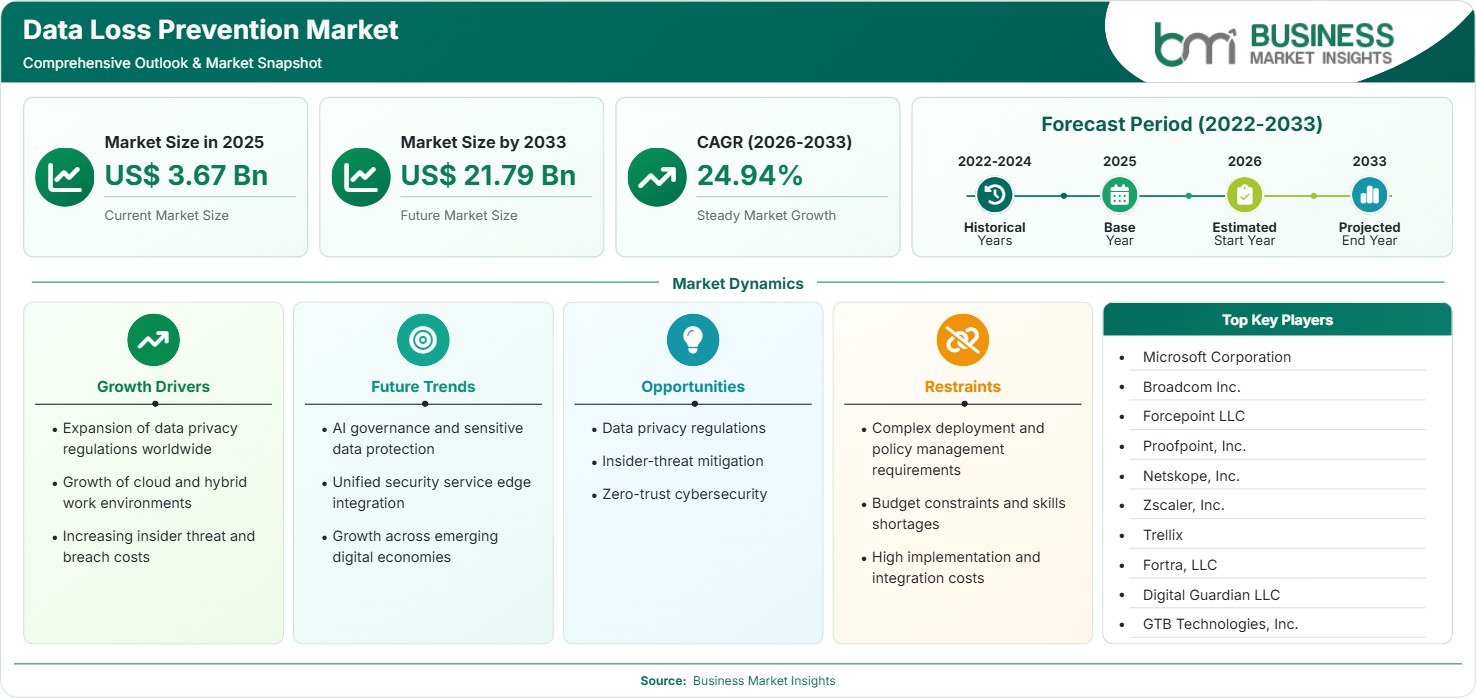
The Data Loss Prevention Market size was valued at US$ 3.67 Billion in 2025 and is projected to reach US$ 21.79 Billion by 2033, growing at a CAGR of 24.94% during 2026–2033. Key growth drivers include rising cloud adoption, AI-driven data governance requirements, stricter privacy regulations, and expanding enterprise investments in insider-threat mitigation and zero-trust cybersecurity architectures.

Report Coverage
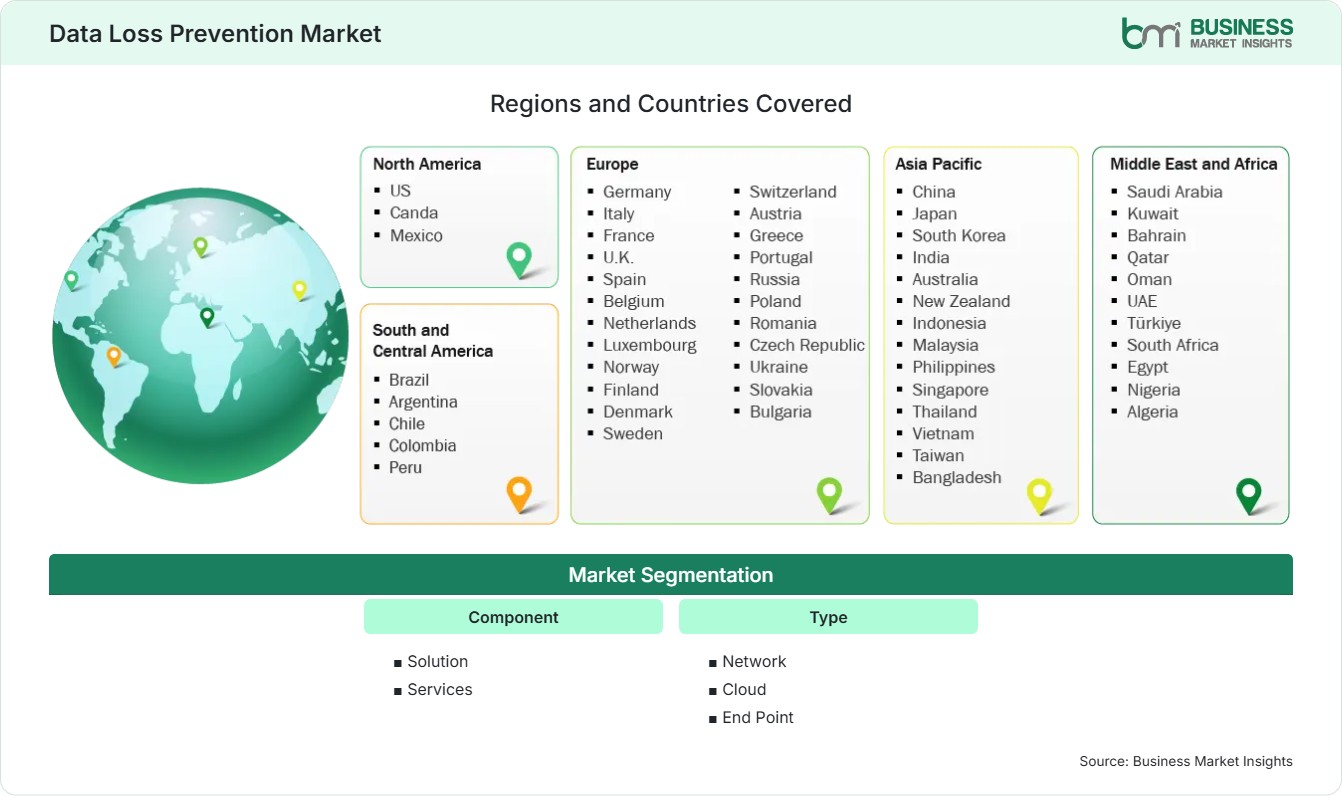
  • Component: Solution, Services
  • Type: Network, Cloud, End Point
US$ 3.67 Bn Market size in 2025
US$ 21.79 Bn Market Size by 2033
24.94% CAGR, 2026 - 2033
2026-2033 Forecast Period

AI Overview

Data Loss Prevention Market Summary

  • North America Region: North America holds a market share of 36%–39% in 2025, growing with a CAGR of 22%–24% during 2026–2033. Key drivers include regulatory compliance, cloud-security modernization, and AI-enabled monitoring. Opportunities emerge from hybrid work expansion, SaaS governance, data-classification automation, and secure collaboration ecosystems across enterprises globally. The U.S. leads regional demand with strong federal cybersecurity spending and a CAGR of 22%–24% through 2033.
  • Fastest Growing Region: Asia Pacific holds a market share of 24%–27% in 2025 and advances at a CAGR of 27%–30% during 2026–2033. Key drivers include digital transformation, cloud migration, and data-sovereignty regulations. Opportunities arise from cybersecurity investments, expanding enterprise digitization, financial technology adoption, and government-supported security modernization initiatives.
  • Leading Segment: Solution accounts for 68%–72% share during 2025 and expands at a CAGR of 24%–26% through 2033. Key drivers include integrated policy enforcement, automated classification, and compliance reporting. Opportunities stem from AI-powered detection, cloud-native architectures, and unified security management strategies.
  • High Growth Segment: Cloud accounts for 34%–37% share in 2025 and records a CAGR of 28%–31% through 2033. Key drivers include SaaS proliferation, remote workforce security, and multi-cloud governance requirements. Opportunities emerge from secure collaboration, AI applications, regulatory compliance, and scalable deployment models.
  • Key Market Opportunity: Enterprises increasingly require integrated protection across cloud platforms, endpoints, and AI workloads, creating opportunities for unified data-security platforms that combine detection, governance, compliance automation, and risk analytics capabilities.
  • Major Market Players: Microsoft Corporation, Broadcom Inc., Forcepoint LLC, Proofpoint, Inc., Netskope, Inc., Zscaler, Inc., Trellix, Fortra, LLC, Digital Guardian LLC, and GTB Technologies, Inc.
Strategic Insights

Data Loss Prevention Market: Strategic Insights

Data Loss Prevention Market Strategic Framework
FREE PDF
Request your free sample
Request free sample
Stakeholder View

Key Takeaways

  • The value chain is shifting toward integrated security ecosystems where data discovery, classification, policy management, and incident response operate through unified platforms rather than isolated controls.
  • Healthcare, finance, and cloud-centric enterprises represent the strongest opportunity pools due to growing compliance obligations, rising breach costs, and expanding volumes of sensitive digital information.
  • Innovation priorities increasingly focus on AI-driven classification, contextual risk scoring, user-behavior analytics, and automated policy orchestration that reduce false positives and administrative complexity.
  • Asia Pacific presents a compelling investment case as governments strengthen cybersecurity mandates and enterprises accelerate cloud migration, creating substantial demand for scalable protection technologies.
  • Strategic acquisitions continue to reshape competitive positioning as vendors expand secure service edge, cloud-security, and insider-risk capabilities through platform consolidation and technology integration.
  • Demand is moving beyond compliance-based deployments toward data-intelligence frameworks that support secure AI adoption, real-time governance, and enterprise-wide risk management objectives.
Geographic Outlook

Data Loss Prevention Market Regional Highlights

North America Data Loss Prevention Market

North America accounted for 36%–39% of global revenue in 2025 and is projected to expand at a 22%–24% CAGR through 2033. Regional leadership stems from mature cybersecurity spending, widespread cloud adoption, and extensive regulatory oversight. Large enterprises continue deploying integrated data-security platforms to manage distributed workforces and protect intellectual property. The region represents the largest Data Loss Prevention Market share globally, supported by advanced digital infrastructure and significant investments in AI-enabled governance technologies across regulated industries.

  • U.S. and Canadian organizations increasingly integrate DLP with zero-trust architectures to secure hybrid work environments, strengthening security visibility while improving compliance and operational resilience.
  • Financial institutions are adopting advanced behavioral analytics and risk-based policy frameworks to address insider threats and protect high-value customer information.
  • Healthcare providers are expanding deployments to safeguard electronic health records and meet evolving privacy obligations amid digital care transformation initiatives.
  • Growing generative AI adoption is creating additional monitoring requirements, encouraging enterprises to implement automated governance and sensitive-data protection measures.
  • Strong federal cybersecurity programs continue supporting enterprise investment in data-centric protection technologies and continuous compliance management.

US Data Loss Prevention Market

The United States represents 82%–86% of the North American Data Loss Prevention Market revenue and advances at a 22%–24% CAGR through 2033. Enterprise cybersecurity budgets, extensive cloud migration, and strict data-protection requirements sustain market expansion. Demand remains particularly strong in healthcare, finance, government, and technology sectors. Organizations continue prioritizing data visibility, insider-risk detection, and AI governance capabilities to address rising exposure from distributed applications, third-party ecosystems, and digital collaboration environments.

  • Federal agencies continue adopting zero-trust security architectures, supporting broader deployment of data-centric controls and automated governance frameworks.
  • Technology companies increasingly require protection for intellectual property, source code, and proprietary AI training datasets.
  • Financial organizations emphasize real-time monitoring, transaction security, and regulatory reporting across multichannel digital-service operations.
  • Expanding SaaS adoption is encouraging cloud-native protection strategies capable of supporting complex enterprise environments.

Europe Data Loss Prevention Market

Europe held 27%–30% Data Loss Prevention Market share in 2025 and is forecast to grow at a 23%–25% CAGR during 2026–2033. Continued enforcement of GDPR requirements and expanding digital-sovereignty initiatives are key adoption catalysts. Enterprises increasingly invest in data governance, encryption, and monitoring technologies to manage compliance risk. Germany leads regional revenue generation, while Eastern European markets demonstrate stronger growth momentum. Organizations emphasize integrated security platforms capable of supporting multi-country operations and evolving regulatory frameworks.

  • Germany remains the leading national market with strong enterprise cybersecurity spending and advanced industrial digitalization initiatives.
  • Poland and other emerging European economies record faster adoption rates, supported by modernization investments and growing cloud usage.
  • Financial and public-sector organizations prioritize regulatory compliance and cross-border data-management capabilities.
  • Enterprises seek integrated platforms combining monitoring, classification, governance, and reporting across distributed IT environments.
  • Sovereign-cloud strategies continue creating demand for localized security and policy management capabilities.

Asia Pacific Data Loss Prevention Market

Asia Pacific captured 24%–27% share in 2025 and is expected to register the highest CAGR of 27%–30% through 2033. Rapid digitalization, cloud adoption, and strengthened cybersecurity regulations are accelerating deployment. China leads regional revenue contribution, while India represents the fastest-growing country market. Enterprises increasingly invest in cloud-native security architectures to protect sensitive information across expanding digital ecosystems. Strong government support for cybersecurity readiness further reinforces regional demand prospects.

  • India benefits from rapid enterprise digitization, data-localization initiatives, and widespread cloud-service adoption across industries.
  • China maintains substantial spending on information security to support large-scale digital infrastructure and cloud development programs.
  • Financial services and e-commerce sectors are significant adopters due to data volume growth and fraud-prevention requirements.
  • Regional enterprises increasingly deploy AI-powered classification and automated governance capabilities.
  • Growing SME awareness of cybersecurity risk is broadening the addressable customer base.

Rest of World Data Loss Prevention Market

Rest of World represented 9%–12% market share during 2025 and is projected to expand at a 25%–28% CAGR through 2033. South and Central America benefit from rising cybersecurity awareness and cloud adoption among enterprises and government agencies.

Middle East and Africa markets are supported by smart-city programs, critical-infrastructure protection initiatives, and increasing investments in digital transformation. Brazil leads regional demand within Latin America, while the United Arab Emirates demonstrates among the highest growth rates across the broader region.

  • Brazil benefits from privacy regulations, financial-sector modernization, and growing adoption of cloud technologies across enterprises.
  • The United Arab Emirates is investing heavily in cyber-resilience initiatives supporting advanced data-security deployments.
  • Energy and critical-infrastructure sectors increasingly implement protection technologies to secure operational and corporate information.
  • Expanding digital-government programs are supporting procurement of governance and compliance solutions.
  • International cloud providers are strengthening regional ecosystems through local data-center investments.
Global Market Geography
FREE PDF
Request your free sample
Request free sample
Segment Analysis

Data Loss Prevention Market Segmentation

Component

Component adoption is led by solutions, which account for 68%–72% share in 2025 and grow at 24%–26% CAGR through 2033. Organizations prioritize platforms that combine discovery, monitoring, classification, encryption, and policy enforcement. The Data Loss Prevention Market scope continues broadening as enterprises seek integrated capabilities across cloud, network, and endpoint environments while reducing security-management complexity.

  • Solution: Widely adopted because enterprises require centralized visibility, automated governance, and policy enforcement across multiple environments while supporting regulatory compliance and insider-threat mitigation objectives.
  • Services: Consulting, implementation, integration, and managed-security offerings are gaining importance as organizations seek expertise to optimize deployments and improve operational effectiveness.

Type

Type segmentation reflects evolving data-security architectures. Cloud deployments represent the highest-growth category with 34%–37% share in 2025 and a CAGR of 28%–31%. Organizations increasingly protect information across SaaS applications and hybrid infrastructures. Data Loss Prevention Market trends indicate a strong shift toward cloud-native governance and scalable policy-management solutions.

  • Network: Remains important for monitoring data movement across enterprise communications channels and enforcing organizational security policies in real time.
  • Cloud: Benefits from accelerating SaaS usage, remote work models, and stronger requirements for visibility across distributed digital ecosystems.
  • End Point: Supports monitoring of user activity, removable-media usage, and local data transfers while strengthening insider-risk management capabilities.

Industry

Industry demand is strongest within finance, supported by regulatory compliance and protection of sensitive customer information. The segment contributes 24%–28% share during 2025 and advances at 25%–27% CAGR. Organizations are strengthening governance frameworks to manage growing digital transactions and evolving cyber threats across operational environments.

  • Healthcare: Adoption is fueled by electronic health records, privacy obligations, and the need to secure patient information across connected systems.
  • Manufacturing: Organizations protect intellectual property, product-development data, and operational information throughout digitally connected production environments.
  • Finance: Institutions require continuous monitoring, governance, and compliance reporting to secure financial data and customer records.
  • Government: Public agencies deploy secure data-management solutions to protect citizen information, national-security assets, and critical administrative records.
Market Forces

Data Loss Prevention Market Dynamics

Key Market Drivers

Expansion of Data Privacy Regulations Worldwide

Growing enforcement of GDPR, CCPA, sector-specific privacy mandates, and national data-protection frameworks is increasing enterprise investment in data-security technologies. There is increased accountability associated with managing sensitive data in digital environments. Visibility of the flow, storage, and control of data has become an integral part of regulatory audits. With the increasing use of cloud services, automated classification and monitoring solutions have become a necessity for compliance. Data Loss Prevention Market growth is being augmented by the demand for reporting and enforcement of policies and incidents. Organizations that do not protect vital information can incur hefty financial fines, damaging their reputation and causing disruptions, and thus, will continue to invest in protection measures.

Growth of Cloud and Hybrid Work Environments

The expansion of remote work and SaaS-based operations has increased the number of locations where sensitive information is stored and transferred. Traditional perimeter-focused security models are no longer sufficient for distributed enterprises. Unified visibility of cloud applications, endpoints, and collaboration tools is required by organizations in order to minimize risk exposure. Adoption of Microsoft 365, Google Workspace, and other cloud ecosystems is driving the need for governance capabilities. Data Loss Prevention Market growth would gain an advantage due to this transition in structure since businesses are interested in having technologies that can detect any unauthorized access, monitor the activity of users, and enforce security policies.

Increasing Insider Threat and Breach Costs

The problem of insider threats is a major issue for companies handling valuable intellectual property data, customer information, and other business data. Mistakes, malice, and accidental data leaks keep playing an important role in security incidents. Growing costs of breaches have been pushing companies to improve their preventive monitoring and governance programs. Behavioral analytics and AI can help detect insider threats earlier. Data Loss Prevention Market trends indicate increasing requirements for context-based control mechanisms that analyze users’ behavior along with the nature of the information and associated business risks. Such solutions assist organizations in reducing false positives while increasing efficiency of protection mechanisms.

Key Market Opportunities

AI Governance and Sensitive Data Protection

Rapid uptake by enterprises of generative AI systems has generated new needs for monitoring prompt engineering, data sets, and automatic content generation flows. Businesses are now looking for ways to keep their sensitive information away from becoming exposed by AI systems.

Vendors capable of integrating governance, monitoring, and policy enforcement into AI environments are positioned to benefit from substantial demand expansion. Data Loss Prevention Market Forecasts now emphasize AI governance as a valuable investing sector owing to the need for transparency regarding the interaction of employees with confidential data using new digital technology. The growing demand for proper AI implementation is a source of sustained revenue for cybersecurity firms.

Unified Security Service Edge Integration

Organizations are consolidating cybersecurity investments into cloud-delivered platforms that combine secure access, governance, and data protection functions. Integration into secure service edge and zero-trust architectures gives rise to possibilities for companies providing end-to-end visibility across dispersed architectures. Enterprises prefer to go with unified systems due to their simplicity, faster time-to-value, and reporting capabilities. The trend towards operational efficiency on the part of cybersecurity professionals will fuel adoption rates further. Companies that manage to integrate sophisticated governance, classification, and analytics into their cloud security platforms will gain a wider customer base and subscription revenue streams.

Growth Across Emerging Digital Economies

Developing economies are accelerating investments in digital infrastructure, e-government services, cloud computing, and financial technology. These trends result in greater vulnerability to information security threats and the need for modernized governing frameworks. National cyber strategies and localization of data policies are forcing both governmental and private sector organizations to invest in more sophisticated monitoring and protection capabilities. Companies that enter these markets will need robust capabilities that would allow them to meet their regulatory and resilience needs. Vendors that develop local partnerships and cloud ecosystem offerings stand to gain from further adoption of digital technologies in Asia, Latin America, and the Middle East.

Market Restraints and Challenges

Complex Deployment and Policy Management Requirements

Factor: Large organizations manage information across multiple cloud platforms, legacy systems, endpoints, and third-party environments. Impact: The security teams encounter challenges such as implementation hurdles, inconsistent policies, and integration issues. Good governance entails the need for classification, training of users, and continuous improvement of policies. Also, too many alerts may hinder efficiency if the controls are not fine-tuned. Although there is high demand for this technology, the challenge of deployment might delay purchase and implementation decisions. Enterprises need specialized consultancy services to improve performance, which results in higher costs.

Budget Constraints and Skills Shortages

Factor: Many organizations face cybersecurity talent shortages and budget limitations despite growing security requirements. Impact: Limited resources might limit the scale of implementation, delay efforts towards modernization, and hamper the development of advanced analytical capabilities. SMEs usually find it difficult to retain their own dedicated governance teams that can effectively deal with the intricate policies. The demand for competent cybersecurity personnel has only made the costs of implementation more expensive. Organizations that lack their own expertise might need to outsource it to external vendors, and this has made the costs even higher. Protection is necessary, but cost and manpower are still barriers.

Company Analysis

Competitive Landscape

Data Loss Prevention Market analysis indicates competition is centered on cloud-native security, AI-driven classification, integrated governance, and zero-trust architecture support.

Company Name

Overview

Products and Services relevant to this market

Microsoft Corporation

Global technology leader with extensive enterprise security ecosystem integrated across productivity and cloud platforms.

Microsoft Purview DLP, information protection, insider risk management, compliance management, and cloud governance solutions.

Broadcom Inc.

Owns the Symantec enterprise security portfolio and serves large regulated organizations worldwide.

Symantec DLP, endpoint security, information governance, compliance monitoring, and data protection solutions.

Forcepoint LLC

Specializes in human-centric cybersecurity and risk-adaptive data protection technologies.

Forcepoint DLP, insider-risk analytics, cloud security, network monitoring, and policy management capabilities.

Proofpoint, Inc.

Focuses on protecting people, data, and communications from advanced threats.

Information protection, email DLP, cloud security, compliance enforcement, and threat intelligence services.

Netskope, Inc.

Cloud-security specialist delivering visibility and protection across distributed enterprise environments.

Cloud DLP, CASB, SSE, data governance, analytics, and application-security solutions.

Zscaler, Inc.

Major zero-trust security provider serving enterprises globally.

Cloud DLP, secure web gateway, zero-trust access, SSE, and data-security controls.

Trellix

Cybersecurity provider created through the merger of established enterprise security businesses.

DLP, threat detection, extended detection and response, analytics, and compliance management.

Fortra, LLC

Enterprise software and cybersecurity company supporting governance and risk-management initiatives.

Data classification, DLP, secure file transfer, threat protection, and compliance tools.

Digital Guardian LLC

Focused provider of data-centric protection and insider-risk management solutions.

Endpoint DLP, data visibility, intellectual-property protection, and compliance monitoring platforms.

GTB Technologies, Inc.

Specialist security vendor emphasizing data discovery and protection.

DLP, content inspection, risk monitoring, compliance controls, and data-classification technologies.

Trust & Transparency

Research Methodology

The market analysis combines proprietary research with secondary data from government agencies, company disclosures, regulatory filings, industry databases and expert interviews. Market estimates are validated through data triangulation, cross-market benchmarking and analyst review.

View Full Research Methodology

Questions Answered

Frequently Asked Questions

What competitive factor most differentiates market participants?

The ability to combine cloud security, data governance, behavioral analytics, compliance automation, and unified policy management within a single platform increasingly determines competitive positioning.

What does this Data Loss Prevention Market Report highlight for investors?

The report emphasizes cloud-native security adoption, AI governance opportunities, regional expansion trends, consolidation activity, and increasing demand for integrated data-protection platforms across regulated industries.

Why are AI applications affecting data-security strategies?

Generative AI tools introduce new pathways for information exposure. Organizations therefore require governance frameworks capable of monitoring prompts, datasets, and user interactions involving sensitive business information.

How does cloud adoption influence market expansion?

Cloud migration increases data movement across distributed environments, creating greater demand for monitoring, governance, classification, and policy-enforcement technologies that protect sensitive information beyond traditional network boundaries.

What industries generate the strongest demand for DLP solutions?

Finance, healthcare, government, and manufacturing lead adoption because they manage large volumes of regulated information, intellectual property, and mission-critical operational data requiring continuous protection and compliance monitoring.

Access the Full Data Loss Prevention Market Report

Get segment-level forecasts, regional estimates, competitive benchmarking, company profiles and downloadable Excel datasets.

Access the full Data Loss Prevention Market Report
350 pages PDF & Excel | 2026-09-02