
Data Center Networking Market Outlook: Size, Share, Trends, Growth Analysis, Competitive Landscape & Forecast, 2026-2033

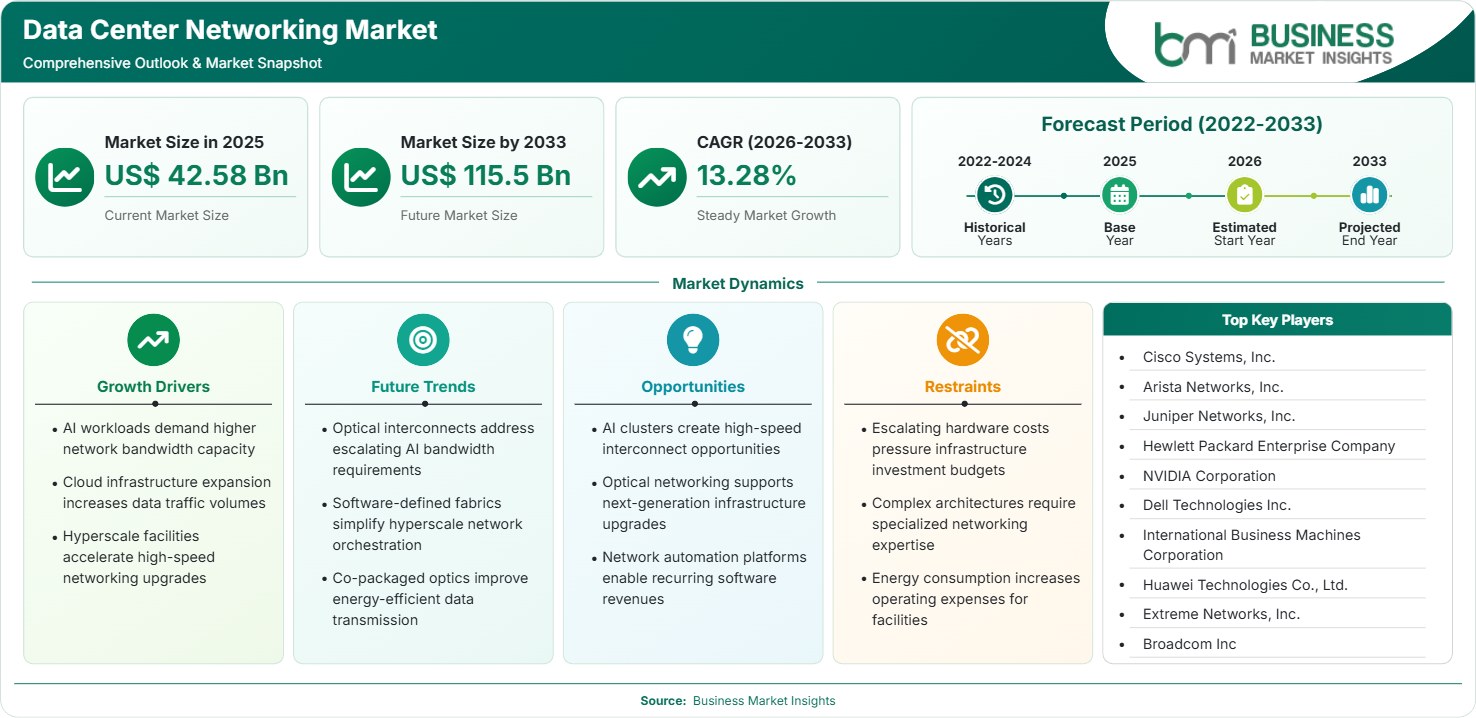
The Data Center Networking Market size was valued at US$ 42.58 Billion in 2025 and is projected to reach US$ 115.5 Billion by 2033, growing at a CAGR of 13.28% during 2026–2033. Key growth drivers include AI-ready infrastructure deployment, hyperscale data center expansion, cloud modernization, and increasing east-west traffic management requirements. Opportunities are emerging from software-defined networking, edge facilities, and high-speed Ethernet adoption.

Report Coverage
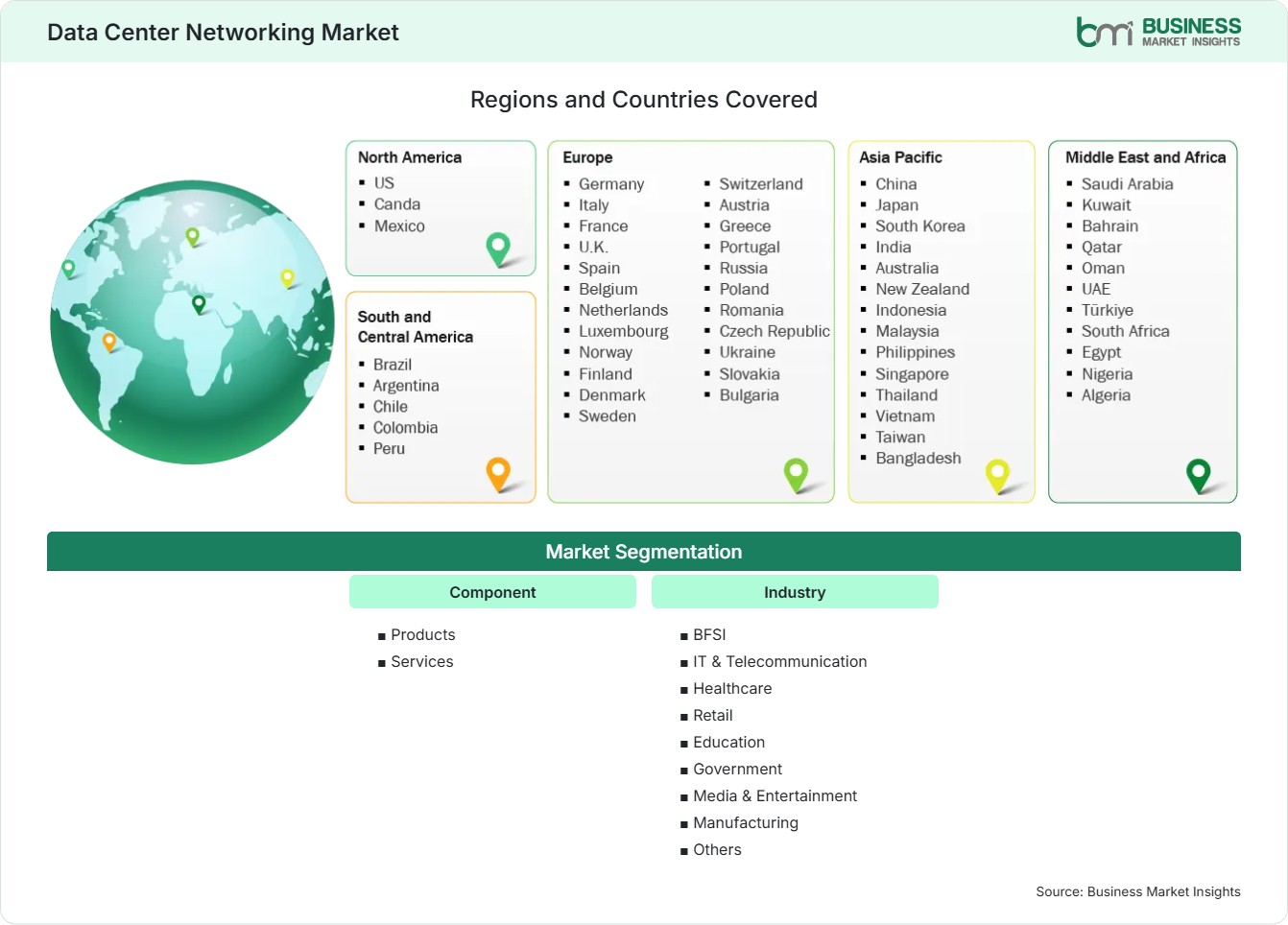
  • Component: Products, Services
  • Industry: BFSI, IT & Telecommunication, Healthcare, Retail, Education, Government, Media & Entertainment, Manufacturing, Others
US$ 42.58 Bn Market size in 2025
US$ 115.5 Bn Market Size by 2033
13.28% CAGR, 2026 - 2033
2026-2033 Forecast Period

AI Overview

Data Center Networking Market Summary

  • North America Region: North America holds a market share of 37%–40% in 2025, growing at a CAGR of 12.4%–13.2% during 2026–2033. Demand is supported by hyperscale cloud investment, AI cluster deployments, network automation adoption, and accelerated migration toward high-bandwidth architectures across enterprise environments. The U.S. market benefits from hyperscale capacity growth, advanced semiconductor ecosystems, and expanding AI infrastructure, progressing at a CAGR of 12.8%–13.6%.
  • Fastest Growing Region: Asia Pacific accounts for 26%–29% market share in 2025 and advances at a CAGR of 14.8%–15.7% during 2026–2033. Digital transformation initiatives, cloud localization strategies, smart manufacturing expansion, and large-scale data center investments continue creating strong networking infrastructure demand.
  • Leading Segment: Products represent 68%–71% share in 2025 and expand at a CAGR of 13.0%–13.8% during 2026–2033. Growing deployment of switches, routers, Ethernet fabrics, optical interconnects, and AI networking platforms reinforces segment leadership across enterprise and hyperscale environments.
  • High Growth Segment: Services account for 29%–32% share in 2025 and grow at a CAGR of 14.2%–15.0% during 2026–2033. Increasing network complexity, managed service requirements, consulting demand, performance optimization initiatives, and cybersecurity integration stimulate accelerated expansion.
  • Key Market Opportunity: AI-driven data center architectures require scalable low-latency fabrics, creating opportunities for advanced Ethernet, network observability, automation software, workload optimization platforms, and high-performance interconnect solutions globally.
  • Major Market Players: Cisco Systems, Inc.; Arista Networks, Inc.; Juniper Networks, Inc.; Hewlett Packard Enterprise Company; NVIDIA Corporation; Dell Technologies Inc.; International Business Machines Corporation; Huawei Technologies Co., Ltd.; Extreme Networks, Inc.; Broadcom Inc.
Strategic Insights

Data Center Networking Market: Strategic Insights

Data Center Networking Market Strategic Framework
FREE PDF
Request your free sample
Request free sample
Stakeholder View

Key Takeaways

  • The industry value chain is becoming increasingly integrated as switch vendors, silicon providers, optical component manufacturers, colocation operators, and cloud service providers collaborate to reduce latency and improve workload distribution across large-scale environments.
  • The strongest growth opportunities are emerging from AI-focused infrastructure deployments, managed networking services, and advanced connectivity requirements within healthcare, manufacturing, and financial services organizations undergoing digital transformation.
  • Innovation is shifting toward 400G and 800G Ethernet ecosystems, network automation, intent-based management, RoCE-enabled fabrics, and AI-assisted network operations that improve utilization, reliability, and operational visibility.
  • Asia Pacific presents a compelling investment case due to rapid cloud adoption, expanding hyperscale capacity, government-backed digital infrastructure projects, and rising enterprise demand for secure, scalable networking platforms.
  • Strategic acquisitions continue to focus on software-defined networking, AI infrastructure optimization, observability, and data center security capabilities as vendors seek broader platform offerings and recurring service revenues.
  • Sustainability considerations are increasingly influencing procurement decisions, encouraging deployment of energy-efficient switches, silicon innovations, intelligent workload orchestration tools, and automated traffic management solutions.
Geographic Outlook

Data Center Networking Market Regional Highlights

North America Data Center Networking Market

North America accounts for approximately 37%–40% of global revenue in 2025 and is projected to register a CAGR of 12.4%–13.2% through 2033. Hyperscale infrastructure, cloud ecosystems, and AI infrastructure investment in this region are well established. Significant capacity increases by cloud players for supporting generative AI loads and digital transformation programs are underway. Increased expenditure on advanced Ethernet fabrics, network automation software, cybersecurity frameworks, and edge computing further enhances the market position. Enterprise infrastructure modernization continues to be an important driver for market development.

  • The major hyperscale operators are now using AI clusters, which require networking architectures capable of high bandwidth and low latency, and this is leading to greater demand for advanced switches, optical interconnects, and automation platforms in large-scale facilities in the area.
  • To meet the demands of enterprise cloud migration, colocation providers are still increasing their capacity, making ongoing investments in scalable routing technologies, fabric architectures, traffic optimization capabilities, and more robust network security frameworks.
  • Growing adoption of 400G and 800G Ethernet technologies enables efficient handling of east-west traffic, supporting cloud-native applications, distributed computing environments, and increasingly demanding artificial intelligence workloads.
  • The government's investment in improving the resilience of its digital infrastructure and in modernizing its cybersecurity helps to facilitate upgrades to enterprise networking, especially within public agencies, regulated industries, and operators who have mission-critical workloads.

US Data Center Networking Market

The United States represents approximately 78%–82% of North American Data Center Networking Market revenue and is expected to expand at a CAGR of 12.8%–13.6% through 2033. Hyperscale building pipelines that are solid, semiconductor technology innovation leaders, and investments in AI fuel networking infrastructure needs. Efforts of enterprise modernization are helping to speed up the uptake of software-defined networks and automation technologies. The presence of strong cloud and edge deployments facilitates infrastructure modernization. The country's position as the leading tech innovator in the region will ensure the continued need for connectivity and network management solutions.

  • Large technology companies are still building data centers that are focused on AI and that require high-performance fabrics, low-latency switch architectures, and scalable interconnect technologies to support intensive computational workloads.
  • Financial institutions are now using sophisticated networking environments to meet the demands of real-time analytics, digital banking operations, cybersecurity needs, and regulatory compliance within their complex infrastructure ecosystems.
  • The increase in the number of edge computing deployments is leading to greater demand for distributed networking architectures that are able to efficiently handle data processing, application delivery, and connectivity over a wide range of geographical locations.
  • The use of automated network operations by enterprises leads to greater efficiency, lowers the chances of downtime, and results in better scalability in hybrid and multi-cloud technology environments.

Europe Data Center Networking Market

Europe maintains a 24%–27% Data Center Networking Market share in 2025 and is forecast to expand at a CAGR of 12.0%–12.8% through 2033. Digital sovereignty initiatives, rising cloud investments, and strict data governance frameworks shape regional demand. Germany and the United Kingdom lead deployment activity, while countries including Spain and Poland exhibit stronger expansion rates. Investments in sustainable data center infrastructure encourage adoption of energy-efficient networking equipment. Demand for secure connectivity platforms continues to increase across government, financial services, healthcare, and industrial applications requiring resilient digital infrastructure and compliance-driven architectures.

  • Germany is still a leading market as a result of its strong industrial digitization programs, the considerable amount of IT investment made by businesses, and the widespread use of cloud and edge computing infrastructure.
  • The United Kingdom benefits from dense colocation ecosystems, financial services demand, and active technology innovation, supporting steady investments in next-generation networking technologies.
  • Spain is showing signs of accelerated growth, with estimated regional growth rates reaching between 13.5% and 14.3%, due to increasing cloud capacity and its digital economy initiatives.
  • Sustainability regulations encourage adoption of intelligent network management solutions that optimize utilization, reduce energy consumption, and support environmental performance objectives.
  • Data residency requirements and cybersecurity strategies continue stimulating infrastructure modernization projects across public and private sector organizations.

Asia Pacific Data Center Networking Market

Asia Pacific holds 26%–29% of global Data Center Networking Market revenue during 2025 and represents the fastest-growing regional market with a CAGR of 14.8%–15.7% through 2033. Rapid digitalization, cloud expansion, 5G deployment, and smart manufacturing programs fuel infrastructure demand. China, Japan, and India continue attracting significant data center investments. Growing internet traffic volumes and enterprise modernization initiatives strengthen requirements for scalable networking solutions. Rising adoption of AI, advanced analytics, and edge computing architectures further accelerates infrastructure development across both developed and emerging markets throughout the region.

  • China maintains regional leadership through extensive cloud ecosystems, AI infrastructure deployment, and strong government-backed digital economy programs supporting networking investments.
  • India has one of the highest regional growth rates, at about 16.0% to 16.8%, due to the expansion of cloud facilities, data localization initiatives, and enterprise digital transformation.
  • Japan is still making investments in advanced automation technologies, in resilient digital infrastructure, and in next-generation connectivity platforms which support high-performance computing environments.
  • The demand for high-capacity switching, optical networking platforms, and intelligent traffic orchestration solutions is increasing as regional hyperscale deployments grow.
  • The success of smart manufacturing projects depends on having reliable and scalable networking systems that support connectivity for industrial IoT, analytics, and operational technology.

Rest of World Data Center Networking Market

The Rest of World region accounts for 8%–10% Data Center Networking Market share in 2025 and is anticipated to register a CAGR of 13.5%–14.4% through 2033. South and Central America benefit from increasing cloud investments and enterprise modernization programs. Brazil remains the leading regional contributor, while Mexico records strong infrastructure development activity.

In the Middle East and in Africa there is an increasing demand as a result of smart city initiatives, sovereign cloud programs, and strategies aimed at diversifying the digital economy. Saudi Arabia and the United Arab Emirates are showing especially strong momentum in terms of investment, which is helping to promote the adoption of long-term networking infrastructure.

  • Brazil is leading regional adoption by expanding its colocation capacity, migrating enterprises to the cloud, and in response to growing demands for secure and scalable digital infrastructure solutions.
  • The demand in Mexico is growing at an accelerated rate due to nearshoring activities, digital transformation projects, and large-scale investments in modern data center facilities.
  • Saudi Arabia is advancing regional development by means of its digital infrastructure programs, national technology strategies, and increasing involvement in hyperscale investments.
  • The United Arab Emirates enjoys the advantages of its smart city projects, its government programmes aimed at modernising technology, and the growing demand for advanced connectivity architectures.
  • The ongoing expansion of internet access and the process of enterprises going digital in emerging economies is still creating opportunities for network providers and investors in infrastructure.
Global Market Geography
FREE PDF
Request your free sample
Request free sample
Segment Analysis

Data Center Networking Market Segmentation

Component

The Component segment represents the core infrastructure foundation of the market and accounts for approximately 68%–71% market share in 2025, advancing at a CAGR of 13.0%–13.8% through 2033. Growth is driven by hyperscale expansion, AI-ready networking deployments, enterprise modernization projects, and increasing network automation requirements. The Data Center Networking Market scope continues expanding as organizations prioritize scalable architectures, advanced fabrics, and integrated management capabilities for cloud-native environments.

  • Products: Switches, routers, network operating systems, optical interconnects, and Ethernet fabrics remain essential for managing increasing data traffic, AI workloads, cloud applications, and low-latency communication requirements.
  • Services: Consulting, deployment, maintenance, optimization, and managed networking services are gaining importance as enterprises seek specialized expertise to manage increasingly complex network infrastructures and hybrid environments.

Industry

The Industry segment reflects broad adoption across digital-first sectors requiring resilient connectivity, secure operations, and scalable infrastructure. This segment contributes substantial demand, supported by cloud migration strategies, data-intensive applications, and digital transformation initiatives. Industry-specific networking requirements continue evolving as organizations adopt AI, edge computing, real-time analytics, and automation technologies. The Data Center Networking Market trends indicate increasing investment across both commercial and public-sector deployments.

  • BFSI: Banking and financial institutions rely on advanced networking frameworks to support real-time transactions, fraud detection systems, cybersecurity operations, cloud banking platforms, and regulatory compliance obligations.
  • IT & Telecommunication: Telecom operators and technology providers generate significant demand through cloud infrastructure expansion, 5G deployment programs, hyperscale facilities, and increasing requirements for traffic management platforms.
  • Healthcare: Healthcare organizations deploy high-performance networking infrastructure to support electronic health records, medical imaging, telemedicine services, research applications, and secure patient data management.
  • Retail: Retail enterprises increasingly require scalable networking solutions supporting omnichannel operations, real-time inventory visibility, digital payment environments, and customer analytics platforms.
  • Education: Educational institutions invest in advanced networking capabilities to support online learning, digital campuses, research collaboration, cloud applications, and growing student connectivity requirements.
  • Government: Government agencies prioritize resilient networking infrastructure for digital citizen services, cybersecurity initiatives, critical operations, and secure management of sensitive information assets.
  • Media & Entertainment: Streaming services, content production environments, digital broadcasting, and interactive platforms require high-capacity networking systems capable of supporting substantial traffic volumes.
  • Manufacturing: Industrial organizations deploy networking architectures supporting smart factories, industrial IoT, predictive maintenance, robotics integration, and real-time operational analytics across connected facilities.
Market Forces

Data Center Networking Market Dynamics

Key Market Drivers

AI Infrastructure Expansion Accelerating Network Modernization

AI implementation leads to a surge in the need for enhanced network infrastructure. The traffic volume between AI training clusters is far higher than in regular enterprise networks, requiring low-latency systems and high-speed connectivity. The rising usage of GPUs and acceleration computing frameworks has resulted in the development of 400G and 800G Ethernet standards. Machine learning algorithms need fabrics that can support data movement at scale. Data Center Networking Market growth is increasingly linked to hyperscale investments targeting AI workloads. As enterprises deploy generative AI capabilities, networking performance becomes a critical determinant of infrastructure efficiency, utilization rates, and application responsiveness across distributed computing environments globally.

Hyperscale Cloud Capacity Growth Driving Infrastructure Demand

The growing use of cloud services is leading to a strong need for scalable networking platforms. To respond to the rising demand from enterprises, hyperscale operators are extending the number of regional availability zones and building new data centers. The demands of cloud-native applications, containerized workloads, and multi-cloud setups call for flexible connectivity options that can handle changing traffic patterns. Network automation techniques enable operators to maintain efficient operations as their infrastructure grows. As the volume of enterprise data processed in cloud environments increases, there is continued investment in switching, routing, observability, and traffic optimization solutions. The substantial demand from software providers, digital platforms, and cloud service companies remains a major factor influencing networking infrastructure purchasing in global markets.

Software-Defined Operations Enhancing Network Efficiency

Organizations increasingly deploy software-defined networking technologies to improve flexibility, visibility, and operational efficiency. Centralized orchestration platforms enable dynamic resource allocation while reducing manual configuration requirements. Network telemetry, analytics, and automation capabilities enhance troubleshooting processes and optimize performance. Enterprises implementing hybrid cloud environments benefit from policy-driven management approaches that improve consistency across distributed infrastructures. Data Center Networking Market trends increasingly reflect strong demand for intelligent management solutions capable of reducing complexity and improving scalability. The ability to automate routine operations, strengthen security controls, and accelerate service delivery continues to support widespread adoption across multiple industry verticals.

Key Market Opportunities

Emergence of AI-Optimized Ethernet Ecosystems

Infrastructure investments in AI are providing new opportunities for vendors offering future-generation Ethernet capabilities. Networking technologies that provide low-latency interprocessor communication platforms have been getting a lot of attention from hyperscale players. There is a growing preference among businesses for open networking environments. Data Center Networking Market Forecasts indicate there will be continuous momentum in investments for switch architectures, optical interconnects, and congestion management. Companies that have solutions that integrate hardware, software, observability, and automation can leverage the situation and attract more business from enterprises. This opportunity will apply to all enterprises that handle intensive computational workloads, including cloud vendors, research organizations, financial companies, and manufacturers.

Edge Data Center Development Across Emerging Economies

The growth of digital ecosystems is leading to a greater need for distributed infrastructure that is closer to end users. Edge data centers need networking platforms that are robust and capable of supporting low-latency applications, content delivery, and local processing. Projects related to smart cities, industrial automation, and 5G-enabled services are increasing the likelihood of deployment. Nations that are implementing national digital infrastructure programs are likely to increase their purchases of high-capacity networking technologies. Vendor companies offering energy-efficient and scalable solutions could benefit from the expansion of regional projects. The mix of increasing internet usage, enterprise digitalization, and the requirement for data localization presents promising opportunities in many emerging markets during the forecast period.

Network Observability and Security Convergence

More organizations are looking for combined solutions that integrate network visibility, performance monitoring, and cybersecurity features. Advanced observability platforms offer real-time analytics, which enhance reliability and at the same time aid in threat detection. As businesses operate in hybrid environments and distributed applications, the need for unified management methods continues to grow. Vendor companies that can deliver comprehensive monitoring, automation, and security capabilities can clearly distinguish their products. The increased focus on operational resilience and regulatory compliance promotes the long-term acceptance of these solutions. This chance is especially pertinent in the case of financial institutions, healthcare providers, government organizations, and technology firms that are responsible for handling highly sensitive workloads and providing mission-critical services.

Market Restraints and Challenges

High Infrastructure Costs and Capital Intensity

The need for advanced networking setups entails significant investments in high-performance switches, optical networking equipment, automation software, and associated infrastructure. As a result, many small and mid-sized companies find themselves constrained by budgetary limits, which causes delays in their modernization efforts and leads to smaller deployment scales. When moving towards AI-ready architectures, procurement costs tend to rise because businesses must upgrade multiple layers of their infrastructure simultaneously. Moreover, economic uncertainty and changing priorities regarding technology spending can affect purchasing decisions. Even though long-term operational efficiencies might make the investment worthwhile, the high initial expenditure remains a major obstacle. A strong sense of cost sensitivity is evident in organizations seeking to modernize while managing their broader digital transformation budgets.

Operational Complexity and Skilled Workforce Gaps

Modern networking environments include cloud platforms, software-defined architectures, automation tools, and security frameworks, all of which demand specialized knowledge. The effect of a shortage of skilled networking professionals is to increase operational risks and make implementation more difficult. When organizations manage older systems alongside cutting-edge networking technologies, they often face integration problems. Complex configuration needs can extend the time required to deploy a system and increase support costs. To ensure consistent performance across distributed infrastructures, continuous monitoring and optimization capabilities are necessary. Moreover, workforce shortages can also affect the efficiency of troubleshooting, the resilience of the infrastructure, and the rate at which new technologies are adopted, thus constituting a continuing difficulty for companies carrying out large-scale modernization strategies.

Company Analysis

Competitive Landscape

The competitive environment is characterized by innovation in high-speed Ethernet, AI networking fabrics, software-defined architectures, and network observability platforms. Data Center Networking Market analysis indicates that leading vendors are expanding portfolios through partnerships, product launches, and ecosystem integrations to address hyperscale, enterprise, and cloud infrastructure requirements.

Company Name

Overview

Products and Services relevant to this market

Cisco Systems, Inc.

Global networking leader with extensive presence across enterprise, cloud, and service provider infrastructure markets.

Data center switches, routing platforms, software-defined networking solutions, automation software, security integration, and network management services.

Arista Networks, Inc.

Specialized provider of cloud networking platforms serving hyperscale operators and enterprise customers globally.

High-performance Ethernet switches, cloud networking software, AI networking solutions, observability platforms, and data center fabric technologies.

Juniper Networks, Inc.

Networking technology company focused on automated, AI-driven infrastructure and enterprise connectivity solutions.

Ethernet switching, routing solutions, network automation platforms, AI operations software, and data center fabrics.

Hewlett Packard Enterprise Company

Infrastructure and hybrid cloud provider serving enterprises, governments, and service providers worldwide.

Data center networking hardware, Aruba networking solutions, infrastructure management platforms, and related consulting services.

NVIDIA Corporation

Accelerated computing and AI infrastructure leader with expanding presence in high-performance networking.

InfiniBand solutions, Ethernet platforms, AI networking fabrics, intelligent interconnect technologies, and network acceleration solutions.

Dell Technologies Inc.

Technology infrastructure company delivering integrated data center and cloud solutions globally.

Enterprise networking systems, data center switches, infrastructure integration services, and hybrid cloud networking solutions.

International Business Machines Corporation

Global technology enterprise focused on hybrid cloud, AI, and digital transformation solutions.

Network management software, infrastructure consulting, cloud networking integration, and enterprise technology services.

Huawei Technologies Co., Ltd.

Telecommunications and ICT provider with comprehensive networking infrastructure capabilities.

Data center switches, cloud networking products, management systems, intelligent network solutions, and enterprise services.

Extreme Networks, Inc.

Networking specialist emphasizing automation, cloud management, and analytics-driven operations.

Switching platforms, network analytics, cloud-managed networking, fabric technologies, and operational intelligence solutions.

Broadcom Inc.

Semiconductor and infrastructure software provider supporting advanced networking ecosystems.

Ethernet switching silicon, network processors, infrastructure software, connectivity solutions, and cloud-scale networking components.

Trust & Transparency

Research Methodology

The market analysis combines proprietary research with secondary data from government agencies, company disclosures, regulatory filings, industry databases and expert interviews. Market estimates are validated through data triangulation, cross-market benchmarking and analyst review.

View Full Research Methodology

Questions Answered

Frequently Asked Questions

What are the primary challenges facing infrastructure operators?

High capital requirements, integration complexity, cybersecurity risks, and shortages of specialized networking professionals remain significant challenges. Organizations must carefully balance modernization objectives with cost management and operational resilience requirements.

What does the Data Center Networking Market Report indicate regarding future technology evolution?

The Data Center Networking Market Report highlights continued transition toward software-defined architectures, AI-assisted operations, 400G and 800G Ethernet adoption, integrated observability platforms, and increasingly automated infrastructure management across enterprise and cloud environments.

How is artificial intelligence influencing networking investments?

AI environments generate exceptionally high bandwidth and low-latency requirements. As a result, enterprises and hyperscale operators are investing in advanced Ethernet fabrics, intelligent traffic management systems, and automated network operations technologies.

Which industries create the strongest demand for networking infrastructure?

IT and telecommunications, BFSI, healthcare, manufacturing, and government sectors are among the largest adopters because they require secure, resilient, and high-capacity infrastructure capable of supporting mission-critical operations and large-scale digital services.

What factors are accelerating adoption of advanced data center networking infrastructure?

AI workloads, cloud-native applications, edge computing deployments, and increasing east-west traffic volumes are driving demand for high-performance networking solutions. Organizations are also prioritizing automation, cybersecurity, and scalable architectures to support digital transformation initiatives.

Access the Full Data Center Networking Market Report

Get segment-level forecasts, regional estimates, competitive benchmarking, company profiles and downloadable Excel datasets.

Access the full Data Center Networking Market Report
350 pages PDF & Excel | 2026-09-21
Similar Research

Related Market Reports