
Data Center Automation Market Outlook: Size, Share, Trends, Growth Analysis, Competitive Landscape & Forecast, 2026-2033

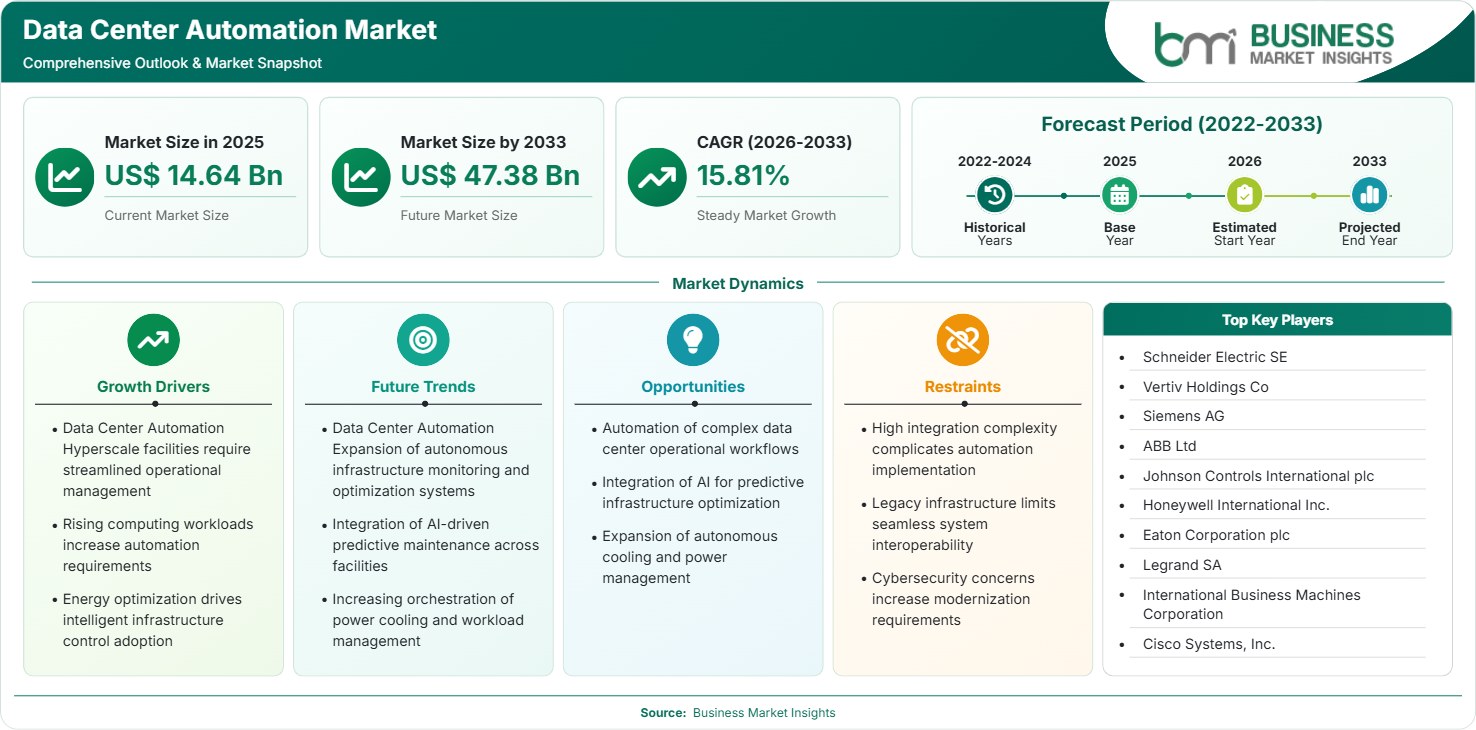
The Data Center Automation Market size was valued at US$ 14.64 Billion in 2025 and is projected to reach US$ 47.38 Billion by 2033, growing at a CAGR of 15.81% during 2026–2033, driven by AI workloads, rising power density, automated cooling, energy optimization, infrastructure integration, and demand for resilient operations.

Report Coverage
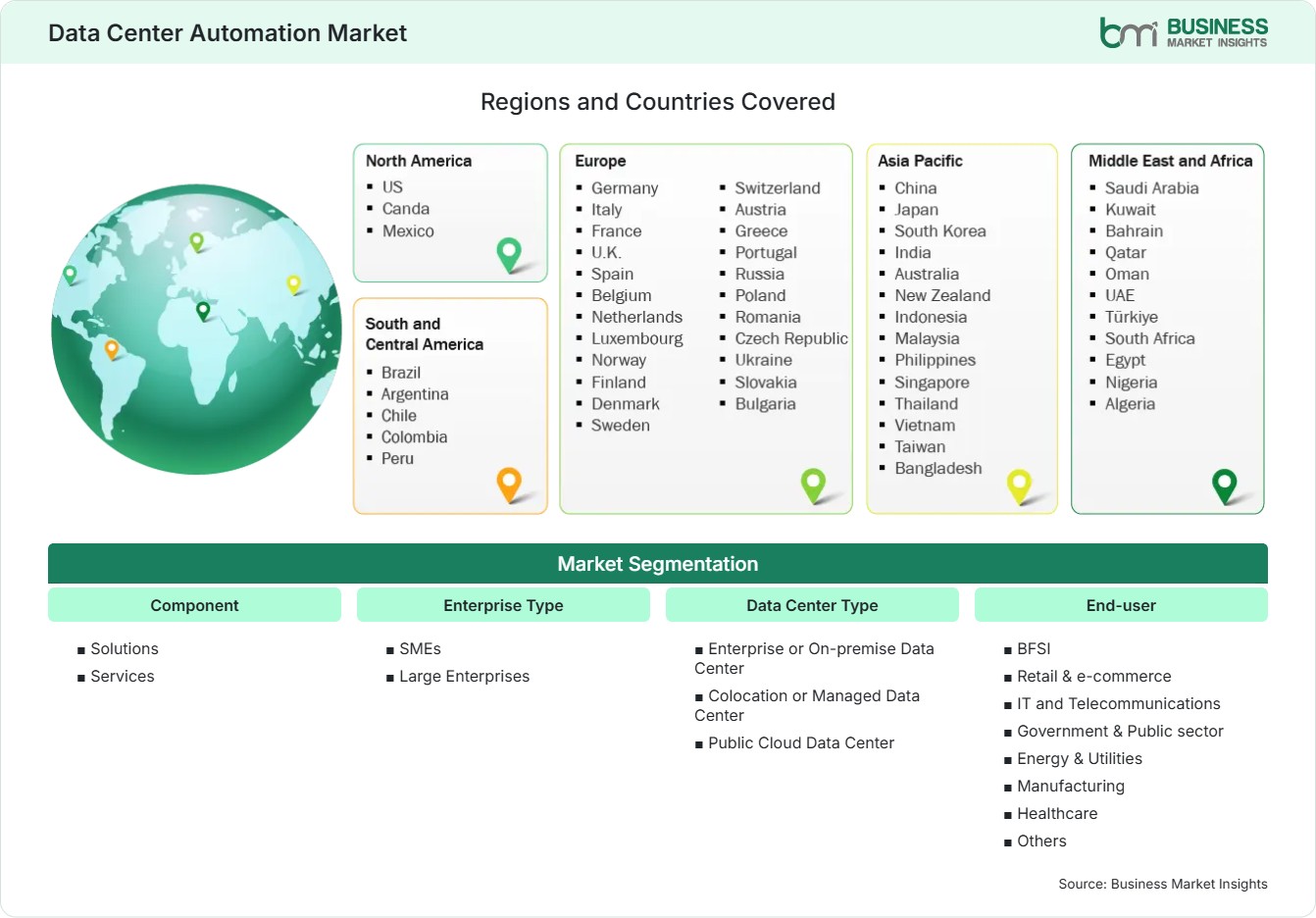
  • Component: Solutions, Services
  • Enterprise Type: SMEs, Large Enterprises
  • Data Center Type: Enterprise or On-premise Data Center, Colocation or Managed Data Center, Public Cloud Data Center
  • End-user: BFSI, Retail & e-commerce, IT and Telecommunications, Government & Public sector, Energy & Utilities, Manufacturing, Healthcare, Others
US$ 14.64 Bn Market size in 2025
US$ 47.38 Bn Market Size by 2033
15.81% CAGR, 2026 - 2033
2026-2033 Forecast Period

AI Overview

Data Center Automation Market Summary

  • North America Region: North America holds a 35%–39% Data Center Automation Market share in 2025, growing at a 14.5%–15.8% CAGR during 2026–2033, supported by hyperscale expansion, AI infrastructure, power constraints, automated cooling, digital operations, and modernization. US facilities prioritize automation to manage rapidly increasing computational density and energy requirements, supporting a 14.7%–15.9% CAGR during 2026–2033.
  • Fastest Growing Region: Asia Pacific holds a 22%–26% share in 2025, expanding at a 17.0%–18.6% CAGR during 2026–2033, supported by cloud adoption, hyperscale investment, digitalization, colocation expansion, AI deployment, smart infrastructure, and increasing demand for energy-efficient facility management.
  • Leading Segment: Solutions hold a 62%–66% share in 2025, advancing at a 15.6%–16.5% CAGR during 2026–2033, driven by integrated monitoring, DCIM, building controls, power management, cooling optimization, predictive analytics, cybersecurity, and centralized infrastructure orchestration.
  • High Growth Segment: Public Cloud Data Center holds a 30%–34% share in 2025, advancing at a 17.5%–18.8% CAGR during 2026–2033, supported by AI computing, hyperscale capacity additions, workload migration, distributed infrastructure, automated provisioning, and rising requirements for operational efficiency.
  • Key Market Opportunity: AI-driven workloads are creating demand for integrated automation spanning power, cooling, security, capacity planning, and digital twins, enabling vendors to monetize software, services, optimization, and lifecycle support.
  • Major Market Players: Schneider Electric SE, Vertiv Holdings Co, Siemens AG, ABB Ltd, Johnson Controls International plc, Honeywell International Inc., Eaton Corporation plc, Legrand SA, International Business Machines Corporation, and Cisco Systems, Inc.
Strategic Insights

Data Center Automation Market: Strategic Insights

Data Center Automation Market Strategic Framework
FREE PDF
Request your free sample
Request free sample
Stakeholder View

Key Takeaways

  • The creation of value is moving away from standalone monitoring devices and towards integrated platforms that connect electrical infrastructure, cooling systems, building management systems, IT assets, analytics, and service workflows. This situation benefits companies that can operate across different types of equipment and outdated protocols.
  • Since computational loads have become more variable and concentrated, the automated provisioning, thermal optimization, capacity planning, and power management required in public cloud and high-density AI facilities provide considerable potential for application growth.
  • Automation is heading toward predictive and adaptive control, with AI-powered analytics that combine data from equipment, environmental information, workload patterns, and past performance to detect anomalies and make dynamic adjustments to how the facility operates.
  • Southeast Asia offers a varied chance for development since investment in digital infrastructure is speeding up, with Singapore and southern Malaysia becoming regional hubs and the neighboring markets being able to provide extra capacity as operators expand their infrastructure footprints.
  • More strategic investment is being directed towards technologies that enhance energy availability and efficiency. In March 2025, ABB made an investment in DG Matrix to support the use of solid-state power electronics in AI data centers, showing its interest in next-generation infrastructure technologies.
Geographic Outlook

Data Center Automation Market Regional Highlights

North America Data Center Automation Market

North America holds a 35%–39% share in 2025, with a 14.5%–15.8% CAGR during 2026–2033. The Data Center Automation Market share reflects extensive hyperscale capacity, mature colocation infrastructure, advanced building controls, and high automation adoption. US demand remains dominant within the region as AI investment raises power and cooling requirements.

  • The rack density and thermal variability associated with AI infrastructure are leading to a need for automated cooling controls, real-time monitoring, predictive analytics, and coordinated power management in high-density data centers.
  • Hyperscale and colocation operators are increasingly making use of centralized platforms, which enable them to monitor a number of sites, improve their capacity visibility, standardize their operating procedures, and reduce their reliance on manual intervention.
  • The amount of available power is now limiting development, with greater interest in automated load management, the integration of distributed energy, and optimization systems, all aimed at maximizing usable electrical capacity.
  • Canada provides further opportunities in the areas of hyperscale development, the availability of renewable electricity, and meeting data sovereignty requirements, which in turn increases the demand for local infrastructure monitoring and facility automation.

US Data Center Automation Market

The US Data Center Automation Market represents the largest national opportunity within North America, with a 31%–35% share of the global market in 2025 and a 14.7%–15.9% CAGR during 2026–2033. US demand is reinforced by hyperscale expansion, AI investment, cloud migration, and constrained power infrastructure

  • AI investment is intensifying requirements for dynamic thermal management because accelerated computing creates higher and less predictable heat loads than conventional enterprise workloads.
  • Operators are now using unified monitoring platforms to coordinate the electrical, mechanical, environmental, and IT infrastructure, which helps to speed up fault detection and improve the consistency of operating performance.
  • The greater concentration of data centers in the major US clusters makes it all the more important to carry out power optimization, demand forecasting, and to employ automated resilience strategies in the regional power grids, which have capacity constraints.
  • Sustainability goals are promoting the automation of measurements of energy, water, and carbon performance, together with the traditional uptime and capacity indicators.

Europe Data Center Automation Market

Europe Data Center Automation Market holds a 25%–29% share in 2025, with a 14.0%–15.2% CAGR during 2026–2033. Europe remains an important automation market because energy costs, sustainability requirements, data sovereignty, and mature industrial automation capabilities encourage sophisticated facility controls. The United Kingdom, Germany, France, and the Netherlands represent established infrastructure markets, while Spain, Italy, and the Nordic countries provide additional development opportunities.

  • European operators are increasingly combining power management, cooling, building management, and environmental monitoring to enhance energy performance while still meeting their strict availability requirements.
  • The regulatory focus on energy efficiency and sustainability is driving the automation of measurement, reporting, optimization, and continuous performance management in large facilities.
  • The Nordic regions benefit from abundant renewable electricity resources and favorable cooling conditions, enabling the establishment of new facilities where automation can coordinate energy systems and thermal infrastructure.
  • Germany and France offer automation companies the chance to benefit from enterprise modernization, the expansion of cloud infrastructure, and the need for secure domestic digital capacity.

Asia Pacific Data Center Automation Market

Asia Pacific holds a 22%–26%Data Center Automation Market share in 2025, with a 17.0%–18.6% CAGR during 2026–2033, making it the fastest-growing regional market. Data center electricity demand is expanding rapidly alongside cloud adoption, digital services, and AI deployment.

  • By combining its extensive cloud infrastructure with the development of domestic technologies, China is generating a demand for automation platforms that can meet the large-scale requirements relating to power, cooling, monitoring, and facility management.
  • India has great room for growth since the rise in cloud adoption, digital public infrastructure, enterprise modernization, and AI workloads is increasing the demand for scalable data center operations.
  • Hyperscale and colocation investments are being drawn to Southeast Asia, which is enhancing the possibilities for remote monitoring, automated cooling, energy management, and the orchestration of multi-site infrastructure.
  • Australia has a well-developed data center infrastructure. It also has strict rules for reliability, sustainability, and energy use. This creates chances to use more automation in both business and colocation data centers.

Rest of World Data Center Automation Market

Rest of World Data Center Automation Market holds a 10%–14% share in 2025, with a 13.2%–14.8% CAGR during 2026–2033. South and Central America offer growth through cloud adoption, digital transformation, and expanding colocation infrastructure, with Brazil and Mexico representing leading markets.

  • Brazil benefits from existing demand for cloud services and the growing regional digital infrastructure, which in turn enables automation of power monitoring, cooling management, and facility optimization in colocation environments.
  • Because of its proximity to the US digital ecosystem, Mexico has opportunities in enterprise cloud migration and in developing new infrastructure to handle regional and international workloads.
  • In the Gulf countries, there is a great deal of investment in large-scale digital infrastructure, which is leading to a demand for automation that can handle thermal conditions, energy usage, and ensure operational resilience in harsh climates.
  • South Africa remains a significant market in Africa as cloud service infrastructure and connectivity expand, with automated cooling and energy optimization being used to address operational challenges in the region.
Global Market Geography
FREE PDF
Request your free sample
Request free sample
Segment Analysis

Data Center Automation Market Segmentation

Component

Solutions hold a 62%–66% share in 2025, with a 15.6%–16.5% CAGR during 2026–2033, reflecting strong demand for integrated automation, DCIM, monitoring, analytics, and control. Services support implementation, integration, maintenance, consulting, and optimization. Data Center Automation Market scope increasingly encompasses combined technology and lifecycle support models.

  • Solutions: Integrated software and control platforms coordinate power, cooling, environmental, asset, and operational data, improving visibility, automation, predictive maintenance, and infrastructure utilization across facilities.
  • Services: Consulting, implementation, integration, managed support, maintenance, and optimization services help operators deploy automation platforms while addressing complex equipment environments, operational requirements, and lifecycle upgrades.

Enterprise Type

Large enterprises represent approximately 58%–62% Data Center Automation Market share in 2025, with a 15.0%–16.0% CAGR during 2026–2033, supported by complex infrastructure estates and greater automation budgets. SMEs represent a smaller base but benefit from managed platforms and cloud-based tools. Adoption increasingly depends on operational complexity, energy costs, and availability requirements.

  • SMEs: Cloud-based monitoring, managed automation, and subscription software reduce deployment complexity, allowing smaller organizations to access infrastructure visibility without extensive internal engineering resources.
  • Large Enterprises: Complex multi-site facilities require centralized orchestration, capacity planning, predictive analytics, and integrated controls, supporting adoption across distributed enterprise infrastructure and mission-critical workloads.

Data Center Type

Public Cloud Data Center represents approximately 30%–34% share in 2025, with a 17.5%–18.8% CAGR during 2026–2033. Hyperscale facilities require automation to coordinate enormous power, cooling, and IT environments. Colocation and enterprise facilities also adopt automation to improve utilization, tenant services, resilience, and operating consistency.

  • Enterprise or On-premise Data Center: Enterprises prioritize infrastructure visibility, energy management, security, and reliability as automation modernizes existing facilities and supports hybrid IT operating models.
  • Colocation or Managed Data Center: Colocation providers use automation to monitor tenant environments, allocate capacity, manage service levels, optimize infrastructure, and improve operating economics across multi-tenant facilities.
  • Public Cloud Data Center: Hyperscale facilities require extensive automation for provisioning, power distribution, thermal management, workload orchestration, predictive maintenance, and centralized control across geographically distributed infrastructure.

End-user

IT and Telecommunications represents approximately 27%–31% share in 2025, with a 16.0%–17.0% CAGR during 2026–2033, reflecting heavy dependence on continuous digital infrastructure. BFSI, government, healthcare, energy, manufacturing, and retail increasingly adopt automation to improve resilience, efficiency, security, and operational visibility.

  • BFSI: Financial institutions prioritize availability, security, and predictable infrastructure performance, supporting automation for monitoring, environmental control, capacity planning, and incident response.
  • Retail & e-commerce: Digital commerce requires scalable infrastructure during demand peaks, encouraging automated provisioning, workload monitoring, energy management, and cooling optimization across distributed facilities.
  • IT and Telecommunications: Network-intensive operators require continuous availability and scalable infrastructure, creating strong demand for integrated monitoring, automated controls, predictive maintenance, and centralized operations.
  • Government & Public sector: Public infrastructure increasingly emphasizes resilience, cybersecurity, energy efficiency, and data sovereignty, supporting controlled automation environments and standardized operational procedures.
  • Energy & Utilities: Utilities and energy companies require secure infrastructure for operational technologies and enterprise systems, encouraging automation that improves availability, monitoring, and energy performance.
  • Manufacturing: Industrial digitalization increases demand for edge and on-premise computing, requiring automated environmental control, remote monitoring, asset management, and reliable infrastructure operation.
  • Healthcare: Healthcare organizations require continuous availability for clinical and administrative systems, supporting automated power, cooling, environmental monitoring, and infrastructure fault detection.
Market Forces

Data Center Automation Market Dynamics

Key Market Drivers

AI workloads are increasing power and thermal complexity

AI adoption is increasing computational density and creating more variable thermal profiles, making manual infrastructure management less effective. AI-focused accelerated servers are projected to grow electricity consumption by about 30% annually in the IEA base case. These conditions support market growth through automated cooling, power monitoring, workload-aware optimization, and predictive maintenance. Data Center Automation Market trends increasingly connect IT telemetry with facility controls so operators can align cooling and electrical capacity with changing workloads.

Energy efficiency is becoming an operating requirement

Electricity costs and constrained grid capacity are strengthening demand for automation that improves infrastructure efficiency without compromising availability. Automated energy management can coordinate electrical equipment, cooling systems, environmental conditions, and workload requirements. This supports Data Center Automation Market growth by converting operational data into actionable controls rather than relying on periodic manual analysis. Vendors increasingly differentiate through integrated monitoring, analytics, adaptive controls, and optimization capabilities that improve facility-level efficiency.

Operational resilience is expanding automation requirements

Automated identification, response, redundancy management, and maintenance have become mandatory for data center providers due to the impact that an outage may cause on digital services. Current automation technologies include alarm handling, equipment status, environmental parameters, capacity details, and operational processes. The ABB Data Center Automation technology is defined by ABB as combining IT, power, cooling, and building technologies. The resulting Data Center Automation Market trends favor platforms that can integrate heterogeneous assets, maintain cybersecurity controls, and provide operators with actionable information rather than isolated equipment measurements.

Key Market Opportunities

AI-based optimization creates software opportunities

AI-enabled optimization can become a major software opportunity as facilities generate larger volumes of operational telemetry. Algorithms can identify equipment degradation, Data Center Automation Market forecast energy requirements, detect abnormal thermal conditions, and recommend operating adjustments. The commercial opportunity extends beyond traditional DCIM toward intelligent control layers that continuously learn from facility conditions. Vendors that combine analytics with actual control capabilities can capture higher-value recurring software revenue while helping operators improve infrastructure efficiency and utilization.

Liquid cooling expands automation requirements

The advancement of high-density computing is opening up possibilities for automation in the areas of liquid cooling, the distribution of coolant, thermal monitoring, and the management of adaptive flow. In September 2025, Johnson Controls launched its Silent-Aire Coolant Distribution Unit platform, providing scalable solutions ranging from 500 kW to over 10 MW and stressing dynamic control of flow and capacity. This is leading to a more extensive layer of automation concerning thermal infrastructure, linking the conditions at the chip level with the facility's cooling systems. As a result, suppliers can create monitoring, control, analytics, and service options that address the growing complexity of liquid-cooling systems in hyperscale, colocation, and AI-oriented facilities.

Modular infrastructure enables faster automation deployment

Because they are prefabricated and modular, data centers offer the possibility of using standardized automation packages that can be configured, tested, deployed, and replicated at various locations. In June 2025, Siemens, Cadolto, and Legrand launched a modular edge data center that combines energy and building automation with a design of configurable infrastructure. Siemens mentioned that planning periods could range from six to twelve months. Using standardized automation can reduce engineering complexity, enhance commissioning consistency, and simplify lifecycle management. Opportunities thus arise for vendors to bundle together controls, monitoring, cybersecurity, and maintenance services into reusable infrastructure modules.

Market Restraints and Challenges

Cybersecurity and interoperability constraints

The fact is that data centers use equipment from a variety of manufacturers, along with different protocols, software layers, and network environments, which increases the number of possible cybersecurity and interoperability dependencies. As a result, the complexity of integration can lead to longer deployment times, higher engineering costs, and operational risks if the older systems are unable to communicate reliably with modern ones. Automation vendors need to provide support for secure architectures, access controls, network segmentation, authentication, software updates, and validated interoperability.

High implementation complexity and skilled-labor requirements

The need for advanced automation involves controls engineers, software specialists, electrical experts, cooling specialists, cybersecurity staff, and commissioning teams who are capable of coordinating various infrastructure layers. This situation can lead to delays in deployments due to skills shortages and complex project demands, result in higher integration costs, and limit uptake by smaller operators. Facilities that are designed to be AI-ready place even greater demands on technical capabilities since the high density of computing brings about more sophisticated requirements in terms of power and thermal management.

Company Analysis

Competitive Landscape

The Data Center Automation Market analysis shows competition increasingly focused on integrated infrastructure control, energy optimization, AI-ready thermal management, digital platforms, and lifecycle services. Vertiv launched Unify in March 2025, while Schneider Electric introduced AI-oriented modular data center solutions in June 2025, reinforcing demand for scalable, integrated infrastructure.

Company Name

Overview

Products and Services relevant to this market

Schneider Electric SE

Global energy-management and automation provider with extensive data center infrastructure capabilities and digital control expertise.

EcoStruxure data center solutions, power management, cooling integration, racks, monitoring, DCIM, automation, and lifecycle services.

Vertiv Holdings Co

Critical digital infrastructure specialist focused on power, thermal management, infrastructure integration, and data center operational technologies.

Power systems, cooling, integrated infrastructure, monitoring software, thermal management, prefabricated solutions, and services.

Siemens AG

Industrial technology company providing automation, electrical infrastructure, building systems, and integrated data center solutions.

Building automation, power distribution, controls, energy management, modular infrastructure, cybersecurity, and digital services.

ABB Ltd

Electrification and automation supplier combining industrial control expertise with power, cooling, and data center management technologies.

ABB Ability Data Center Automation, electrical systems, power management, controls, monitoring, optimization, and cybersecurity.

Johnson Controls International plc

Building technology and thermal-management specialist increasingly focused on high-density AI data center infrastructure.

Metasys controls, chillers, liquid cooling, CDUs, thermal management, automation, monitoring, and lifecycle services.

Honeywell International Inc.

Industrial technology supplier with building controls, automation, cybersecurity, and facility-management capabilities applicable to mission-critical infrastructure.

Building management, controls, cybersecurity, energy management, monitoring, automation, and operational software.

Eaton Corporation plc

Power-management company supplying electrical infrastructure and intelligent systems for mission-critical data center environments.

UPS, power distribution, monitoring, electrical management, automation, energy optimization, and digital infrastructure services.

Legrand SA

Specialist in electrical and digital building infrastructure with dedicated data center solutions and modular deployment capabilities.

Power distribution, racks, busways, monitoring, connectivity, containment, infrastructure systems, and data center solutions.

International Business Machines Corporation

Enterprise technology provider supporting infrastructure management, hybrid cloud operations, AI, automation, and IT service environments.

AI automation, hybrid cloud management, infrastructure software, observability, orchestration, and managed services.

Cisco Systems, Inc.

Networking and technology provider supporting secure connectivity, infrastructure visibility, observability, and automated data center operations.

Networking, security, observability, infrastructure management, automation, telemetry, and data center networking solutions.

Trust & Transparency

Research Methodology

The market analysis combines proprietary research with secondary data from government agencies, company disclosures, regulatory filings, industry databases and expert interviews. Market estimates are validated through data triangulation, cross-market benchmarking and analyst review.

View Full Research Methodology

Questions Answered

Frequently Asked Questions

What is the role of the Data Center Automation Market Report for investors?

The Data Center Automation Market Report can help investors assess component categories, enterprise adoption, facility types, end-user demand, regional development, competitive positioning, technology priorities, and opportunities associated with AI-driven infrastructure expansion.

Why is edge computing relevant to automation adoption?

Edge facilities are often distributed and remotely operated, increasing the value of centralized monitoring and automated response. Automation can reduce the need for continuous on-site intervention while maintaining visibility across geographically dispersed infrastructure.

Can automation support sustainability reporting?

Yes. Integrated platforms can collect electricity, cooling, environmental, and equipment-performance data continuously. This creates a consistent operational dataset that can support internal efficiency programs and sustainability reporting requirements, subject to applicable measurement standards.

What role does digital twin technology play in automated facilities?

Digital twins can provide virtual representations of infrastructure assets and operating conditions. Operators can use them for capacity planning, scenario testing, maintenance planning, and evaluation of infrastructure changes before implementing physical modifications.

How does automation affect data center commissioning?

Automation can standardize equipment configuration, testing, alarm validation, monitoring, and operational procedures. This can improve commissioning consistency and provide operators with earlier visibility into equipment performance before facilities enter full production.

Access the Full Data Center Automation Market Report

Get segment-level forecasts, regional estimates, competitive benchmarking, company profiles and downloadable Excel datasets.

Access the full Data Center Automation Market Report
350 pages PDF & Excel | 2026-09-30
Similar Research

Related Market Reports