
Cryogenic Valve Market Outlook: Size, Share, Trends, Growth Analysis, Competitive Landscape & Forecast, 2026-2033

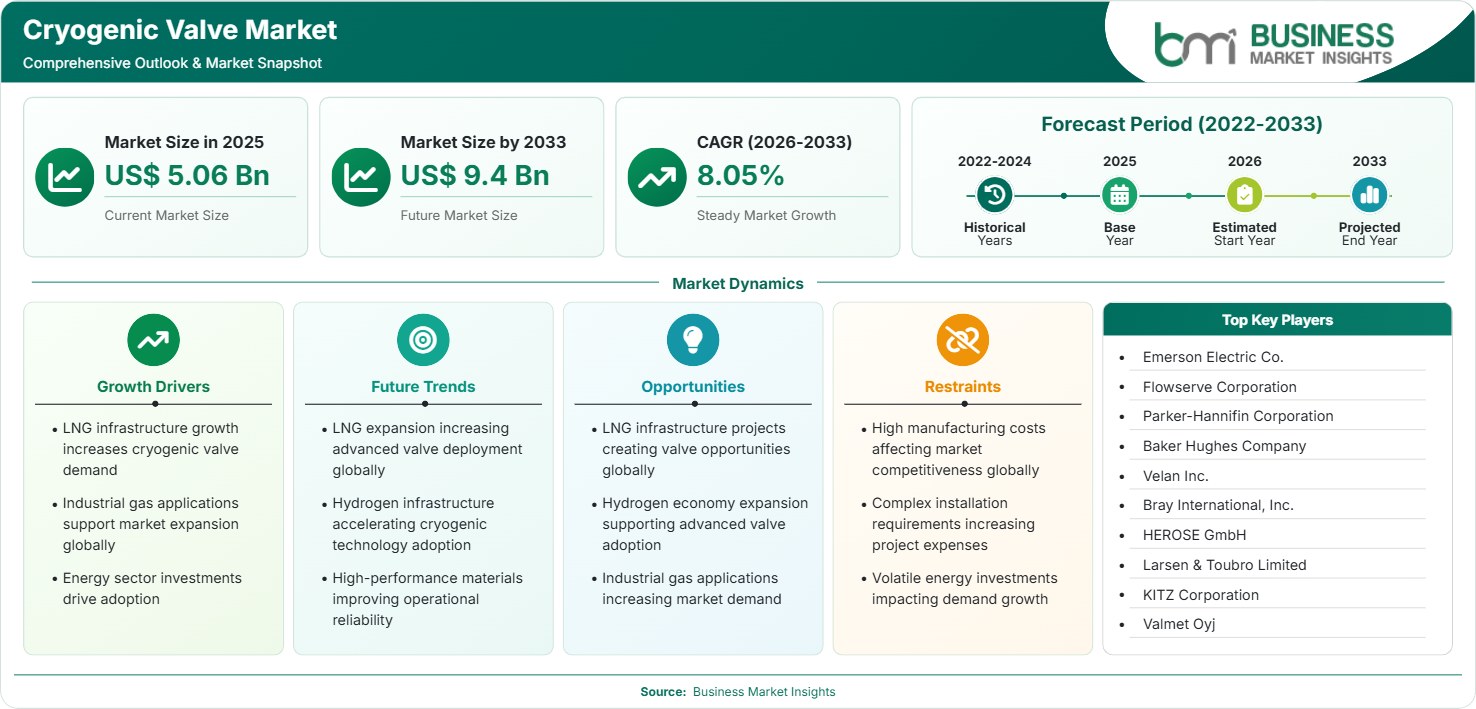
The Cryogenic Valve Market size was valued at US$5.06 Billion in 2025 and is projected to reach US$9.4 Billion by 2033, growing at a CAGR of 8.05% during 2026–2033, driven by LNG infrastructure, hydrogen projects, industrial gas demand, and investments in low-temperature flow-control systems.

Report Coverage
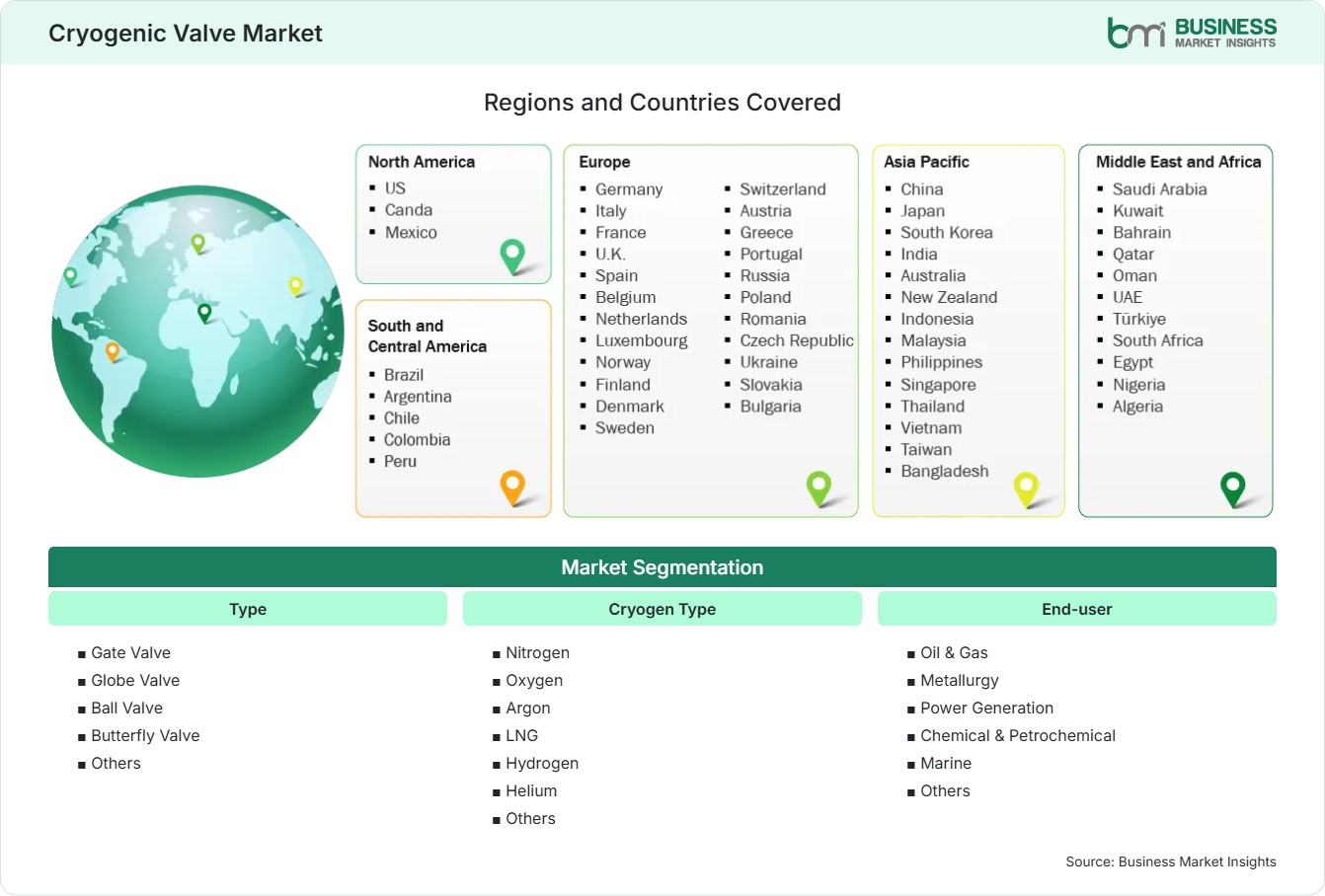
  • Type: Gate Valve, Globe Valve, Ball Valve, Butterfly Valve, Others
  • Cryogen Type: Nitrogen, Oxygen, Argon, LNG, Hydrogen, Helium, Others
  • End-user: Oil & Gas, Metallurgy, Power Generation, Chemical & Petrochemical, Marine, Others
US$ 5.06 Bn Market size in 2025
US$ 9.4 Bn Market Size by 2033
8.05% CAGR, 2026 - 2033
2026-2033 Forecast Period

AI Overview

Cryogenic Valve Market Summary

  • North America Region: North America holds a 30%–34% Cryogenic Valve Market share in 2025, growing at a 7.4%–8.1% CAGR through 2033, supported by LNG capacity, hydrogen infrastructure, industrial gas expansion, and replacement demand for high-integrity valves. The US remains the regional anchor, with 7.6%–8.3% CAGR, supported by LNG exports, hydrogen hubs, and process-industry investment.
  • Fastest Growing Region: Asia Pacific holds a 31%–35% share in 2025, expanding at a 9.0%–9.8% CAGR, supported by LNG terminals, industrial gas production, hydrogen projects, petrochemical capacity, semiconductor manufacturing, and expanding regional process infrastructure.
  • Leading Segment: Ball valves account for a 31%–35% share in 2025 and are projected to expand at a 8.2%–9.0% CAGR, supported by tight shutoff, quarter-turn operation, LNG applications, hydrogen handling, reduced leakage, and increasingly demanding maintenance requirements.
  • High Growth Segment: Hydrogen represents the fastest-expanding cryogen category, with a 10%–14% share in 2025 and a 10.5%–12.0% CAGR, supported by electrolyzer projects, hydrogen liquefaction, storage, transport, export infrastructure, and emerging maritime applications.
  • Key Market Opportunity: Advanced cavity-free designs, low-emission packing, digital monitoring, hydrogen-compatible materials, and modular cryogenic valve platforms can capture premium demand as LNG and hydrogen infrastructure moves toward stricter reliability requirements.
  • Major Market Players: Emerson Electric Co., Flowserve Corporation, Parker-Hannifin Corporation, Baker Hughes Company, Velan Inc., Bray International, Inc., HEROSE GmbH, Larsen & Toubro Limited, KITZ Corporation, and Valmet Oyj.
Strategic Insights

Cryogenic Valve Market: Strategic Insights

Cryogenic Valve Market Strategic Framework
FREE PDF
Request your free sample
Request free sample
Stakeholder View

Key Takeaways

  • The value chain is becoming more specification-intensive, with EPC contractors and end users increasingly evaluating valve metallurgy, cryogenic testing, fugitive-emission performance, actuation, certification, maintainability, and lifecycle support rather than purchase price alone.
  • Ball valves offer the strongest near-term application upside because quarter-turn operation, tight shutoff, compact architecture, and improved sealing technologies align with LNG terminals, hydrogen systems, industrial gases, and emergency isolation duties.
  • Product innovation is moving toward cavity-free ball designs, top-entry construction, improved packing systems, digitally monitored actuators, and materials engineered for repeated thermal cycling. Emerson's AEV ²XC design illustrates the direction toward cavity elimination and high-integrity isolation.
  • Asia Pacific presents the strongest expansion case as LNG infrastructure, industrial gases, petrochemicals, semiconductor manufacturing, and hydrogen investments create multiple demand pools. China, India, Japan, South Korea, and Southeast Asia provide differentiated opportunities.
  • Competitive positioning increasingly depends on portfolio breadth and engineering support. Large suppliers can cross-sell valves, actuation, automation, testing, maintenance, and lifecycle services, while specialists compete through application expertise and customized cryogenic designs.
  • Supply-chain localization is becoming strategically important. KITZ's manufacturing expansion in Vietnam and broader regional production footprint illustrate how valve producers are positioning capacity closer to Asian customers and reducing logistics dependence.
Geographic Outlook

Cryogenic Valve Market Regional Highlights

North America Cryogenic Valve Market

North America accounts for a 30%–34% share in 2025 and is projected to grow at a 7.4%–8.1% CAGR through 2033. LNG export infrastructure, gas processing, industrial gases, hydrogen hubs, and replacement projects support demand. The US dominates regional procurement, while Canada contributes through LNG, natural gas, and industrial projects. Manufacturers with established testing capabilities and EPC relationships remain advantaged because project specifications emphasize safety, emissions control, and reliable low-temperature operation.

  • LNG export projects sustain demand for isolation, control, and emergency shutdown valves across liquefaction and terminal infrastructure.
  • Hydrogen infrastructure creates additional demand for valves capable of maintaining sealing performance during extreme thermal conditions.
  • Industrial gas producers increasingly prioritize automated valve packages that reduce maintenance intervention and improve process availability.
  • North American buyers increasingly evaluate fugitive-emission performance alongside pressure, temperature, and certification requirements.

US Cryogenic Valve Market

The US represents a 20%–24% Cryogenic Valve Market share of global demand and is expected to expand at a 7.6%–8.3% CAGR through 2033. LNG export capacity, industrial gas production, hydrogen projects, and petrochemical investment create a diversified demand base. Domestic manufacturers also benefit from replacement cycles and stringent engineering specifications. The US remains important for technology development because major valve suppliers maintain engineering, testing, manufacturing, and service capabilities across the country.

  • LNG remains a major application, covering liquefaction, loading, transportation, storage, regasification, and emergency isolation requirements.
  • Hydrogen projects broaden demand for specialized valves as liquefaction, storage, and transport infrastructure develops.
  • Advanced valve designs increasingly target lower leakage, faster maintenance, and reduced installed weight.

Europe Cryogenic Valve Market

Europe accounts for 22%-26% of the market share in 2025 and has a forecasted growth rate of 7.5%-8.4% CAGR. Countries like Germany, France, Italy, the Netherlands, and the UK have robust industrial demand, while Germany and the Netherlands are key players in hydrogen and LNG infrastructure. In Europe, procurement is based on emissions, safety, pressure equipment, and overall life-cycle performance.

  • Germany provides a major hydrogen infrastructure opportunity, including large-scale pipeline conversion and storage development.
  • The Netherlands benefits from LNG terminals, industrial gases, maritime applications, and its role as an energy logistics hub.
  • France and Italy provide demand through LNG, industrial gases, chemicals, and energy infrastructure.
  • European suppliers benefit from strong expertise in cryogenic engineering, testing, pressure equipment, and specialized valve manufacturing.

Asia Pacific Cryogenic Valve Market

Asia-Pacific holds a 31%-35% market share in 2025 and is expected to witness a 9.0%-9.8% CAGR, making it the fastest-growing region. Major demand sources include China, Japan, South Korea, and India, while Southeast Asia is contributing LNG, petrochemicals, marine, and hydrogen-related applications. Localization of manufacturing in the region is improving through investments in developing valve manufacturing capacity and industrial infrastructure. Electrolyzer manufacturing leadership in China also drives growth in the cryogenic equipment market for hydrogen applications.

  • China combines LNG, industrial gas, petrochemical, semiconductor, and hydrogen applications, creating multiple procurement channels for specialized valves.
  • India offers opportunities through LNG terminals, refining, petrochemicals, industrial gases, and emerging hydrogen infrastructure.
  • Japan and South Korea maintain strong demand from LNG import systems, shipbuilding, industrial gases, and advanced process industries.
  • Southeast Asia is gaining attention as hydrogen, ammonia, LNG, and maritime infrastructure expands across Singapore, Indonesia, Malaysia, and Vietnam.

Rest of World Cryogenic Valve Market

Rest of World Cryogenic Valve Market represents a 10%–14% share in 2025 and is projected to expand at a 7.0%–8.0% CAGR. South and Central America benefit from LNG, mining, industrial gases, and emerging hydrogen projects. Middle Eastern demand is tied to LNG, gas processing, petrochemicals, hydrogen, and ammonia. Saudi Arabia, the UAE, Brazil, and Argentina provide the strongest investment cases as energy diversification creates new cryogenic infrastructure requirements.

  • Saudi Arabia is developing large hydrogen capacity, with the NEOM project targeting multi-gigawatt electrolyzer capacity and supporting export infrastructure.
  • Brazil provides opportunities through industrial gases, LNG, mining, chemicals, and emerging low-emissions hydrogen projects.
  • The UAE combines LNG-related infrastructure with hydrogen and ammonia initiatives targeting international energy markets.
  • Latin American projects can favor suppliers offering modular equipment, localized service, and technical support for remote installations.
Global Market Geography
FREE PDF
Request your free sample
Request free sample
Segment Analysis

Cryogenic Valve Market Segmentation

Type

Ball valves account for the largest share, at 31-35% in 2025, with an 8.2%-9.0% CAGR until 2033. These valves are well-known for providing tight shut-off capabilities, having a small design, quarter-turn functionality, and being suitable for automated isolation applications in LNG, hydrogen, industrial gases, and petrochemical industries. The Cryogenic Valve Market trends are moving towards cavity-free and top-entry designs.

  • Gate Valve: Gate valves remain important for high-integrity isolation in pipelines, storage systems, LNG facilities, and industrial gas networks where low pressure drop and full-bore flow are priorities.
  • Globe Valve: Globe valves serve throttling and flow-control duties where precise regulation is required, particularly in process plants, gas handling systems, and pressure-management applications.
  • Ball Valve: Ball valves benefit from quarter-turn actuation, tight shutoff, compact construction, and expanding use in LNG, hydrogen, industrial gases, and emergency isolation systems.
  • Butterfly Valve: Butterfly valves provide weight and space advantages for larger pipelines and terminals, supporting LNG, oxygen, nitrogen, marine, and industrial gas applications.
  • Others: Other configurations serve specialized safety, control, pressure-management, and custom applications where standard gate, globe, ball, or butterfly architectures do not meet operating requirements.

Cryogen Type

Nitrogen and oxygen have sizable installed capacities from existing industrial gas production, while LNG remains an important infrastructure application. Hydrogen, on the other hand, is the fastest-growing segment, underpinned by fresh liquefaction and export ventures. Consequently, the scope of the Cryogenic Valve Market is increasingly moving from existing industrial gases to energy transition requirements.

  • Nitrogen: Nitrogen valves support air separation, food processing, electronics, metal fabrication, laboratories, and industrial gas distribution where reliable low-temperature handling is essential.
  • Oxygen: Oxygen applications demand strict cleanliness and material compatibility, creating opportunities in steelmaking, healthcare, chemicals, air separation, and industrial gas facilities.
  • Argon: Argon supports metallurgy, welding, electronics, and specialized industrial processes, requiring dependable cryogenic storage, transfer, and vaporization systems.
  • Liquefied Natural Gas (LNG): LNG remains a major application because liquefaction, storage, shipping, regasification, and bunkering require valves engineered for extreme temperature and pressure cycling.
  • Hydrogen: Hydrogen demand is moving toward higher-value cryogenic equipment as liquefaction, storage, transport, export, and maritime fuel systems develop.
  • Helium: Helium valves serve specialized applications including research, medical systems, superconducting equipment, and advanced scientific infrastructure where extremely low temperatures require precise control.
  • Others: Other cryogens include specialized gases used in research, aerospace, electronics, healthcare, and emerging energy applications requiring dedicated low-temperature flow management.

End-user

Oil & Gas continues to be an important end user; meanwhile, chemical and petrochemical, metallurgy, and power generation add diverse demands. Marine applications become more important thanks to the use of LNG-powered vessels and bunkering. According to the Cryogenic Valve Market analysis, energy transition projects will contribute to the expansion of hydrogen infrastructure without reducing industrial usage.

  • Oil & Gas: LNG processing, transportation, storage, and regasification create sustained valve requirements, with procurement increasingly emphasizing emissions control, reliability, and lifecycle maintenance.
  • Metallurgy: Steel and metal producers use oxygen, nitrogen, and argon extensively, supporting demand for cryogenic storage, transfer, and distribution valves.
  • Power Generation: Cryogenic systems support LNG-based power infrastructure, industrial gases, and emerging hydrogen applications, creating opportunities for automated valves and high-integrity isolation.
  • Chemical & Petrochemical: Chemical and petrochemical facilities use cryogenic gases and LNG feedstocks, requiring valves with strong sealing performance and resistance to thermal cycling.
  • Marine: LNG-fueled vessels, bunkering systems, and marine storage infrastructure expand demand for compact, reliable cryogenic valves designed for vibration and repeated operating cycles.
  • Others: Healthcare, food processing, aerospace, research, electronics, and specialized manufacturing create additional demand for cryogenic gas control and transfer systems.
Market Forces

Cryogenic Valve Market Dynamics

Key Market Drivers

Expansion of LNG Liquefaction and Import Infrastructure

LNG infrastructure remains one of the most potent demand drivers because specialized low-temperature valve products are required in liquefaction, storage, loading, transportation, and regasification processes. According to IEA statistics, global gas demand growth decelerated to 1% in 2025, while LNG supply growth accelerated in 2026. Such dynamics ensure the emergence of an attractive equipment cycle for valves despite the volatility in the gas market. New LNG projects require large numbers of isolation, control, emergency shut-off, and pressure-management valves. The Cryogenic Valve Market growth, therefore, reflects both greenfield investment and lifecycle replacement.

Rising Hydrogen Infrastructure and Low-Temperature Processing

A new layer of applications is emerging for cryogenic valves due to hydrogen, in which liquefaction, storage, transport, export, or marine refueling at significantly lower temperatures than for traditional industrial gases is necessary. According to the International Energy Agency, hydrogen production through low-emission processes from current operations, those under construction, or with final investment decisions made can reach 4.2 Mtpa by 2030. Even with considerable project delays, the equipment focus remains on higher-performing models. Hydrogen systems also create opportunities for valves integrated with automation, monitoring, and safety systems. These Cryogenic Valve Market trends favor suppliers able to validate materials and sealing technologies for demanding hydrogen service.

Demand for High-Integrity and Lower-Emission Valve Technology

The trend in operations is to view leak prevention as a dual mandate concerning environmental and reliability concerns. Cryogenic fluids could produce disastrous results if the liquid expands due to a temperature rise, and thus cavity control, sealing geometry, bonnet design, and pressure release become crucial issues. In Emerson’s AEV ²XC cryogenic valve, the design features a cavity-less C-ball system, while other valve manufacturers focus on low-emission packing and cryogenic testing. Such valve systems reduce maintenance needs while meeting increasingly strict emissions regulations.

Key Market Opportunities

Premium Hydrogen-Compatible Cryogenic Valve Platforms

Hydrogen creates an opportunity for manufacturers to develop dedicated valve platforms rather than simply adapting LNG products. The small molecular structure, extremely high temperatures required for hydrogen liquefaction, and sensitivity make engineering sealing, material specification, leak detection, and specialty actuation more critical. According to the IEA, almost 45% of announced low-emission hydrogen production projects are destined for export. However, only 5% of these projects were at the investment stage in the IEA's 2025 analysis. Early-design winners will be able to capitalize as projects move from engineering into procurement. As a result, the Cryogenic Valve Market Forecasts will rely on turning the hydrogen announcements into funded facilities.

Digital Valve Monitoring and Lifecycle Service Contracts

Monitoring in digital format could convert cryogenic valves from discrete purchases into smart assets with lifetime value. Position sensing, actuator diagnostics, cycle counting, leakage detection, and predictive maintenance might help operators identify deterioration before it causes unexpected downtime. This possibility would be most interesting for LNG facilities, industrial gas plants and large chemical facilities where a valve problem could impact the interrelated system as a whole. For suppliers with an existing installed base, there is potential to monetize it through services, remote diagnostics, spare parts, and planned maintenance.

Localized Manufacturing for Asia Pacific Projects

Asia Pacific provides an opportunity to localize manufacturing, testing, assembly, and service as regional infrastructure investment expands. KITZ's Vietnam manufacturing operation demonstrates how valve companies are strengthening production capacity closer to Asian markets while improving manufacturing efficiency through automation. Localizing production can help reduce lead times, ensure spare parts are available, and provide customization based on customer needs. It will also open up avenues for suppliers to participate in LNG, industrial gas, semiconductor, petrochemical, and hydrogen projects without relying solely on their manufacturing facilities in distant locations. Companies that incorporate global engineering and regional services capabilities will gain a competitive edge in such markets.

Market Restraints and Challenges

Extreme-Service Engineering Raises Product and Validation Costs

Factor: There is a need for cryogenic valves to be manufactured from special materials, to have long bonnets, to require complicated machining, clean-up procedures, low-temperature testing, proper sealing devices, and project-specific certificates. Cryogenic valves are therefore harder to manufacture than conventional valves. Impact: Increased engineering and validation costs lengthen the purchase cycle, making the valves less favorable for small-scale industrial operators. Cost-effectiveness is even more important when project needs involve customization of size, pressures, oxygen cleanliness, hydrogen suitability, and other factors. Hence, manufacturers need to find a balance between customization and modular product platform design. Modular products save engineering and inventory costs, but extreme standardization could make them unsuitable for high-value projects. Those suppliers that have laboratory testing facilities and qualification processes will have an advantage due to reduced technical risks.

Project Delays and Uncertain Hydrogen Investment Timelines

Factor: Hydrogen projects continue to face uncertainty offtake, financing, infrastructure readiness, policy changes, and development delays. The IEA found that more than half of the potential electrolyzer capacity in its assessed pipeline was at risk of slipping beyond target operational dates. Impact: Delays in project execution may also delay valve ordering, even though fundamentals for long-term demand remain strong. Suppliers with high exposure to initial hydrogen projects are likely to face a volatile order book and uncertain visibility into forecasting. Demand for LNG, industrial gases, and chemicals can serve as ballast until hydrogen infrastructure is well developed. Exposure can also be reduced through product design and focusing on projects that have progressed to construction.

Company Analysis

Competitive Landscape

The Cryogenic Valve Market analysis indicates competition is divided between diversified flow-control groups with global service networks and specialists focused on engineered low-temperature applications. Product differentiation increasingly centers on sealing performance, cryogenic testing, emissions control, automation, and lifecycle support.

Company Name

Overview

Products and Services relevant to this market

Emerson Electric Co.

Global automation and flow-control supplier with extensive cryogenic isolation and control capabilities.

AEV cryogenic ball valves, Fisher control valves, Vanessa cryogenic valves, actuation, automation, and lifecycle services.

Flowserve Corporation

Major flow-control manufacturer serving LNG, hydrogen, industrial gas, energy, and chemical applications.

Worcester cryogenic floating ball valves, isolation valves, control products, engineered services, and aftermarket support.

Parker-Hannifin Corporation

Diversified motion and control company with established Bestobell cryogenic valve capabilities.

Bestobell cryogenic globe valves, isolation products, engineered sealing, actuation, and flow-control solutions.

Baker Hughes Company

Energy technology company supplying specialized valves for LNG and process applications.

Masoneilan and Consolidated Valve Technologies offer cryogenic LNG valves, control systems, lifecycle, and repair services.

Velan Inc.

Specialist valve manufacturer with extensive experience in severe-service and cryogenic applications.

Cryogenic gate, globe and ball valves, extended-bonnet designs, engineered isolation products, testing and support.

Bray International, Inc.

Flow-control specialist offering cryogenic valve and actuator solutions across industrial applications.

Cryogenic butterfly and ball valves, actuators, controls, isolation systems, and application engineering.

HEROSE GmbH

German specialist focused strongly on valves for gases and cryogenic liquid applications.

Cryogenic globe, safety, changeover, pressure-relief, and specialized gas-handling valves.

Larsen & Toubro Limited

An Indian engineering group with a broad industrial valve portfolio and major EPC relationships.

Industrial and cryogenic valves, engineered packages, project supply, automation, and lifecycle services.

KITZ Corporation

Japanese valve manufacturer with global production and distribution capabilities.

Industrial valves, stainless-steel products, engineered flow-control equipment, and regional manufacturing support.

Valmet Oyj

Global flow-control and automation supplier with dedicated LNG and cryogenic valve capabilities.

Neles cryogenic ball and butterfly valves, actuators, controllers, automation, testing, and lifecycle services.

Trust & Transparency

Research Methodology

The market analysis combines proprietary research with secondary data from government agencies, company disclosures, regulatory filings, industry databases and expert interviews. Market estimates are validated through data triangulation, cross-market benchmarking and analyst review.

View Full Research Methodology

Questions Answered

Frequently Asked Questions

Why is cryogenic testing important before commercial deployment?

Cryogenic testing verifies valve behavior under low-temperature conditions that can alter material properties, clearances, sealing performance, and actuator behavior. Qualification reduces operational risk and helps demonstrate compliance with project and industry requirements.

What should investors examine in a Cryogenic Valve Market report?

Investors should examine product mix, exposure to LNG and hydrogen projects, regional manufacturing, testing capabilities, EPC relationships, aftermarket revenue, technological differentiation, project conversion rates, and the supplier's ability to manage customized specifications.

Which valve type is generally preferred for cryogenic isolation?

Ball valves are increasingly favored where quarter-turn operation, compact design, tight shutoff, automation, and rapid isolation are important. Gate and globe valves remain important for specific pipeline and control duties.

How is hydrogen changing cryogenic valve design?

Hydrogen is increasing demand for improved sealing, material qualification, leak testing, cavity management, and thermal-cycle resistance. Liquefaction and export applications place additional emphasis on extremely low-temperature performance and high-integrity isolation.

What factors determine the selection of a cryogenic valve for LNG applications?

Selection depends on operating temperature, pressure class, valve type, material compatibility, sealing configuration, fugitive-emission requirements, fire safety, certification, actuation, maintenance access, and the specific LNG process duty.

Access the Full Cryogenic Valve Market Report

Get segment-level forecasts, regional estimates, competitive benchmarking, company profiles and downloadable Excel datasets.

Access the full Cryogenic Valve Market Report
350 pages PDF & Excel | 2026-10-22
Similar Research

Related Market Reports