Market Summary
Executive Summary and Global Market Analysis
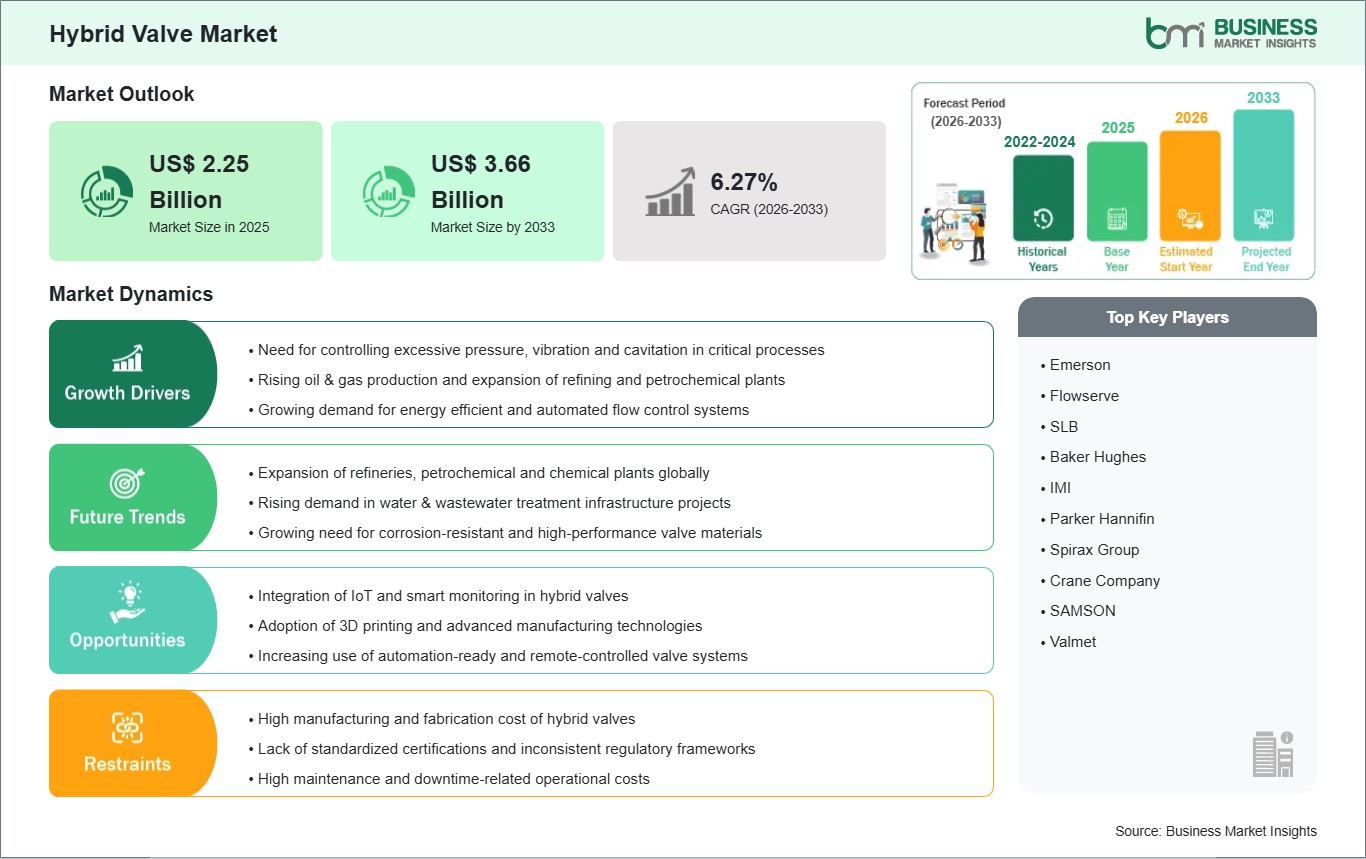
The global hybrid valve market is witnessing steady growth, driven by increasing demand for advanced flow control solutions across complex industrial processes. Hybrid valves combine features of traditional control and isolation valves, offering improved efficiency in handling pressure, noise, vibration, and cavitation. These capabilities make them highly suitable for critical applications in industries such as oil & gas, chemicals, and power generation. Rising industrial automation and the need for reliable process control systems are further strengthening market expansion globally.
From a market perspective, North America and the Asia-Pacific are key contributors to global demand. Asia-Pacific leads growth due to rapid industrialization, expanding refinery capacity, and increasing investments in petrochemical infrastructure, particularly in China and India. North America follows closely, supported by technological advancements and the modernization of aging industrial infrastructure. Europe also maintains a significant share due to stringent environmental regulations and the adoption of energy-efficient systems across process industries.
The oil & gas industry remains the dominant end-use segment, accounting for a major portion of hybrid valve demand. This is primarily due to harsh operating environments that require durable, corrosion-resistant, and high-performance valves. Additionally, the chemical and power sectors are increasingly adopting hybrid valves to improve operational safety and process efficiency. Water and wastewater treatment applications are also emerging as a promising segment due to rising global water management concerns.
Technological advancements are reshaping the competitive landscape of the market. Integration of IoT, predictive maintenance systems, and automation technologies is enabling smarter valve operations with reduced downtime and improved reliability. Manufacturers are also investing in advanced materials such as duplex steel and tungsten carbide to enhance durability and performance in extreme conditions.
Overall, the hybrid valve market is positioned for sustained growth, supported by industrial expansion, rising energy demand, and increasing focus on operational efficiency. However, challenges such as high manufacturing costs and complex maintenance requirements may slightly restrain adoption in cost-sensitive markets. Despite these limitations, continuous innovation and digital transformation are expected to unlock significant long-term opportunities for market players.
Segment Analysis
Hybrid Valve Market Segmentation
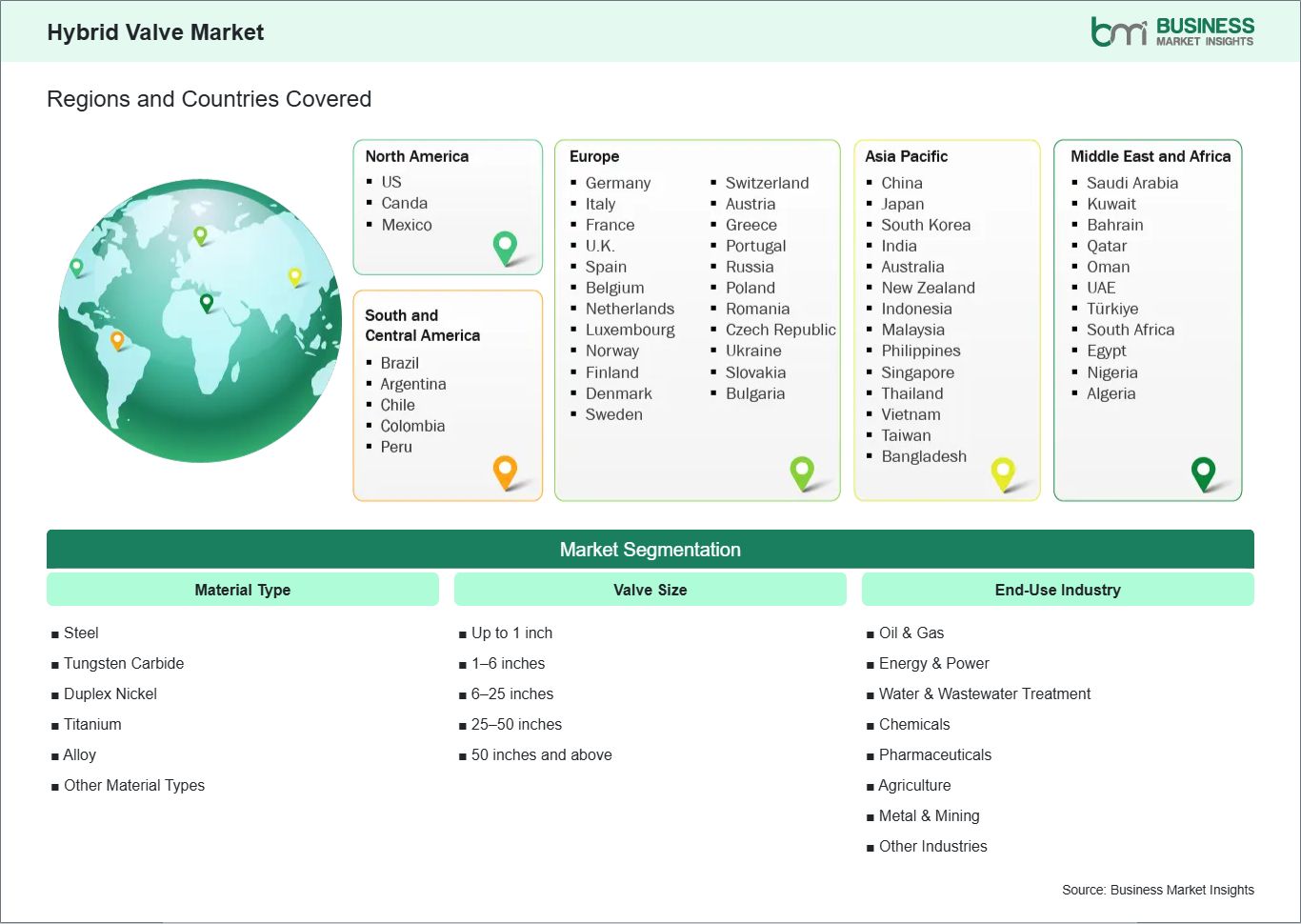
The Hybrid Valve market is segmented based on Material Type, Valve Size, and End-Use Industry.
By Material Type
- Steel – Widely used due to high strength and durability
- Tungsten Carbide – Preferred for extreme wear and corrosion resistance
- Duplex Nickel – Offers excellent corrosion resistance in harsh environments
- Titanium – Used in highly corrosive and lightweight applications
- Alloy – Provides balanced performance across industrial conditions
- Others – Includes specialized materials for niche applications.
By Valve Size
- Up to 1 inch – Used in precision and low-flow applications
- 1 inch – 6 inches – Most commonly used in industrial systems
- 6 inches – 25 inches – Suitable for medium-scale process industries
- 25 inches – 50 inches – Used in large industrial pipelines
- 50 inches and above – Designed for heavy-duty infrastructure systems.
By End-Use Industry
- Oil & Gas – Largest demand due to high-pressure operations
- Energy & Power – Used in generation and distribution systems
- Water & Wastewater Treatment – Ensures efficient flow and control
- Chemicals – Handles corrosive and reactive fluid environments
- Pharmaceuticals – Requires high precision and contamination control
- Agriculture – Supports irrigation and fluid distribution systems
- Metal & Mining – Used in abrasive and high-wear conditions
- Others – Includes diverse niche industrial applications.
Market Forces
Hybrid Valve Market Drivers and Opportunities
Increasing Demand for Efficient Flow Control Systems
Rising industrial complexity in oil & gas, chemical, and power sectors is increasing the need for precise flow control systems. Hybrid valves are being adopted due to their ability to reduce noise, vibration, cavitation, and pressure fluctuations. This is driving industries to replace conventional valves with advanced hybrid solutions. Growing automation in process industries further accelerates adoption, as companies seek improved operational reliability and reduced system failures in critical environments.
This trend is significantly impacting global industrial operations, especially in high-pressure and corrosive environments. Hybrid valves are becoming essential in refineries, petrochemical plants, and energy facilities. Their relevance is increasing due to stricter safety standards and efficiency requirements. As industries modernize infrastructure, demand for durable and high-performance valve systems continues to grow steadily across both developed and emerging economies.
Growth in Industrial Automation and Smart Valve Technologies
Industrial automation is driving innovation in hybrid valve systems, particularly through IoT-enabled monitoring and predictive maintenance capabilities. These technologies are being integrated into valve systems to enhance real-time performance tracking and reduce unexpected downtime. Hybrid valves are increasingly used in smart industrial setups where operational efficiency and remote control are critical use cases across oil & gas, chemicals, and energy industries.
The future scope of smart hybrid valves is expanding rapidly with the digital transformation in industrial infrastructure. Their adoption is expected to grow in emerging markets as industries invest in automated and connected systems. This expansion will improve operational efficiency, reduce maintenance costs, and enhance system reliability. As a result, hybrid valves are expected to play a key role in next-generation smart industrial ecosystems globally.
Size and Share Analysis
Hybrid Valve Market Size and Share Analysis
The Hybrid Valve Market is projected to grow from US$ 2.25 Billion in 2025 to US$ 3.66 Billion by 2033 , registering a CAGR of 6.27% from 2026 to 2033.
The hybrid valve market is witnessing steady expansion in size, driven by increasing industrial automation and demand for high-performance flow control systems. This growth reflects rising investments in oil & gas infrastructure, chemical processing plants, and power generation facilities. Continuous modernization of industrial systems and the shift toward efficient and durable valve technologies are further strengthening overall market growth across global regions.
In terms of segmentation, material-based and size-based categories show clear dominance patterns. Steel-based hybrid valves lead due to their strength, durability, and cost-effectiveness, while mid-range valve sizes are most widely adopted across industries. Among end-use industries, oil & gas remains the dominant segment, supported by extensive upstream and downstream operations requiring reliable pressure and flow management solutions in harsh operating conditions.
From an application perspective, hybrid valves are most extensively used in flow control and pressure regulation systems. These applications are critical in maintaining operational safety and efficiency in process-intensive industries. Chemical processing, energy production, and water treatment applications also contribute significantly, but oil & gas infrastructure continues to hold the strongest share due to continuous demand for robust and corrosion-resistant valve systems.
Report Coverage
Hybrid Valve Market Report Coverage and Deliverables
The "Hybrid Valve Market Size and Forecast (2022–2033)" report provides a detailed analysis of the market covering below areas:
- Market size and forecast at global, regional, and country levels for all market segments covered under the scope
- Market trends, as well as drivers, restraints, and opportunities
- Market analysis covering key trends, global and regional framework, major players, regulations, and recent developments
- Industry landscape and competition analysis covering market concentration, heat map analysis, prominent players, and recent developments for the market
- Detailed company profiles, including SWOT analysis
Geographic Insights
Hybrid Valve Market Geographic Insights
The hybrid valve market shows diverse regional adoption patterns influenced by industrialization levels, energy demand, and technological advancements across key global economies. Growing investments in oil & gas infrastructure, chemical processing, and power generation are shaping demand dynamics worldwide. Increasing focus on operational efficiency, automation, and safety compliance is further driving the adoption of hybrid valves in multiple industries, making regional market performance highly varied yet consistently expanding across developed and emerging regions.
North America holds a strong position in the hybrid valve market due to its advanced industrial infrastructure and early adoption of smart valve technologies. The region benefits from extensive oil & gas operations, particularly shale gas production and refinery modernization. High emphasis on process automation, safety standards, and energy efficiency further supports demand. Continuous upgrades in aging infrastructure and integration of digital monitoring systems are enhancing the adoption of advanced hybrid valve solutions across industrial sectors.
Asia Pacific dominates the global hybrid valve market in terms of growth potential, driven by rapid industrialization and large-scale infrastructure development. Countries such as China and India are investing heavily in refining capacity, petrochemical expansion, and power generation projects. Increasing energy consumption and government support for industrial development are accelerating demand. The region’s growing manufacturing base and expanding chemical and water treatment industries further strengthen the adoption of hybrid valves across multiple applications.
Europe, along with emerging markets in the Middle East, Africa, and South America, plays a significant role in the hybrid valve market. Strict environmental regulations and the shift toward energy-efficient industrial systems drive Europe’s demand. Meanwhile, the Middle East benefits from strong oil & gas investments, and Africa and South America are witnessing gradual industrial expansion. These regions collectively contribute to steady market growth through modernization efforts and increasing focus on efficient industrial operations.
Industry Activity
Recent Developments
The Hybrid Valve market is evaluated by gathering qualitative and quantitative data post primary and secondary research, which includes important corporate publications, association data, and databases. A few of the key developments in the Hybrid Valve market are:
- In June 2025, Crane Co organized a webinar, an online CPD that explores the transformative impact of digital technologies on hydronic HVAC systems, focusing on how smart valves are revolutionising energy efficiency and control.
- In July 2024, Emerson launched its AVENTICS Series XV pneumatic valves. Series XV valves are designed with interoperability in mind to provide machine builders across multiple industries and factory automation applications with a flexible and cost-effective valve platform. The new valves are ideal for machine builders and end users that operate across the globe, with universal threads and other features that support regional standards and global availability.
Trust & Transparency
Research Methodology
The market analysis combines proprietary research with secondary data from government agencies, company disclosures, regulatory filings, industry databases and expert interviews. Market estimates are validated through data triangulation, cross-market benchmarking and analyst
review.
View Full Research Methodology
Key Sources Referred:
S. Energy Information Administration (EIA) S. Department of Energy (DOE) Eurostat – EU industrial production and energy usage statistics India Ministry of Petroleum & Natural Gas China National Bureau of Statistics