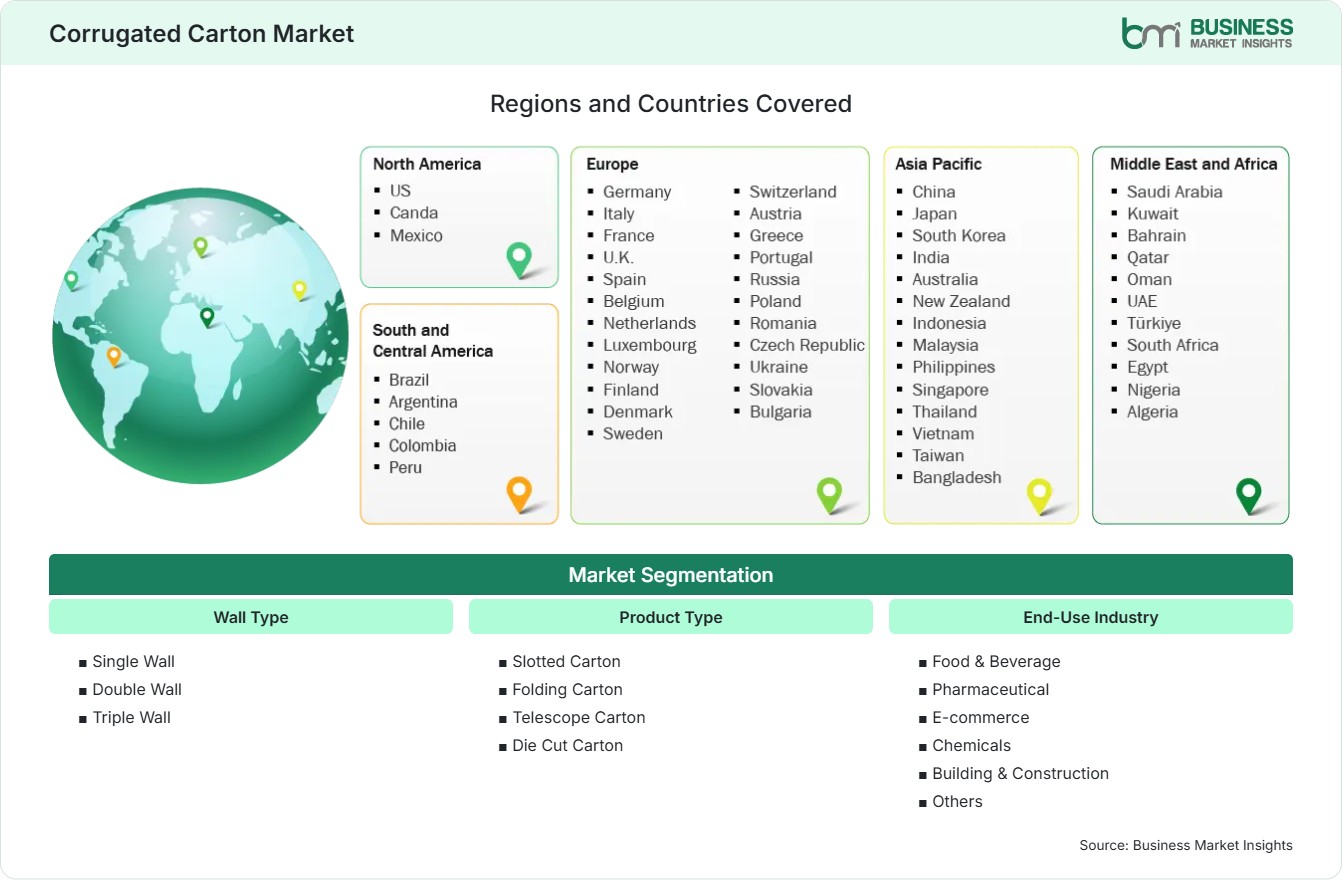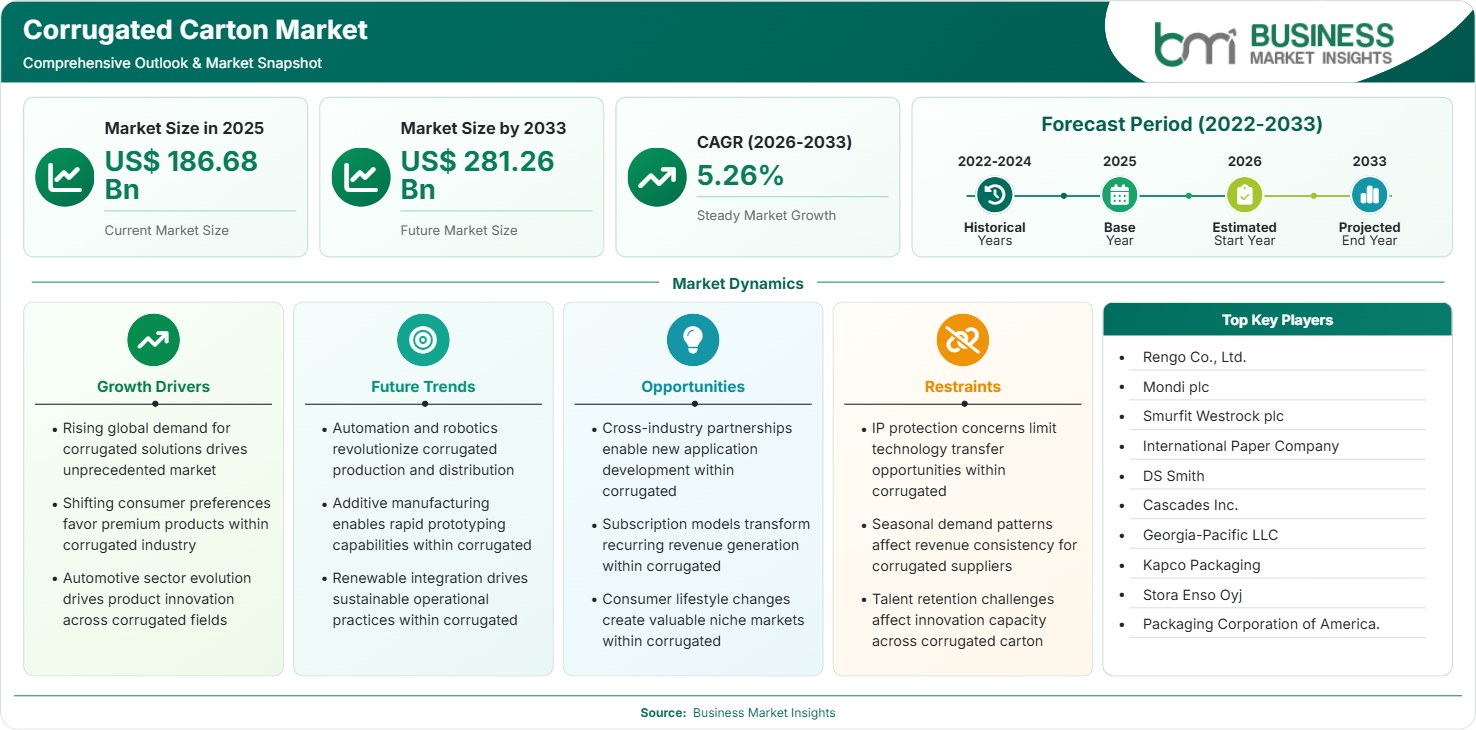
Corrugated Carton Market Regional Highlights
North America Corrugated Carton Market
North America accounted for 27%–30% Corrugated Carton Market share in 2025 and is projected to expand at a 4.6%–5.0% CAGR through 2033. Regional demand is anchored by food distribution, consumer packaged goods, industrial shipments, and mature e-commerce fulfillment. US manufacturers are increasingly emphasizing right-sized boxes, recycled content, automated converting, and supply-chain responsiveness. Mexico adds manufacturing-linked demand as automotive, electronics, appliances, and consumer products supply chains expand. North American producers also face pressure to optimize mill and converting footprints as demand patterns become more localized.
- Recycled fiber availability, domestic manufacturing, and automation support stable packaging demand across food, beverage, retail, and industrial supply chains.
- E-commerce fulfillment centers increasingly favor fanfold, right-sized, and digitally printed formats that reduce void space, handling steps, and secondary packaging requirements.
- Mexico provides an attractive manufacturing-linked opportunity as nearshoring increases packaging requirements for automotive components, electronics, appliances, and consumer products.
- Producers are consolidating inefficient assets while investing selectively in higher-productivity mills, sheet plants, converting lines, digital printing, and automated material handling.
US Corrugated Carton Market
The US represented approximately 82%–85% of North American Corrugated Carton Market demand in 2025, equivalent to roughly 22%–25% of global demand, with a projected 4.7%–5.1% CAGR through 2033. Mature retail infrastructure creates recurring carton consumption, while automated fulfillment is increasing demand for standardized and right-sized formats. Domestic production remains important because bulky cartons are expensive to transport over long distances. International Paper’s sheet feeder network illustrates this localized service model.
- Food, beverage, agriculture, industrial components, and household products provide diversified demand, limiting dependence on any single end-use category.
- Automated warehouses are encouraging packaging specifications compatible with robotic handling, high-speed case forming, automated sealing, and machine-readable identification.
- Production rationalization is increasing as converters balance capacity utilization against softer demand in selected consumer and e-commerce categories.
- Sustainability requirements are accelerating recycled-content adoption, fiber optimization, water-based printing, and alternatives to plastic protective components.
Europe Corrugated Carton Market
Europe held approximately 22%–25% Corrugated Carton Market share in 2025 and is expected to record a 4.5%–4.9% CAGR through 2033. Germany, the United Kingdom, France, Italy, and Spain remain leading demand centers, while Poland and Eastern Europe provide higher-growth manufacturing opportunities. Packaging producers are responding to energy costs, recycling targets, lightweighting requirements, and retailer sustainability programs. Mondi’s Western European expansion illustrates consolidation around integrated, high-capacity assets, while Stora Enso demonstrates growing interest in reusable corrugated formats and lifecycle optimization.
- Germany is a leading packaging and manufacturing hub, with demand supported by automotive, food, chemicals, machinery, and industrial export logistics.
- Poland and Central Europe offer comparatively faster expansion as manufacturing investment, regional distribution, and cross-border e-commerce increase packaging requirements.
- France provides an attractive modernization opportunity, reflected by Smurfit Westrock’s planned approximately €600 million investment across French operations over three to five years.
- European energy costs remain a competitiveness issue because IEA data indicates industrial electricity prices remain substantially above US and Chinese levels.
Asia Pacific Corrugated Carton Market
Asia Pacific represented approximately 34%–37% Corrugated Carton Market share in 2025 and is projected to grow at a 6.1%–6.6% CAGR through 2033, making it the fastest-growing regional market. China remains the largest regional demand center, while India, Indonesia, Vietnam, and Thailand offer strong incremental opportunities. Rising consumer spending, food processing, electronics manufacturing, organized retail, and e-commerce are expanding carton requirements. Rengo’s Indonesian expansion demonstrates the strategic importance of Southeast Asia, with its proposed Mypak transaction expected to increase its Indonesian corrugated packaging factory network to twelve.
- China combines large-scale manufacturing, retail distribution, export activity, and e-commerce, creating broad demand for standardized and customized cartons.
- India offers high-growth potential from food processing, pharmaceuticals, electronics, organized retail, and domestic e-commerce, supported by expanding manufacturing ecosystems.
- Indonesia and Thailand benefit from food, consumer products, agriculture, and export-oriented manufacturing, encouraging investment in integrated regional packaging capacity.
- Vietnam is emerging as a manufacturing and export packaging hub as electronics, consumer goods, and industrial production diversify across Asia.
Rest of World Corrugated Carton Market
Rest of World accounted for approximately 13%–16% Corrugated Carton Market share in 2025 and is projected to grow at a 5.0%–5.5% CAGR through 2033. South and Central America benefit from agriculture, food exports, beverages, and consumer goods distribution, with Brazil and Mexico serving as major demand centers. Mexico is discussed within North America for regional consistency. Middle East and Africa demand is supported by food processing, pharmaceuticals, retail modernization, and logistics development. Packaging localization is increasingly important where import dependence and long transport distances raise landed costs.
- Brazil remains a major opportunity because agricultural exports, processed foods, beverages, and domestic retail networks require durable transport packaging across long distribution routes.
- Chile, Colombia, and Peru provide growth opportunities through food exports, mining-related industrial logistics, and expanding consumer markets requiring protective secondary packaging.
- Saudi Arabia and the United Arab Emirates are developing packaging demand through food processing, retail modernization, logistics infrastructure, and industrial diversification programs.
- South Africa remains a regional packaging hub, while Egypt and other North African markets benefit from food manufacturing, pharmaceuticals, and regional distribution networks.