
Container Homes Market Outlook: Size, Share, Trends, Growth Analysis, Competitive Landscape & Forecast, 2026-2033

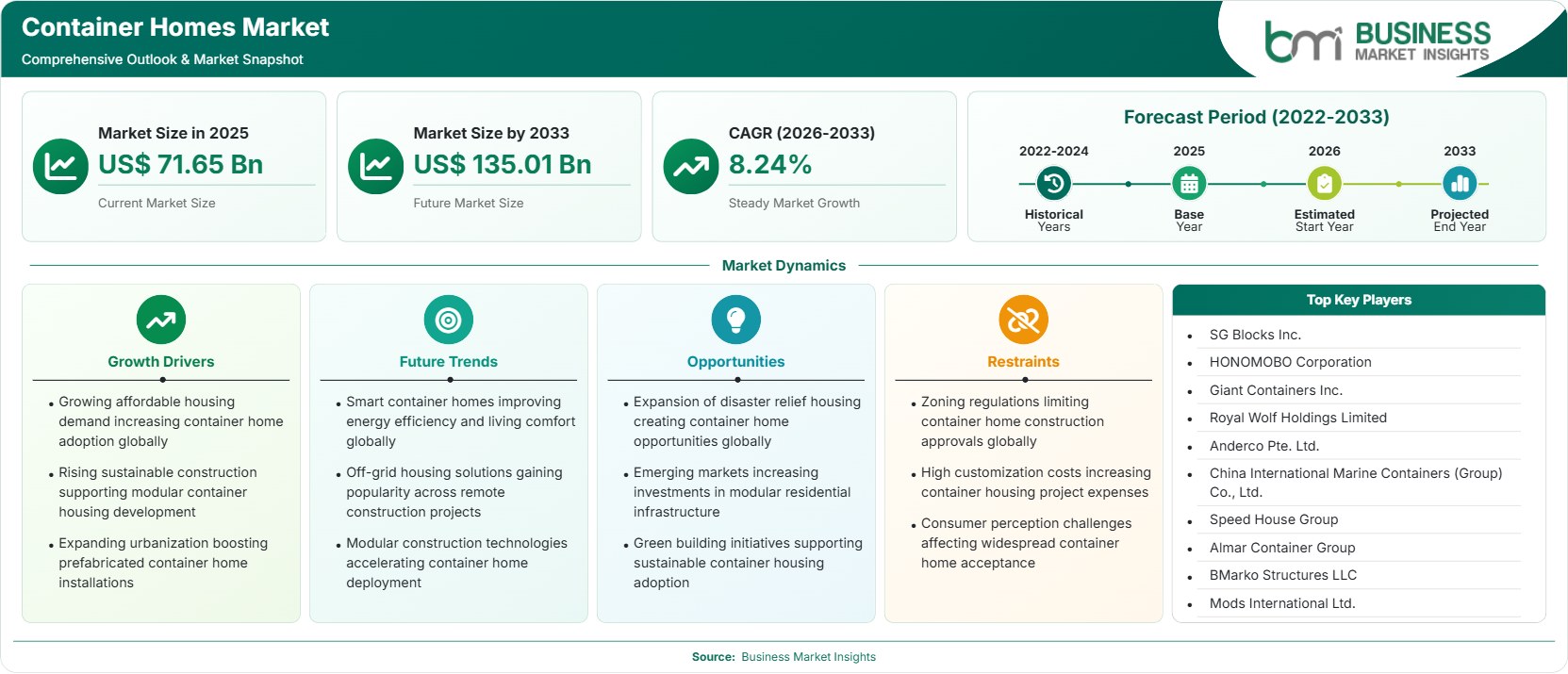
The Container Homes Market size was valued at US$ 71.65 billion in 2025 and is projected to reach US$ 135.01 billion by 2033, growing at a CAGR of 8.24% during 2026–2033, driven by affordable housing demand, sustainable construction practices, modular building technologies, and expanding urban infrastructure investments worldwide.

Report Coverage
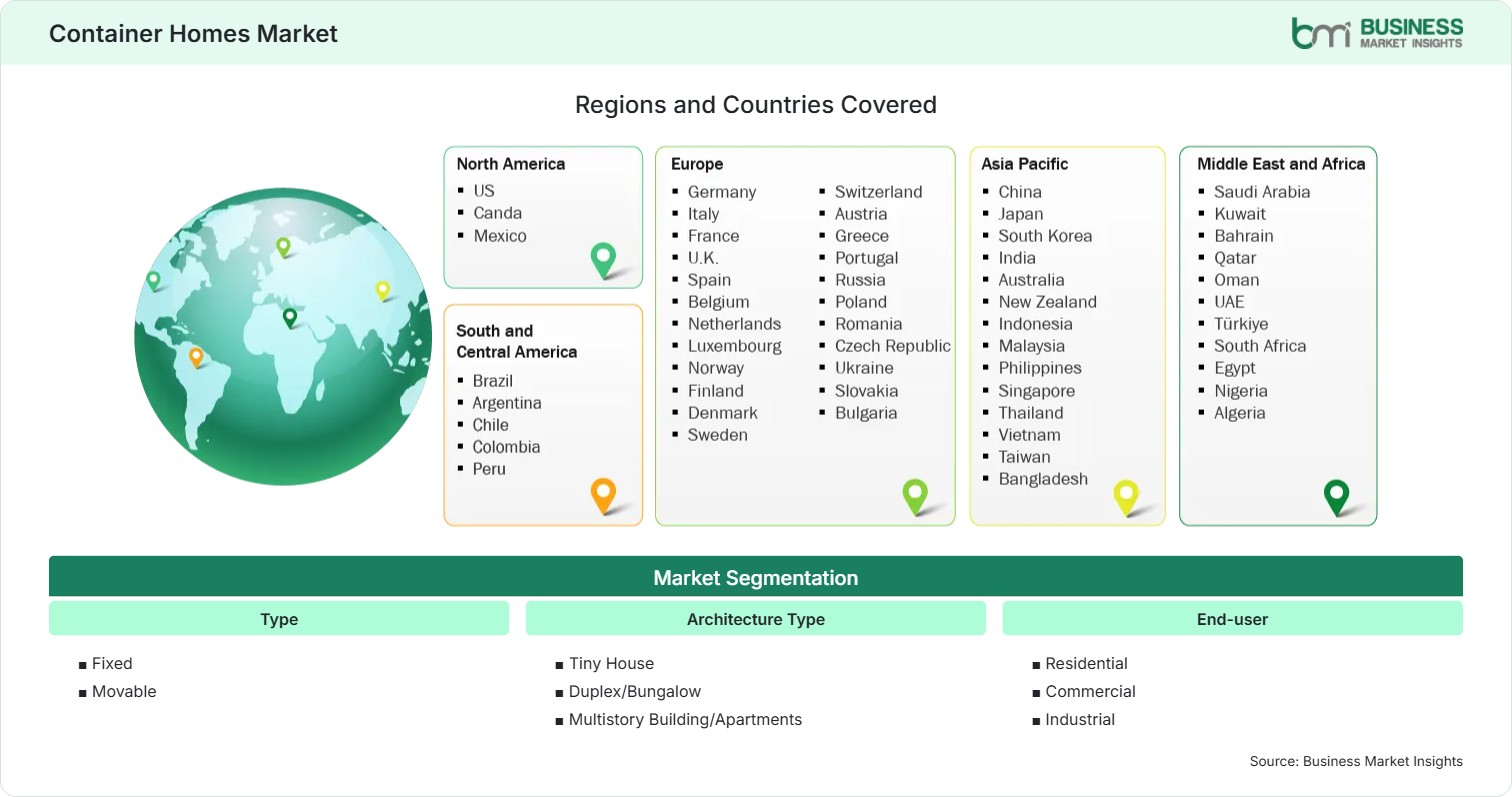
  • Type: Fixed, Movable
  • Architecture Type: Tiny House, Duplex/Bungalow, Multistory Building/Apartments
  • End-user: Residential, Commercial, Industrial
US$ 71.65 Bn Market size in 2025
US$ 135.01 Bn Market Size by 2033
8.24% CAGR, 2026 - 2033
2026-2033 Forecast Period

01 AI Overview

Container Homes Market Summary

  • North America Region: North America holds 34%–37% share in 2025 and is projected to grow at a CAGR of 7.70%–8.10% during 2026–2033, supported by modular housing demand, sustainable construction practices, and rising affordable housing initiatives. The US market is projected to grow at a CAGR of 7.80%–8.20%, driven by expanding prefabricated housing projects, urban redevelopment, and increasing adoption of eco-friendly residential construction.
  • Fastest Growing Region: Asia Pacific accounts for 27%–30% share in 2025 and is expected to register a CAGR of 9.10%–9.60% during 2026–2033, supported by rapid urbanization, infrastructure development, affordable housing demand, and modular construction investments.
  • Leading Segment: Residential holds 59%–62% share in 2025 and is projected to expand at a CAGR of 8.40%–8.80%, supported by rising affordable housing demand and sustainable residential construction.
  • High Growth Segment: Multistory Building/Apartments is projected to grow at a CAGR of 9.40%–9.90%, driven by urban population growth, land optimization, and modular high-rise construction technologies.
  • Key Market Opportunity: Disaster relief housing, green construction policies, modular building technologies, and rapid deployment capabilities continue creating significant long-term investment opportunities across residential and commercial construction sectors.
  • Major Market Players: SG Blocks Inc., HONOMOBO Corporation, Giant Containers Inc., Royal Wolf Holdings Limited, Anderco Pte. Ltd., China International Marine Containers (Group) Co., Ltd., Speed House Group, Almar Container Group, BMarko Structures LLC, Mods International Ltd.
02 Strategic Insights

Container Homes Market: Strategic Insights

Container Homes Market Strategic Framework
FREE PDF
Request your free sample
Request free sample
03 Stakeholder View

Key Takeaways

  • The market ecosystem increasingly integrates shipping container suppliers, modular construction companies, engineering firms, architects, and technology providers to deliver scalable housing solutions.
  • Residential construction remains the largest revenue contributor, while multistory modular developments present the strongest future investment opportunity for urban infrastructure expansion.
  • Innovation continues focusing on smart construction techniques, energy-efficient insulation, digital building design, and prefabricated modular engineering to improve construction quality and sustainability.
  • Asia Pacific offers attractive long-term investment potential because of rapid urbanization, increasing affordable housing demand, and expanding infrastructure development initiatives.
  • Strategic collaborations, modular manufacturing expansion, sustainable construction technologies, and green building investments continue strengthening competitive positioning across the global container housing industry.
04 Geographic Outlook

Container Homes Market Regional Highlights

North America Container Homes Market

North America accounts for 34%–37% share in 2025 and is projected to grow at a CAGR of 7.70%–8.10% during 2026–2033. Strong demand for affordable housing, sustainable construction, and modular building technologies continues supporting regional expansion. The Container Homes Market share remains the highest globally because developers increasingly adopt prefabricated housing solutions that reduce construction time, improve resource efficiency, and support environmentally responsible building practices.

  • The US leads regional demand through rising modular housing developments, affordable housing initiatives, and expanding green building investments.
  • Canada continues increasing adoption of prefabricated residential projects supported by sustainable construction regulations and urban development programs.
  • Construction companies increasingly integrate energy-efficient materials and smart building technologies into modular housing projects.
  • Growing labor shortages continue encouraging builders to adopt factory-built construction methods for faster project completion.

US Container Homes Market

The US represents 81%–84% of the North American market in 2025 and is expected to expand at a CAGR of 7.80%–8.20% during 2026–2033. Rising housing affordability challenges, expanding modular construction, and stronger sustainability objectives continue supporting adoption. Public and private developers increasingly utilize prefabricated housing technologies to reduce project costs and accelerate residential delivery.

  • Affordable housing programs continue supporting wider adoption of modular residential construction.
  • Growing interest in sustainable homes strengthens demand for recycled shipping container structures.
  • Digital construction technologies improve project planning and manufacturing efficiency.
  • Private developers continue investing in scalable modular housing communities.

Europe Container Homes Market

Europe captures 26%–29% share in 2025 and is forecast to register a CAGR of 8.10%–8.50% during 2026–2033. Germany, the UK, the Netherlands, and Scandinavia continue driving regional growth through sustainable building regulations and circular economy initiatives. Germany leads regional adoption, while Eastern Europe records faster expansion through increasing modular housing investments.

  • Germany remains the largest regional market through advanced modular construction capabilities and green building policies.
  • The UK continues expanding affordable housing projects utilizing prefabricated construction technologies.
  • Circular economy initiatives encourage reuse of shipping containers for residential applications.
  • Sustainable building certifications continue supporting wider adoption of modular housing solutions.

Asia Pacific Container Homes Market

Asia Pacific accounts for 27%–30% share in 2025 and is projected to expand at a CAGR of 9.10%–9.60% during 2026–2033. China, India, Japan, and Australia continue strengthening demand through rapid urbanization, infrastructure expansion, and increasing affordable housing investments. Government initiatives promoting modular construction continue accelerating regional development.

  • China remains the largest regional market through extensive modular manufacturing and urban development projects.
  • India is the fastest-growing country because of rising affordable housing demand and expanding urban infrastructure.
  • Japan continues promoting modular construction to improve disaster resilience and construction efficiency.
  • Australia increases adoption of prefabricated housing across remote and regional communities.
  • Developers continue investing in factory-built housing to reduce construction timelines.

Rest of World Container Homes Market

Rest of World represents 8%–10% share in 2025 and is expected to grow at a CAGR of 8.00%–8.40% during 2026–2033. Latin America is expanding affordable housing initiatives, while the Middle East and Africa continue investing in modular infrastructure for residential and commercial developments. Brazil, the UAE, and South Africa remain key emerging markets.

  • Brazil continues expanding modular housing projects addressing affordable housing requirements.
  • UAE developers increasingly adopt premium container-based commercial and residential buildings.
  • South Africa strengthens modular construction for cost-effective housing developments.
  • Disaster-resilient construction projects continue supporting modular building adoption.
  • International developers expand partnerships across emerging construction markets.
Global Market Geography
FREE PDF
Request your free sample
Request free sample
05 Segment Analysis

Container Homes Market Segmentation

Type

The Type segment defines the Container Homes Market scope by determining construction flexibility, mobility, and application suitability across residential, commercial, and industrial projects. The segment accounted for 100% of the market in 2025 and is projected to grow at a CAGR of 8.24% during 2026–2034. Increasing demand for affordable, sustainable, and rapidly deployable housing solutions continues supporting adoption of different container home formats.

  • Fixed: Fixed container homes are gaining adoption for permanent residential and commercial applications due to structural durability, customization potential, and integration with modern building systems.
  • Movable: Movable container homes are expanding through demand for portable housing, temporary accommodation, disaster relief solutions, and flexible construction models.

Architecture Type

The Architecture Type segment accounted for 100% of the market in 2025 and is projected to expand at a CAGR of 8.24% during 2026–2034. Increasing urbanization, land availability challenges, and demand for efficient construction methods are encouraging developers to adopt diverse container-based architectural designs. The Container Homes Market trends increasingly focus on compact living, scalable structures, and sustainable modular housing concepts.

  • Tiny House: Tiny House designs are gaining popularity among consumers seeking affordable, minimalist, energy-efficient, and environmentally responsible housing alternatives.
  • Duplex/Bungalow: Duplex/Bungalow container homes support larger residential requirements through flexible layouts, enhanced customization, and improved space utilization.
  • Multistory Building/Apartments: Multistory Building/Apartments are emerging as high-growth solutions for urban housing shortages through vertical modular construction and efficient land utilization.

End-user

The End-user segment accounted for 100% of market demand in 2025 and is projected to grow at a CAGR of 8.24% during 2026–2034. Increasing adoption across residential communities, commercial establishments, and industrial facilities is supported by construction efficiency, cost optimization, and sustainability objectives. Developers increasingly utilize container-based structures for diverse applications requiring rapid deployment.

  • Residential: Residential applications represent the leading segment due to increasing affordable housing demand, sustainable living preferences, and growing acceptance of modular home designs.
  • Commercial: Commercial applications are expanding through demand for offices, retail spaces, hospitality facilities, and temporary business infrastructure using prefabricated container structures.
  • Industrial: Industrial users adopt container homes and structures for workforce accommodation, remote facilities, and operational support buildings in challenging locations.
06 Market Forces

Container Homes Market Dynamics

Key Market Drivers

Growing affordable housing demand increasing container home adoption globally

Rising housing affordability challenges, increasing urban population density, and demand for cost-effective construction solutions are accelerating adoption of container-based housing worldwide. Developers and governments are exploring modular housing approaches to address housing shortages while reducing construction timelines and resource consumption. Container structures provide flexibility, faster deployment, and lower material requirements compared with traditional construction methods. Container Homes Market growth is supported by increasing investments in affordable housing projects, while market trends are increasingly influenced by compact living concepts, prefabrication technologies, and sustainable construction practices across residential and urban development applications.

Rising sustainable construction supporting modular container housing development

Increased levels of environmental awareness and rising importance being placed on sustainable building techniques have led to the adoption of recycled and reusable building solutions. Container homes contribute to the achievement of the sustainable goals through the reuse of the steel structure, minimization of construction waste, and efficient production process. Energy efficient insulation, renewable energy sources, and environmental friendly materials are some of the features used to enhance the efficiency of the container homes. Certifications for green buildings and circular economy practices have also increased the consideration of modular container houses among the developers.

The increasing attention paid to minimizing the carbon footprint in the construction industry has driven the demand for prefabricated and modular solutions, which make use of lesser amounts of raw materials and produce lesser wastes than conventional constructions. Container homes provide various benefits such as time savings during construction, effective usage of materials, and reduced on-site environmental impacts. Governments and urban planners are searching for sustainable housing strategies to meet the rising demands for housing. The innovations in smart home technology, energy management systems, and environmental designs are other factors making the container homes more appealing both commercially and residentially.

Expanding urbanization boosting prefabricated container home installations

Urbanization at a fast pace has resulted in an increased need for effective housing solutions which could be used quickly in densely populated areas. The benefits offered by container houses include shorter time taken to construct, flexibility in design, and decreased reliance on labor required for conventional building processes. Urban housing providers have now become more inclined towards using prefabricated housing solutions to cater to the limitations of land and increased housing needs.

Key Market Opportunities

Expansion of disaster relief housing creating container home opportunities globally

Natural disasters, humanitarian emergencies, and temporary accommodation requirements are creating significant opportunities for rapidly deployable container housing solutions. Government agencies, humanitarian organizations, and construction companies increasingly utilize modular structures for emergency shelters and transitional housing. Container Homes Market Forecasts indicate continued opportunity growth as climate-related events increase demand for durable, transportable, and quickly assembled housing solutions across vulnerable regions.

Emerging markets increasing investments in modular residential infrastructure

Economies under development are making more investment in affordable housing projects, urban infrastructures, and modular building. Increased population, lack of housing, and government support for residential programs are prompting the use of prefabricated container structures. Local manufacturing growth and technology partnership have enhanced affordability, while lowering the cost of the project. Developing countries offer numerous opportunities for container housing firms aiming to grow.

Green building initiatives supporting sustainable container housing adoption

Growing awareness and interest of governments in sustainable buildings, energy efficiency, and less pollution from the building process are leading to a rise in demand for environmentally conscious housing options. The concept of container houses is in line with green building goals due to the reuse of materials, reduced waste production, and the efficiency of the building process.

Market Restraints and Challenges

Zoning regulations limiting container home construction approvals globally

Factor: Complex zoning regulations, building codes, and local approval requirements create uncertainty for container home developers across different regions. Impact: Regulatory limitations delay project approvals, increase compliance requirements, and restrict adoption in areas with traditional construction standards. Although governments are gradually recognizing modular housing benefits, inconsistent regulatory frameworks remain a challenge affecting market expansion and project execution timelines.

High customization costs increasing container housing project expenses

Factor: Extensive customization, insulation upgrades, architectural modifications, and specialized interior requirements can significantly increase container housing costs. Impact: Higher customization expenses reduce affordability advantages and limit adoption among price-sensitive consumers and organizations. Manufacturers continue improving standardized designs and production efficiency; however, premium customization requirements remain a major challenge affecting wider market penetration.

07 Company Analysis

Competitive Landscape

The Container Homes Market analysis reflects a competitive environment shaped by modular construction companies, container conversion specialists, and sustainable housing developers. Leading companies are focusing on customized designs, rapid deployment capabilities, energy-efficient structures, and scalable modular solutions to address growing residential, commercial, and industrial demand.

Company Name

Overview

Products and Services relevant to this market

SG Blocks Inc.

SG Blocks Inc. specializes in modular construction using shipping containers for residential, commercial, and institutional applications.

Provides container-based modular buildings, prefabricated structures, customized housing solutions, and sustainable construction services.

HONOMOBO Corporation

HONOMOBO Corporation develops modern modular homes using recycled shipping containers with contemporary architectural designs.

Offers container homes, customizable residential units, energy-efficient modular housing, and prefabricated living solutions.

Giant Containers Inc.

Giant Containers Inc. provides container modification and conversion solutions for various commercial and residential applications.

Supplies converted container homes, offices, accommodation units, storage solutions, and customized modular structures.

Royal Wolf Holdings Limited

Royal Wolf Holdings Limited provides container solutions and modular infrastructure across multiple industries.

Offers modified containers, accommodation units, portable buildings, and modular construction solutions for residential and commercial use.

Anderco Pte. Ltd.

Anderco Pte. Ltd. specializes in container-based modular structures and customized accommodation solutions.

Provides container housing, site facilities, modular buildings, workforce accommodation, and project-specific solutions.

China International Marine Containers (Group) Co., Ltd.

China International Marine Containers (Group) Co., Ltd. is a global container manufacturing and modular infrastructure provider.

Supplies shipping containers, modular construction units, prefabricated buildings, and customized container-based structures.

Speed House Group

Speed House Group develops prefabricated modular housing solutions with emphasis on rapid construction and flexible designs.

Provides modular homes, container houses, prefabricated buildings, and customized residential solutions.

Almar Container Group

Almar Container Group specializes in container leasing, modification, and modular building solutions worldwide.

Offers converted containers, accommodation units, modular offices, and customized container structures.

BMarko Structures LLC

BMarko Structures LLC develops modular construction solutions using steel-based prefabricated building systems.

Provides modular container buildings, custom structures, commercial units, and rapid deployment construction solutions.

Mods International Ltd.

Mods International Ltd. focuses on innovative modular construction solutions using repurposed shipping containers.

Supplies container homes, commercial modular buildings, portable structures, and customized housing solutions.

10 Trust & Transparency

Research Methodology

The market analysis combines proprietary research with secondary data from government agencies, company disclosures, regulatory filings, industry databases and expert interviews. Market estimates are validated through data triangulation, cross-market benchmarking and analyst review.

View Full Research Methodology

11 Questions Answered

Frequently Asked Questions

What does the market report include?

The Container Homes Market Report includes market size analysis, segmentation insights, regional trends, competitive landscape, industry developments, growth opportunities, and future market outlook.

Why are container homes considered sustainable?

Container homes support sustainability by reusing steel structures, reducing construction waste, enabling efficient manufacturing, and supporting integration of renewable energy and energy-efficient building technologies.

Which type of container home is growing faster?

Movable container homes are experiencing strong growth because they provide flexibility, portability, rapid installation, and suitability for temporary housing and emergency accommodation applications.

Which region dominates the market?

North America leads the market due to strong demand for affordable housing, sustainable construction practices, modular building adoption, and increasing investments in prefabricated residential solutions.

What is driving the Container Homes Market?

Increasing affordable housing demand, sustainable construction adoption, urbanization, modular building technologies, and demand for rapidly deployable structures are driving market expansion globally.

Access the Full Container Homes Market Report

Get segment-level forecasts, regional estimates, competitive benchmarking, company profiles and downloadable Excel datasets.

Access the full Container Homes Market Report
350 pages PDF & Excel | 2026-08-12