
Camping And Hiking Equipment Market Outlook: Size, Share, Trends, Growth Analysis, Competitive Landscape & Forecast, 2026–2033

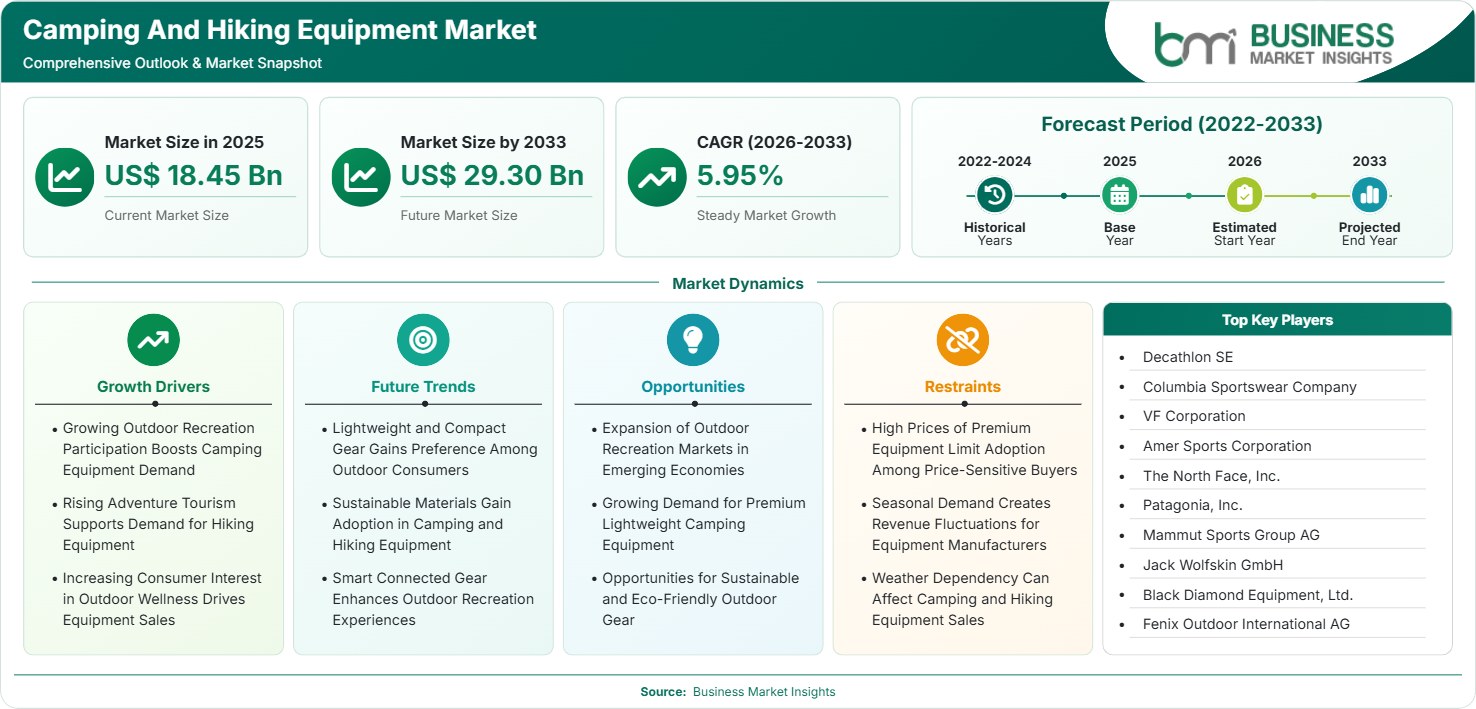
The Camping and Hiking Equipment Market size was valued at US$ 18.45 Billion in 2025 and is projected to reach US$ 29.30 Billion by 2033, growing at a CAGR of 5.95% during 2026–2033, supported by wellness-focused lifestyles, premium equipment demand, and sustainable gear development.

Report Coverage
  • Product: Tents, Sleeping Bags, Backpacks, Trekking Poles
  • Distribution Channel: Specialty Sports Retail Stores, Online Retail, Hypermarkets & Supermarkets, Department Stores, Institutional/Direct Sales , Others
US$ 18.45 Bn Market size in 2025
US$ 29.30 Bn Market Size by 2033
5.95% CAGR, 2026 - 2033
2026-2033 Forecast Period

01 AI Overview

Camping And Hiking Equipment Market Summary

  • North America Region: North America holds a 34%–37% share in 2025, growing at a 5.4%–5.9% CAGR during 2026–2033, supported by established outdoor participation, campground infrastructure, and digital retail expansion. The U.S. market grows at a 5.5%–6.0% CAGR, supported by established outdoor retail, hiking participation, domestic travel, and demand for technically advanced equipment.
  • Fastest Growing Region: Asia Pacific holds a 20%–23% share in 2025 and records a 7.0%–7.7% CAGR through 2033, supported by rising disposable income, domestic tourism, outdoor recreation, urban wellness trends, expanding specialty retail, and growing consumer familiarity with organized camping.
  • Leading Segment: Tents hold a 34%–37% share in 2025 and advance at a 6.1%–6.7% CAGR, supported by family camping, recreational travel, lightweight designs, improved weather protection, faster setup, and broader product availability through online channels.
  • High Growth Segment: Online Retail holds a 25%–28% share in 2025 and expands at a 7.0%–7.6% CAGR, supported by wider product selection, price comparison, direct-to-consumer models, digital product reviews, convenient delivery, and increasing consumer comfort with online equipment purchases.
  • Key Market Opportunity: Suppliers can capture additional value through lightweight products, repairable designs, recycled materials, modular equipment, direct-to-consumer channels, rental models, and premium products designed for longer outdoor use.
  • Major Market Players: Decathlon SE, Columbia Sportswear Company, VF Corporation, Amer Sports Corporation, The North Face, Inc., Patagonia, Inc., Mammut Sports Group AG, Jack Wolfskin GmbH, Black Diamond Equipment, Ltd., Fenix Outdoor International AG.
02 Strategic Insights

Camping And Hiking Equipment Market: Strategic Insights

Camping And Hiking Equipment Market Strategic Framework
FREE PDF
Request your free sample
Request free sample
03 Stakeholder View

Key Takeaways

  • The value chain is becoming more closely connected from material sourcing and product design to manufacturing, retail, repair, resale, and direct consumer engagement.
  • Tents remain a major commercial opportunity, while backpacks and sleeping bags offer additional room for premiumization through lighter materials, improved insulation, and compact designs suited to different outdoor activities.
  • Product innovation is shifting toward lightweight construction, recycled materials, modular components, improved packability, repair-friendly designs, and technical fabrics.
  • Asia Pacific provides the strongest expansion opportunity as outdoor tourism, domestic travel, urban wellness, and organized recreational activities develop.
  • Investment is increasingly directed toward direct-to-consumer infrastructure, specialty retail networks, product development, circular business models, and supply-chain efficiency.
  • Longer product life, repair services, recycled inputs, resale channels, and lower-impact manufacturing can influence customer retention and strengthen competitiveness across premium and mainstream equipment categories.
04 Geographic Outlook

Camping And Hiking Equipment Market Regional Highlights

North America Camping and Hiking Equipment Market

North America accounted for a 34%–37% share in 2025 and is projected to grow at a 5.4%–5.9% CAGR through 2033. The Camping and Hiking Equipment Market share is supported by established outdoor recreation, mature specialty retail, campground availability, replacement demand, and strong interest in technical products. The U.S. represents the principal regional demand center, while Canada contributes through hiking, camping, wilderness travel, and seasonal outdoor activities. Premium equipment remains important across established consumers.

  • Mature specialty retail networks provide broad access to tents, backpacks, sleeping bags, trekking poles, and supporting outdoor equipment across major consumer markets.
  • Product replacement supports recurring demand as consumers upgrade toward lighter construction, improved weather resistance, better insulation, and enhanced carrying comfort.
  • Direct-to-consumer platforms are expanding product access and allowing brands to communicate technical specifications, product features, and sustainability attributes more effectively.
  • Premium outdoor equipment retains strong positioning where consumers prioritize durability, technical performance, comfort, and extended product life.

US Camping and Hiking Equipment Market

The U.S. represents approximately 29%–32% of global demand in 2025 and U.S. Camping and Hiking Equipment Market forecast to expand at a 5.5%–6.0% CAGR through 2033. Demand benefits from established camping infrastructure, extensive hiking destinations, specialty outdoor retail, domestic recreation, and strong consumer awareness of technical equipment.

  • Specialty outdoor retailers remain important for technical equipment because consumers often require product information, fit guidance, and comparisons before higher-value purchases.
  • Online channels are strengthening their role through broader assortments, transparent pricing, consumer reviews, and direct brand relationships.
  • Product innovation increasingly targets lower weight, improved weather protection, greater durability, and easier transport without reducing functional performance.

Europe Camping and Hiking Equipment Market

Europe Camping and Hiking Equipment Market held a 24%–27% share in 2025 and is expected to grow at a 5.0%–5.6% CAGR through 2033. Germany leads regional demand, followed by the United Kingdom, France, Italy, and the Nordic markets. Poland records comparatively faster growth at 6.4%–7.1%. European demand benefits from established hiking cultures, organized camping facilities, outdoor tourism, and sustainability awareness.

  • Germany remains an important regional market because of established outdoor retail, hiking participation, camping infrastructure, and demand for technically capable equipment.
  • The United Kingdom and France provide diversified demand across hiking, camping, recreational travel, and outdoor lifestyle categories.
  • Nordic markets favor durable, weather-resistant equipment suited to demanding conditions, supporting premium positioning and technical product development.
  • Sustainability considerations are influencing material selection, product longevity, repair services, and resale strategies across outdoor equipment categories.

Asia Pacific Camping and Hiking Equipment Market

Asia Pacific Camping and Hiking Equipment Market represented a 20%–23% share in 2025 and is forecast to grow at a 7.0%–7.7% CAGR through 2033. China and Japan lead regional demand, while India records a faster 7.8%–8.6% CAGR. Rising disposable incomes, domestic tourism, outdoor wellness, social interest in recreation, and expanding digital commerce are broadening equipment adoption.

  • China provides a major expansion opportunity as domestic tourism, outdoor recreation, specialty retail, and digital commerce improve access to camping and hiking equipment.
  • India is developing rapidly as urban consumers show greater interest in outdoor recreation, adventure travel, weekend activities, and wellness-oriented leisure.
  • Japan maintains demand for compact, functional, durable equipment suited to organized outdoor recreation and consumers with strong interest in product quality.
  • Southeast Asian markets are gaining traction as tourism development, rising incomes, and greater exposure to outdoor recreation expand consumer awareness.

Rest of World Camping and Hiking Equipment Market

South and Central America represented approximately 8%–10% of global demand in 2025 and are growing at a 6.0%–6.7% CAGR. Brazil leads regional demand, supported by domestic recreation, tourism, and expanding specialty distribution. Mexico and Chile provide additional opportunities as outdoor participation and organized retail develop.

Middle East and Africa accounted for about 6%–8% of global demand and are forecast to grow at a 6.3%–7.0% CAGR. The UAE, Saudi Arabia, and South Africa lead regional demand, supported by tourism development, outdoor leisure, and improving access to branded equipment.

  • Brazil provides a sizable consumer base and growing distribution opportunities for camping, hiking, trekking, and outdoor lifestyle equipment.
  • Mexico benefits from tourism, expanding retail networks, and growing consumer access to international outdoor brands.
  • Gulf markets are developing through tourism investment, outdoor leisure initiatives, and rising demand for premium recreational equipment.
  • South Africa provides an established outdoor recreation base, while broader African markets offer longer-term potential as distribution and consumer awareness improve.
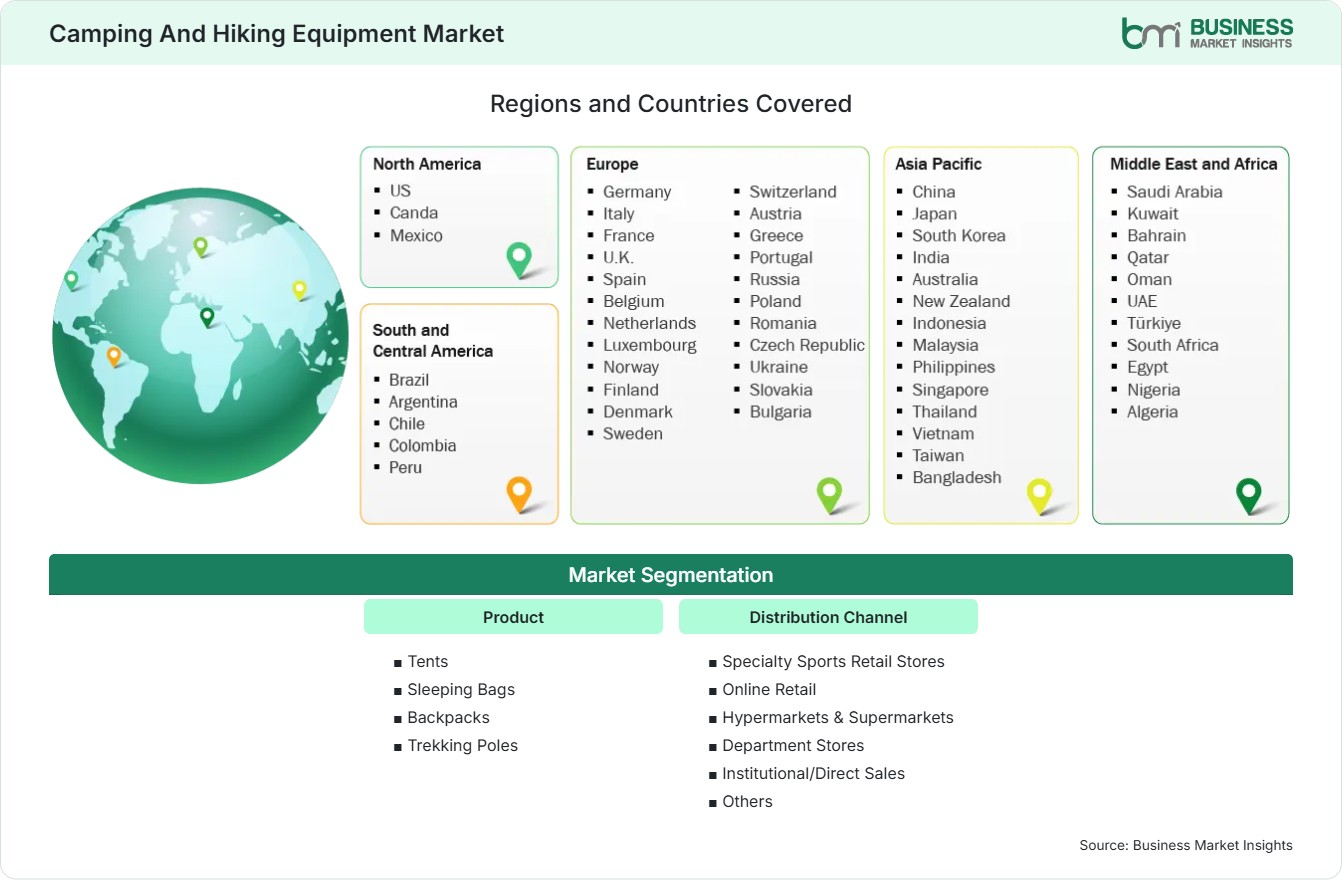
Global Market Geography
FREE PDF
Request your free sample
Request free sample
05 Segment Analysis

Camping And Hiking Equipment Market Segmentation

Product

Tents represented a 34%–37% Camping and Hiking Equipment Market share in 2025 and are projected to grow at a 6.1%–6.7% CAGR through 2033. Demand is supported by family camping, recreational travel, improved lightweight construction, easier setup, and stronger weather protection. Backpacks and sleeping bags benefit from product upgrades, while trekking poles remain linked to hiking participation.

  • Tents: Demand is supported by camping participation, compact designs, faster setup systems, improved weather protection, and wider availability across specialty and online retail channels.
  • Sleeping Bags: Lightweight insulation, improved temperature ratings, packability, and seasonal versatility support demand across recreational camping and more technical outdoor activities.
  • Backpacks: Ergonomic carrying systems, lightweight construction, compartment flexibility, durability, and improved ventilation support adoption among hikers and recreational travelers.
  • Trekking Poles: Growing hiking participation supports demand for adjustable, lightweight, durable poles designed to improve stability, reduce fatigue, and support varied terrain conditions.

Distribution Channel

Specialty Sports Retail Stores represented a 35%–38% share in 2025 and are projected to grow at a 5.4%–6.0% CAGR through 2033. Online Retail is expanding faster at a 7.0%–7.6% CAGR as product comparison, direct purchasing, digital discovery, and wider assortments improve accessibility across consumer markets.

  • Specialty Sports Retail Stores: Technical product guidance, brand availability, physical inspection, and specialist assistance support continued relevance for higher-value equipment purchases.
  • Online Retail: Broad assortments, price comparison, direct brand access, digital reviews, and convenient delivery support faster channel expansion across outdoor equipment categories.
  • Hypermarkets & Supermarkets: Broad consumer reach and accessible pricing support equipment purchases among occasional campers and recreational users seeking convenient shopping.
  • Department Stores: Established retail networks provide visibility for mainstream outdoor equipment and support purchases among consumers seeking familiar brands and accessible product ranges.
  • Institutional/Direct Sales (B2B): Bulk purchasing supports demand from organized outdoor programs, hospitality operations, recreation providers, and institutional users requiring standardized equipment.
06 Market Forces

Camping And Hiking Equipment Market Dynamics

Key Market Drivers

Growing Outdoor Recreation Participation Boosts Camping Equipment Demand

The increasing engagement in camping and outdoor recreation has contributed to the increasing need for tents, sleeping bags, backpacks, and hiking poles in both developed and developing nations. There has been a trend towards the inclusion of outdoor activities in the leisure schedule of people, thus creating demand not only from the professionals but also other groups of consumers. In response, the product companies have introduced products which are more portable, quick to set up, lightweight, and cater to all levels of experience. This shift supports Camping and Hiking Equipment Market trend by expanding the potential customer base.

Rising Adventure Tourism Supports Demand for Hiking Equipment

Adventure tourism has increased the need for equipment that caters to mobility, durability, protection from weather conditions, and reusability. This encourages innovation in packs, trekking poles, sleep gear, and camping gear that can be packed in small sizes. Tourists, as well as companies engaged in tourism services, have realized the importance of equipment that is reliable but lightweight and packable at the same time. The Camping and Hiking Equipment Market growth are therefore moving toward technically capable equipment that serves both recreational and travel-oriented users.

Increasing Consumer Interest in Outdoor Wellness Drives Equipment Sales

Outdoor recreation is increasingly associated with physical activity, relaxation, mental well-being, and lifestyle balance, broadening the consumer base for camping and hiking products. This demand encourages manufacturers to make equipment easier to use for consumers with different experience levels. Comfort, portability, intuitive setup, and durability are becoming important product attributes alongside technical specifications. The wellness orientation also supports demand for equipment suitable for shorter recreational activities rather than extended expeditions.

Key Market Opportunities

Expansion of Outdoor Recreation Markets in Emerging Economies

Emerging countries present a lot of scope for the penetration of outdoor equipment as domestic tourism, disposable incomes, recreational activities, and online shopping evolve. There is a lot of opportunity for manufacturers to expand by way of forming distribution channels in various regions, adopting price strategies that fit the region, and offering a product range suitable for new customers going outdoors. Suppliers with regional service support have the added benefit of instilling confidence among consumers.

Growing Demand for Premium Lightweight Camping Equipment

Lightweight products offer an evident path of product development as the customers' interest is rising towards light products that do not compromise on toughness and weather resistance. Improvement in materials, manufacturing processes, insulation, and component design enables manufacturers to decrease the weight of their products while keeping up their performance level. High-end products can thus be sold at high prices due to the improvements made in terms of packing ease, quick assembly, packability, or multiple season usage. Suppliers can strengthen margins through differentiated technical specifications rather than competing only on volume.

Opportunities for Sustainable and Eco-Friendly Outdoor Gear

Sustainability will provide opportunities for products manufactured from recycled ingredients, durable materials, components that are easy to repair and more sustainable production practices. More consumers will be taking into account sustainability aspects when considering different outdoor brands, especially in the high-end segment. The manufacturer can build a differentiation through sustainability and durability/technicality of products combined.

Market Restraints and Challenges

High Prices of Premium Equipment Limit Adoption Among Price-Sensitive Buyers

Factor: The use of high-end materials, high-quality construction, technical insulation, resistance to elements, and better manufacturing processes increases the price of such equipment. Impact: High cost can limit the adoption of the product by users who do not utilize it regularly. Manufacturers must balance technical performance with accessible pricing to broaden market penetration.

Seasonal Demand Creates Revenue Fluctuations for Equipment Manufacturers

Factor: Camping and hiking purchases are influenced by weather conditions, holiday periods, tourism cycles, and regional outdoor seasons, causing demand to vary during the year. Impact: Seasonal concentration can create inventory pressure, uneven production utilization, discounting requirements, and working-capital challenges for manufacturers and retailers. Companies must manage procurement and production carefully to avoid excess stock after peak periods.

07 Company Analysis

Competitive Landscape

The Camping and Hiking Equipment Market analysis indicates a competitive structure built around global outdoor brands, specialist equipment manufacturers, vertically integrated retailers, and premium technical suppliers. Product performance, brand credibility, distribution reach, sustainability, pricing, and innovation determine competitive positioning across major categories.

Company Name

Overview

Products and Services relevant to this market

Decathlon SE

Global sporting goods company combining product design, manufacturing, retail, and direct consumer distribution across outdoor categories.

Camping tents, sleeping bags, backpacks, trekking equipment, outdoor accessories, repair, resale, and rental services.

Columbia Sportswear Company

Global outdoor company focused on technically engineered products designed for changing outdoor conditions and recreational use.

Outdoor equipment, hiking products, camping accessories, technical apparel, footwear, and related outdoor products.

VF Corporation

Global branded lifestyle and outdoor company with broad international distribution and strong outdoor brand recognition.

Outdoor equipment, technical products, hiking accessories, apparel, footwear, and related outdoor lifestyle products.

Amer Sports Corporation

Sporting goods company with premium outdoor and performance brands serving technical recreation markets.

Hiking equipment, outdoor accessories, backpacks, footwear, technical gear, and performance-oriented products.

The North Face, Inc.

Outdoor-focused brand known for technical products designed around exploration, hiking, camping, and mountain activities.

Tents, sleeping bags, backpacks, outdoor equipment, technical apparel, footwear, and hiking accessories.

Patagonia, Inc.

Outdoor brand emphasizing durable products, environmental responsibility, product longevity, and repair-oriented customer engagement.

Outdoor equipment, camping products, packs, technical apparel, accessories, repair services, and circular product initiatives.

Mammut Sports Group AG

Swiss outdoor company specializing in technical equipment for mountain and outdoor activities.

Backpacks, sleeping systems, climbing equipment, hiking products, outdoor accessories, and technical gear.

Jack Wolfskin GmbH

European outdoor brand serving hiking, trekking, camping, and general outdoor recreation markets.

Tents, backpacks, sleeping bags, outdoor equipment, footwear, technical clothing, and accessories.

Black Diamond Equipment, Ltd.

Specialist outdoor equipment company focused on technical mountain and outdoor activities.

Trekking poles, packs, technical equipment, outdoor accessories, and specialized mountain products.

Fenix Outdoor International AG

Outdoor group operating multiple specialist brands across equipment, apparel, and outdoor lifestyle categories.

Camping equipment, backpacks, outdoor accessories, trekking products, technical clothing, and related services.

10 Trust & Transparency

Research Methodology

The market analysis combines proprietary research with secondary data from government agencies, company disclosures, regulatory filings, industry databases and expert interviews. Market estimates are validated through data triangulation, cross-market benchmarking and analyst review.

View Full Research Methodology

11 Questions Answered

Frequently Asked Questions

What supports premium positioning in camping and hiking equipment?

Premium positioning is supported by lighter construction, stronger weather protection, advanced materials, ergonomic design, durability, technical functionality, warranty support, and credible sustainability attributes.

How does online retail affect outdoor equipment competition?

Online retail increases assortment visibility, price transparency, customer comparison, and direct brand access, while requiring manufacturers to communicate technical specifications and product benefits clearly.

Why is repairability becoming relevant to equipment manufacturers?

Repairability can extend product life, strengthen customer relationships, support resale value, and reduce replacement frequency while reinforcing sustainability positioning.

How are outdoor equipment brands addressing changing consumer budgets?

Brands are using broader product tiers, direct distribution, simplified designs, and differentiated technical features to serve both occasional users and experienced outdoor consumers.

What product attributes are becoming most important in Camping and Hiking Equipment Market report?

Buyers increasingly assess weight, durability, weather protection, portability, comfort, repairability, and product versatility alongside price and brand reputation.

Access the Full Camping And Hiking Equipment Market Report

Get segment-level forecasts, regional estimates, competitive benchmarking, company profiles and downloadable Excel datasets.

Access the full Camping And Hiking Equipment Market Report
350 pages PDF & Excel | 2026-08-19