
Calcium Fortified Foods Market Outlook: Size, Share, Trends, Growth Analysis, Competitive Landscape & Forecast, 2026-2033

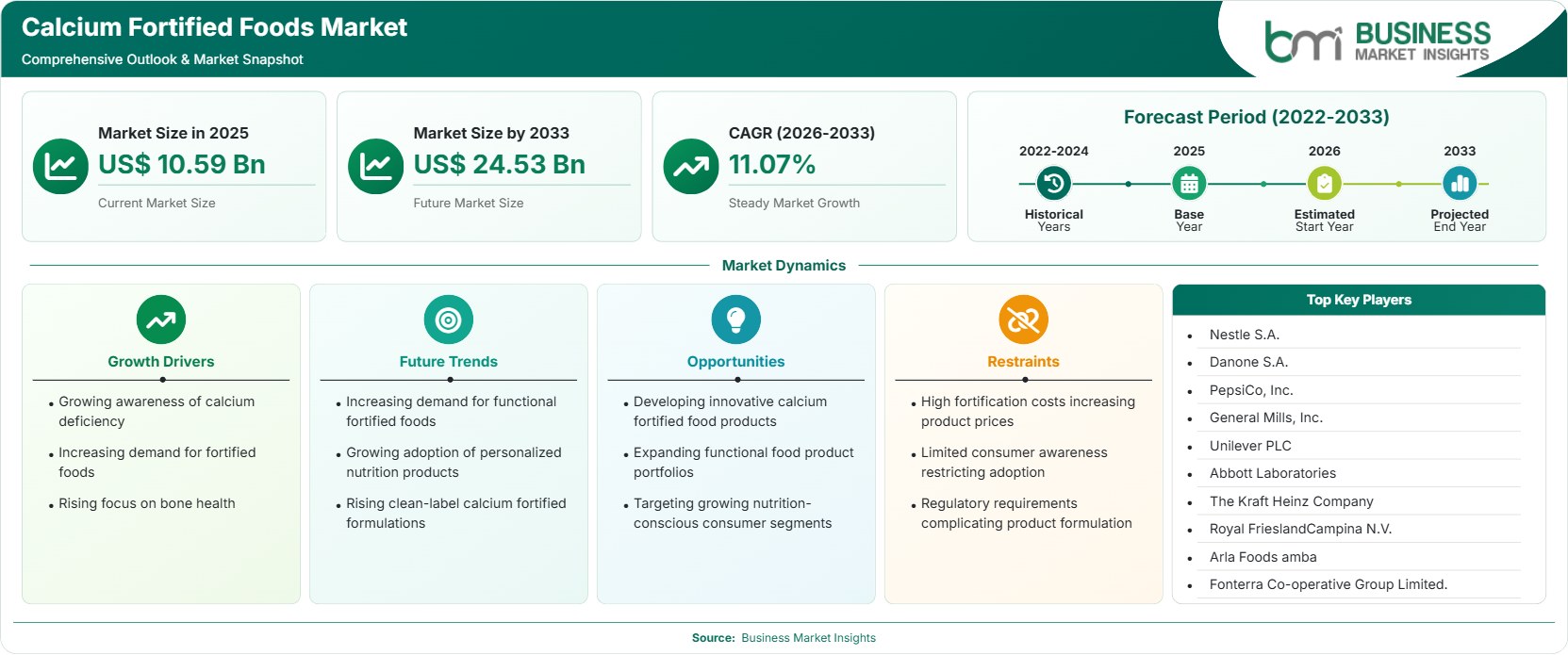
The Calcium Fortified Foods Market size was valued at US$ 10.59 Billion in 2025 and is projected to reach US$ 24.53 Billion by 2033, growing at a CAGR of 11.07% during 2026–2033. Growing awareness of calcium deficiency, increasing consumer preference for fortified food products, and rising focus on bone health and preventive nutrition are supporting market expansion. Innovation in functional foods and increasing health-conscious consumption patterns continue creating growth opportunities.

Report Coverage
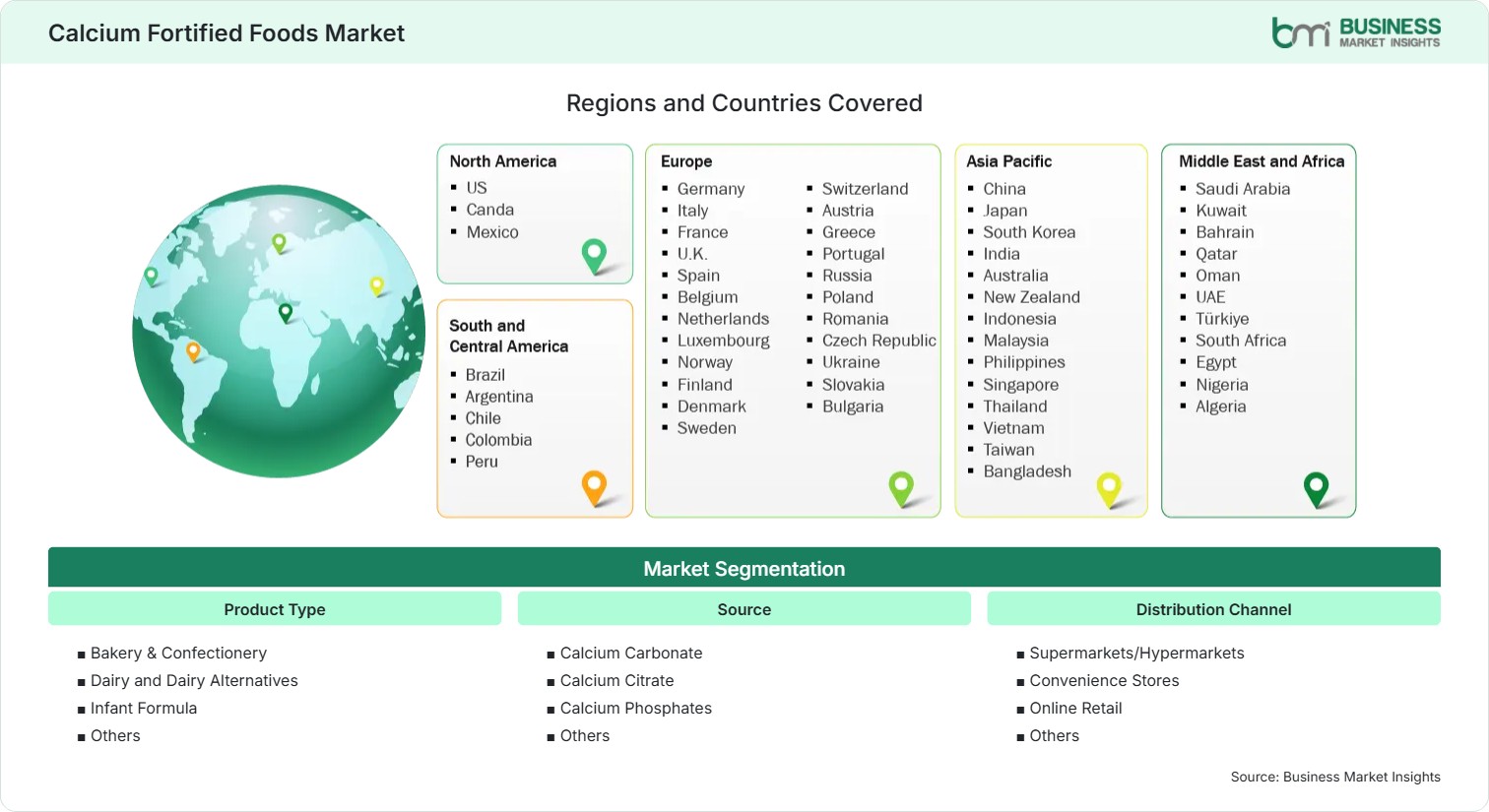
  • Product Type: Bakery & Confectionery, Dairy and Dairy Alternatives, Infant Formula, Others
  • Source: Calcium Carbonate, Calcium Citrate, Calcium Phosphates, Others
  • Distribution Channel: Supermarkets/Hypermarkets, Convenience Stores, Online Retail, Others
US$ 10.59 Bn Market size in 2025
US$ 24.53 Bn Market Size by 2033
11.07% CAGR, 2026 - 2033
2026-2033 Forecast Period

01 AI Overview

Calcium Fortified Foods Market Summary

  • North America Region: North America holds 35%–38% share in 2025, growing at a 10.2%–10.8% CAGR during 2026–2033. High consumer awareness, strong functional food demand, widespread fortification practices, and growing preventive healthcare expenditure continue supporting regional growth. The US market is expected to register a 10.4%–11.0% CAGR.
  • Fastest Growing Region: Asia Pacific accounted for 25%–28% share in 2025 and is anticipated to expand at a 12.3%–12.9% CAGR during 2026–2033. Rising disposable income, increasing nutrition awareness, expanding urban populations, and growing demand for fortified food products continue accelerating adoption.
  • Leading Segment: Dairy and Dairy Alternatives represented 38%–41% share in 2025 and are projected to grow at a 11.2%–11.8% CAGR during 2026–2033. Strong consumer acceptance, established consumption patterns, and increasing demand for nutrient-enriched products support segment leadership.
  • High Growth Segment: Online Retail accounted for 17%–20% share in 2025 and is expected to register a 13.1%–13.8% CAGR during 2026–2033. Expanding e-commerce networks, increased product accessibility, and growing digital purchasing behavior continue supporting growth.
  • Key Market Opportunity: Expansion of premium fortified foods, innovative functional products, personalized nutrition offerings, and calcium-enriched formulations is creating significant opportunities for manufacturers targeting health-conscious consumers.
  • Major Market Players: Nestlé S.A., Danone S.A., PepsiCo, Inc., General Mills, Inc., Unilever PLC, Abbott Laboratories, The Kraft Heinz Company, Royal FrieslandCampina N.V., Arla Foods amba, Fonterra Co-operative Group Limited.
02 Strategic Insights

Calcium Fortified Foods Market: Strategic Insights

Calcium Fortified Foods Market Strategic Framework
FREE PDF
Request your free sample
Request free sample
03 Stakeholder View

Key Takeaways

  • The market is experiencing sustained growth as consumers increasingly seek food products that provide nutritional benefits beyond basic dietary requirements, particularly those supporting bone health and overall wellness.
  • Dairy and dairy alternatives continue to generate significant revenue opportunities due to established consumer trust, high calcium absorption rates, and expanding product innovation within functional nutrition categories.
  • Manufacturers are investing in advanced fortification technologies, clean-label formulations, and ingredient optimization strategies to enhance nutritional content while maintaining taste, texture, and product quality.
  • Asia Pacific offers a strong investment opportunity driven by expanding middle-class populations, rising health awareness, growing urbanization, and increased consumption of fortified food products.
  • Strategic partnerships between food manufacturers, ingredient suppliers, and retail channels are accelerating product launches and strengthening market penetration across both developed and emerging economies.
  • Companies focusing on personalized nutrition, premium functional foods, and health-focused product positioning are expected to strengthen competitive advantage during the forecast period.
04 Geographic Outlook

Calcium Fortified Foods Market Regional Highlights

North America Calcium Fortified Foods Market

North America accounted for 35%–38% Calcium Fortified Foods Market share in 2025 and is projected to grow at a 10.2%–10.8% CAGR during 2026–2033. The region benefits from strong consumer awareness regarding nutritional deficiencies, well-established functional food markets, and growing preventive healthcare spending. Increasing demand for fortified dairy products, plant-based alternatives, and nutritional beverages continues supporting market growth. Product innovation and strong retail penetration further enhance opportunities for manufacturers operating across the region.

  • Consumers increasingly seek functional foods that support bone health, immunity, and overall nutritional well-being.
  • Dairy products and nutritional beverages remain major calcium fortification categories due to widespread consumer acceptance.
  • Growing adoption of plant-based fortified food products is creating new opportunities for manufacturers.
  • Retailers continue expanding premium nutrition offerings to meet evolving health-conscious consumer preferences.
  • Product innovation focusing on convenience and nutritional enhancement remains a key competitive strategy.

US Calcium Fortified Foods Market

The US represented 79%–83% share within North America in 2025 and is anticipated to register a 10.4%–11.0% CAGR during 2026–2033. Strong consumer awareness regarding bone health, widespread availability of fortified foods, and increasing demand for preventive nutrition continue driving growth. Food manufacturers actively develop innovative products targeting children, adults, and aging populations. Growing health and wellness trends continue strengthening demand across both traditional and emerging product categories in Calcium Fortified Foods Market.

  • Consumers increasingly prioritize nutrient-dense products supporting long-term health outcomes.
  • Functional dairy products and fortified snacks continue experiencing strong demand growth.
  • E-commerce platforms are improving accessibility to specialized nutrition products.
  • Manufacturers are expanding product portfolios to address diverse nutritional requirements.

Europe Calcium Fortified Foods Market

Europe held 24%–27% share in 2025 and is expected to register a 10.8%–11.4% CAGR during 2026–2033. Demand is supported by growing awareness of healthy aging, expanding functional food consumption, and increasing interest in nutritional supplementation through everyday food products. Manufacturers continue developing innovative fortified dairy products, bakery items, and beverages. Strong regulatory standards and growing consumer preference for quality nutrition support Calcium Fortified Foods Market expansion throughout the region.

  • Germany remains a leading market due to strong demand for functional and fortified food products.
  • France and the UK continue benefiting from rising consumer awareness regarding nutritional health.
  • Dairy alternatives with added calcium are gaining popularity among health-conscious consumers.
  • Expanding healthy lifestyle trends support greater consumption of nutrient-enriched foods.
  • Retail expansion and premium product positioning continue encouraging category growth.

Asia Pacific Calcium Fortified Foods Market

Asia Pacific accounted for 25%–28% share in 2025 and is projected to grow at a 12.3%–12.9% CAGR during 2026–2033, making it the fastest-growing regional market. Rising disposable incomes, expanding urban populations, increasing awareness of nutritional deficiencies, and growing demand for functional food products are supporting market growth. Governments and health organizations across the region are also promoting nutrient-rich dietary practices. Manufacturers are increasingly introducing calcium-enriched products tailored to regional consumer preferences, further accelerating adoption.

  • China represents a major market due to rising health awareness and increasing demand for fortified dairy and nutritional products.
  • India continues witnessing strong growth driven by nutritional improvement programs and growing consumer focus on preventive healthcare.
  • Japan and South Korea are expanding demand for premium functional foods designed to support healthy aging and bone health.
  • Growing middle-class populations are increasing consumption of value-added food and beverage products.
  • Expansion of modern retail and e-commerce channels is improving access to fortified products across urban and semi-urban areas.

Rest of World Calcium Fortified Foods Market

Rest of World accounted for 8%–11% share in 2025 and is anticipated to register a 10.5%–11.1% CAGR during 2026–2033. Increasing nutritional awareness, improving healthcare infrastructure, and growing adoption of fortified food products are supporting Calcium Fortified Foods Market trends expansion. Countries in Latin America, the Middle East, and Africa are witnessing greater demand for health-focused food products as consumers become more aware of calcium deficiency and associated health risks. Product availability continues improving through both retail and digital distribution networks.

  • Brazil remains an important market supported by growing interest in functional and nutritional food products.
  • Gulf countries continue witnessing demand growth due to increasing health consciousness and premium food consumption.
  • Expanding healthcare awareness campaigns are encouraging greater adoption of nutrient-enhanced products.
  • Manufacturers are introducing affordable fortified food options to improve accessibility among broader consumer groups.
  • Growth in organized retail continues strengthening product availability across developing markets.
Global Market Geography
FREE PDF
Request your free sample
Request free sample
05 Segment Analysis

Calcium Fortified Foods Market Segmentation

Product Type

Product Type accounted for 38%–41% share in 2025 and is projected to grow at a 11.2%–11.8% CAGR during 2026–2033. The Calcium Fortified Foods Market scope continues expanding as manufacturers develop innovative products addressing nutritional deficiencies and health-conscious dietary preferences. Increased demand for nutrient-rich foods, changing consumer lifestyles, and broader product availability are supporting growth across multiple food categories.

  • Bakery & Confectionery: Growing adoption of calcium-enriched bakery products reflects consumer preference for convenient foods with added nutritional value.
    • Bread & Baked Products: Widely consumed products increasingly fortified with calcium to support daily nutritional intake.
    • Cookies & Biscuits: Manufacturers are introducing fortified variants targeting families, children, and health-conscious consumers.
    • Cakes & Pastries: Premium and functional bakery offerings increasingly feature calcium fortification to enhance nutritional appeal.
    • Confectioneries: Selected confectionery products are incorporating calcium ingredients to differentiate products in competitive markets.
  • Dairy and Dairy Alternatives: Leading category driven by high consumer acceptance, nutritional credibility, and extensive product innovation.
  • Infant Formula: Strong demand supported by increasing awareness regarding

Source

Source represented 29%–32% share in 2025 and is expected to register a 10.9%–11.5% CAGR during 2026–2033. Manufacturers continue utilizing different calcium compounds based on formulation requirements, bioavailability, stability, and cost considerations. Ongoing product innovation and ingredient optimization are supporting broader application across food and beverage categories.

  • Calcium Carbonate: Extensively used due to high calcium concentration, affordability, and compatibility with multiple food applications.
  • Calcium Citrate: Increasingly preferred in premium formulations because of improved absorption characteristics and consumer perception.
  • Calcium Phosphates: Widely utilized across dairy products, bakery items, and nutritional products requiring functional ingredient performance.

Distribution Channel

Distribution Channel accounted for 34%–37% share in 2025 and is projected to expand at a 11.4%–12.0% CAGR during 2026–2033. The Calcium Fortified Foods Market trends indicate growing importance of omnichannel retail strategies as consumers increasingly seek convenient access to nutritional products. Expansion of organized retail and digital commerce continues supporting market penetration.

  • Supermarkets/Hypermarkets: Remain the dominant sales channel due to extensive product availability and strong consumer traffic.
  • Convenience Stores: Continue attracting consumers seeking quick access to nutritional snacks, dairy products, and fortified beverages.
  • Online Retail: Rapidly growing channel supported by product variety, convenience, subscription models, and direct-to-consumer strategies.
06 Market Forces

Calcium Fortified Foods Market Dynamics

Key Market Drivers

Growing awareness of calcium deficiency

Growing awareness regarding calcium deficiency and its impact on overall health is significantly contributing to market expansion. Consumers are becoming increasingly informed about the role of calcium in maintaining bone strength, supporting muscle function, and reducing the risk of osteoporosis and other bone-related disorders. Public health campaigns, healthcare recommendations, and educational initiatives are encouraging individuals to incorporate calcium-rich foods into their daily diets. As awareness increases across both developed and emerging economies, demand for fortified food products continues to rise. Manufacturers are responding by expanding product portfolios and introducing innovative calcium-enriched food offerings tailored to different age groups and nutritional requirements. The growing focus on preventive healthcare is expected to remain a major factor supporting Calcium Fortified Foods Market forecasts.

Increasing demand for fortified foods

Consumer food preferences are now moving towards foods that offer extra nutritional value other than fulfilling the dietary requirements. Fortified foods have gained popularity for their convenience, availability, and ability to support specific health goals. Calcium-fortified foods are becoming a regular part of diet through such as dairy foods, baked foods, drinks, baby nutrition foods, and snacks. Food companies are taking advantage of fortified food technology to enhance the nutritional content without compromising on taste and quality. The trend towards functional nutrition is growing as consumers seek foods that promote health and wellness.

Rising focus on bone health

The growing incidence of osteoporosis, osteopenia, and aging-related bone problems has enhanced the emphasis of consumers on bone health and nutrition-based preventive measures. The growing elderly population in different nations is resulting in increasing needs for bone-friendly products. Food items containing calcium can provide an easy way to meet their daily nutrient requirements. Experts are promoting the consumption of calcium-enriched diet due to its importance as part of a well-rounded health program. Food companies are seizing this opportunity and developing products that provide bone-care health benefits. Growing health awareness among younger people is providing new market opportunities for the industry.

Key Market Opportunities

Developing innovative calcium fortified food products

Product innovation continues to present substantial growth opportunities for manufacturers operating in the market. Companies are developing new formulations that combine calcium fortification with additional nutritional ingredients such as vitamin D, protein, probiotics, and other functional components. Innovation is also spreading into categories such as beverages, snack foods, bakery products, plant-based milk products, and infant nutrition products. The demand for products that are convenient, offer more than one health benefit in one serving and taste good continues to grow among consumers. Companies that can differentiate their products through innovations in formulation, taste, and nutrition will gain market share.

Expanding functional food product portfolios

The global functional food industry continues experiencing robust growth, creating significant opportunities for calcium-fortified food manufacturers. Companies are increasingly integrating fortification strategies into broader functional nutrition portfolios designed to support immunity, digestive health, cardiovascular wellness, and bone strength. The increased availability of health-related products on retail shelves is due to rising consumer demand. Expansion of product ranges helps the producers to cater to different consumer segments and adds value to their brands. The combination of trends of functional nutrition and preventive healthcare is helping to introduce new products.

Targeting growing nutrition-conscious consumer segments

Nutrition-conscious consumers are becoming one of the most influential customer groups within the food industry. Demand is increasing among parents seeking healthier products for children, adults interested in preventive nutrition, and older consumers focused on healthy aging. These groups increasingly evaluate food choices based on nutritional content and health benefits. Manufacturers are responding through targeted marketing strategies, premium product offerings, and personalized nutrition approaches. Growing interest in clean-label products, transparent ingredient sourcing, and scientifically supported health claims further strengthens opportunities within the market. Companies that effectively address evolving consumer expectations can benefit from expanding demand over the forecast period.

Market Restraints and Challenges

High fortification costs increasing product prices

Factor: Calcium fortification requires specialized ingredients, formulation expertise, quality testing, regulatory compliance, and production modifications that can increase manufacturing costs. Additional expenses associated with research, ingredient sourcing, and product development further contribute to overall cost structures. Impact: Higher production costs may result in premium pricing, limiting affordability for certain consumer groups. Price-sensitive consumers in developing markets may be reluctant to adopt fortified products when lower-cost alternatives are available. Manufacturers must balance nutritional enhancement with cost efficiency to maintain competitiveness while expanding market accessibility across different income segments.

Limited consumer awareness restricting adoption

Factor: Despite growing health consciousness, awareness regarding calcium deficiency and the benefits of fortified foods remains limited in some regions and consumer demographics. Misconceptions regarding nutritional requirements and lack of education can influence purchasing behavior. Impact: Lower awareness levels may slow market penetration and reduce product adoption rates, particularly in emerging markets. Companies often need to invest significantly in consumer education, marketing campaigns, and nutritional awareness initiatives to drive demand. Improving understanding of calcium-related health benefits will remain essential for unlocking the market's full growth potential and expanding long-term consumer adoption.

07 Company Analysis

Competitive Landscape

The Calcium Fortified Foods Market analysis reflects a competitive environment driven by product innovation, nutritional fortification expertise, functional food development, brand strength, distribution network expansion, and the ability to address growing consumer demand for health-focused and calcium-enriched food products across global markets.

Company Name

Overview

Products and Services Relevant to the Market

Nestlé S.A.

Global food and nutrition company with extensive fortified product offerings.

Fortified dairy products, infant nutrition, nutritional beverages, functional foods.

Danone S.A.

Leading health-focused food company with strong dairy and nutrition portfolio.

Calcium-fortified dairy products, yogurt, nutritional beverages, dairy alternatives.

PepsiCo, Inc.

Global food and beverage manufacturer with functional nutrition offerings.

Fortified beverages, nutritional products, value-added food solutions.

General Mills, Inc.

Major producer of cereals, snacks, and health-oriented food products.

Calcium-fortified cereals, bakery products, nutritional food items.

Unilever PLC

Multinational consumer goods company with nutrition-focused food brands.

Functional foods, fortified products, nutritional consumer goods.

Abbott Laboratories

Healthcare and nutrition company specializing in advanced nutritional products.

Infant formula, clinical nutrition products, fortified dietary solutions.

The Kraft Heinz Company

Global food manufacturer with diversified packaged food portfolio.

Nutritionally enhanced foods, dairy products, fortified snacks.

Royal FrieslandCampina N.V.

International dairy company focused on nutrition and health products.

Calcium-enriched dairy products, infant nutrition, specialty dairy solutions.

Arla Foods amba

Dairy cooperative known for premium nutrition and fortified dairy products.

Fortified milk, dairy beverages, calcium-enhanced dairy offerings.

Fonterra Co-operative Group Limited

Global dairy exporter and nutrition ingredient supplier.

Calcium-fortified dairy ingredients, dairy nutrition products, functional formulations.

10 Trust & Transparency

Research Methodology

The market analysis combines proprietary research with secondary data from government agencies, company disclosures, regulatory filings, industry databases and expert interviews. Market estimates are validated through data triangulation, cross-market benchmarking and analyst review.

View Full Research Methodology

11 Questions Answered

Frequently Asked Questions

What are the key challenges affecting market growth?

High fortification costs, premium product pricing, limited consumer awareness in developing regions, and the need for continuous nutritional education remain significant challenges for market participants.

How are manufacturers creating differentiation in the market?

Manufacturers are introducing innovative formulations, combining calcium with additional nutrients, expanding functional food portfolios, and developing products tailored to specific consumer health needs.

Why is Asia Pacific the fastest-growing region in Calcium Fortified Foods market?

Asia Pacific is experiencing rapid growth due to increasing nutrition awareness, rising disposable income, expanding urban populations, and growing demand for health-focused and fortified food products.

Which product category dominates the market?

Dairy and dairy alternatives represent the leading product segment due to strong consumer trust, high nutritional value, and widespread use of calcium fortification across multiple dairy-based products.

What is driving growth in the Calcium Fortified Foods Market report?

The market is driven by growing awareness of calcium deficiency, increasing consumer demand for fortified foods, rising focus on bone health, and expanding interest in preventive nutrition and functional food products.

Access the Full Calcium Fortified Foods Market Report

Get segment-level forecasts, regional estimates, competitive benchmarking, company profiles and downloadable Excel datasets.

Access the full Calcium Fortified Foods Market Report
350 pages PDF & Excel | 2026-08-24