
Bread Maker Market Outlook: Size, Share, Trends, Growth Analysis, Competitive Landscape & Forecast, 2026-2033

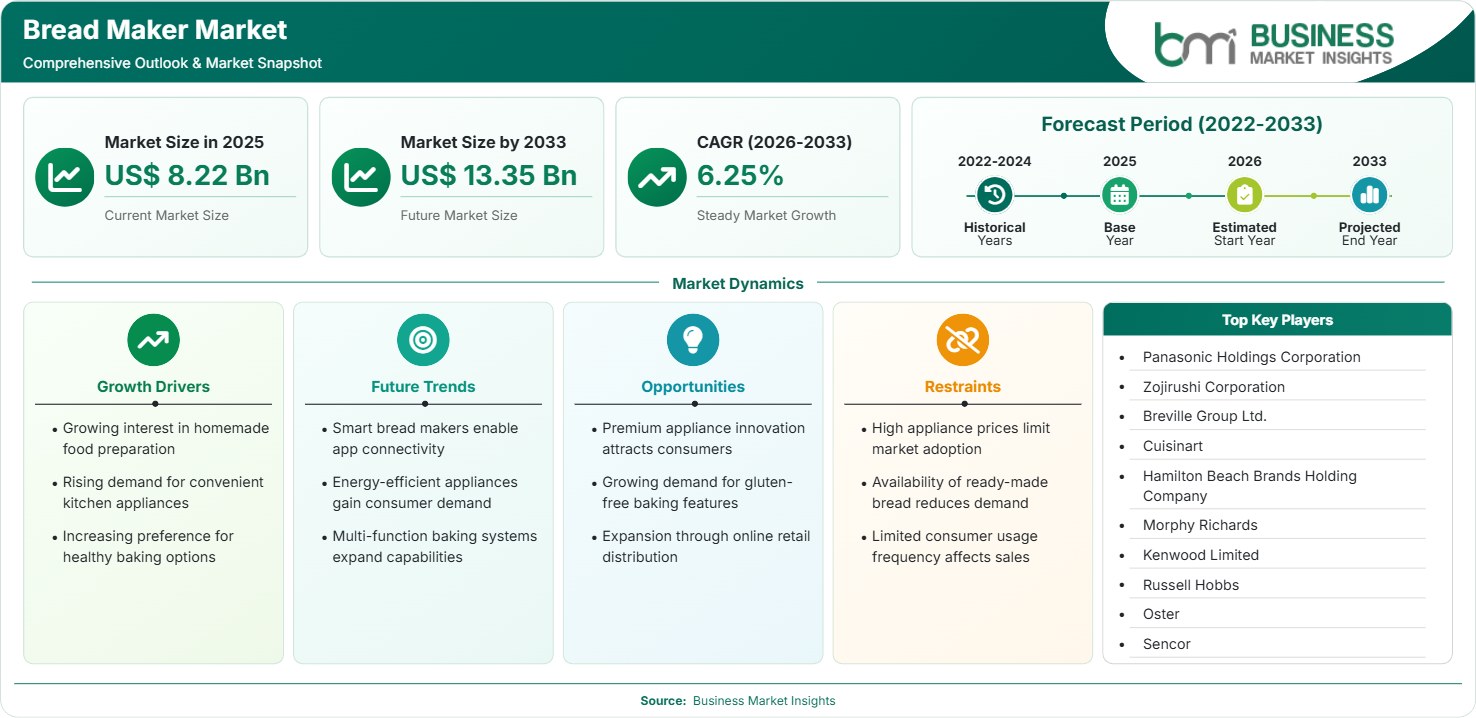
The Bread Maker Market size was valued at US$ 8.22 billion in 2025 and is projected to reach US$ 13.35 billion by 2033, growing at a CAGR of 6.15% during 2026–2033. The increase in demand for homemade food preparation, the increase in demand for kitchen appliances that are convenient to use, the shift towards healthier baking options, innovation in premium products, and online availability of products are all driving market growth.

Report Coverage
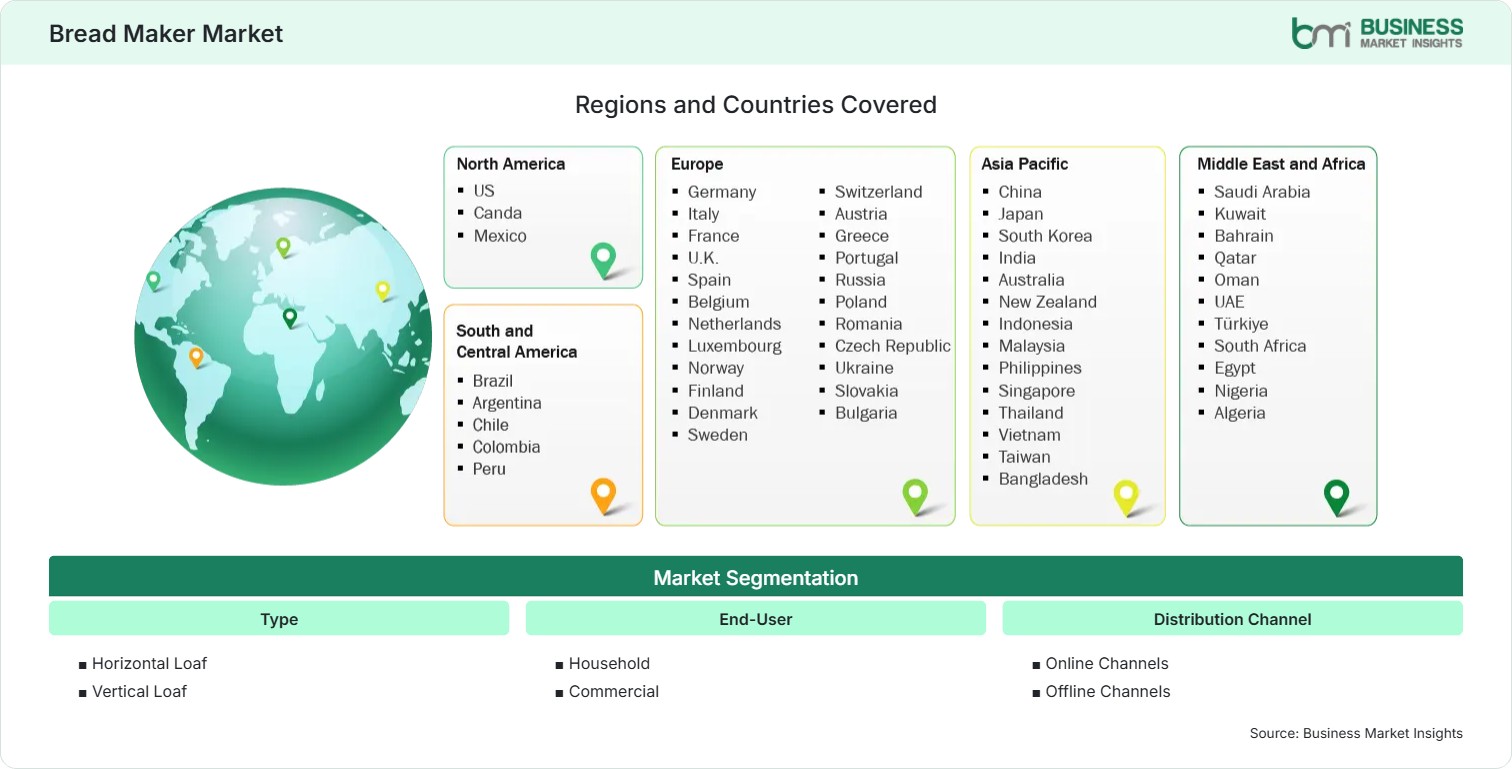
  • Type: Horizontal Loaf, Vertical Loaf
  • End-User: Household, Commercial
  • Distribution Channel: Online Channels, Offline Channels
US$ 8.22 Bn Market size in 2025
US$ 13.35 Bn Market Size by 2033
6.25% CAGR, 2026 - 2033
2026-2033 Forecast Period

01 AI Overview

Bread Maker Market Summary

  • North America Region: North America holds 34%–37% bread maker market share in 2025 and is expected to grow at a CAGR of 5.9%–6.3% during 2026–2033. High household appliance penetration, strong consumer preference for premium kitchen equipment, increasing home baking activities, and product innovation continue supporting regional growth. The United States remains the largest regional market, driven by rising demand for multifunctional kitchen appliances and an estimated CAGR of 6.0%–6.4% during the forecast period.
  • Fastest Growing Region: Asia Pacific accounts for 27%–30% market share in 2025 and is projected to register a CAGR of 7.1%–7.6% during 2026–2033. Expanding middle-class households, increasing disposable income, growing adoption of smart kitchen appliances, and rapid e-commerce expansion continue accelerating regional demand.
  • Leading Segment: Household represents 72%–75% market share in 2025 and is anticipated to grow at a CAGR of 6.2%–6.6% during 2026–2033. Rising home baking trends, growing health awareness, increasing preference for customized bread recipes, and demand for convenient food preparation appliances continue supporting segment leadership.
  • High Growth Segment: Online Channels account for 39%–42% market share in 2025 and are projected to expand at a CAGR of 7.3%–7.8% during 2026–2033. Increasing digital shopping adoption, wider product availability, attractive promotional campaigns, and doorstep delivery services continue strengthening online sales.
  • Key Market Opportunity: Continuous innovation in smart bread makers featuring programmable settings, gluten-free baking modes, energy-efficient operation, and mobile application connectivity is expected to generate substantial long-term commercial opportunities.
  • Major Market Players: Panasonic Holdings Corporation, Zojirushi Corporation, Breville Group Limited, Cuisinart, Hamilton Beach Brands Holding Company, Morphy Richards, Kenwood Limited, Russell Hobbs, Oster, and Sencor.
02 Strategic Insights

Bread Maker Market: Strategic Insights

Bread Maker Market Strategic Framework
FREE PDF
Request your free sample
Request free sample
03 Stakeholder View

Key Takeaways

  • The value chain continues evolving through closer collaboration among component suppliers, appliance manufacturers, software developers, retailers, and e-commerce platforms, enabling faster product innovation and improved customer reach across global consumer markets.
  • Household applications remain the strongest revenue contributor as consumers increasingly invest in automated appliances that simplify baking while supporting healthier dietary preferences and customized bread preparation.
  • Product innovation is increasingly focused on artificial intelligence-enabled baking programs, touchscreen interfaces, mobile application connectivity, programmable recipes, energy-efficient technologies, and multifunctional appliance capabilities.
  • Asia Pacific presents an attractive long-term investment opportunity owing to expanding urbanization, rising disposable income, increasing adoption of smart home appliances, and rapid development of organized retail and digital commerce.
  • Strategic product launches, technology partnerships, distribution agreements, and brand expansion initiatives continue strengthening competitive positioning while enabling manufacturers to increase market penetration across developed and emerging economies.
  • Sustainability is becoming an important competitive differentiator as manufacturers increasingly utilize recyclable materials, energy-efficient heating technologies, durable product designs, and environmentally responsible manufacturing practices to meet evolving consumer expectations and regulatory requirements.
04 Geographic Outlook

Bread Maker Market Regional Highlights

North America Bread Maker Market

North America accounted for 34%–37% of the Bread Maker Market Share in 2025 and is projected to expand at a CAGR of 5.9%–6.3% during 2026–2033. Strong consumer purchasing power, widespread adoption of premium kitchen appliances, growing interest in home baking, and continuous product innovation support regional expansion. Established retail infrastructure, high smart appliance penetration, and increasing demand for healthy homemade food continue strengthening the regional market while supporting long-term Bread Maker Market Growth.

  • Growing consumer preference for homemade bread encourages adoption of programmable bread makers featuring multiple baking modes, customizable recipes, and improved energy efficiency across residential households.
  • Manufacturers continue introducing premium appliances with touchscreen controls, automatic ingredient dispensers, and smart connectivity, enhancing convenience while supporting product differentiation in the regional market.
  • Well-developed retail and e-commerce networks improve product availability, enabling consumers to compare features, prices, and customer reviews before purchasing advanced bread makers.
  • Increasing awareness regarding healthier eating habits continues encouraging households to prepare preservative-free bread using automated baking appliances with customizable ingredient options.
  • Expansion of smart home ecosystems supports integration of connected kitchen appliances, encouraging manufacturers to introduce intelligent bread makers compatible with mobile applications.

US Bread Maker Market

The United States represented 29%–32% of global revenue in 2025 and is forecast to register a CAGR of 6.0%–6.4% through 2026–2033. High adoption of premium household appliances, increasing consumer interest in healthy home cooking, expanding online retail channels, and continuous product innovation continue maintaining the country's leadership in the regional market.

  • Strong demand for multifunctional kitchen appliances encourages manufacturers to develop bread makers capable of preparing dough, cakes, jams, and gluten-free recipes.
  • E-commerce platforms continue expanding product visibility through promotional campaigns, customer reviews, and competitive pricing, strengthening online appliance sales.
  • Consumer preference for smart home technologies supports demand for programmable bread makers with automated operation and digital user interfaces.
  • Rising health awareness encourages consumers to prepare fresh bread using customized ingredients, reducing dependence on commercially processed bakery products.

Europe Bread Maker Market

Europe held 27%–30% market share during 2025 and is anticipated to grow at a CAGR of 5.8%–6.2% through 2026–2033. Growing interest in artisan baking, increasing demand for premium kitchen appliances, and rising consumer preference for energy-efficient household products continue supporting regional expansion. Germany leads regional revenue with a CAGR of 5.9%–6.3%, while Poland records the fastest growth at 6.7%–7.1% during the forecast period.

  • Germany maintains leadership through strong household appliance adoption, premium consumer spending, and continuous innovation by leading kitchen appliance manufacturers.
  • Poland experiences rapid growth owing to increasing disposable income, expanding organized retail, and rising consumer interest in convenient home baking solutions.
  • Growing demand for specialty breads, including gluten-free and whole-grain varieties, encourages broader adoption of advanced programmable bread makers.
  • Manufacturers increasingly emphasize sustainable materials, energy-efficient operation, and compact appliance designs to address evolving consumer expectations.
  • Expansion of omnichannel retail strategies strengthens product availability across specialty appliance stores and online marketplaces.

Asia Pacific Bread Maker Market

Asia Pacific accounted for 27%–30% of industry revenue in 2025 and is projected to record the highest CAGR of 7.1%–7.6% during 2026–2033. Rising disposable income, rapid urbanization, expanding middle-class households, and increasing adoption of smart kitchen appliances continue accelerating regional demand. China leads regional revenue with a CAGR of 7.0%–7.4%, while India records the fastest growth at 7.8%–8.2%.

  • China continues strengthening household appliance manufacturing while supporting technological innovation and competitive product pricing across domestic and export markets.
  • India benefits from expanding e-commerce penetration, increasing urban households, and growing awareness of convenient home cooking appliances.
  • Japan and South Korea continue driving premium appliance innovation through compact product designs, intelligent baking technologies, and energy-efficient manufacturing.
  • Rising consumer preference for healthy homemade food supports increasing demand for bread makers capable of preparing customized recipes and specialty bread varieties.
  • Growing investments in organized retail and digital commerce continue improving product accessibility across emerging Asian economies.

Rest of World Bread Maker Market

The Rest of World accounted for 8%–10% market share in 2025 and is expected to register a CAGR of 6.1%–6.5% during 2026–2033. South & Central America continue experiencing increasing household appliance adoption supported by improving consumer purchasing power and expanding retail networks.

The Middle East & Africa continue benefiting from rising urbanization, increasing demand for modern kitchen appliances, and expanding digital commerce. Brazil leads South & Central America with a CAGR of 6.2%–6.6%, while the United Arab Emirates records the fastest regional growth at 6.8%–7.2% due to increasing premium appliance adoption.

  • Brazil continues witnessing stronger demand through expanding retail distribution, improving household income, and increasing preference for convenient food preparation appliances.
  • The United Arab Emirates benefits from premium consumer spending, smart home adoption, and rapid expansion of organized appliance retail channels.
  • International appliance manufacturers continue strengthening regional distribution partnerships to improve product availability and after-sales service.
  • Growing awareness regarding healthier dietary habits supports increasing adoption of home bread makers across urban households.
  • Continuous expansion of online retail platforms creates additional sales opportunities while improving accessibility to premium kitchen appliance brands.
Global Market Geography
FREE PDF
Request your free sample
Request free sample
05 Segment Analysis

Bread Maker Market Segmentation

Type

The Type segment accounted for 52%–55% of the market in 2025 and is projected to expand at a CAGR of 6.3%–6.7% during 2026–2033. Consumer preference for loaf size, appliance capacity, kitchen space optimization, and baking versatility continues influencing purchasing decisions. The Bread Maker Market Forecasts indicate growing demand for technologically advanced bread makers offering improved convenience, consistent baking quality, and enhanced customization features.

  • Horizontal Loaf: Preferred by consumers seeking traditional loaf shapes, larger baking capacity, improved crust consistency, and greater flexibility for preparing artisan-style homemade bread.
  • Vertical Loaf: Continues gaining popularity among consumers with limited kitchen space because of its compact design, efficient footprint, and affordable pricing.

End-User

The End-User segment represented 72%–75% market share in 2025 and is expected to register a CAGR of 6.2%–6.6% during 2026–2033. Rising household baking activities, increasing health consciousness, and growing preference for convenient meal preparation continue supporting segment expansion. The Bread Maker Market Trends increasingly emphasize multifunctional appliances that improve user convenience while enabling customized bread preparation.

  • Household: Continues dominating demand due to increasing home baking activities, healthier lifestyle preferences, convenient food preparation, and rising adoption of smart kitchen appliances.
  • Commercial: Growing adoption across cafés, boutique bakeries, restaurants, and hospitality establishments supports consistent demand for reliable, programmable bread-making equipment.

Distribution Channel

The Distribution Channel segment generated 58%–61% of total revenue in 2025 and is forecast to grow at a CAGR of 6.4%–6.8% through 2026–2033. Expansion of omnichannel retailing, digital commerce, and specialty appliance stores continues improving product accessibility while enabling manufacturers to strengthen consumer engagement and brand visibility.

  • Online Channels: Continue recording robust expansion through competitive pricing, wider product selection, detailed product comparisons, customer reviews, and convenient home delivery services.
  • Offline Channels: Maintain significant importance through appliance showrooms, electronics retailers, department stores, and personalized customer assistance that supports purchasing decisions.
06 Market Forces

Bread Maker Market Dynamics

Key Market Drivers

Growing interest in homemade food preparation

The increasing desire for people to cook their own healthy food at home is greatly contributing to the growth in demand for bread machines globally. Rising consciousness about the importance of quality food, natural ingredients, and preservative-free foods makes it imperative for individuals to bake their own bread at home with natural ingredients. The expansion of home cooking trends, supported by digital recipe platforms and social media communities, continues strengthening Bread Maker Market Growth while encouraging manufacturers to introduce versatile appliances capable of preparing multiple bread varieties with minimal user intervention.

Rising demand for convenient kitchen appliances

Busy lifestyles and increasing urbanization are encouraging consumers to adopt automated kitchen appliances that reduce food preparation time while maintaining product quality. Bread machines which are designed with timers, automatic ingredients dispensing, delayed start options, and different baking modes offer more ease and flexibility in terms of usage. Companies have been constantly developing intelligent systems that make operation and use easier for customers. Continuous improvements in the product are boosting consumers’ confidence while expanding the range of intelligent bread-making machines.

Increasing preference for healthy baking options

Growing awareness regarding nutritional health and dietary preferences is driving demand for appliances capable of producing customized bread with reduced sugar, lower sodium, and preservative-free ingredients. Consumers are looking for appliances that cater to gluten-free, keto, multi-grains, and fiber-rich diets. Manufacturers keep developing their programmable features to cater to different dietary needs and enhance the quality of baking. This helps boost the value of the products and motivates buyers to buy new replacements.

Key Market Opportunities

Premium appliance innovation attracts consumers

Premium bread makers with innovative technologies, such as connectivity, touch screens, artificial intelligence-controlled baking modes, automatic dispensing of ingredients, and customizable recipes keep coming from manufacturers. The new technological features enhance convenience and offer product differentiation within the premium appliances market. Increasing readiness of consumers to spend money on kitchen technologies presents huge business opportunities. The Bread Maker Market Forecasts indicate sustained demand for connected appliances capable of integrating with smart home ecosystems and delivering personalized baking experiences.

Growing demand for gluten-free baking features

The increasing popularity of gluten-free diets and specialized nutritional preferences encourages manufacturers to develop bread makers equipped with dedicated baking cycles for gluten-free recipes. Improvement in the quality of bread can be achieved through better temperature control and programmed kneading and baking processes. The increasing knowledge of consumers about allergies and digestion issues makes it easier for them to use machines that can bake special bread without needing any baking skills.

Expansion through online retail distribution

Rapid expansion of digital commerce platforms continues improving global accessibility to bread makers through broader product selection, competitive pricing, and enhanced customer engagement. Online channels allow manufacturers to reach new consumer segments while leveraging digital marketing, influencer campaigns, and personalized recommendations. Improved logistics networks, convenient home delivery, and flexible payment options continue supporting online appliance sales while strengthening long-term market expansion opportunities.

Market Restraints and Challenges

High appliance prices limit market adoption

Factor: Premium bread makers incorporate advanced electronics, intelligent baking technologies, durable components, and multifunctional features that increase manufacturing costs and retail pricing. Impact: Higher product prices discourage price-sensitive consumers, particularly in developing economies, reducing penetration among first-time buyers and limiting overall market expansion despite growing consumer interest in home baking.

Availability of ready-made bread reduces demand

Factor: Supermarkets, convenience stores, artisan bakeries, and commercial food retailers offer a broad selection of affordable fresh bread with extensive flavor and packaging options. Impact: Easy availability of ready-made bakery products reduces the necessity for home bread preparation, limiting appliance purchases among consumers who prioritize convenience over homemade food production.

07 Company Analysis

Competitive Landscape

Competition is characterized by continuous product innovation, smart appliance integration, premium product differentiation, and expansion of omnichannel distribution strategies. Leading manufacturers continue investing in connected technologies, energy-efficient designs, and multifunctional baking capabilities to strengthen brand positioning and consumer loyalty. These initiatives continue supporting comprehensive Bread Maker Market Analysis while enabling companies to address evolving consumer preferences across residential and commercial applications.

Company Name

Overview

Products and Services Relevant to this Market

Panasonic Holdings Corporation

Global consumer electronics and home appliance manufacturer with extensive expertise in premium kitchen appliances.

Automatic bread makers, smart kitchen appliances, programmable baking machines, and home cooking solutions.

Zojirushi Corporation

Japanese manufacturer recognized for premium household appliances and innovative food preparation technologies.

Bread makers, rice cookers, kitchen appliances, programmable baking systems, and home cooking products.

Breville Group Limited

International designer and manufacturer of premium kitchen appliances for residential consumers.

Bread makers, smart kitchen appliances, baking equipment, and multifunctional food preparation products.

Cuisinart

Established kitchen appliance brand offering innovative cooking solutions for household consumers.

Bread makers, countertop appliances, baking equipment, food processors, and cooking accessories.

Hamilton Beach Brands Holding Company

Global manufacturer of household kitchen appliances serving residential and commercial markets.

Bread makers, small kitchen appliances, programmable baking equipment, and countertop cooking solutions.

Morphy Richards

Home appliance manufacturer specializing in innovative kitchen products and household solutions.

Bread makers, kitchen appliances, baking machines, food preparation equipment, and home appliances.

Kenwood Limited

International kitchen appliance company recognized for food preparation and cooking equipment.

Bread makers, stand mixers, food processors, and multifunctional kitchen appliances.

Russell Hobbs

Global home appliance manufacturer focused on practical and innovative kitchen products.

Bread makers, kitchen appliances, food preparation equipment, and household cooking solutions.

Oster

Consumer appliance brand offering reliable kitchen products for everyday food preparation.

Bread makers, countertop appliances, baking equipment, and multifunctional kitchen appliances.

Sencor

Consumer electronics and household appliance manufacturer serving global retail markets.

Bread makers, compact kitchen appliances, programmable baking equipment, and smart home products.

10 Trust & Transparency

Research Methodology

The market analysis combines proprietary research with secondary data from government agencies, company disclosures, regulatory filings, industry databases and expert interviews. Market estimates are validated through data triangulation, cross-market benchmarking and analyst review.

View Full Research Methodology

11 Questions Answered

Frequently Asked Questions

What does the Bread Maker Market Report include?

The Market Report provides comprehensive insights into market size, segmentation, regional performance, competitive landscape, growth drivers, opportunities, restraints, technological developments, and future business outlook.

What are the major growth opportunities for manufacturers?

Key opportunities include premium smart appliance innovation, expanding gluten-free baking functions, integration with connected home ecosystems, and wider market reach through online retail distribution.

Which end-user segment accounts for the largest market share?

The household segment dominates because consumers increasingly prefer preparing fresh bread at home while benefiting from convenient, automated, and customizable baking solutions.

Which region dominates the Bread Maker Market?

North America remains the leading regional market due to strong household appliance adoption, high consumer spending on premium kitchen products, advanced retail infrastructure, and increasing preference for healthy home baking.

What factors are driving the Market?

The market is driven by growing consumer interest in homemade food, increasing demand for convenient kitchen appliances, rising health awareness, and continuous innovation in smart baking technologies that improve convenience and customization.

Access the Full Bread Maker Market Report

Get segment-level forecasts, regional estimates, competitive benchmarking, company profiles and downloadable Excel datasets.

Access the full Bread Maker Market Report
350 pages PDF & Excel | 2026-08-05