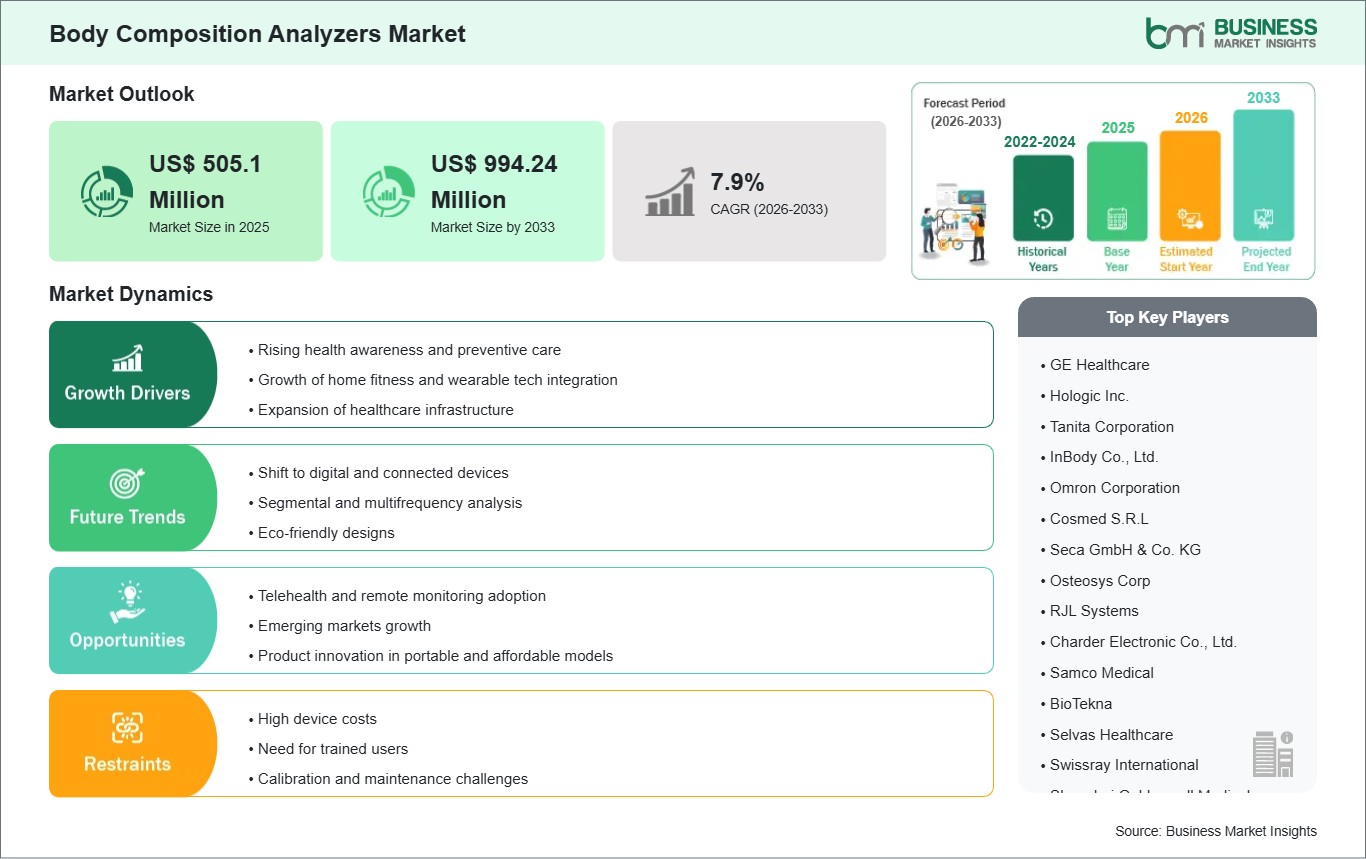
The Body Composition Analyzers Market size is expected to reach US$ 994.24 Million in 2033 from US$ 505.1 Million in 2025. The market is estimated to record a CAGR of 7.9% from 2026 to 2033.
Globally, Body Composition Analyzers are vital in assessing human health and fitness, providing precise and trustworthy readings of body fat, muscle mass, bone density, and hydration. Body Composition Analyzers are hugely important in the transportation of goods, globally, as they can provide fast and reliable delivery. The healthcare, fitness, and wellness, sports performance, research, and weight management industries are all relying on Body Composition Analyzers for their day-to-day activities. Body composition analyzers have many benefits: they provide accurate information, are non-invasive, and can monitor changes in the body over time. The market is being driven by the growing awareness of obesity, the increasing inclination for customized fitness programs, and the spreading adoption of preventive healthcare. Also, the innovations in bioimpedance technology, dual-energy X-ray absorptiometry (DEXA), and portable devices are already affecting the measurement accuracy, usability, and accessibility in positive ways.
However, there are various challenges that may limit the growth of the market, including high costs of equipment, the requirement for specialists in the field, and the calibration and maintenance of devices. The market is also affected by changes in regulatory norms, reimbursement, and the general economic situation that in turn impacts consumer spending on fitness and healthcare. Challenges do exist but the market offers significant opportunities to businesses, which are coming from increased acceptance of smart and connected devices, the rapid growth of home healthcare and fitness monitoring, and the rise in awareness of preventive health programs. There will be no doubt that investment in portable, affordable, and multifunctional analyzers will lead to new opportunities for market growth

Key segments that contributed to the derivation of the Body Composition Analyzers market analysis are type, destination, and end user.
The significant increase in people's awareness of health and wellness around the world has been recognized as an important factor that positively supports the body composition analyzers market. With the preventive healthcare, personal fitness programs, and performance monitoring trends gaining ground, consumers and healthcare practitioners alike are now looking for accurate, dependable, and user-friendly measurement tools, thus making body composition analyzers an important part of health appraisal.
For example, the Global Wellness Institute's 2024 report indicates that the wellness sector will be worth USD $7.3 trillion by 2027, mainly due to increased demand for fitness, weight management, nutrition, and preventive healthcare services. This growth is closely tied to the rising penetration of health wearables, organized workout programs, sports performance monitoring, medical diagnostics, remote health consultations, and workplace wellness programs. The market for body composition analyzers will not stop growing as the demand for exact and easy-to-use body composition measurement keeps rising throughout gyms, hospitals, clinics, and homes.
The leading companies, including Tanita, OMRON, InBody, and GE Healthcare, have not merely broadened their global presence but have also considerably changed product characteristics through their provision of advanced segmental analysis, multi-frequency technology, and portable analyzers. Body composition analyzers, in terms of their accuracy, usability, and fast assessments, are in a unique position to cater to the gradually changing demands of both consumers and institutions. These analyzers, as opposed to conventional weight measurement devices, allow comprehensive assessment of fat, muscle, bone, and water composition, which is crucial for fitness aficionados, patients, and medical practitioners who demand exact and useful insights.
Body composition analyzers market to a large extent has been influenced by the ongoing globalization of health and fitness practices. The global distribution of fitness awareness campaigns and preventive healthcare initiatives is pinning the reliance of consumers and institutions on measurement solutions that are accurate to the tenth of the gram to monitor the results of their wellness programs. Body composition analyzers, which possess the capability to render body metric insights in a very short period, are playing the crucial role of the health movement enabler of the world.
The last few years have seen the rise of various health and fitness programs in the corporate sector, fitness gyms, monitoring of patients in homes, and rehabilitation centers which have opened new markets, and with that, there has been a tendency of sales and product penetration across borders. High-accuracy, segmental, and multi-frequency analyzers are the choices in most cases when it comes to clinics, gyms, and research institutions. This is mainly because such devices provide the accuracy, dependability, and insights through data that are needed. These instruments are mainly applied for the purposes of enhancing performance, determining health status, and administering preventive care in diverse communities thus the demand for the reliable and user-friendly body composition analyzers remains strong.
Moreover, manufacturers are still coming up with new ideas and bringing out portable, connected, and smart analyzers so as to keep the competition and cater to market needs that are changing. Such a change generally requires the use of devices that are supportive of complicated, individualized fitness programs, clinical monitoring, and telemedicine. Besides, as consumers and institutions more and more take up health-oriented lifestyles and data-based treatments, the demand for body composition analyzers is bound to increase continuously.

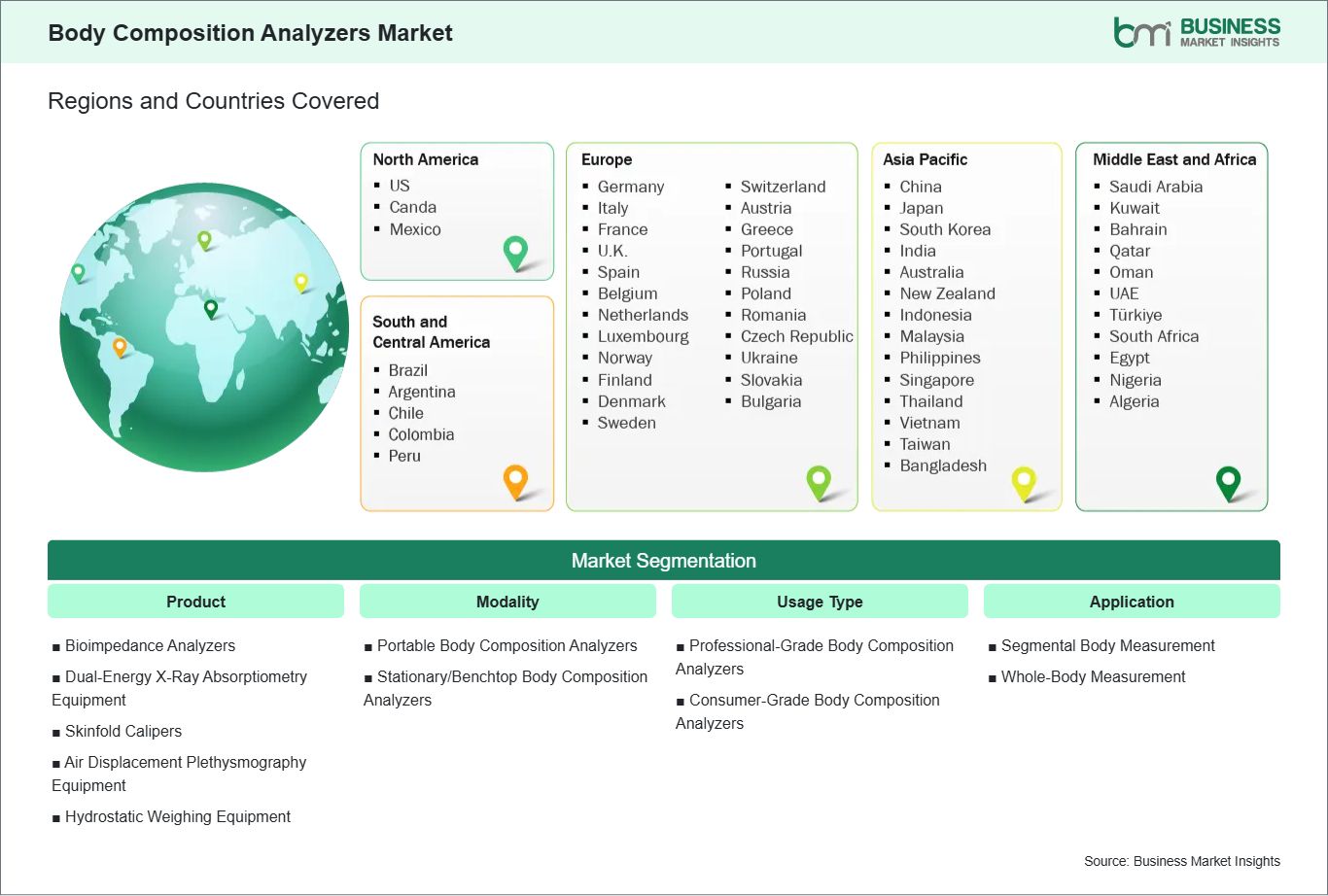
By Product, the Body Composition Analyzers market is segmentation into Bioimpedance Analyzers, Dual-Energy X-Ray Absorptiometry (DEXA) Equipment, Skinfold Calipers, Air Displacement Plethysmography (ADP) Equipment, Hydrostatic Weighing Equipment. The Bioimpedance Analyzers segment dominated the market in 2025. Bioimpedance Analyzers: Dominates due to affordability, ease of use, non-invasive measurements, accuracy in fat and muscle analysis, widespread adoption in clinics and gyms, and suitability for both professional and consumer applications.
By Modality, the market is bifurcated into Portable Body Composition Analyzers and Stationery/Benchtop Body Composition Analyzers. The Portable Body Composition Analyzers segment held the larger share of the market in 2025. Portable Body Composition Analyzers lead the market because of convenience, mobility for home or field use, easy installation, user-friendliness, growing demand in fitness centers, and suitability for remote or smaller healthcare facilities.
By Usage Type, the market is bifurcated into Professional-Grade Body Composition Analyzers and Consumer-Grade Body Composition Analyzers. The Professional-Grade Body Composition Analyzers segment held a larger share of the market in 2025. Professional-Grade Body Composition Analyzers dominate due to high accuracy, multi-frequency and segmental analysis, clinical validation, reliability for hospitals and research, advanced features, and preference among healthcare professionals for precise patient monitoring.
By Application, the market is bifurcated into Segmental Body Measurement and Whole-Body Measurement. The Segmental Body Measurement segment held a larger share of the market in 2025. Segmental Body Measurement leads the market as it provides detailed insights into specific body areas, crucial for athletes, rehabilitation, medical assessments, and personalized fitness programs, offering higher value than whole-body analysis.
By end user, the market is segmented into Fitness Clubs and Wellness Centers, Hospitals and Clinics, Academic & Research Centers, Home Users. The Hospitals and Clinics segment held the largest share of the market in 2025. Hospitals and Clinics Dominate due to high patient volumes, frequent monitoring needs, trained staff availability, integration in diagnostics, research, preventive care, and bulk procurement of accurate, reliable body composition analyzers.
| Report Attribute | Details |
|---|---|
| Market size in 2025 | US$ 505.1 Million |
| Market Size by 2033 | US$ 994.24 Million |
| Global CAGR (2026 - 2033) | 7.9% |
| Historical Data | 2022-2024 |
| Forecast period | 2026-2033 |
| Segments Covered | By Product
|
|
Regions and Countries Covered
| |
| North America | US, Canada, Mexico |
| Europe | Belgium, Austria, Finland, Denmark, Greece, Poland, Romania, Russia, Ukraine, Czech Republic, Slovakia, Bulgaria, Italy, Luxembourg, Germany, Switzerland, France, Netherlands, Norway, Portugal, Spain, Sweden, United Kingdom |
| Asia-Pacific | Australia, China, India, Japan, South Korea, Indonesia, Malaysia, Philippines, Singapore, Thailand, Vietnam, Bangladesh, New Zealand, Taiwan |
| South and Central America | Brazil, Argentina, Peru, Chile, Colombia |
| Middle East and Africa | Bahrain, Kuwait, Oman, Qatar, Saudi Arabia, United Arab Emirates, Turkiye, South Africa, Egypt, Algeria, Nigeria |
| Market leaders and key company profiles |
|
The "Body Composition Analyzers Market Size and Forecast (2022 - 2033)" report provides a detailed analysis of the market covering below areas:
The geographical scope of the Body Composition Analyzers market report is divided into five regions: North America, Asia Pacific, Europe, Middle East & Africa, and South & Central America. The Body Composition Analyzers market in Asia Pacific is expected to grow significantly during the forecast period.
The Asia-Pacific Body Composition Analyzers market is segmented into China, Japan, South Korea, India, Australia, New Zealand, Indonesia, Malaysia, the Philippines, Singapore, Thailand, Vietnam, Taiwan, Bangladesh, and the Rest of Asia. The Asia-Pacific air cargo market is experiencing robust growth, driven by the rapid expansion of cross-border e-commerce, growing international trade volumes, and the rising demand for time-sensitive delivery services. Major economies like China and India are leading the way, fueled by increasing industrial output, strategic logistics investments, and the development of free trade zones.
The region is also witnessing increased adoption of advanced logistics technologies, including AI-based shipment tracking, digital freight booking, and temperature-controlled cargo systems particularly relevant for sectors like pharmaceuticals and perishables. Air cargo capacity expansion, alongside fleet modernization efforts by regional airlines and integrators, is enhancing operational efficiency and reducing transit times. Additionally, the surge in manufacturing activity and exports, coupled with the growth of express delivery networks, is positioning Asia-Pacific as a key hub in the global air freight ecosystem. The rise of regional trade agreements (such as RCEP) and strong infrastructure development across major logistics corridors further solidifies the region’s dominant market position.

The Body Composition Analyzers market is evaluated by gathering qualitative and quantitative data post primary and secondary research, which includes important corporate publications, association data, and databases. A few of the key developments in the Body Composition Analyzers market are:
The Body Composition Analyzers Market is valued at US$ 505.1 Million in 2025, it is projected to reach US$ 994.24 Million by 2033.
As per our report Body Composition Analyzers Market, the market size is valued at US$ 505.1 Million in 2025, projecting it to reach US$ 994.24 Million by 2033. This translates to a CAGR of approximately 7.9% during the forecast period.
The Body Composition Analyzers Market report typically cover these key segments-
The historic period, base year, and forecast period can vary slightly depending on the specific market research report. However, for the Body Composition Analyzers Market report:
The Body Composition Analyzers Market is populated by several key players, each contributing to its growth and innovation. Some of the major players include:
The Body Composition Analyzers Market report is valuable for diverse stakeholders, including:
Essentially, anyone involved in or considering involvement in the Body Composition Analyzers Market value chain can benefit from the information contained in a comprehensive market report.
Please tell us your area of interest
(Market Segments/ Regions and Countries/ Companies)