Full Body Scanner Market Outlook (2022-2033)

Historic Data: 2022-2024   |   Base Year: 2025   |   Forecast Period: 2026-2033
Report Content: Market Scope, Market Segmentation, Market Dynamics, and Competitive Analysis

Report Coverage:
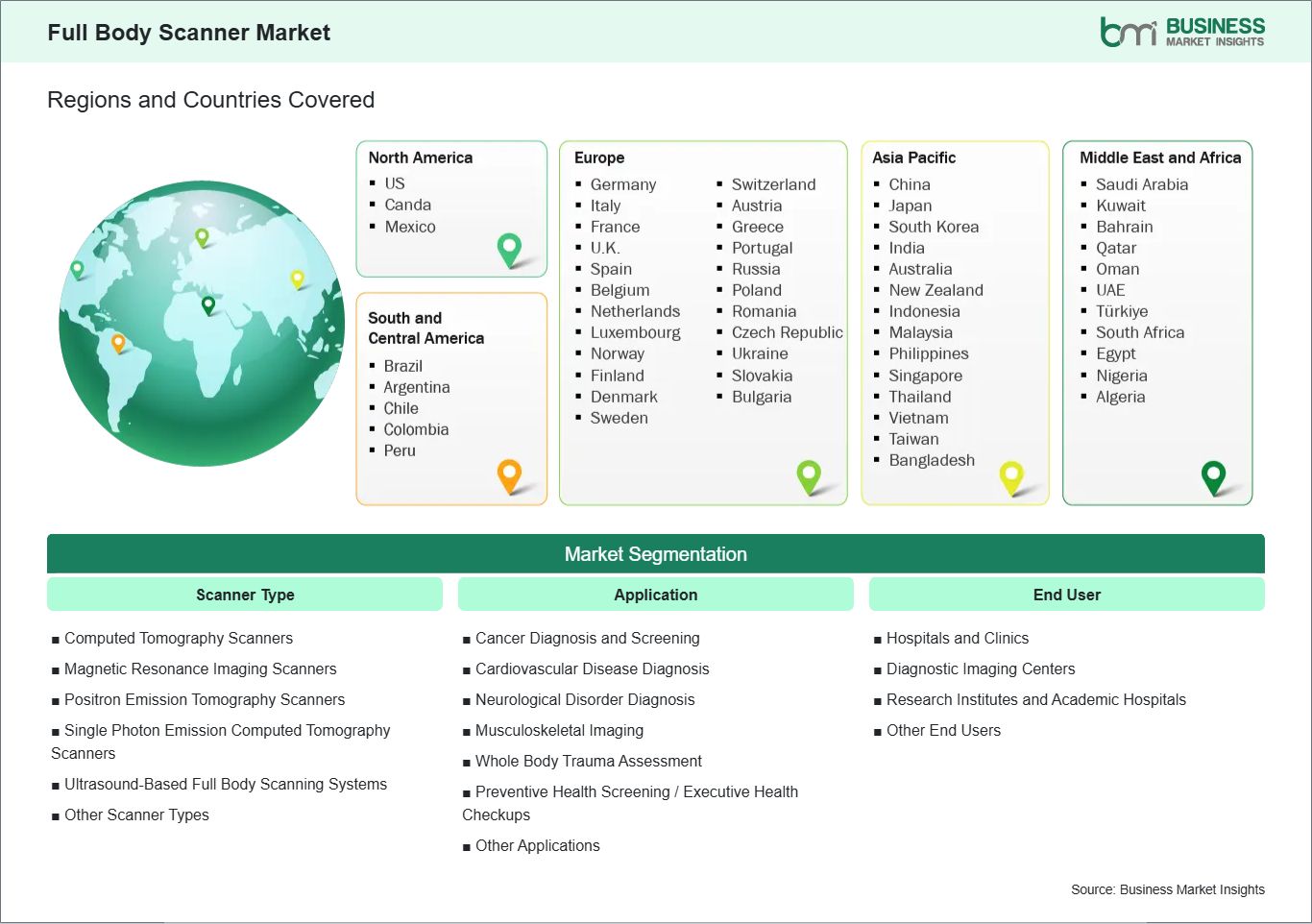
  • Scanner Type (Computed Tomography (CT) Scanners, Magnetic Resonance Imaging (MRI) Scanners, Positron Emission Tomography (PET) Scanners, Single Photon Emission Computed Tomography (SPECT) Scanners, Ultrasound-Based Full Body Scanning Systems, Other Scanner Types)
  • Application (Cancer Diagnosis and Screening, Cardiovascular Disease Diagnosis, Neurological Disorder Diagnosis, Musculoskeletal Imaging, Whole Body Trauma Assessment, Preventive Health Screening / Executive Health Checkups, Other Applications)
  • End User (Hospitals and Clinics, Diagnostic Imaging Centers, Research Institutes and Academic Hospitals, Other End Users)

No. of Pages: 400
Report Code: BMIPUB00033421
Category: Life Sciences
Full Body Scanner Market

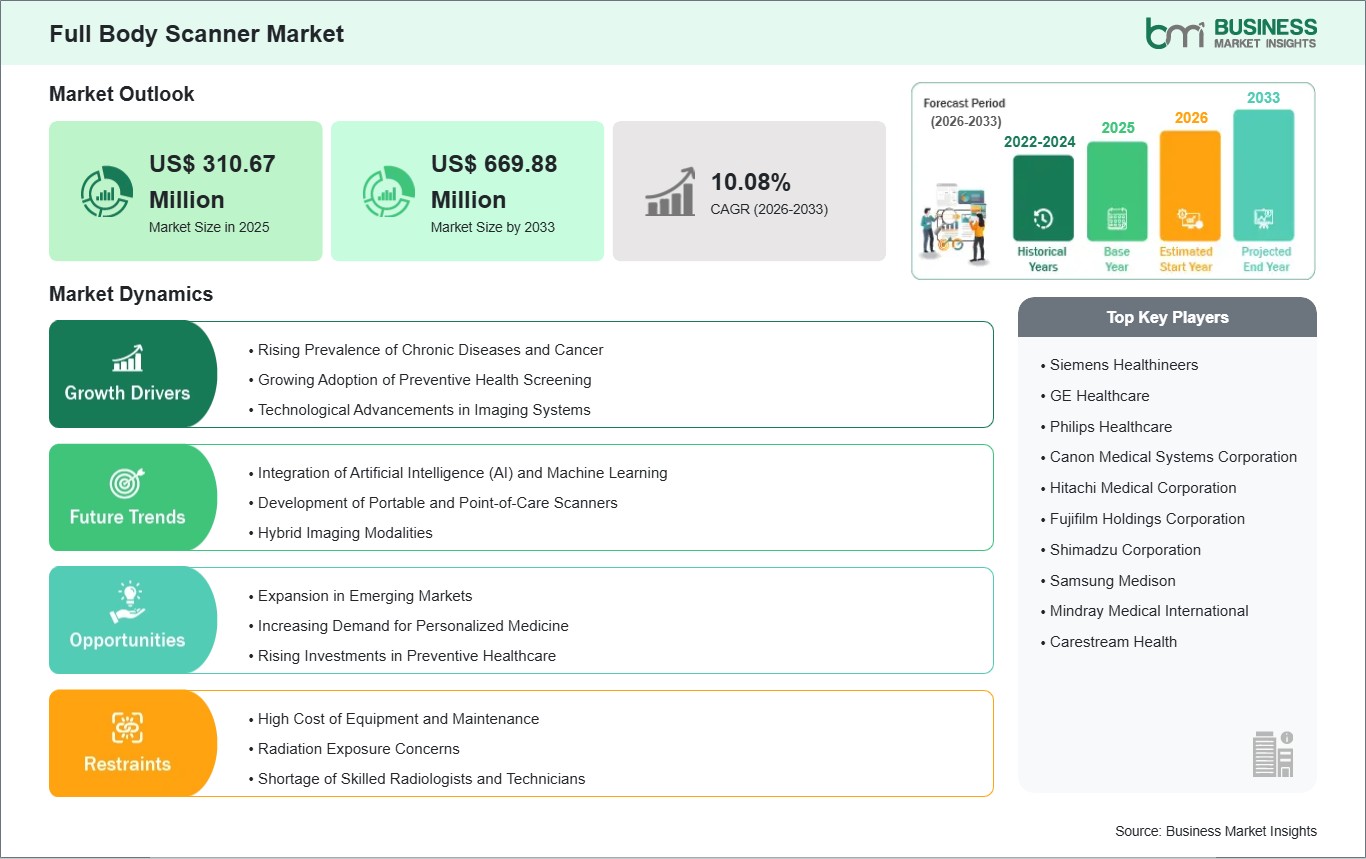
The Full Body Scanner market size is expected to reach US$ 669.88 million by 2033 from US$ 310.67 million in 2025. The market is estimated to record a CAGR of 10.08% from 2026 to 2033.

Executive Summary and Global Market Analysis:

The growth of the full body scanner market is being driven by increasing rates of chronic diseases including Cancer (oncological diseases), cardiovascular diseases and neurological diseases which require the use of full-body diagnostic imaging. These types of scanners (including advanced forms of CT Scanners, MRI machines and PET Scanners) are being utilized for disease diagnosis at an earlier stage, plan for treatment and continuous monitoring of a patient's health during their illness. The increased awareness of and adoption for preventive health screenings and whole body checkups will continue to drive demand within the market. The development of new technology, such as increased resolution imaging and decreased scan times, as well as decreased radiation exposure to patients, has been encouraging healthcare providers to continue upgrading older equipment in order to improve on the outcomes of their patients. The development of AI and machine learning capabilities in the analysis of images has also improved the accuracy and efficiency of the diagnostic process, therefore encouraging even more use of full-body scanners for diagnostic purposes.

The market for full body scanners is led by North America because of its good medical facilities, high costs of healthcare, and availability of advanced imaging devices. Europe has a large share of the market because there are strong government programs encouraging early diagnosis, and management of chronic diseases. The fastest growing market for full body scanners is in Asia-Pacific because healthcare infrastructure is expanding, costs are increasing and there is an increase demand for quality diagnostic services in emerging countries such as India and China. Therefore, the full body scanner market is driven by improvement through innovations, a shift toward more preventive type health care, and a growing investment in health care infrastructure.

Full Body Scanner Market - Strategic Insights:

global-market-strategic-framework
Get more information on this report

Full Body Scanner Market Segmentation Analysis:

Key segments that contributed to the derivation of the Full Body Scanner market analysis are scanner type, application, and end user.

  • By scanner type, the full body scanner market is segmented into computed tomography (CT) scanners, magnetic resonance imaging (MRI) scanners, positron emission tomography (PET) scanners, single photon emission computed tomography (SPECT) scanners, ultrasound-based full body scanning systems, others. The computed tomography (CT) scanners segment dominated the market in 2025.
  • By application, the market is segmented into cancer diagnosis and screening, cardiovascular disease diagnosis, neurological disorder diagnosis, musculoskeletal imaging, whole body trauma assessment, preventive health screening / executive health checkups, and others. The cancer diagnosis and screening segment held the largest share of the market in 2025.
  • By end user, the market is segmented into hospitals and clinics, diagnostic imaging centers, research institutes and academic hospitals, others. The hospitals and clinics segment held the largest share of the market in 2025.

Full Body Scanner Market Drivers and Opportunities:

Rising Prevalence of Chronic Diseases and Demand for Early Diagnosis

There has been an increase in the prevalence of chronic disease due to the rising incidence and prevalence of cancer, cardiac illness and neurological disorders. As these types of illnesses frequently require comprehensive diagnostic imaging/and full-body scans for the purposes of early detection (diagnosis), accurate staging of the disease(s) and treatment plans, and ongoing monitoring, global healthcare providers are investing in advanced full-body scanning technology, such as high-resolution computed tomography, magnetic resonance imaging (MRI), and positron emission tomography (PET) systems, to support improved clinical outcomes for their patients. As the population continues to age and the number of people diagnosed with cancer, cardiac, and neurological illness rises, a healthcare institution that uses advanced diagnostic equipment or technologies such as full-body scanning can provide early identification of chronic diseases, which leads to longer lives for patients, as well as a reduction in long-term treatment costs. There is strong motivation for hospitals and diagnostic facilities to utilize the latest technology available in order to enhance the overall quality of care and patient experience by reducing time, expense and lack of precision associated with traditional diagnostic imaging methods (e.g., plain film x-ray). Additionally, patients have become more aware over time regarding how preventive healthcare and having regular screenings can help them stay healthy; therefore creating an overall increase in demand for full-body scanners throughout various types of facilities. Newer models of full-body scanners incorporate advanced imaging technologies, speedier scan times, and lower radiation dosages; therefore, improving the likelihood that patients will be safe during the procedure and comfortable afterwards.

There is also an increasing emphasis on utilizing a combination of personalized medicine and targeted therapy to provide patients with high-quality resolution and whole-body images for developing more accurate diagnoses of different diseases. With these elements such as an increase in the number of people suffering from chronic diseases; continued development within medical technology; and an overall growing awareness regarding preventive healthcare and achieving regular check-ups - all create a solid and continuous force behind the global full body scanner marketplace which will guarantee ongoing demand as well as stimulate ongoing development within the imaging sector of the healthcare field.

Expansion in Emerging Markets and Healthcare Infrastructure Development

The full body scanner industry has a great chance of growth in emerging markets due to growing healthcare infrastructure, increasing healthcare spending, and demand for high quality diagnostic services. Countries in Asia Pacifc, Latin America, and the Middle East are experiencing rapid urbanization, which provides for a greater middle class and a greater disposable income leading to increased health care consumption and use of advanced imaging technologies. Therefore, governments of Asia-Pacific, Latin America, and Middle East are allocating large amounts of funds towards modernizing their hospitals and other diagnostic centres and outpatient facilities, thus usually buying equipment that would help with early detection of disease and preventative care. The increased demand for full body scanners because of the rising incidence of chronic disease supports the need for advanced health care imaging/diagnostic equipment.

Moreover, the growth of medical tourism in India, Thailand, and Mexico is also creating demand for high-quality imaging tools that meet international standards. Manufacturers that produce high-quality, low-cost full-body scanners with the unique specifications required by these countries will capture a large share of this market. Additionally, the increase in multi-specialty hospitals and diagnostic chain facilities will lead to greater economies of scale and continuous demand for advanced scanners. Overall, infrastructure improvements, increased public awareness regarding health, and the expansion of medical services represent major and sustaining growth opportunities for full-body scanner suppliers in emerging market economies around the globe.

Full Body Scanner Market Size and Share Analysis:

By product type, the full body scanner market is segmented into computed tomography (CT) scanners, magnetic resonance imaging (MRI) scanners, positron emission tomography (PET) scanners, single photon emission computed tomography (SPECT) scanners, ultrasound-based full body scanning systems, and others. The computed tomography (CT) scanners segment dominated the market in 2025. This is widely used for fast, detailed whole-body imaging, especially in emergencies and cancer diagnosis.

By application, the full body scanner market is bifurcated into cancer diagnosis and screening, cardiovascular disease diagnosis, neurological disorder diagnosis, musculoskeletal imaging, whole body trauma assessment, preventive health screening/executive health checkups, and others. The cancer diagnosis and screening segment dominated the market in 2025. The high demand for early detection and staging drives extensive use of full body scanners.

By end user, the market is segmented into hospitals and clinics, diagnostic imaging centers, research institutes and academic hospitals, others. The hospitals and clinics segment held the largest share of the market in 2025. The high patient volumes and comprehensive diagnostic needs position hospitals as primary users.

Full Body Scanner Market Report Highlights:

Report Attribute Details
Market size in 2025 US$ 310.67 Million
Market Size by 2033 US$ 669.88 Million
Global CAGR (2026 - 2033)10.08%
Historical Data 2022-2024
Forecast period 2026-2033
Segments Covered By Scanner Type
  • Computed Tomography Scanners
  • Magnetic Resonance Imaging Scanners
  • Positron Emission Tomography Scanners
  • Single Photon Emission Computed Tomography Scanners
  • Ultrasound-Based Full Body Scanning Systems
  • Other Scanner Types
By Application
  • Cancer Diagnosis and Screening
  • Cardiovascular Disease Diagnosis
  • Neurological Disorder Diagnosis
  • Musculoskeletal Imaging
  • Whole Body Trauma Assessment
  • Preventive Health Screening / Executive Health Checkups
  • Other Applications
By End User
  • Hospitals and Clinics
  • Diagnostic Imaging Centers
  • Research Institutes and Academic Hospitals
  • Other End Users
Regions and Countries Covered
North America US, Canada, Mexico
Europe Belgium, Austria, Finland, Denmark, Greece, Poland, Romania, Russia, Ukraine, Czech Republic, Slovakia, Bulgaria, Italy, Luxembourg, Germany, Switzerland, France, Netherlands, Norway, Portugal, Spain, Sweden, United Kingdom
Asia-Pacific Australia, China, India, Japan, South Korea, Indonesia, Malaysia, Philippines, Singapore, Thailand, Vietnam, Bangladesh, New Zealand, Taiwan
South and Central America Brazil, Argentina, Peru, Chile, Colombia
Middle East and Africa Bahrain, Kuwait, Oman, Qatar, Saudi Arabia, United Arab Emirates, Turkiye, South Africa, Egypt, Algeria, Nigeria
Market leaders and key company profiles
  • Siemens Healthineers
  • GE Healthcare
  • Philips Healthcare
  • Canon Medical Systems Corporation
  • \r\nHitachi Medical Corporation
  • Fujifilm Holdings Corporation
  • Shimadzu Corporation
  • Samsung Medison
  • Mindray Medical International
  • Carestream Health
Get more information on this report

Full Body Scanner Market Report Coverage and Deliverables:

The "Full Body Scanner Market Size and Forecast (2022-2033)" report provides a detailed analysis of the market covering below areas:

  • Full Body Scanner market size and forecast at global, regional, and country levels for all the key market segments covered under the scope
  • Full Body Scanner market trends, as well as market dynamics such as drivers, restraints, and key opportunities
  • Full Body Scanner market analysis covering key market trends, global and regional framework, major players, regulations, and recent market developments
  • Industry landscape and competition analysis covering market concentration, heat map analysis, prominent players, and recent developments for the Full Body Scanner market
  • Detailed company profiles, including SWOT analysis

Full Body Scanner Market Geographic Insights:

The geographical scope of the Full Body Scanner market report is divided into five regions: North America, Asia Pacific, Europe, Middle East & Africa, and South & Central America. The Full Body Scanner market in Asia Pacific is expected to grow significantly during the forecast period.

The Asia-Pacific Full Body Scanner market is segmented into China, Japan, South Korea, India, Australia, New Zealand, Indonesia, Malaysia, the Philippines, Singapore, Thailand, Vietnam, Taiwan, Bangladesh, and the Rest of Asia. There is a considerable rise in the demand for full body scanners in APAC due to an expanding health care infrastructure, increasing health-care costs, and an increase in the incidence of diseases, such as cancers, heart disease, and neurological disorders. As hospitals, diagnostic imaging centers, and outpatient facilities in countries such as China, India, Japan, South Korea, and Australia continue to grow, so does the increased use of full-body CT, MRI, and PET scanners to provide hospitals and medical professionals with better tools to assist in the earlier diagnosis of disease or the planning of treatment and preventive health measures. The increasing population, not only in the APAC but also globally, due to aging and longevity, is driving the demand for greater availability of comprehensive imaging services. In addition, the growing understanding of preventive health care, including the importance of whole-body health examinations, among urban populations is further contributing to the increased utilization of imaging technologies, including full-body scanners. Furthermore, governmental initiatives and/or reform efforts to improve access to quality diagnostic imaging, as well as improvements in global medical tourism in counties such as India, Thailand, and Malaysia are further increasing the demand for diagnostic imaging in the APAC region.

Technological developments such as high-speed scanning, high-resolution images, low radiation dosages and artificial intelligence-enhanced diagnostic capabilities are driving widespread adoption of full body scanners in both urban and semi-urban settings. In addition, there is significant growth in multi-specialty hospitals, diagnostic chain stores and private clinics will further facilitate large-scale procurement of advanced scanners, creating many opportunities for both global manufacturers and manufacturers based on regional location. The continued demographic trends, increased burden of disease, improvement of healthcare infrastructure, and technological advancements should contribute to the Asia Pacific becoming one of the fastest-growing markets for full body scanners within the global healthcare community.

global-market-geography
Get more information on this report

Full Body Scanner Market Research Report Guidance:

  • The report includes qualitative and quantitative data in the Full Body Scanner market across product type, application, end user, and geography.
  • The report starts with the key takeaways (chapter 2), highlighting the key trends and outlook of the Full Body Scanner market.
  • Chapter 3 includes the research methodology of the study.
  • Chapter 4 further includes ecosystem analysis.
  • Chapter 5 highlights the major industry dynamics in the Full Body Scanner market, including factors that are driving the market, prevailing deterrents, potential opportunities, as well as future trends. Impact analysis of these drivers and restraints is also covered in this section.
  • Chapter 6 discusses the Full Body Scanner market scenario, in terms of historical market revenues, and forecast till the year 2031.
  • Chapters 7 to 10 cover Full Body Scanner market segments by product type, application, end user, and geography across North America, Europe, Asia Pacific, Middle East and Africa, and South and Central America. They cover the market volume revenue forecast and factors driving the market.
  • Chapter 11 describes the competitive analysis along with the heat map analysis for the key players operating in the market.
  • Chapter 12 describes the industry landscape analysis. It provides detailed descriptions of business activities such as market initiatives, new developments, mergers, and joint ventures globally, along with a competitive landscape.
  • Chapter 13 provides detailed profiles of the major companies operating in the Full Body Scanner market. Companies have been profiled on the basis of their key facts, business descriptions, products and services, financial overview, SWOT analysis, and key developments.
  • Chapter 14, i.e., the appendix is inclusive of a brief overview of the company, list of abbreviations, and disclaimer.

Full Body Scanner Market News and Key Development:

The Full Body Scanner market is evaluated by gathering qualitative and quantitative data post primary and secondary research, which includes important corporate publications, association data, and databases. A few of the key developments in the full body scanner market are:

  • In September 2025, VITRONIC launched its new 3D body scanning platform BodyLoop on the global market. The system creates reproducible 360° images in under one second and delivers precise body data after minimal processing time. The technology is utilized for performance optimization in professional sports, sports medicine applications in prevention, as well as rehabilitation, general health promotion and longevity.
  • In August 2025, Samsung, in collaboration with NeuroLogica, a subsidiary of Samsung Electronics Co., Ltd., has launched its next-generation mobile CT product portfolio in India. Specifically designed to transform diagnostic and interventional radiology in India, these next-generation systems combine mobility, AI-powered efficiency, and patient-first design, ultimately empowering healthcare providers to deliver quality care anytime, anywhere.

Key Sources Referred:

  • World Bank - Global Trade Indicators
  • World Trade Organization (WTO)
  • (International Monetary Fund )IMF
  • International Trade Administration (ITA)
  • Company website
  • Company annual reports
  • Company investor presentations
The List of Companies - Full Body Scanner Market
Frequently Asked Questions
How big is the Full Body Scanner Market?

The Full Body Scanner Market is valued at US$ 310.67 Million in 2025, it is projected to reach US$ 669.88 Million by 2033.

What is the CAGR for Full Body Scanner Market by (2026 - 2033)?

As per our report Full Body Scanner Market, the market size is valued at US$ 310.67 Million in 2025, projecting it to reach US$ 669.88 Million by 2033. This translates to a CAGR of approximately 10.08% during the forecast period.

What segments are covered in this report?

The Full Body Scanner Market report typically cover these key segments-

  • Scanner Type (Computed Tomography (CT) Scanners, Magnetic Resonance Imaging (MRI) Scanners, Positron Emission Tomography (PET) Scanners, Single Photon Emission Computed Tomography (SPECT) Scanners, Ultrasound-Based Full Body Scanning Systems, Other Scanner Types)
  • Application (Cancer Diagnosis and Screening, Cardiovascular Disease Diagnosis, Neurological Disorder Diagnosis, Musculoskeletal Imaging, Whole Body Trauma Assessment, Preventive Health Screening / Executive Health Checkups, Other Applications)
  • End User (Hospitals and Clinics, Diagnostic Imaging Centers, Research Institutes and Academic Hospitals, Other End Users)

What is the historic period, base year, and forecast period taken for Full Body Scanner Market?

The historic period, base year, and forecast period can vary slightly depending on the specific market research report. However, for the Full Body Scanner Market report:

  • Historic Period : 2022-2024
  • Base Year : 2025
  • Forecast Period : 2026-2033
  • Who are the major players in Full Body Scanner Market?

    The Full Body Scanner Market is populated by several key players, each contributing to its growth and innovation. Some of the major players include:

  • Siemens Healthineers
  • GE Healthcare
  • Philips Healthcare
  • Canon Medical Systems Corporation
  • \r\nHitachi Medical Corporation
  • Fujifilm Holdings Corporation
  • Shimadzu Corporation
  • Samsung Medison
  • Mindray Medical International
  • Carestream Health
  • Who should buy this report?

    The Full Body Scanner Market report is valuable for diverse stakeholders, including:

    • Investors: Provides insights for investment decisions pertaining to market growth, companies, or industry insights. Helps assess market attractiveness and potential returns.
    • Industry Players: Offers competitive intelligence, market sizing, and trend analysis to inform strategic planning, product development, and sales strategies.
    • Suppliers and Manufacturers: Helps understand market demand for components, materials, and services related to concerned industry.
    • Researchers and Consultants: Provides data and analysis for academic research, consulting projects, and market studies.
    • Financial Institutions: Helps assess risks and opportunities associated with financing or investing in the concerned market.

    Essentially, anyone involved in or considering involvement in the Full Body Scanner Market value chain can benefit from the information contained in a comprehensive market report.

    Available Report Formats

    pdf-format excel-format pptx-format
    Buy Now
    Sales Assistance
    +1 646 791 7070 (US & UK)
    Customization Form

    Please tell us your area of interest
    (Market Segments/ Regions and Countries/ Companies)