
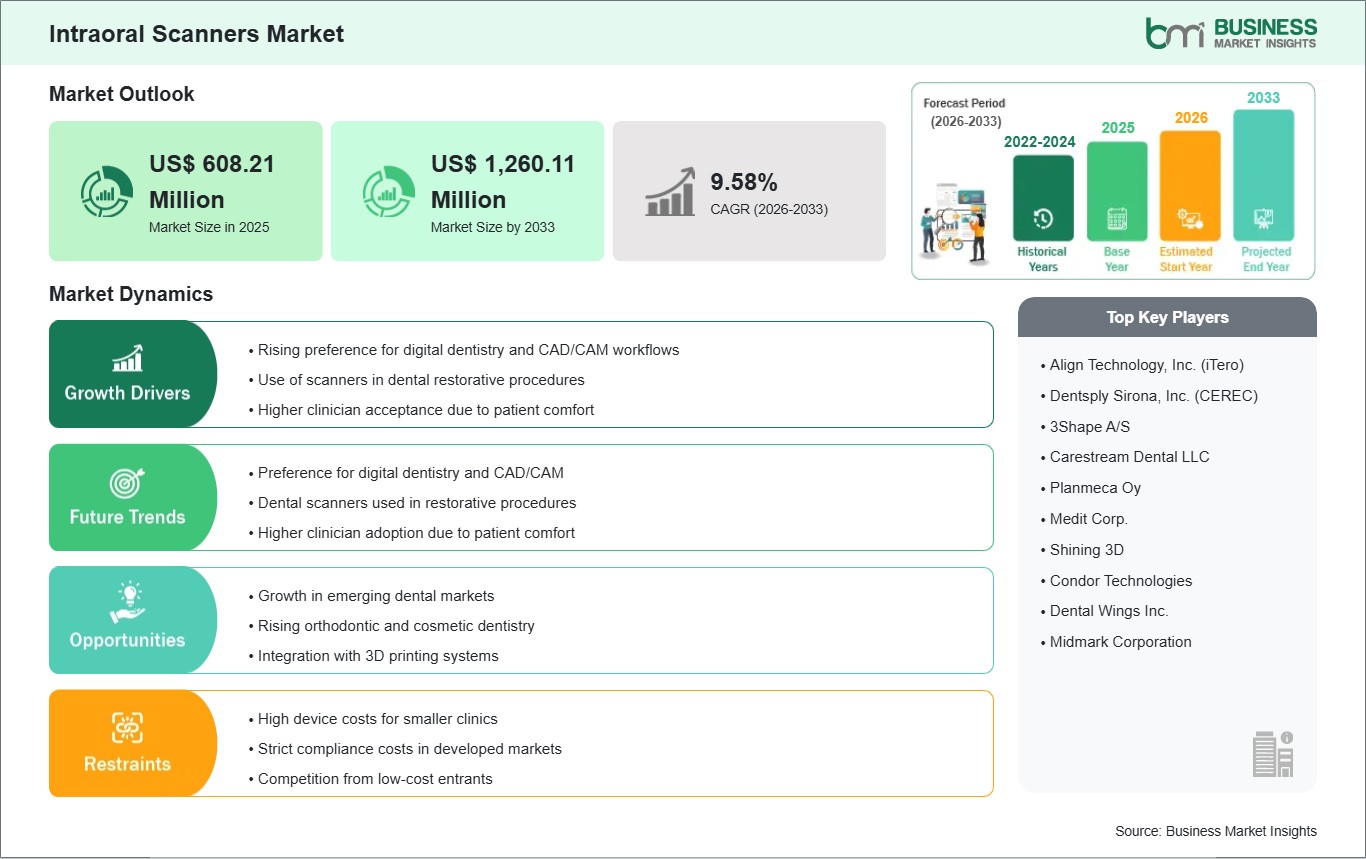
The intraoral scanners market size is expected to reach US$ 1,260.11 million by 2033 from US$ 608.21 million in 2025. The market is estimated to record a CAGR of 9.58% from 2026 to 2033.
In modern dentistry intraoral scanners enable dental professionals to create accurate digital dental impressions of patients' teeth and oral structures without using traditional mold systems. The devices create three-dimensional images which dental professionals use to conduct restorative dentistry and orthodontics and dental implant planning and prosthodontics procedures. Intraoral scanners replace traditional impression materials to deliver better patient experiences which shorten treatment time while achieving higher precise results that decrease both errors and unnecessary follow-up treatments.
The global intraoral scanners market is experiencing significant growth due to the rising adoption of digital dentistry and increased demand for cosmetic and restorative dental procedures and the growing geriatric population who need advanced dental care. Dental practices now dedicate resources to digital solutions which will enhance their operational processes and improve patient satisfaction and achieve better clinical results. The market encounters obstacles because high equipment prices necessitate dedicated educational programs while existing dental software systems present challenges for system implementation. The market will experience continuous expansion because of technical advancements that improve scanning speed and imaging accuracy and software integration and affordable pricing which will occur in the following years.

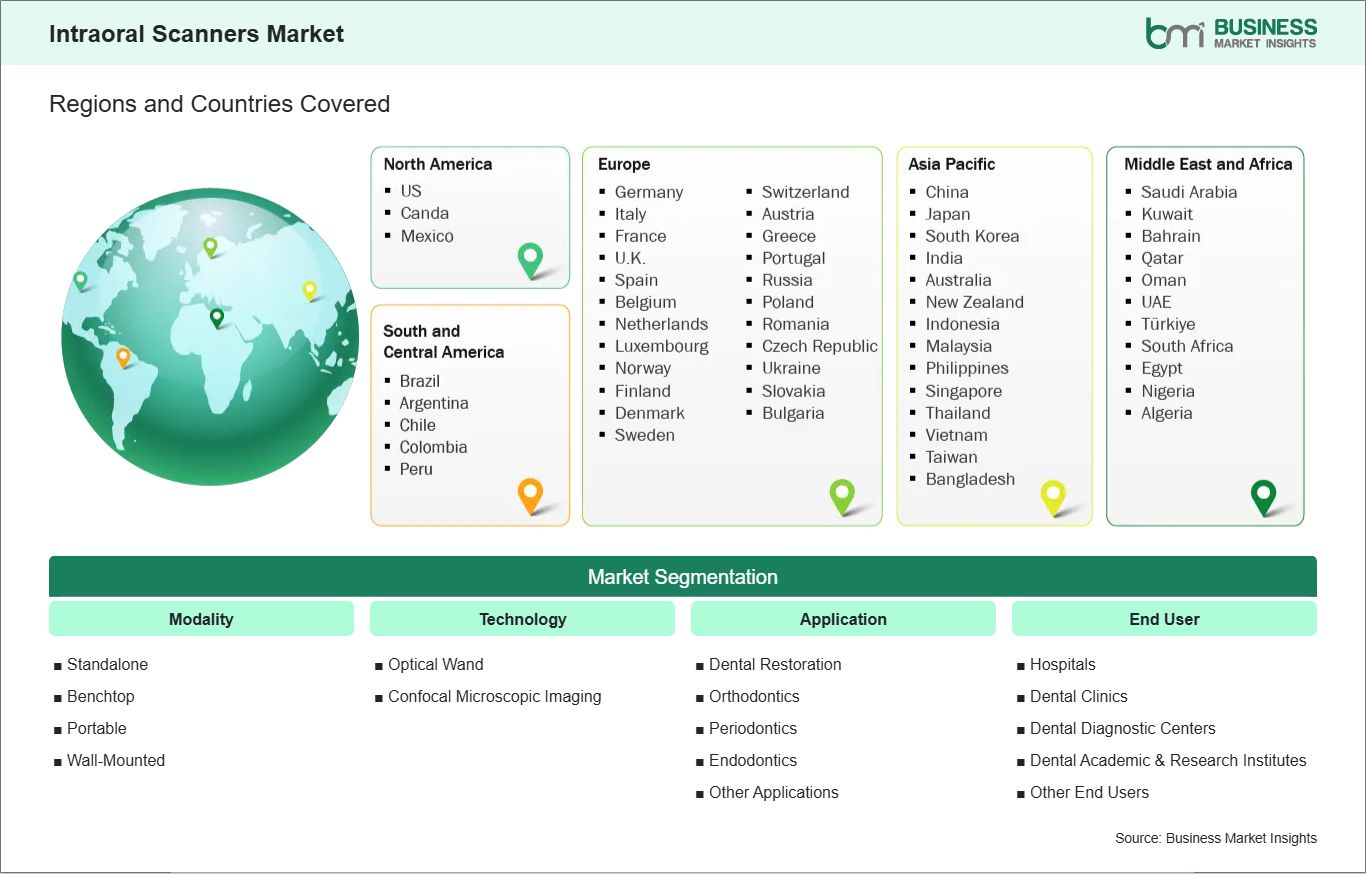
Key segments that contributed to the derivation of the intraoral scanners market analysis are modality, technology, application, and end user.
The growth of the intraoral scanners market results from two main factors which are the rising use of digital dentistry solutions and the increased emphasis on providing patient-centered care. Dental professionals are switching from traditional impression methods to digital scanning because three factors drive this shift which are rising oral health awareness and growing demand for cosmetic dentistry and need for fast and precise treatment planning. Intraoral scanners provide three main benefits which include decreased patient discomfort and elimination of impression material allergies and enhanced clinical accuracy that leads to higher treatment satisfaction.
The need for intraoral scanners increases because restorative and orthodontic procedures require multiple dental treatments which include crowns and bridges and aligners and implants. Digital impressions have become the preferred choice for dental clinics because they help with two main benefits which are error reduction and faster processing times and better communication with dental laboratories. The growth of chair-side procedures together with the rise of same-day restorations has led to increased use of advanced intraoral scanning systems which has resulted in continuous growth of the market.
The intraoral scanners market relies on technological innovation as its primary market driving force. The optical scanning technologies and structured light systems and laser scanning systems along with their software platforms have achieved enhancements in accuracy and speed and user accessibility. Dental professionals can plan and simulate and execute treatments with better accuracy because of the integration between CAD/CAM systems and cloud-based workflows and artificial intelligence algorithms.
The manufacturers create compact and wireless and ergonomic scanner designs to improve user experience across different clinical environments. The dental field now uses intraoral scanners for restorative dentistry and orthodontics and implantology and digital smile design. The rise of teledentistry together with virtual treatment planning has made intraoral scanners more important for remote and collaborative dental treatment methods.
By modality, the intraoral scanners market is segmented into standalone, benchtop, portable, and wall mounted. The standalone segment dominated the market in 2025. Ease of integration with CAD/CAM systems, high scanning accuracy, portability within clinics, independence from external imaging, cost-effectiveness, and growing adoption in digital dentistry procedures drive standalone scanners’ market dominance.
By technology, the intraoral scanners market is segmented into optical wand, confocal microscopic imaging. optical wand segment dominated the market in 2025. High precision and speed, non-invasive imaging, superior patient comfort, wide compatibility with restorative workflows, easy handling, and expanding adoption in orthodontics and restorative dentistry fuel optical wand technology leadership.
By application, the intraoral scanners market is segmented into dental restoration, orthodontics, periodontics, endodontics, and others. The dental restoration segment dominated the market in 2025. Rising demand for crowns, bridges, and veneers, faster chairside procedures, accuracy in prosthetic fabrication, adoption of digital workflows, growing aesthetic dentistry trends, and improved patient outcomes support dental restoration dominance.
By end user, the intraoral scanners market is segmented into hospitals, dental clinics, dental diagnostic centers, dental academic & research institutes, others. The dental clinics segment dominated the market in 2025. High patient volumes, focus on modern digital workflows, affordability of scanners for medium-sized practices, rapid ROI, ease of adoption, and increasing demand for restorative and orthodontic services drive clinic segment leadership.
| Report Attribute | Details |
|---|---|
| Market size in 2025 | US$ 608.21 Million |
| Market Size by 2033 | US$ 1,260.11 Million |
| Global CAGR (2026 - 2033) | 9.58% |
| Historical Data | 2022-2024 |
| Forecast period | 2026-2033 |
| Segments Covered | By Modality
|
|
Regions and Countries Covered
| |
| North America | US, Canada, Mexico |
| Europe | Belgium, Austria, Finland, Denmark, Greece, Poland, Romania, Russia, Ukraine, Czech Republic, Slovakia, Bulgaria, Italy, Luxembourg, Germany, Switzerland, France, Netherlands, Norway, Portugal, Spain, Sweden, United Kingdom |
| Asia-Pacific | Australia, China, India, Japan, South Korea, Indonesia, Malaysia, Philippines, Singapore, Thailand, Vietnam, Bangladesh, New Zealand, Taiwan |
| South and Central America | Brazil, Argentina, Peru, Chile, Colombia |
| Middle East and Africa | Bahrain, Kuwait, Oman, Qatar, Saudi Arabia, United Arab Emirates, Turkiye, South Africa, Egypt, Algeria, Nigeria |
| Market leaders and key company profiles |
|
The "Intraoral Scanners Market Size and Forecast (2022&2033)" report provides a detailed analysis of the market covering below areas:
The geographical scope of the intraoral scanners market report is divided into five regions: North America, Asia Pacific, Europe, Middle East & Africa, and South & Central America. The intraoral scanners market in Asia Pacific is expected to grow significantly during the forecast period.
The Asia-Pacific intraoral scanners market is segmented into China, Japan, South Korea, India, Australia, New Zealand, Indonesia, Malaysia, the Philippines, Singapore, Thailand, Vietnam, Taiwan, Bangladesh, and the Rest of Asia. The Asia-Pacific intraoral scanners market shows rapid growth because dental infrastructure improvements and healthcare spending increases and patient awareness of digital dentistry services. China Japan India South Korea and Australia are developing modern dental clinics which include advanced imaging systems and digital training programs for dental professionals. The market expansion potential exists because large populations and rising disposable incomes and government programs which promote oral health and preventive care create new business opportunities. The Asia-Pacific market for intraoral scanners will experience rapid growth because dental practices increasingly implement digital solutions to improve their operational performance and customer contentment.

The intraoral scanners market is evaluated by gathering qualitative and quantitative data post primary and secondary research, which includes important corporate publications, association data, and databases. A few of the key developments in the intraoral scanners market are:
The Intraoral Scanners Market is valued at US$ 608.21 Million in 2025, it is projected to reach US$ 1,260.11 Million by 2033.
As per our report Intraoral Scanners Market, the market size is valued at US$ 608.21 Million in 2025, projecting it to reach US$ 1,260.11 Million by 2033. This translates to a CAGR of approximately 9.58% during the forecast period.
The Intraoral Scanners Market report typically cover these key segments-
The historic period, base year, and forecast period can vary slightly depending on the specific market research report. However, for the Intraoral Scanners Market report:
The Intraoral Scanners Market is populated by several key players, each contributing to its growth and innovation. Some of the major players include:
The Intraoral Scanners Market report is valuable for diverse stakeholders, including:
Essentially, anyone involved in or considering involvement in the Intraoral Scanners Market value chain can benefit from the information contained in a comprehensive market report.
Please tell us your area of interest
(Market Segments/ Regions and Countries/ Companies)