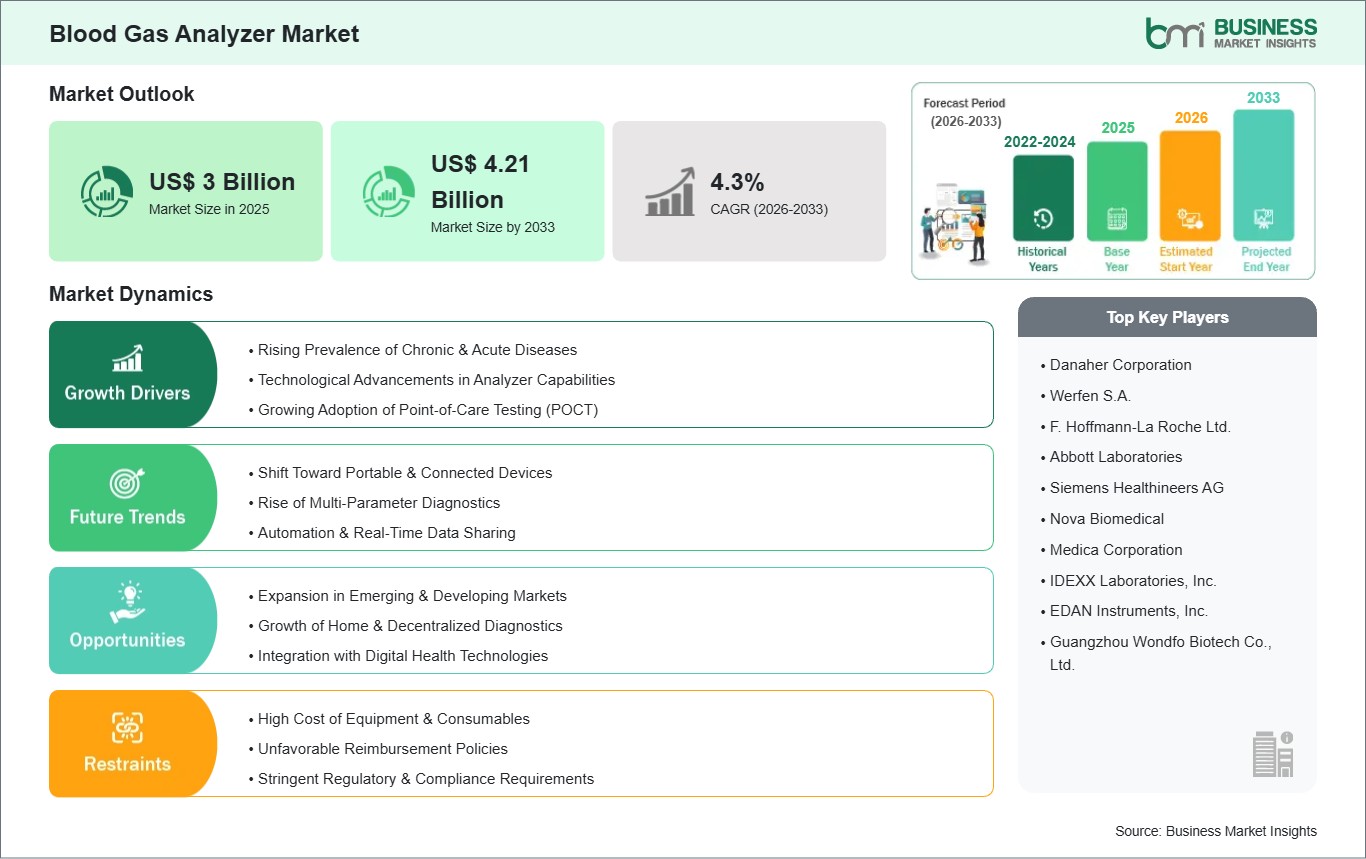
The Blood Gas Analyzer Market size is expected to reach US$ 4.21 Billion in 2033 from US$ 3 Billion in 2025. The market is estimated to record a CAGR of 4.3% from 2026 to 2033.
Blood Gas Analyzers are pivotal diagnostic devices that allow determining blood's oxygen, carbon dioxide, and pH levels among other important parameters in a very quick and accurate manner thus providing quick insight into respiratory, metabolic, and electrolyte status of the patient. These scientists are indispensable in hospitals, intensive care units, emergency rooms, and laboratories, where they assist doctors in making quick decisions regarding patients with respiratory issues, heart diseases, metabolic disorders, and critical conditions. Blood Gas Analyzers come with the benefits of rapid tests, a small amount of blood required, and very accurate results which all together allow for proper patient management and good clinical outcomes. The market expansion is attributed to the worldwide increase in the number of patients suffering from chronic diseases, the demand for testing at the patient's side growing, and the development of portable and automated devices that make the testing easier. Technological updates like the incorporation of data management with varying wireless connectivity, and the reduction in the size of the devices are other factors that are improving the quality and speed of diagnostics.
However, the market is under the pressure of certain factors, including expensive equipment, needing expert workers, and strict quality control of the products. Besides, different reimbursement practices from region to region and the risk of making mistakes while handling samples might also be an impediment to the adoption. Nevertheless, the market is very attractive since the demand for bedside diagnostics is increasing, the healthcare infrastructure in developing countries is also expanding, and the knowledge of the advantages of rapid blood gas monitoring is becoming more widespread. Furthermore, the collaboration with digital health platforms, telemedicine, and AI-based analytics will be a core factor for adoption and innovation thus generating new opportunities for growth in the market

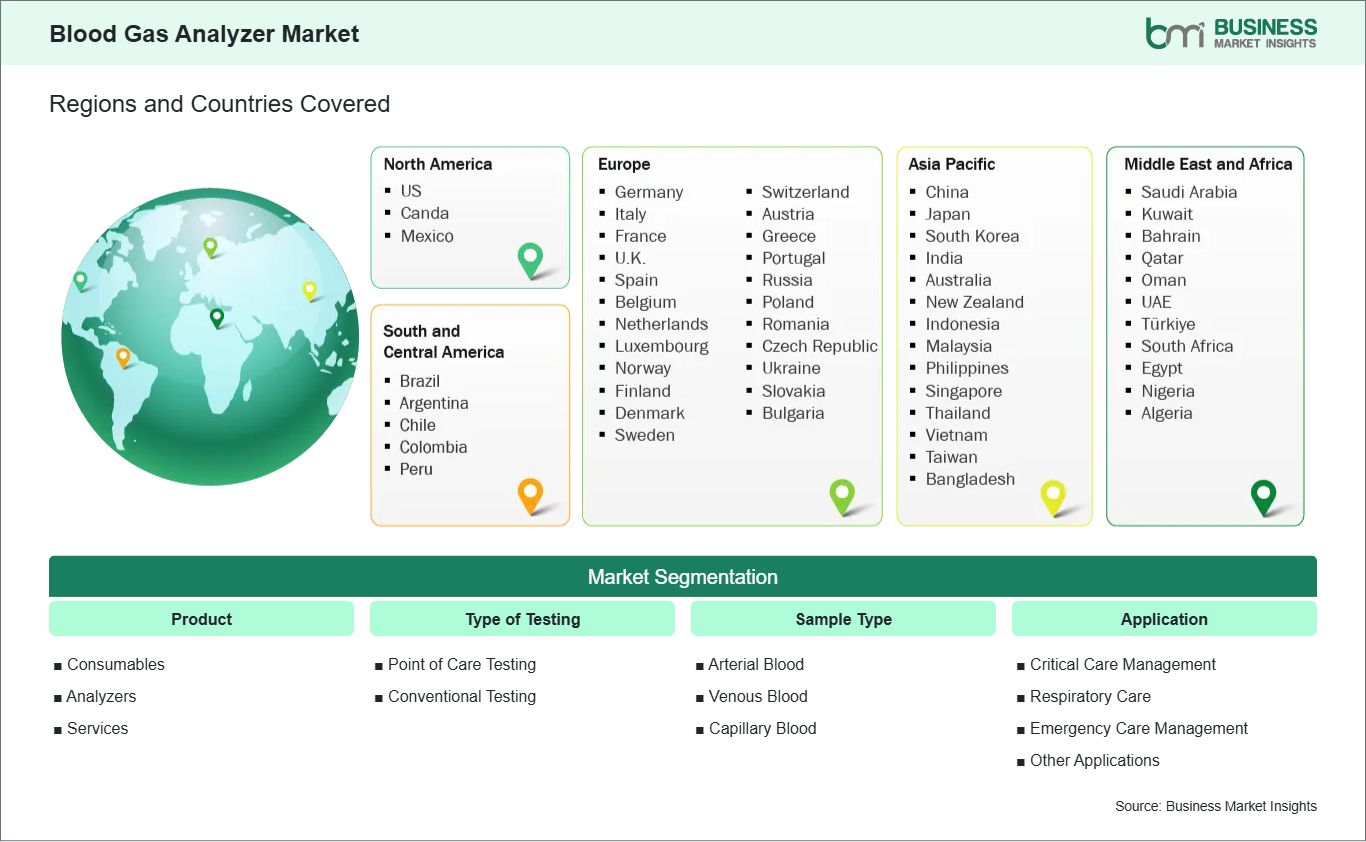
Key segments that contributed to the derivation of the Blood Gas Analyzer market analysis are Product, Type of Testing, Sample Type, Application, End User.
The rising occurrence of both chronic and critical health problems has turned out to be the main factor propelling the blood gas analyzer market to grow. The doctor will be able to prescribe the right treatment and thus prevent complications by doing blood gas level monitoring for patients with diseases like COPD, heart problems, diabetes, and lung infections. The WHO (World Health Organization) predicts global health in the year 2025 and estimates that COPD will have a global patient base of over 400 million, while the number of deaths caused by heart diseases will still be the highest, approximately 18 million per year. The situation in hospitals and intensive care units with more and more patients and sudden medical emergencies has led to a great demand for fast, trustworthy, and point-of-care diagnostic tools. The blood gas analyzers, with their quality of providing the real-time readings for oxygen, carbon dioxide, pH, and electrolyte levels, are very important in treating these diseases rapidly and efficiently. Compared to traditional laboratory tests, these machines grant the possibility of immediate clinical decision-making, which in turn leads to better patient outcomes, shorter hospital stays, and critical interventions supported, the latter being essential in intensive care and emergency settings.
The technological innovations and the use of blood gas analyzers in point-of-care (POC) contexts have opened up a significant market opportunity. The latest analyzers are being designed to be more and more portable, automated, and user-centered, thus enabling the healthcare providers to carry out fast testing at the patient's bedside, in ambulances, or in far-flung medical facilities. For instance, the cutting-edge gadgets come with wireless connectivity, cooperation of data management systems, and AI-led diagnostics that smoothen the processes and lessen the chances of human error. Hospitals and clinics are more and more accepting of these solutions because they believe that it will help them with workflow efficiency, lessen the time between tests and results, and support telehealth. Moreover, the demand for less invasive and quicker tests in developing countries is going up because of better healthcare facilities and more people being educated about the latest monitoring methods. All these developments are being seen as potential pick-ups for blood gas analyzer manufacturers and vendors and thus the market is rid of prospects of expansion in both developed and developing regions.
By product, the Blood Gas Analyzer market is segmented into consumables, analyzers, and services. The consumables segment dominated the market in 2025. High-frequency usage of cartridges, reagents, and electrodes drives repeat demand, making consumables the largest revenue contributor for routine and continuous blood gas testing in healthcare facilities
By type of testing, the market is bifurcated into Point of Care (PoC) Testing and Conventional Testing. The Point of Care (PoC) Testing segment held the largest share of the market in 2025. PoC analyzers provide rapid results at the patient’s bedside, enabling immediate clinical decisions, critical for emergencies and intensive care settings, boosting adoption over conventional lab testing.
By sample type, the market is divided into arterial blood, venous blood, and capillary blood. The arterial blood segment held the largest share of the market in 2025. Arterial samples provide the most accurate representation of oxygenation, carbon dioxide, and pH levels, making them the preferred choice for critical care and respiratory monitoring applications.
By application, the market is divided into critical care management, respiratory care, emergency care management, and other applications. The critical care management segment held the largest share of the market in 2025. Blood gas analyzers are essential in ICUs and emergency departments to monitor critically ill patients, guide interventions, and prevent complications, driving the largest market share in this application.
By end user, the market is segmented into hospitals & ambulatory surgical centers (ASCs), clinics, and other end users. The hospitals & ambulatory surgical centers (ASCs), segment held the largest share of the market in 2025. Hospitals and ambulatory surgical centers manage high patient volumes with critical and emergency cases, requiring frequent blood gas analysis, making them the largest end-user segment
| Report Attribute | Details |
|---|---|
| Market size in 2025 | US$ 3 Billion |
| Market Size by 2033 | US$ 4.21 Billion |
| Global CAGR (2026 - 2033) | 4.3% |
| Historical Data | 2022-2024 |
| Forecast period | 2026-2033 |
| Segments Covered | By Product
|
|
Regions and Countries Covered
| |
| North America | US, Canada, Mexico |
| Europe | Belgium, Austria, Finland, Denmark, Greece, Poland, Romania, Russia, Ukraine, Czech Republic, Slovakia, Bulgaria, Italy, Luxembourg, Germany, Switzerland, France, Netherlands, Norway, Portugal, Spain, Sweden, United Kingdom |
| Asia-Pacific | Australia, China, India, Japan, South Korea, Indonesia, Malaysia, Philippines, Singapore, Thailand, Vietnam, Bangladesh, New Zealand, Taiwan |
| South and Central America | Brazil, Argentina, Peru, Chile, Colombia |
| Middle East and Africa | Bahrain, Kuwait, Oman, Qatar, Saudi Arabia, United Arab Emirates, Turkiye, South Africa, Egypt, Algeria, Nigeria |
| Market leaders and key company profiles |
|
The "Blood Gas Analyzer Market Size and Forecast (2022 - 2033)" report provides a detailed analysis of the market covering below areas:
The geographical scope of the Blood Gas Analyzer market report is divided into five regions: North America, Asia Pacific, Europe, Middle East & Africa, and South & Central America. The Blood Gas Analyzer market in Asia Pacific is expected to grow significantly during the forecast period.
The Asia-Pacific Blood Gas Analyzer market is segmented into China, Japan, South Korea, India, Australia, New Zealand, Indonesia, Malaysia, the Philippines, Singapore, Thailand, Vietnam, Taiwan, Bangladesh, and the Rest of Asia. The region is experiencing robust growth, driven by the rising prevalence of chronic and critical illnesses, increasing hospital admissions, and growing awareness of point-of-care testing benefits. Major economies like China, India, and Japan are leading the way, fueled by expanding healthcare infrastructure, strategic government healthcare initiatives, and rising investments in modern medical devices.
The region is also witnessing increased adoption of advanced diagnostic technologies, including portable analyzers, automated testing systems, and wireless-integrated devices particularly relevant for intensive care, emergency care, and respiratory monitoring applications. Hospitals and clinics are upgrading their diagnostic capabilities to enhance workflow efficiency, reduce turnaround times, and support critical care decision-making. Additionally, the expansion of telemedicine services, growth in private and public healthcare spending, and rising demand for minimally invasive and rapid diagnostics are positioning Asia-Pacific as a key hub for blood gas analyzer adoption. Government programs aimed at improving critical care accessibility, combined with increasing awareness among healthcare professionals, further solidify the region’s dominant market position

The Blood Gas Analyzer market is evaluated by gathering qualitative and quantitative data post primary and secondary research, which includes important corporate publications, association data, and databases. A few of the key developments in the Blood Gas Analyzer market are:
The Blood Gas Analyzer Market is valued at US$ 3 Billion in 2025, it is projected to reach US$ 4.21 Billion by 2033.
As per our report Blood Gas Analyzer Market, the market size is valued at US$ 3 Billion in 2025, projecting it to reach US$ 4.21 Billion by 2033. This translates to a CAGR of approximately 4.3% during the forecast period.
The Blood Gas Analyzer Market report typically cover these key segments-
The historic period, base year, and forecast period can vary slightly depending on the specific market research report. However, for the Blood Gas Analyzer Market report:
The Blood Gas Analyzer Market is populated by several key players, each contributing to its growth and innovation. Some of the major players include:
The Blood Gas Analyzer Market report is valuable for diverse stakeholders, including:
Essentially, anyone involved in or considering involvement in the Blood Gas Analyzer Market value chain can benefit from the information contained in a comprehensive market report.
Please tell us your area of interest
(Market Segments/ Regions and Countries/ Companies)