Blood Collection Market Outlook (2022-2033)

Historic Data: 2022-2024   |   Base Year: 2025   |   Forecast Period: 2026-2033
Report Content: Market Scope, Market Segmentation, Market Dynamics, and Competitive Analysis

Report Coverage:
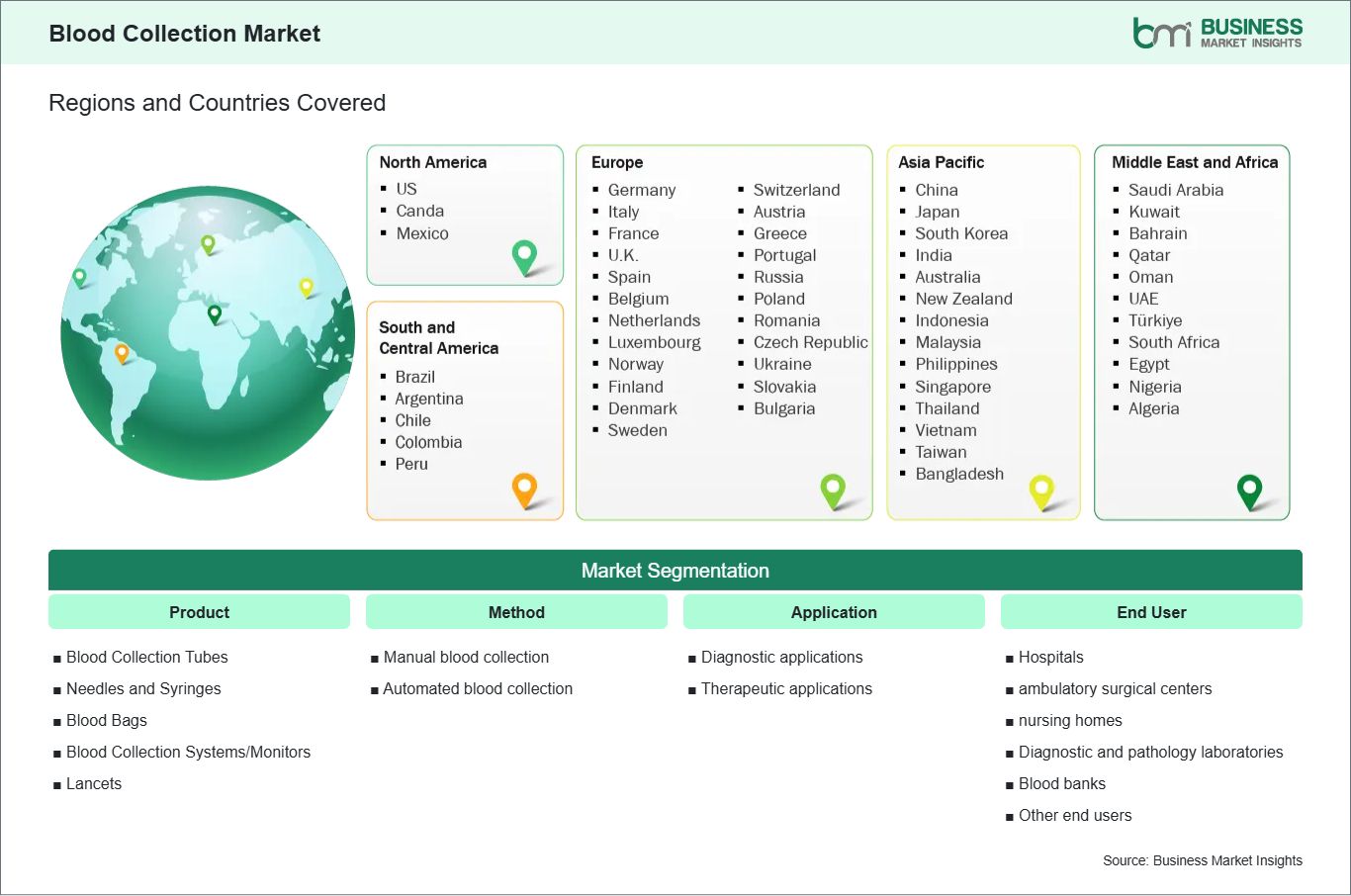
  • Product (Blood Collection Tubes, Needles and Syringes, Blood Bags, Blood Collection Systems/Monitors, Lancets)
  • Method (Manual blood collection, Automated blood collection)
  • Application (Diagnostic applications, Therapeutic applications)
  • End User (Hospitals, ambulatory surgical centers (ASCs), and nursing homes, Diagnostic and pathology laboratories, Blood banks, Other end users)

No. of Pages: 400
Report Code: BMIPUB00033207
Category: Life Sciences
Blood Collection Market

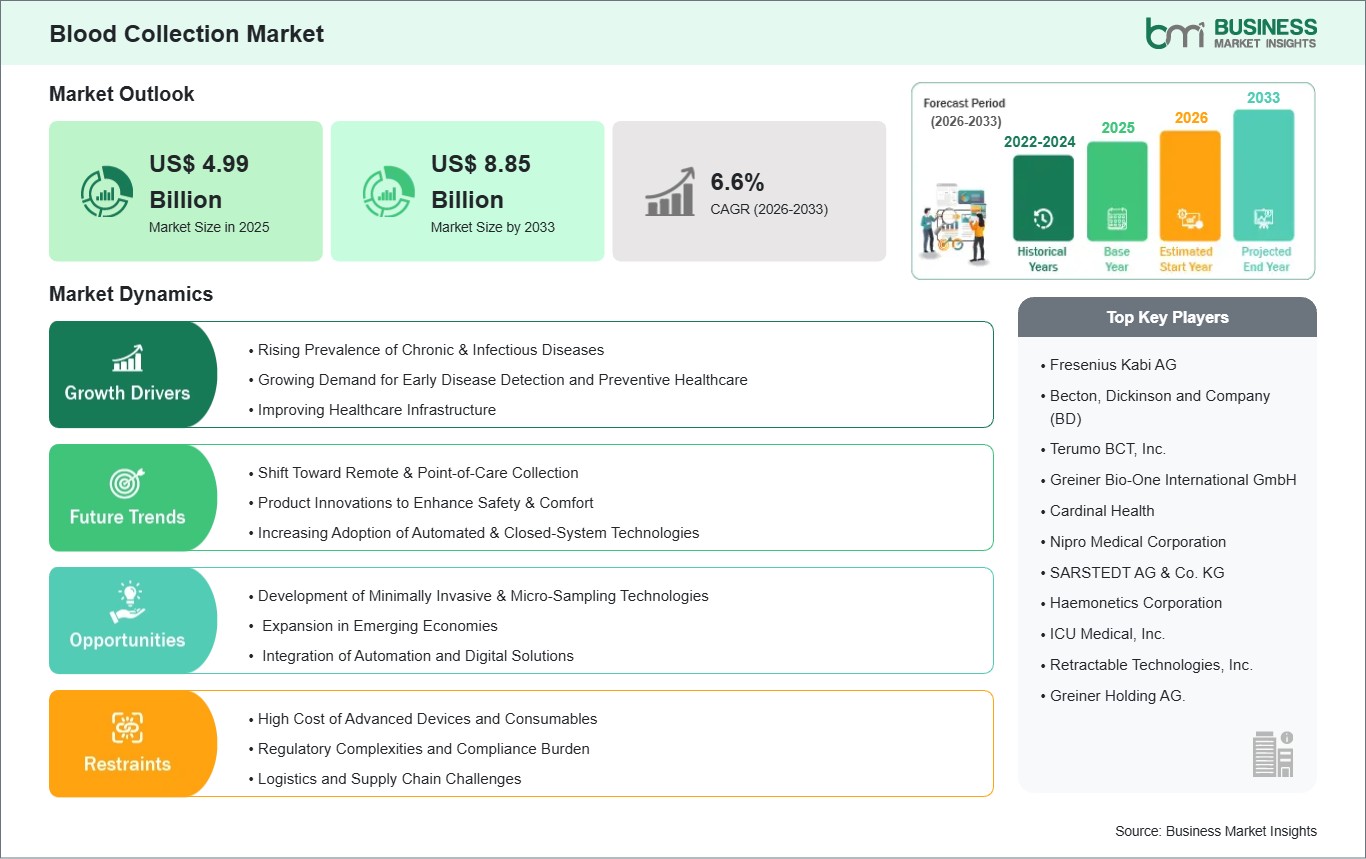
The Blood Collection Market size is expected to reach US$ 8.85 Billion in 2033 from US$ 4.99 Billion in 2025. The market is estimated to record a CAGR of 6.6% from 2026 to 2033.

Executive Summary and Global Market Analysis:

The collection of blood is a significant aspect of different freight transport services that offer rapid and guaranteed delivery even over long distances. They are required in sectors such as pharmaceuticals, electronics, automotive, perishables, and e-commerce. Air freight carries a number of benefits, which include quick delivery times, lower chances of damage, and providing access to inaccessible and landlocked regions. Rising international freight volumes, growth of cross-border e-commerce, and increased demand for just-in-time inventory solutions drive the market. In addition, advancements in freight monitoring and cold chain solutions have improved service deliverables.

However, certain factors may impede the development of the market. These include high fuel prices, restricted carry capacity in passenger carriers, and complexities in regulations on international borders. The market is also prone to economic uncertainties in the form of geopolitical issues or pandemics. Despite this backdrop, the market presents immense opportunities with the growing need for temperature-controlled products, trade route development in developing nations, and the adoption of online freight management systems. The development of green logistics and sustainable aviation fuel also presents opportunities to tap in the market

Blood Collection Market - Strategic Insights:

global-market-strategic-framework
Get more information on this report

Blood Collection Market Segmentation Analysis:

Key segments that contributed to the derivation of the blood collection market analysis are Product, Method, Application, End User.

  • By Product, the blood collection market is segmented into blood collection tubes, needles and syringes, blood bags, blood collection systems/monitors, lancets. The blood collection tubes segment dominated the market in 2025.
  • By Method, the market is segmented into manual blood collection and automated blood collection. The manual blood collection segment held a larger share of the market in 2025.
  • By Application, the market is bifurcated into diagnostic applications and therapeutic applications. The diagnostic applications segment held a larger share of the market in 2025.   
  • By end user, the market is segmented into Hospitals, ambulatory surgical centers (ASCs), and nursing homes, Diagnostic and pathology laboratories, Blood banks, and other end users. The hospitals, ambulatory surgical centers (ASCs), and nursing homes segment held the largest share of the market in 2025

Blood Collection Market Drivers and Opportunities:

Rising Prevalence of Chronic and Infectious Diseases  

Chronic and infectious disease prevalence is one of the main drivers for revenue growth in the blood collection market. With the ageing population and a growing number of individuals suffering from lifestyle-related health issues (such as diabetes, heart disease and cancer), healthcare providers require testing of blood specimens multiple times over the life cycle of the patient to aid in diagnosing, monitoring, and treating their condition(s). A recent WHO (2024) global health estimate indicates that there are currently approximately 1.3 billion people around the world suffering from chronic diseases, in addition to the millions of annual cases associated with infectious diseases. Thus, increased demand for blood collection due to a growing number of chronically and acutely ill patients supports growth in the blood collection markets who provide hospitals, laboratories and blood banks with ways to efficiently collect specimens for increasing patient testing volumes.

Due to their ongoing expansion in international markets, major healthcare networks (such as Quest Diagnostics, Labcorp, and Roche Diagnostics) have increased demand for advanced blood collection devices to ensure sample integrity and eliminate contamination while increasing workflow efficiency. In addition to providing an automated way of collecting blood, the automated blood collection systems, safety-engineered needles, and customized blood bags are designed specifically for use in high-volume testing environments, making them ideally suited to satisfy the needs of laboratories where speed, accuracy, and safety are top priorities. Unlike traditional manual collection techniques, modern collection methods allow healthcare providers to collect large volumes of samples while still maintaining the quality of those samples, thereby providing healthcare professionals with the ability to perform both everyday diagnostic work and emergency interventions.

Growth of At-Home and Remote Blood Collection

The growth of at-home and remote blood collection represents a major opportunity for blood collection market. Increased adoption of home healthcare, telemedicine, and decentralized clinical testing is leading to demand for blood collection methods that are convenient and friendly to the patients. At-home blood collection devices such as fingerstick kits, microsampling tools, and dried blood spot (DBS) cards, allow patients to take samples without going to hospitals or labs, hence, accessibility and compliance are improved.

Moreover, this trend is also influenced by the increase in the number of people suffering from chronic diseases, aging population, and the necessity of regular diagnostic monitoring. Healthcare providers as well as laboratories gain reduction in operational burden and better workflow efficiency, whereas patients are provided with more convenience and less risk of contracting infections associated with healthcare. What is more, advancements in sample stabilization technologies, logistics, and digital health integration are further improving the dependability and large-scale use of remote blood collection. Consequently, as healthcare systems will more and more turn to patient-centric and decentralized care models, the market will see steady growth in the demand for innovative at-home blood collection products, as well as the creation of new revenue opportunities for the players in the market

Blood Collection Market Size and Share Analysis:

By Product, the blood collection market is segmented into blood collection tubes, needles and syringes, blood bags, blood collection systems/monitors, lancets. The blood collection tubes segment dominated the market in 2025. Blood collection tubes dominate due to their ease of use, compatibility with automated analyzers, ability to preserve sample integrity, and suitability for high-volume diagnostic testing, making them essential for hospitals, laboratories, and blood banks worldwide.

By Method, the market is segmented into manual blood collection and automated blood collection. The manual blood collection segment held a larger share of the market in 2025. Manual blood collection leads the market because it is cost-effective, simple, and versatile, suitable for small clinics, rural healthcare centers, emergency situations, and blood donation drives where automated systems may not be feasible or available.

By Application, the market is bifurcated into diagnostic applications and therapeutic applications. The diagnostic applications segment held a larger share of the market in 2025. Diagnostic applications dominate as routine blood testing for disease detection, monitoring, and preventive care is consistently high, requiring reliable and accurate sample collection across hospitals, laboratories, and research centers, driving substantial demand for blood collection products.

By end user, the market is segmented into Hospitals, ambulatory surgical centers (ASCs), and nursing homes, Diagnostic and pathology laboratories, Blood banks, and other end users. The hospitals, ambulatory surgical centers (ASCs), and nursing homes segment held the largest share of the market in 2025. Hospitals, ASCs, and nursing homes hold the largest share due to high patient volumes, frequent surgical procedures, emergency care, and ongoing diagnostic testing, necessitating extensive blood collection supplies to ensure timely, safe, and accurate sample collection

Blood Collection Market Report Highlights:

Report Attribute Details
Market size in 2025 US$ 4.99 Billion
Market Size by 2033 US$ 8.85 Billion
Global CAGR (2026 - 2033)6.6%
Historical Data 2022-2024
Forecast period 2026-2033
Segments Covered By Product
  • Blood Collection Tubes
  • Needles and Syringes
  • Blood Bags
  • Blood Collection Systems/Monitors
  • Lancets
By Method
  • Manual blood collection
  • Automated blood collection
By Application
  • Diagnostic applications
  • Therapeutic applications
By End User
  • Hospitals
  • ambulatory surgical centers
  • nursing homes
  • Diagnostic and pathology laboratories
  • Blood banks
  • Other end users
Regions and Countries Covered
North America US, Canada, Mexico
Europe Belgium, Austria, Finland, Denmark, Greece, Poland, Romania, Russia, Ukraine, Czech Republic, Slovakia, Bulgaria, Italy, Luxembourg, Germany, Switzerland, France, Netherlands, Norway, Portugal, Spain, Sweden, United Kingdom
Asia-Pacific Australia, China, India, Japan, South Korea, Indonesia, Malaysia, Philippines, Singapore, Thailand, Vietnam, Bangladesh, New Zealand, Taiwan
South and Central America Brazil, Argentina, Peru, Chile, Colombia
Middle East and Africa Bahrain, Kuwait, Oman, Qatar, Saudi Arabia, United Arab Emirates, Turkiye, South Africa, Egypt, Algeria, Nigeria
Market leaders and key company profiles
  • Fresenius Kabi AG
  • Becton, Dickinson and Company (BD)
  • Terumo BCT, Inc.
  • Greiner Bio-One International GmbH
  • Cardinal Health
  • Nipro Medical Corporation
  • SARSTEDT AG & Co. KG
  • Haemonetics Corporation
  • ICU Medical, Inc.
  • Retractable Technologies, Inc.
Get more information on this report

Blood Collection Market Report Coverage and Deliverables:

The "Blood Collection Market Size and Forecast (2022 - 2033)" report provides a detailed analysis of the market covering below areas:

  • Blood Collection market size and forecast at global, regional, and country levels for all the key market segments covered under the scope
  • Blood Collection market trends, as well as market dynamics such as drivers, restraints, and key opportunities
  • Blood Collection market analysis covering key market trends, global and regional framework, major players, regulations, and recent market developments
  • Industry landscape and competition analysis covering market concentration, heat map analysis, prominent players, and recent developments for the blood collection market
  • Detailed company profiles, including SWOT analysis

Blood Collection Market Geographic Insights:

The Blood Collection Market is segmented geographically into North America, Asia Pacific, Europe, Middle East & Africa, and South & Central America, each exhibiting distinct growth drives and market dynamics. The Asia Pacific Blood Collection Market is projected to expand rapidly during the forecast period, supported by rising healthcare access, growing diagnostic demand, and increased adoption of advanced blood collection technologies. Major countries like China and India are at the forefront, driven by expanding hospital infrastructure, government-driven blood donation initiatives, and increasing prevalence of chronic diseases that require frequent testing.

Demand for blood collection products and services is being considerably driven across the Asia Pacific region by the significant rise in hospital outpatient testing, molecular diagnostics and safety devices usage. Urbanization and the directing of private healthcare networks are advantages for the emerging Southeast Asian and Oceania markets, while the integration of automation and AI-enabled lab systems is at its peak in Japan and South Korea.

North America market is still the leader in blood collection products and services due to the presence of well-established healthcare systems, high volume of diagnostic procedures and strong penetration of advanced safety-engineered collection devices. The United States has the major share and is backed by the highest chronic disease screening, a lot of surgical procedures and the widespread use of automation in clinical laboratories. Nevertheless, Canada and Mexico are also players in the regional growth through their expanding diagnostic testing and hospital services.

The European market is the second largest contributor to the blood collection products segment. The combination of a well-established healthcare system, a high degree of laboratory automation, and the most stringent regulations ensuring the safety and effectiveness of blood collection practices is what keeps Europe so dominant in the blood collection products market. The major countries in this respect are Germany, the UK, France, Italy, and Spain, where the demand is driven mainly by the diagnostics of chronic diseases and blood draws in hospitals.

The Middle East and Africa are slowly but surely coming up the ladder, and the main drivers are increasing healthcare investments and the awareness created by government-sponsored blood donation drives. The primary markets are Saudi Arabia, the UAE, and South Africa, where the growth in demand for diagnostics, safety devices, and better laboratory infrastructure are pushing the market up, though the growth is from a smaller base than in the case of developed regions.   


In South & Central America, emerging healthcare infrastructure, rising insurance penetration, and increasing chronic disease prevalence are enhancing demand for blood collection solutions. Brazil and Mexico are primary contributors, with growing adoption of automated blood collection systems and broader diagnostic testing services improving regional market prospects

global-market-geography
Get more information on this report

Blood Collection Market Research Report Guidance:

  • The report includes qualitative and quantitative data in the Blood Collection market across product, method, application, end user, and geography.
  • The report starts with the key takeaways (chapter 2), highlighting the key trends and outlook of the Blood Collection market.
  • Chapter 3 includes the research methodology of the study.
  • Chapter 4 further includes ecosystem analysis.
  • Chapter 5 highlights the major industry dynamics in the Blood Collection market, including factors that are driving the market, prevailing deterrents, potential opportunities, as well as future trends. Impact analysis of these drivers and restraints is also covered in this section.
  • Chapter 6 discusses the Blood Collection market scenario, in terms of historical market revenues, and forecast till the year 2031.
  • Chapters 7 to 10 cover Blood Collection market segments by product, method, application, end user, and geography across North America, Europe, Asia Pacific, Middle East and Africa, and South and Central America. They cover the market volume revenue forecast and factors driving the market.
  • Chapter 11 describes the competitive analysis along with the heat map analysis for the key players operating in the market.
  • Chapter 12 describes the industry landscape analysis. It provides detailed descriptions of business activities such as market initiatives, new developments, mergers, and joint ventures globally, along with a competitive landscape.
  • Chapter 13 provides detailed profiles of the major companies operating in the Blood Collection market. Companies have been profiled on the basis of their key facts, business descriptions, products and services, financial overview, SWOT analysis, and key developments.
  • Chapter 14, i.e., the appendix is inclusive of a brief overview of the company, list of abbreviations, and disclaimer.

Blood Collection Market News and Key Development:

The Blood Collection market is evaluated by gathering qualitative and quantitative data post primary and secondary research, which includes important corporate publications, association data, and databases. A few of the key developments in the air cargo services market are:

  • In December 2025, Hims and Hers to Acquire YourBio Health, Pioneer Behind Advanced, Pain-Free Blood Sampling Technology.
  • In August 2024, Medical Technology and Devices (MTD) announced the successful closing of the acquisition of Ypsomed’s Pen Needles and Blood Glucose Monitoring Systems (BGM) businesses, a strategic acquisition initially announced at the end of March. This acquisition marks a major step forward in MTD’s mission to provide superior diabetes and obesity care solutions on a global scale.
  • In December 2024, GVS S.p.A., a global leader in advanced filtration solutions, announced a binding agreement to acquire Haemonetics Corporation’s Transfusion Medicine business. This acquisition marks a significant milestone for GVS as it strengthens its position in the healthcare filtration sector and expands its global reach.

Key Sources Referred:

  • World Bank Global Trade Indicators
  • American Medical Association (AMA)
  • National Center for Biotechnology Information (NCBI)
  • National Library of Medicine (NLM)
  • Centers for Disease Control and Prevention (CDC)
  • Company website
  • National Institutes of Health (NIH)
  • International Hospital Federation (IHF)
  • Company annual reports
  • Company investor presentations
The List of Companies - Blood Collection Market
  • Fresenius Kabi AG
  • Becton, Dickinson and Company (BD)
  • Terumo BCT, Inc.
  • Greiner Bio-One International GmbH
  • Cardinal Health
  • Nipro Medical Corporation
  • SARSTEDT AG & Co. KG
  • Haemonetics Corporation
  • ICU Medical, Inc.
  • Retractable Technologies, Inc.
  • Greiner Holding AG.
Frequently Asked Questions
How big is the Blood Collection Market?

The Blood Collection Market is valued at US$ 4.99 Billion in 2025, it is projected to reach US$ 8.85 Billion by 2033.

What is the CAGR for Blood Collection Market by (2026 - 2033)?

As per our report Blood Collection Market, the market size is valued at US$ 4.99 Billion in 2025, projecting it to reach US$ 8.85 Billion by 2033. This translates to a CAGR of approximately 6.6% during the forecast period.

What segments are covered in this report?

The Blood Collection Market report typically cover these key segments-

  • Product (Blood Collection Tubes, Needles and Syringes, Blood Bags, Blood Collection Systems/Monitors, Lancets)
  • Method (Manual blood collection, Automated blood collection)
  • Application (Diagnostic applications, Therapeutic applications)
  • End User (Hospitals, ambulatory surgical centers (ASCs), and nursing homes, Diagnostic and pathology laboratories, Blood banks, Other end users)

What is the historic period, base year, and forecast period taken for Blood Collection Market?

The historic period, base year, and forecast period can vary slightly depending on the specific market research report. However, for the Blood Collection Market report:

  • Historic Period : 2022-2024
  • Base Year : 2025
  • Forecast Period : 2026-2033
  • Who are the major players in Blood Collection Market?

    The Blood Collection Market is populated by several key players, each contributing to its growth and innovation. Some of the major players include:

  • Fresenius Kabi AG
  • Becton, Dickinson and Company (BD)
  • Terumo BCT, Inc.
  • Greiner Bio-One International GmbH
  • Cardinal Health
  • Nipro Medical Corporation
  • SARSTEDT AG & Co. KG
  • Haemonetics Corporation
  • ICU Medical, Inc.
  • Retractable Technologies, Inc.
  • Greiner Holding AG.
  • Who should buy this report?

    The Blood Collection Market report is valuable for diverse stakeholders, including:

    • Investors: Provides insights for investment decisions pertaining to market growth, companies, or industry insights. Helps assess market attractiveness and potential returns.
    • Industry Players: Offers competitive intelligence, market sizing, and trend analysis to inform strategic planning, product development, and sales strategies.
    • Suppliers and Manufacturers: Helps understand market demand for components, materials, and services related to concerned industry.
    • Researchers and Consultants: Provides data and analysis for academic research, consulting projects, and market studies.
    • Financial Institutions: Helps assess risks and opportunities associated with financing or investing in the concerned market.

    Essentially, anyone involved in or considering involvement in the Blood Collection Market value chain can benefit from the information contained in a comprehensive market report.

    Available Report Formats

    pdf-format excel-format pptx-format
    Buy Now
    Sales Assistance
    +1 646 791 7070 (US & UK)
    Customization Form

    Please tell us your area of interest
    (Market Segments/ Regions and Countries/ Companies)