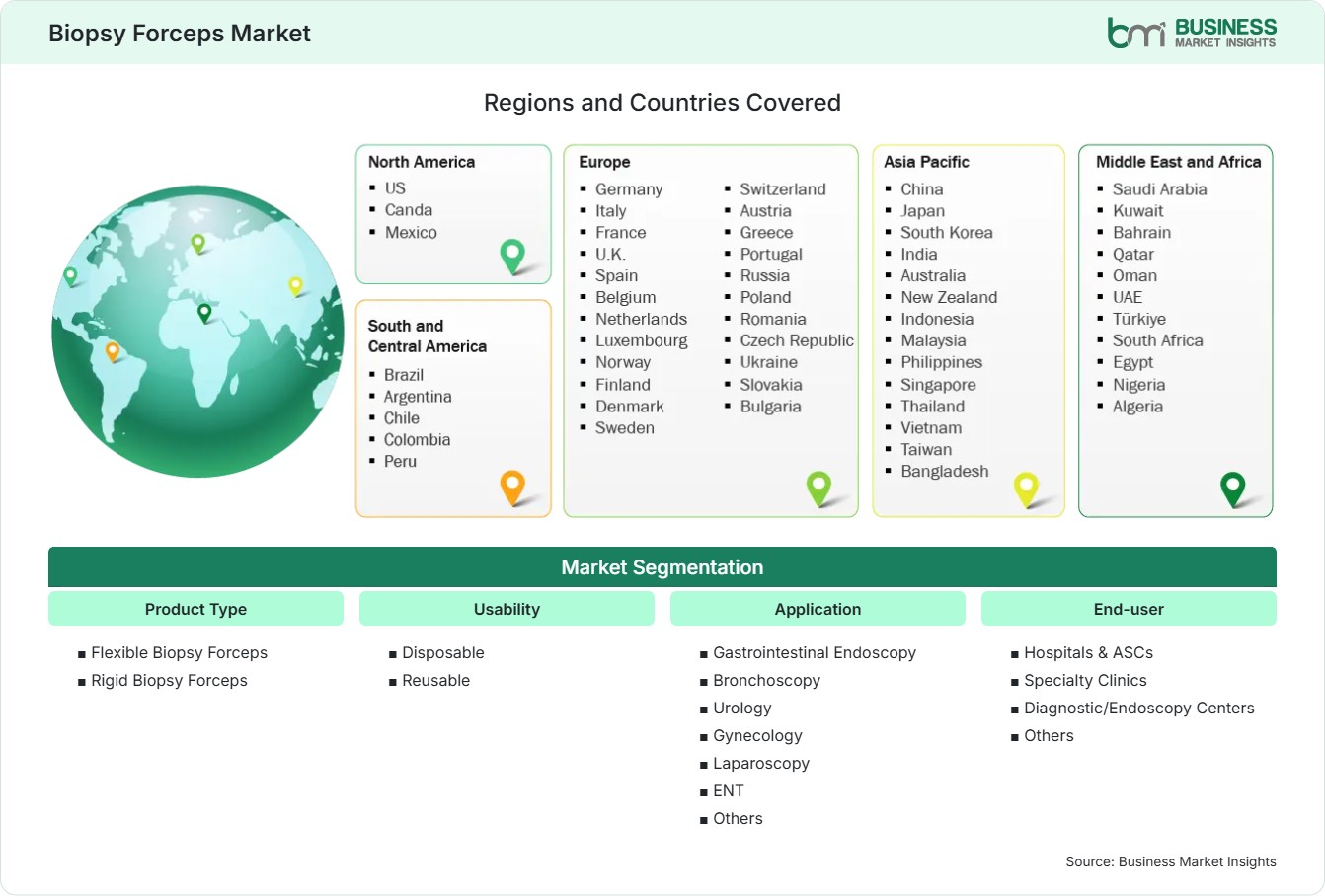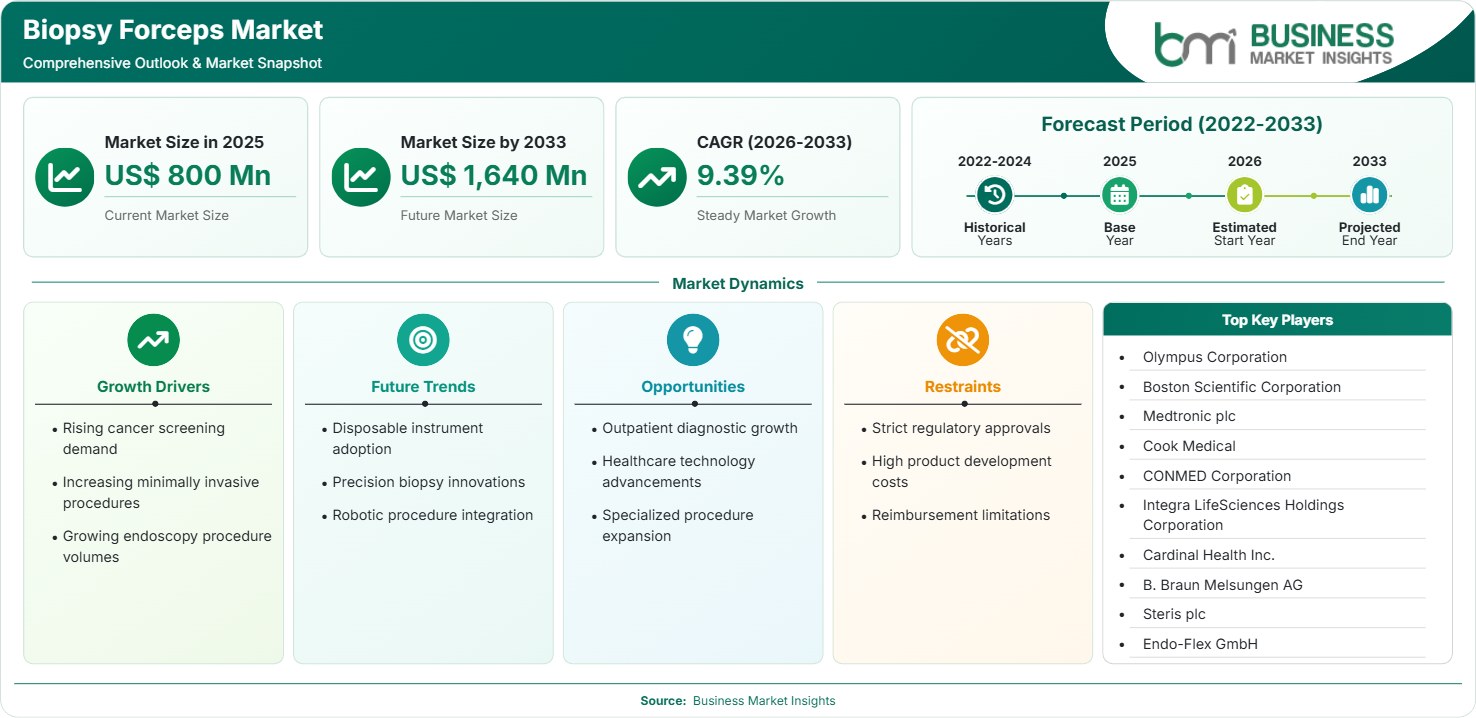
Biopsy Forceps Market Regional Highlights
North America Biopsy Forceps Market
North America accounted for 37%–40% of global revenue in 2025 and is projected to register a CAGR of 8.5%–9.2% during 2026–2033. The region benefits from high endoscopy procedure volumes, well-established healthcare infrastructure, favorable reimbursement systems, and strong adoption of advanced minimally invasive technologies. The Biopsy Forceps Market share remains the highest globally due to increasing colorectal cancer screening, growing bronchoscopy procedures, and widespread availability of specialized endoscopy centers.
- Hospitals and ambulatory surgical centers increasingly adopt high-performance disposable biopsy forceps to improve infection control while reducing device reprocessing requirements and operational complexity.
- Expanding colorectal cancer screening initiatives continue increasing gastrointestinal endoscopy procedures, supporting sustained demand for precision biopsy instruments across healthcare facilities.
- Healthcare providers increasingly invest in advanced endoscopy systems integrating high-definition visualization with precision tissue sampling technologies.
- Strong regulatory oversight encourages adoption of clinically validated biopsy devices meeting stringent safety, performance, and quality standards.
- Medical device manufacturers continue strengthening regional distribution networks and clinical education programs supporting wider physician adoption.
US Biopsy Forceps Market
The United States contributes approximately 30%–33% of global revenue in 2025 while expanding at a CAGR of 8.6%–9.3% through 2026–2033. Growing cancer awareness, expanding outpatient diagnostics, favorable reimbursement policies, and increasing adoption of minimally invasive procedures continue driving sustained market growth.
- Gastrointestinal cancer screening programs continue generating high procedural volumes requiring reliable tissue acquisition devices across hospitals and outpatient centers.
- Pulmonary diagnostics increasingly utilize advanced biopsy forceps during bronchoscopy procedures to improve early disease detection and diagnostic accuracy.
- Growing ambulatory surgery center expansion supports increasing demand for single-use biopsy devices with simplified workflow integration.
- Healthcare providers continue investing in advanced endoscopy platforms supporting improved visualization and precise tissue sampling.
Europe Biopsy Forceps Market
Europe represented 28%–31% of global market revenue in 2025 and is projected to grow at a CAGR of 9.0%–9.7% during 2026–2033. Strong public healthcare systems, increasing cancer screening initiatives, and expanding adoption of minimally invasive diagnostics continue driving regional demand. Germany remains the leading regional market, while Spain demonstrates one of the fastest growth rates.
- Germany maintains regional leadership through advanced hospital infrastructure, high procedural volumes, and continued investment in modern endoscopy technologies.
- Spain records robust growth supported by expanding outpatient diagnostics, healthcare modernization, and increasing awareness of preventive cancer screening programs.
- Growing preference for disposable biopsy forceps supports improved infection prevention and operational efficiency across healthcare facilities.
- Medical device innovation continues improving tissue sampling accuracy, ergonomic performance, and procedural safety for physicians.
- Increasing investment in hospital modernization supports broader adoption of advanced diagnostic instruments throughout Europe.
Asia Pacific Biopsy Forceps Market
Asia Pacific accounted for 24%–27% of global revenue in 2025 and is expected to register the fastest CAGR of 10.8%–11.6% during 2026–2033. The Biopsy Forceps Market growth is driven by expanding healthcare infrastructure, increasing endoscopy capacity, growing cancer incidence, and broader access to minimally invasive diagnostics. China leads regional demand, while India is projected to achieve the highest growth rate.
- China continues dominating regional demand through significant healthcare investment, hospital expansion, and increasing gastrointestinal diagnostic procedure volumes.
- India is anticipated to record a CAGR of 11.5%–12.3%, supported by expanding medical infrastructure, rising healthcare expenditure, and growing awareness of early cancer diagnosis.
- Japan and South Korea continue adopting technologically advanced biopsy devices supporting highly specialized diagnostic procedures.
- Expansion of private hospitals and specialty clinics accelerates procurement of advanced endoscopy instruments across emerging economies.
- Government initiatives supporting cancer screening programs continue strengthening long-term market demand throughout the region.
Rest of World Biopsy Forceps Market
The Rest of World region accounted for 7%–9% of global revenue in 2025 and is projected to grow at a CAGR of 9.4%–10.2% during 2026–2033.
South & Central America continues benefiting from healthcare infrastructure improvements and expanding diagnostic services, while the Middle East & Africa witness increasing investments in specialized healthcare facilities and minimally invasive diagnostic capabilities. Brazil leads regional demand, whereas Saudi Arabia records the fastest projected growth.
- Brazil continues expanding endoscopy capacity across public and private hospitals, supporting higher adoption of advanced biopsy instruments.
- Saudi Arabia is projected to achieve a CAGR of 10.3%–11.0%, driven by healthcare transformation initiatives, hospital expansion, and increasing investment in specialized diagnostic services.
- Growing medical tourism encourages healthcare providers to adopt advanced endoscopic technologies meeting international clinical standards.
- Rising prevalence of gastrointestinal and respiratory diseases supports increasing demand for minimally invasive biopsy procedures.
- Continuous healthcare modernization programs strengthen long-term procurement opportunities for advanced biopsy forceps across emerging healthcare systems.